Floor plan

Time and place18th-century France

18th-century France

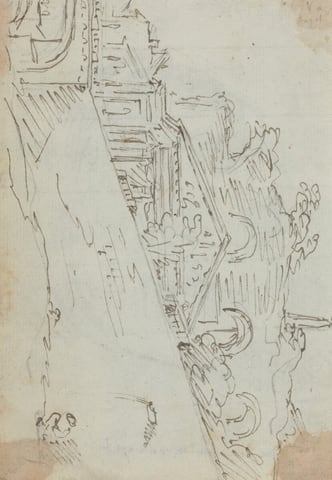
The image shows a sketch of an architectural scene with structures lining a road or pathway. The horizon is not clearly defined, and the sketch focuses on architectural details. The drawing features loose, freehand lines outlining buildings and trees, with classical elements like columns and entablatures. The color palette is monochromatic, with light parchment and dark ink strokes creating contrast. Close-up details are lightly shaded for depth, while distant details are less defined. The composition is open and airy, emphasizing architectural features over precision.
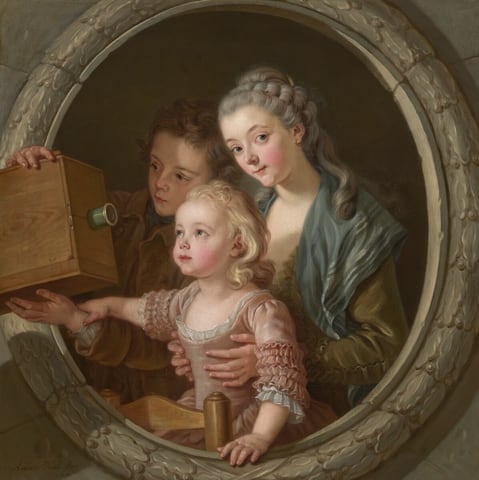
A young woman and two children are shown from the waist up through an oval, stone opening, holding and looking at a wooden box with a lens protruding from one side in this square painting. All three people have pale skin with rosy cheeks. To our right, the young woman’s body is angled to our left as she braces the torso of a young girl. The young woman looks at us from the corners of her sage-green eyes, under lifted brows. Her small, pink mouth is pursed in a slight smile, and she has a faint dimple in her rounded chin. Her heather-gray hair is partially plaited over the crown of her head, and long curls fall over her shoulders. She wears a spruce-blue shawl over the shoulders of her low-cut, olive-green dress. The child she braces has chubby cheeks, and her wavy blond hair is brushed back from her forehead and falls loosely to her shoulders. She wears a blush-pink dress with ruffles on the half-length sleeves and gossamer-white trim around the neckline and cuffs. The top and side rails of a wooden, ladderback chair up against the inside of the opening suggests she stands or kneels on a backward-facing chair. She rests her left hand on the edge of the stone opening and her other hand on the wrist of the boy standing close behind her. Mostly in the shadow behind the others, the boy has small, pointed features and short, curly, sable-brown hair. He wears a tan coat, and a muted blue scarf is tied at his throat. The two children gaze at the wooden box the boy holds, which is about the size of a toaster. A short, cylindrical, brass-lined lens pokes out of the center of the side facing the trio. The oval opening through which we see them is carved on our side with stylized leaves and berries, and the wall around it is the same elephant gray as the carvings. The girl and the box cast a shadow across the opening. The artist signed and dated the painting in the lower left corner, “Amedee Can Loo./1764.”
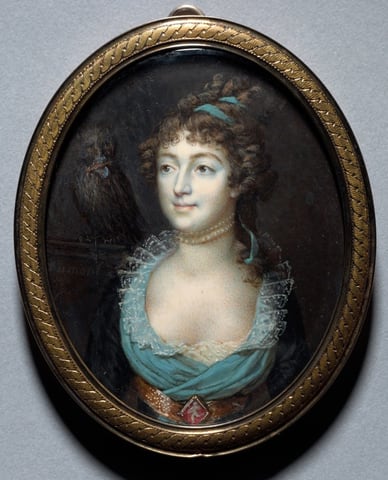
Portrait of Mademoiselle Marie-Anne Adelaide Le Normand, by François Dumont, c. 1793
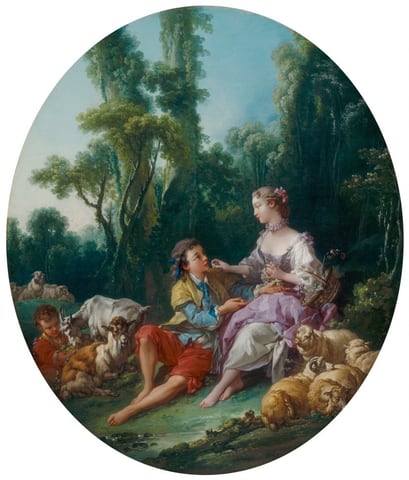
A work made of oil on canvas.
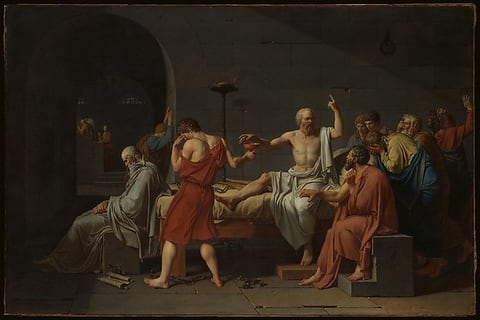
The Death of Socrates, by Jacques-Louis David, 1787
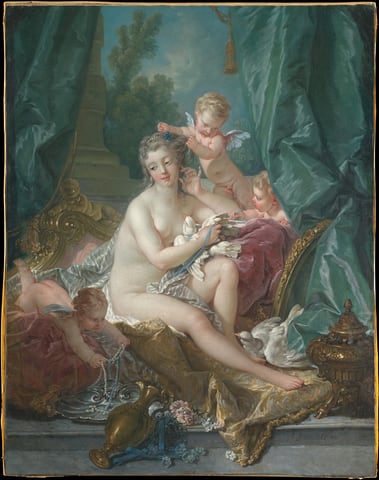
The Toilette of Venus, by François Boucher, 1751
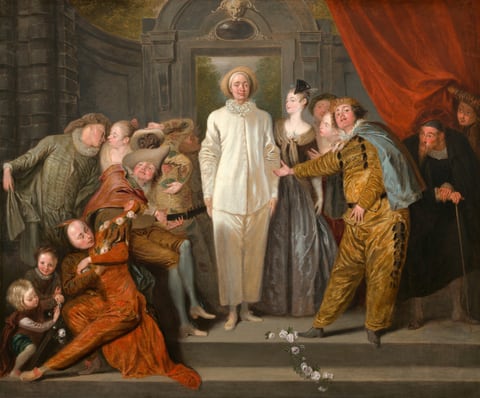
A man wearing loose, ivory-white clothing stands flanked by two groups of people in this horizontal painting. All the people have pale or peachy skin except for one person, who may have a brown mask. The man in the center, representing the character Pierrot, stands facing us with his hands by his sides. He has slightly bulging eyes, a bulbous nose, ruddy cheeks, and his full pink lips slightly smile. He wears a straw hat pushed back on his high forehead and a narrow ruffled collar around his neck. His shirt has long, voluminous sleeves and a row of small white buttons down the front. The pants are baggy and end abruptly above his white-stockinged ankles over white slippers. The fabric seems to have a sheen. In the shallow space behind him, a stone wall curves toward us to either side of a doorway that leads to a park-like setting. A crimson-red curtain is pulled to our right. Pierrot stands on the top of two steps, and the people to either side are arranged along the stage or the step that runs close to the bottom edge of the canvas. A spray of white flowers drapes down the front of the steps to our right of center. The group to our left has eight men, women, and children. Closest to us and in the lower left corner, a young man wearing a tomato-red jester’s costume trimmed with bells sits on the steps as he twists and looks back at the scene behind him. He holds a scepter or puppet in the shape of a doll-like jester. Two children gather at his feet. One weaves stems of white flowers together, and the other looks at us, smiling. Just above them another cleanshaven young man sits holding a lute in his lap. He wears a brick-red coat, brown breeches, and slate-blue stockings over crossed legs. He leans back and looks up and to our left, his round cheeks flushed. At the back of this group, two people wear tan-colored costumes covered in muted green and pink diamond shapes, and one might wear a brown mask. That person’s pink lips, black mustache and eyebrows, and black dots for eyes appear painted onto a hard, molded surface. The group of six people to our right stand on the same level as Pierrot. At the front of that group, a heavyset young man wears a gold-colored costume trimmed with black and a waist-length, Wedgewood-blue cape. He faces us but looks to our right as he leans back with one arm extended toward Pierrot. Beyond him are two woman and another person shown only from the neck up. The woman closest to Pierrot wears a pewter-gray gown with a scooped neckline. To the right of the man in gold is an old man with a long beard, wearing a black skullcap and cloak. He leans on a short staff and turns his head to look at the group. The last person on the far right is shown from the neck up and stands before the red curtain hanging from the upper right.

The works in this room are listed below.

Works in this room

Works made in France in the 18th century.

Section 1, north wall

  1. The image shows a sketch of an architectural scene with structures lining a road or pathway. The horizon is not clearly defined, and the sketch focuses on architectural details. The drawing features loose, freehand lines outlining buildings and trees, with classical elements like columns and entablatures. The color palette is monochromatic, with light parchment and dark ink strokes creating contrast. Close-up details are lightly shaded for depth, while distant details are less defined. The composition is open and airy, emphasizing architectural features over precision.
    Ancient Ruins on the Bank of the TiberAugustin Pajou, 1752/1756Courtesy National Gallery of Art, Washington
  2. A young woman and two children are shown from the waist up through an oval, stone opening, holding and looking at a wooden box with a lens protruding from one side in this square painting. All three people have pale skin with rosy cheeks. To our right, the young woman’s body is angled to our left as she braces the torso of a young girl. The young woman looks at us from the corners of her sage-green eyes, under lifted brows. Her small, pink mouth is pursed in a slight smile, and she has a faint dimple in her rounded chin. Her heather-gray hair is partially plaited over the crown of her head, and long curls fall over her shoulders. She wears a spruce-blue shawl over the shoulders of her low-cut, olive-green dress. The child she braces has chubby cheeks, and her wavy blond hair is brushed back from her forehead and falls loosely to her shoulders. She wears a blush-pink dress with ruffles on the half-length sleeves and gossamer-white trim around the neckline and cuffs. The top and side rails of a wooden, ladderback chair up against the inside of the opening suggests she stands or kneels on a backward-facing chair. She rests her left hand on the edge of the stone opening and her other hand on the wrist of the boy standing close behind her. Mostly in the shadow behind the others, the boy has small, pointed features and short, curly, sable-brown hair. He wears a tan coat, and a muted blue scarf is tied at his throat. The two children gaze at the wooden box the boy holds, which is about the size of a toaster. A short, cylindrical, brass-lined lens pokes out of the center of the side facing the trio. The oval opening through which we see them is carved on our side with stylized leaves and berries, and the wall around it is the same elephant gray as the carvings. The girl and the box cast a shadow across the opening. The artist signed and dated the painting in the lower left corner, “Amedee Can Loo./1764.”
    The Camera ObscuraCharles Amédée Philippe Van Loo, 1764Courtesy National Gallery of Art, Washington
  3. Portrait of Mademoiselle Marie-Anne Adelaide Le Normand, by François Dumont, c. 1793
    Portrait of Mademoiselle Marie-Anne Adelaide Le NormandFrançois Dumont, c. 1793Courtesy of the Cleveland Museum of Art
  4. A work made of oil on canvas.
    Are They Thinking about the Grape? (Pensent-ils au raisin?)François Boucher, 1747Courtesy of the Art Institute of Chicago

Section 1, south wall

  1. The Death of Socrates, by Jacques-Louis David, 1787
    The Death of SocratesJacques-Louis David, 1787Courtesy of The Metropolitan Museum of Art
  2. The Toilette of Venus, by François Boucher, 1751
    The Toilette of VenusFrançois Boucher, 1751Courtesy of The Metropolitan Museum of Art
  3. A man wearing loose, ivory-white clothing stands flanked by two groups of people in this horizontal painting. All the people have pale or peachy skin except for one person, who may have a brown mask. The man in the center, representing the character Pierrot, stands facing us with his hands by his sides. He has slightly bulging eyes, a bulbous nose, ruddy cheeks, and his full pink lips slightly smile. He wears a straw hat pushed back on his high forehead and a narrow ruffled collar around his neck. His shirt has long, voluminous sleeves and a row of small white buttons down the front. The pants are baggy and end abruptly above his white-stockinged ankles over white slippers. The fabric seems to have a sheen. In the shallow space behind him, a stone wall curves toward us to either side of a doorway that leads to a park-like setting. A crimson-red curtain is pulled to our right. Pierrot stands on the top of two steps, and the people to either side are arranged along the stage or the step that runs close to the bottom edge of the canvas. A spray of white flowers drapes down the front of the steps to our right of center. The group to our left has eight men, women, and children. Closest to us and in the lower left corner, a young man wearing a tomato-red jester’s costume trimmed with bells sits on the steps as he twists and looks back at the scene behind him. He holds a scepter or puppet in the shape of a doll-like jester. Two children gather at his feet. One weaves stems of white flowers together, and the other looks at us, smiling. Just above them another cleanshaven young man sits holding a lute in his lap. He wears a brick-red coat, brown breeches, and slate-blue stockings over crossed legs. He leans back and looks up and to our left, his round cheeks flushed. At the back of this group, two people wear tan-colored costumes covered in muted green and pink diamond shapes, and one might wear a brown mask. That person’s pink lips, black mustache and eyebrows, and black dots for eyes appear painted onto a hard, molded surface. The group of six people to our right stand on the same level as Pierrot. At the front of that group, a heavyset young man wears a gold-colored costume trimmed with black and a waist-length, Wedgewood-blue cape. He faces us but looks to our right as he leans back with one arm extended toward Pierrot. Beyond him are two woman and another person shown only from the neck up. The woman closest to Pierrot wears a pewter-gray gown with a scooped neckline. To the right of the man in gold is an old man with a long beard, wearing a black skullcap and cloak. He leans on a short staff and turns his head to look at the group. The last person on the far right is shown from the neck up and stands before the red curtain hanging from the upper right.
    The Italian ComediansAntoine Watteau, probably 1720Courtesy National Gallery of Art, Washington

Section 2, south wall
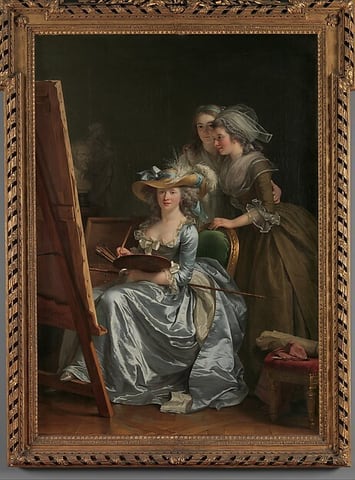
  1. Self-Portrait with Two Pupils, Marie Gabrielle Capet (1761–1818) and Marie Marguerite Carraux de Rosemond (1765–1788), by Adélaïde Labille-Guiard, 1785
    Self-Portrait with Two Pupils, Marie Gabrielle Capet (1761–1818) and Marie Marguerite Carraux de Rosemond (1765–1788)Adélaïde Labille-Guiard, 1785Courtesy of The Metropolitan Museum of Art
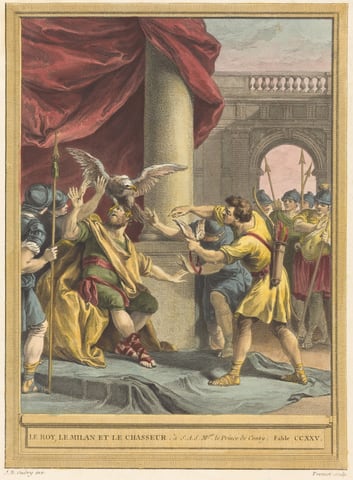
  2. This is a painting of a king, a hawk, and a hunter in a classical architectural setting with columns and arches. In the image, a figure in royal clothing is seated beneath draped red fabric, facing a man in hunting attire holding a bird. A hawk perches on the royal figure's head, wings spread, while the hunter reaches toward the hawk. Surrounding them are other figures in armor, holding spears and shields. The style is reminiscent of classic European paintings with themes of mythology or allegory.
    Le roi, le milan, et le chasseur (The King, the Kite, and the Hunter)Benoît-Louis Prévost, published 1759Courtesy National Gallery of Art, Washington
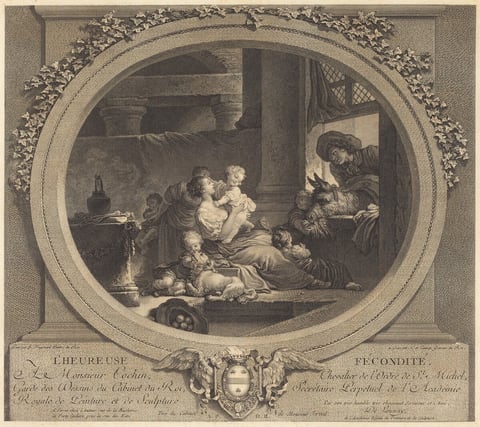
  3. The engraving depicts a gathering around a woman holding a child in her arms in an indoor setting with stone columns and an arched background. Another woman is next to her, looking towards her while leaning over what appears to be a child or possibly a doll on a small donkey. Surrounding the central woman are several children, some seated and playing on the floor. A dog is resting at the central woman's feet. The image features lush drapery, creating a warm and intimate setting. The style suggests classical or historical fashion, and there is an ornate border with ivy leaves. The text and emblem below likely contain relevant inscriptions.
    L'heureuse féconditéNicolas Delaunay, 1777Courtesy National Gallery of Art, Washington
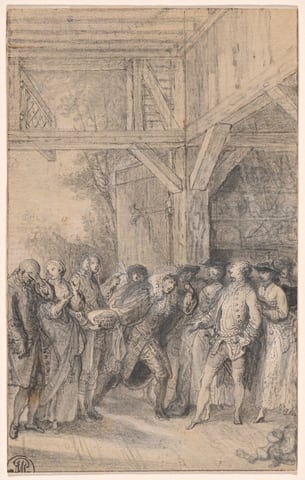
  4. A work made of graphite and pen and black ink, with touches of opaque, white watercolor on cream laid paper.
    Farmer Requesting Permission to Marry a Nobleman's DaughterGabriel de Saint-Aubin, 1761Courtesy of the Art Institute of Chicago

Section 2, north wall
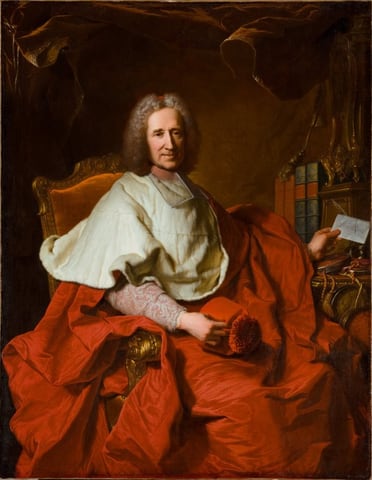
  1. Portrait of Cardinal Guillaume Dubois, by Hyacinthe Rigaud, 1723
    Portrait of Cardinal Guillaume DuboisHyacinthe Rigaud, 1723Courtesy of the Cleveland Museum of Art
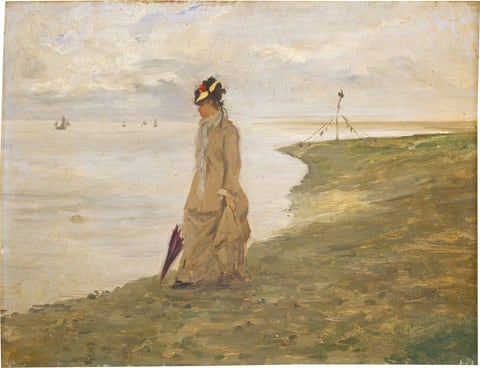
  2. This painting shows a woman in a tan dress and a tan hat with red flowers, walking on a grassy shoreline, holding a dark purple umbrella. The woman is positioned in the center of the painting, and she faces the left, standing at the edge of the water, looking downward. She has light skin and dark hair put up under her hat. The horizon is high in the painting, where the blue-gray sky and water meet. Small ships are visible in the distance, floating on the horizon. On the right side of the painting, the yellow and green ground curves, sloping slightly downward to meet the water. The painting has loose, visible brushstrokes.
    Woman by the SeasideUnrecorded French maker, 19th centuryCourtesy National Gallery of Art, Washington
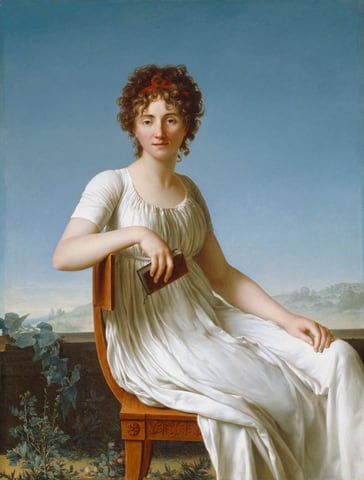
  3. A work made of oil on canvas.
    Portrait of Constance PipeletJean Baptiste François Désoria, 1797Courtesy of the Art Institute of Chicago

Section 3, north wall
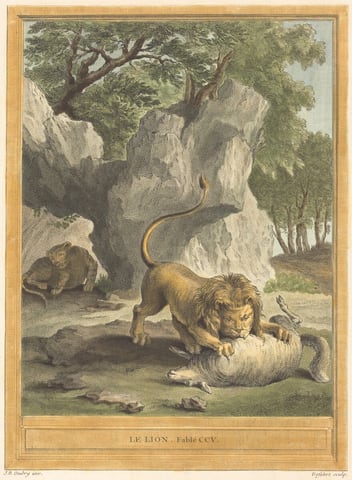
  1. This is a drawing of a lion in a forested rocky landscape. The lion is seen standing over a defeated animal. In the background, a forest with dense trees frames the scene. One monkey is visible among the rocks watching the lion. The setting conveys a wild, rugged terrain with rocky formations and scattered vegetation. Light and shadow emphasize textures in the lion's mane and the surrounding rocks. The composition focuses on the lion and its prey.
    Le lion (The Lion)A.-J. de Fehrt, published 1759Courtesy National Gallery of Art, Washington
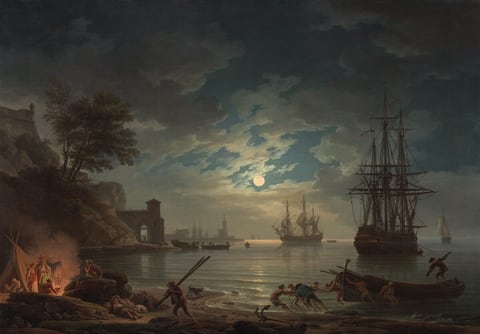
  2. Moonlight falls across several masted ships near a rocky shoreline in this horizontal painting. The sky fills the top three-quarters of the picture. A veil of slate-gray clouds is lit to pearl white around the crisp, full moon at the center of the composition. Patches of denim-blue sky are seen through breaks in the blanket of clouds. Moonlight reflects down the center of rippling, silvery-gray water that laps against a beach close to us, along the bottom edge of the painting. A tent is set up in the lower left corner of the composition. There, two women and one man stand looking at a glowing fire next to the tent. One woman holds a basket on her head, the other tucks a flat basket under one arm. The man stands between the two women, and a fourth man crouches near the fire, his back to us. In the opening of the tent, another woman kneels over a large bowl as she looks at the fire. A fifth person, a man, gazes at the fire as he sits smoking a long-stemmed pipe on a boulder. At the foot of the boulders, a man lies back against some bundles, one arm thrown up over his head. A dog curls up next to his hip. Not far from the sleeping man and in the center of the foreground, a man carries several long wooden objects, possibly oars, over one shoulder while a dog beyond him barks at the lapping surf. The beach curves like a C away from us, along the left. At the point of the curve in the middle distance, a structure like a city wall and gate jut out to the water’s edge. More buildings atop steep cliffs rise vertically beyond the gate. The shoreline curves into the distance again, and more buildings, including a lighthouse, and masted ships there are smoke-gray silhouettes. Near the lower right corner of the painting, four men pull on ropes tied around the prow of a small wooden boat while three others push it toward the land. Another man stands in the far end. A short distance beyond that boat is a tall wooden ship with three masts and rigging outlined against the night sky. Windows along the decks of that boat’s wide stern, angled toward us, glow with golden light. Beyond it and a bit to our left, another ship, smaller in scale, sails away from us. Several more ships move back to the horizon until we only see strokes of white and gray to indicate their unfurled sails.
    MoonlightClaude-Joseph Vernet, 1772Courtesy National Gallery of Art, Washington