Floor plan

Time and place18th-century France

18th-century France

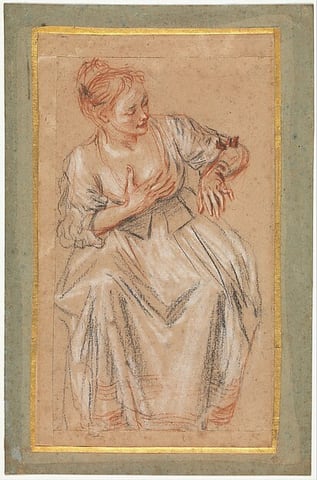
Seated Woman, by Antoine Watteau, 1716–17
A work made of oil on canvas.
A pale-skinned man sits facing our left as he plays a harp while turning his face to smile at us in this vertical portrait painting. He looks out the corners of his light blue eyes under arched, gray brows. He has a rounded nose, pale pink lips, and a round face. Gray hair is brushed back from his high forehead and curls around his ears. His long fingers rest on the strings of the harp, and the ends of strings curl like wind-loosened strands of hair along the top edge. The man wears a pale mauve-purple cravat, and his snow-white, long-sleeved chemise is untucked and loose around his thighs. The cuff we see is open and folded back over a bright white shirt edged with lace. His dusky rose-pink breeches are unbuttoned at the knee over white stockings. The square-seated chair on which he sits is carved with garlands and floral patterns, which are gilded gold. The seat itself is topaz blue, and it has a low back. A similarly ornamented and gilded table along the back of the room holds a portfolio and roll of papers, the tooled and gilded spines of books, and a statuette to the right. The pale pinkish-orange statuette shows a woman holding a tablet and wearing a long, loose robe and head covering. Her body angles to our left and she looks off in that direction. The wall behind the table is mottled with smoky shades of gray and tan.
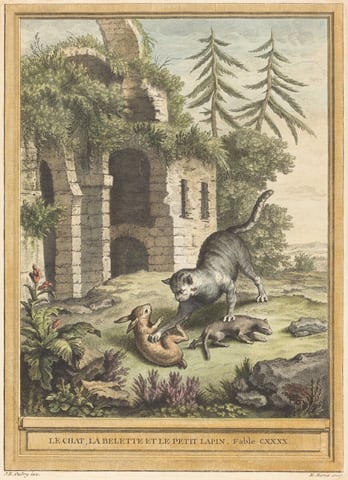
This is a painting of animals in front of a ruined structure. The painting features a cat, a weasel, and a small rabbit gathered on a patch of grass. The cat has its paw over the rabbit, with the weasel observing. They are in front of an ancient stone structure surrounded by vegetation. In the background are trees against a sky. The foreground has detailed foliage and flowers.
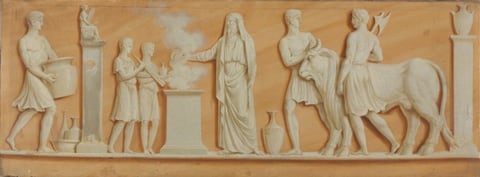
Overdoor Painting, by Pierre Rousseau, 1790s
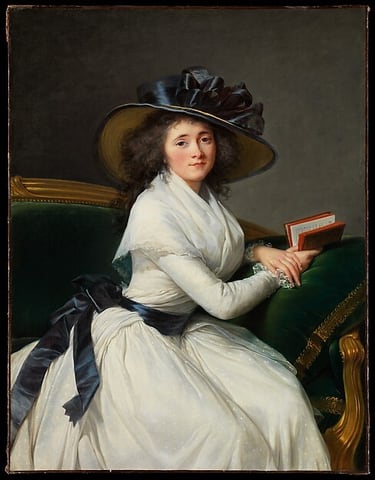
Comtesse de la Châtre (Marie Charlotte Louise Perrette Aglaé Bontemps, 1762–1848), by Elisabeth Louise Vigée Le Brun, 1789

The works in this room are listed below.

Works in this room

Works made in France in the 18th century.

Section 1, north wall

  1. Seated Woman, by Antoine Watteau, 1716–17
    Seated WomanAntoine Watteau, 1716–17Courtesy of The Metropolitan Museum of Art
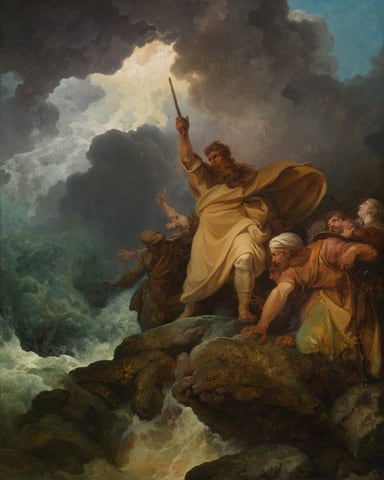
  2. A work made of oil on canvas.
    The Destruction of Pharaoh's ArmyPhilippe Jacques de Loutherbourg, II, 1792Courtesy of the Art Institute of Chicago
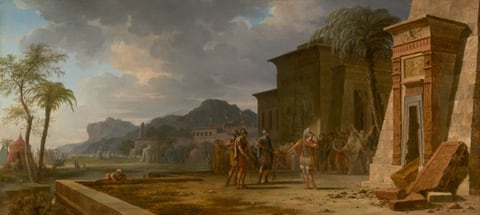
  3. A work made of oil on canvas.
    Alexander at the Tomb of Cyrus the GreatPierre Henri de Valenciennes, 1796Courtesy of the Art Institute of Chicago
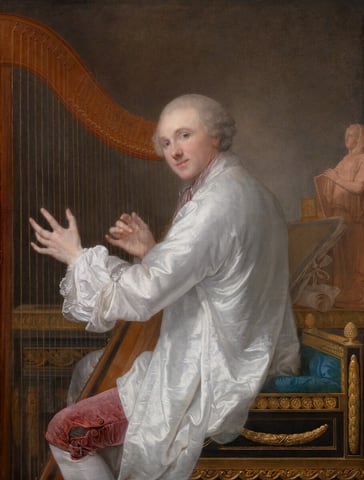
  4. A pale-skinned man sits facing our left as he plays a harp while turning his face to smile at us in this vertical portrait painting. He looks out the corners of his light blue eyes under arched, gray brows. He has a rounded nose, pale pink lips, and a round face. Gray hair is brushed back from his high forehead and curls around his ears. His long fingers rest on the strings of the harp, and the ends of strings curl like wind-loosened strands of hair along the top edge. The man wears a pale mauve-purple cravat, and his snow-white, long-sleeved chemise is untucked and loose around his thighs. The cuff we see is open and folded back over a bright white shirt edged with lace. His dusky rose-pink breeches are unbuttoned at the knee over white stockings. The square-seated chair on which he sits is carved with garlands and floral patterns, which are gilded gold. The seat itself is topaz blue, and it has a low back. A similarly ornamented and gilded table along the back of the room holds a portfolio and roll of papers, the tooled and gilded spines of books, and a statuette to the right. The pale pinkish-orange statuette shows a woman holding a tablet and wearing a long, loose robe and head covering. Her body angles to our left and she looks off in that direction. The wall behind the table is mottled with smoky shades of gray and tan.
    Ange Laurent de La Live de JullyJean Baptiste Greuze, probably 1759Courtesy National Gallery of Art, Washington

Section 1, south wall

  1. This is a painting of animals in front of a ruined structure. The painting features a cat, a weasel, and a small rabbit gathered on a patch of grass. The cat has its paw over the rabbit, with the weasel observing. They are in front of an ancient stone structure surrounded by vegetation. In the background are trees against a sky. The foreground has detailed foliage and flowers.
    Le chat, la balette et le petit lapin (The Cat, the Weasel, and the Rabbit)Martin Marvie, published 1756Courtesy National Gallery of Art, Washington
  2. Overdoor Painting, by Pierre Rousseau, 1790s
    Overdoor PaintingPierre Rousseau, 1790sCourtesy of the Cleveland Museum of Art
  3. Comtesse de la Châtre (Marie Charlotte Louise Perrette Aglaé Bontemps, 1762–1848), by Elisabeth Louise Vigée Le Brun, 1789
    Comtesse de la Châtre (Marie Charlotte Louise Perrette Aglaé Bontemps, 1762–1848)Elisabeth Louise Vigée Le Brun, 1789Courtesy of The Metropolitan Museum of Art

Section 2, south wall
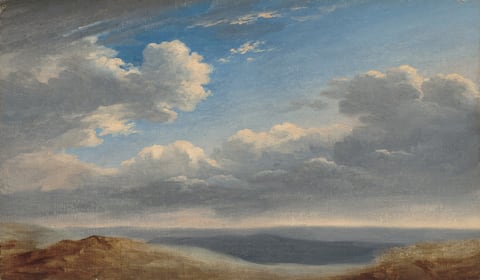
  1. A sliver of land across the bottom of this composition gives way to a procession of puffy gray and white clouds sweeping up across a vivid blue, panoramic sky in this horizontal landscape painting. An area of darker gray beyond the brown land could be a valley, mountain, or shadows from the billowing clouds. About one-fifth of the way up the composition, the horizon glows the faintest peach. The clouds trundle from our left up and to our right. The view is loosely painted, especially in the land.
    Study of Clouds over the Roman CampagnaPierre Henri de Valenciennes, c. 1782/1785Courtesy National Gallery of Art, Washington
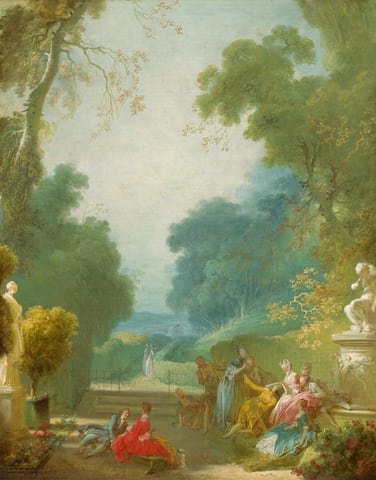
  2. Towering, pale, celery-green trees frame a view of a lush park with about a dozen elegantly dressed, light-skinned men and women in this vertical landscape painting. The color palette is dominated by moss and lemon-lime green, golden yellow, and spruce blue. The men all wear jackets with long tails over knee-breeches, and their long hair is pulled back at the napes of their necks. The women wear long dresses with full skirts and hints of lace at the sleeves and bust, and their brown or white hair is pulled up. Nine of the men and women gather to our right on a stone terrace along the bottom edge of the painting. A man in butter yellow kneels in front of a woman wearing rose pink. Around this pair, people stand, kneel, sit, or recline wearing aquamarine blue, light turquoise, or ivory white. A man and woman sit on a bench to our left, a little removed from the larger group. This woman wears ruby red and the man leaning toward her wears topaz blue. Two people in the park beyond these groups are painted with only a few strokes of pale blue and white paint, and they look over a low hedge row lining the walking path. Beds of red flowers fill the lower corners of the composition in front of a statue of a woman to our left and a person, perhaps on a fountain, to our right. The grassy walking path and trees become more blue as they fade into the hazy distance between the tall tress to either side. The sky fades from pale blue along the horizon to a silvery blue, almost white, at the top.
    A Game of Hot CocklesJean Honoré Fragonard, c. 1775/1780Courtesy National Gallery of Art, Washington
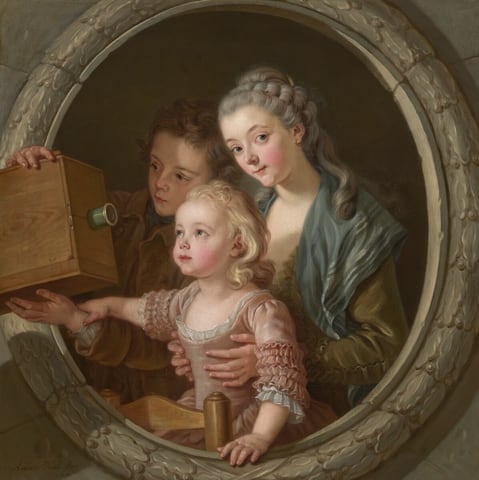
  3. A young woman and two children are shown from the waist up through an oval, stone opening, holding and looking at a wooden box with a lens protruding from one side in this square painting. All three people have pale skin with rosy cheeks. To our right, the young woman’s body is angled to our left as she braces the torso of a young girl. The young woman looks at us from the corners of her sage-green eyes, under lifted brows. Her small, pink mouth is pursed in a slight smile, and she has a faint dimple in her rounded chin. Her heather-gray hair is partially plaited over the crown of her head, and long curls fall over her shoulders. She wears a spruce-blue shawl over the shoulders of her low-cut, olive-green dress. The child she braces has chubby cheeks, and her wavy blond hair is brushed back from her forehead and falls loosely to her shoulders. She wears a blush-pink dress with ruffles on the half-length sleeves and gossamer-white trim around the neckline and cuffs. The top and side rails of a wooden, ladderback chair up against the inside of the opening suggests she stands or kneels on a backward-facing chair. She rests her left hand on the edge of the stone opening and her other hand on the wrist of the boy standing close behind her. Mostly in the shadow behind the others, the boy has small, pointed features and short, curly, sable-brown hair. He wears a tan coat, and a muted blue scarf is tied at his throat. The two children gaze at the wooden box the boy holds, which is about the size of a toaster. A short, cylindrical, brass-lined lens pokes out of the center of the side facing the trio. The oval opening through which we see them is carved on our side with stylized leaves and berries, and the wall around it is the same elephant gray as the carvings. The girl and the box cast a shadow across the opening. The artist signed and dated the painting in the lower left corner, “Amedee Can Loo./1764.”
    The Camera ObscuraCharles Amédée Philippe Van Loo, 1764Courtesy National Gallery of Art, Washington
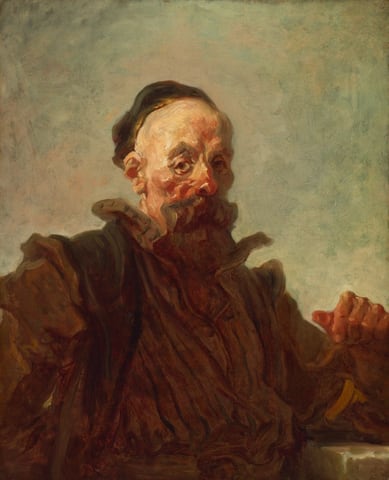
  4. Painting of bearded, ruddy-faced man in eighteenth century style clothing.
    Portrait of a Man in CostumeJean Honoré Fragonard, c. 1767–68Courtesy of the Art Institute of Chicago

Section 2, north wall
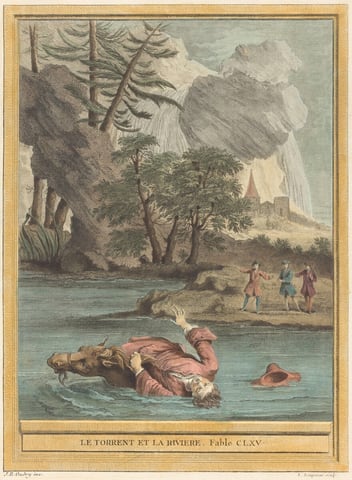
  1. The image shows a man in a red coat in a river, holding on to a horse. A hat floats nearby. Three figures in 18th-century clothing stand on a rocky riverbank looking concerned. In the background, there are trees, a castle-like structure, and large clouds. The brushstrokes are detailed, capturing movement and textures. The color palette includes muted tones like earthy browns, greens, soft blue, and subtle reds.
    Le torrent et la riviere (The Torrent and theRiver)Louis-Simon Lempereur, published 1756Courtesy National Gallery of Art, Washington
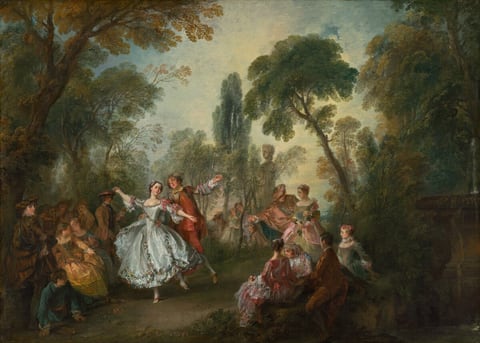
  2. Twenty-one men in long waistcoats and women in elegantly trimmed gowns gather and dance within a verdant landscape in this horizontal painting. The men wear jackets and breeches in ginger brown, pale pink, or spruce blue. The women’s gowns have full sleeves, tight-fitting bodices, and full skirts in shades of bronze, teal blue, butterscotch gold, or rich pink edged with ribbons and lace. Some of them wear floral wreaths or ribbons in their upswept hair. Groups gather around a woman and man who dance together to our left in the scene. Some in the group of onlookers to our left hold musical instruments, including a violin and a pipe. Another group is nestled among trees just beyond the dancers, at the center of the painting, and more sit and stand to our right. The dancing woman wears a gleaming, ice-blue gown with rows of flowers in muted pink, blue, and gold down the full skirt and around the bottom hem, which falls short of her thin ankles. More garlands cross her chest and shoulders, and flowers are tucked into her dark gray hair. She faces us with her head turned to our right as she looks off in that direction with dark eyes under curving brows. She has a delicate nose, rosy, round cheeks, and pink lips. She holds her arms spread wide with the thumb touching the index finger of each hand. The man with whom she dances wears a coral-red tunic and breeches with sleeves decorated with pale pink and blue ribbons. The brim of his brown hat is turned up. His body faces us but he turns his head to look at the woman, his lips parted. The man and woman each have one gracefully pointed foot raised. The dancers and groups are enclosed within a park-like setting with tall trees to either side, and a screen of trees across the back of the space. The trees have slender trunks and canopies in shades of pine, sage, and moss green. Near the back middle of the scene, a stone column topped by a human head wearing a wreath of laurel leaves rises above the central group. A fountain with a vertical jet of water is tucked into the shadows within a grove of trees along the right edge of the painting. The water falls into a pool in the lower right corner.
    La Camargo DancingNicolas Lancret, c. 1730Courtesy National Gallery of Art, Washington
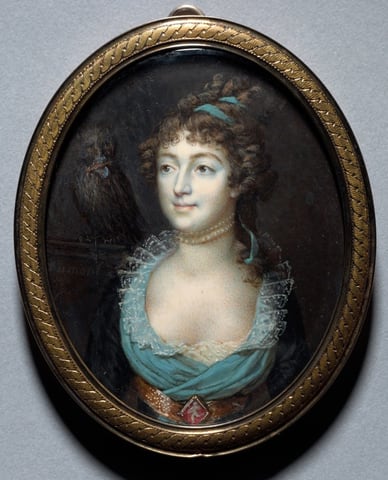
  3. Portrait of Mademoiselle Marie-Anne Adelaide Le Normand, by François Dumont, c. 1793
    Portrait of Mademoiselle Marie-Anne Adelaide Le NormandFrançois Dumont, c. 1793Courtesy of the Cleveland Museum of Art

Section 3, north wall
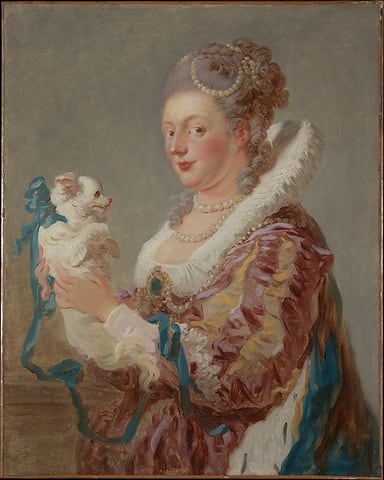
  1. Marie Emilie Coignet de Courson (1716–1806) with a Dog, by Jean Honoré Fragonard, ca. 1769
    Marie Emilie Coignet de Courson (1716–1806) with a DogJean Honoré Fragonard, ca. 1769Courtesy of The Metropolitan Museum of Art
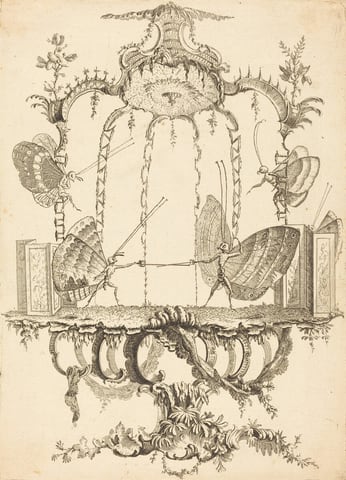
  2. This is a drawing of anthropomorphic butterflies engaged in a duel with fencing swords. The butterflies have human-like bodies with wings resembling cloaks or capes. They stand on an ornate structure featuring decorative architectural elements like columns with floral and leaf motifs. Above them are arches, canopies, and hanging vines, creating a theatrical setting. The drawing combines fantasy and nature elements, showcasing elegance and imagination.
    Le Duel (The Duel)Charles Germain de Saint-Aubin, in or after 1756Courtesy National Gallery of Art, Washington