Floor plan

Time and place18th-century France

18th-century France

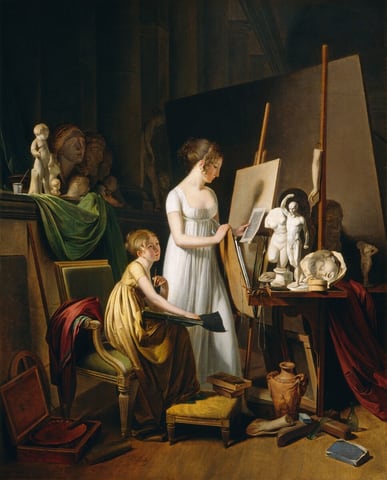
In a room filled with easels, white plaster heads and statuettes, a box of paints, books, and papers, a young woman stands looking at a sketch and a young girl looks on, seated in an armchair, in this vertical painting. The scene is lit from the upper left, presumably from a window out of our view. Both women have smooth, pale skin, and their hair is swept up with curls framing their faces. They face our right in profile so their faces are in gentle shadow. They have straight noses, and their rose-pink lips are closed. They wear gowns with short sleeves, low, scooped necks, and floor-length skirts cinched under the bust. In the center of the painting, the young woman has chestnut-brown hair and wears a white gown tied with a sky-blue ribbon. She stands in front of a portfolio propped up against a tall easel. The portfolio is made of two stiff boards that tie together with pale blue ribbon to secure large sheets of paper. She rests her right hand, closer to us, on the front board of the portfolio and looks down at the sketch on a gray piece of paper she holds with her other hand. Next to her and closer to us, the younger girl sits in a gold chair upholstered with olive-green velvet. She faces our right almost in profile, and she looks up toward the drawing the other woman holds. The girl in the chair has blond hair and a gold-colored dress. Her feet are propped on a gold footstool, and she holds another portfolio on her lap. She supports the portfolio and holds a piece of paper with one hand, and a stylus or brush in the other hand, up by her chin. To the right of the easel, a wooden table holds a collection of plaster casts of faces, a hand, and small-scale bodies along with a glass vessel and a few other tools. Two translucent green bottles, boxes, a book, and a terracotta vase are collected on the footstool and the floor around the base of the easel. Garnet-red cloths are draped down the front of the table to our right and behind the girl on the chair. Next to her chair, in the lower left corner of the composition, is a wooden box with a paint palette and a handful of thin paintbrushes. A scroll of paper lies next to the box. A shelf at the standing girl’s shoulder height and behind the pair, to our left, is piled with white busts of a man, child, and woman, more figurines, and a brush in a small cup, all arranged across a moss-green cloth. The space with the girls and artist’s tools is enclosed by a large, dark brown form, presumably a canvas in shadow, that leans against the tall easels and mostly cuts off a view into the rest of the room. A glimpse of shadowy capitals is seen over the board, across the top of the painting, to suggest that a row of columns recedes into the space beyond. The artist signed the work as if he had painted his name on the floor next to the scroll, “L. Boilly.”
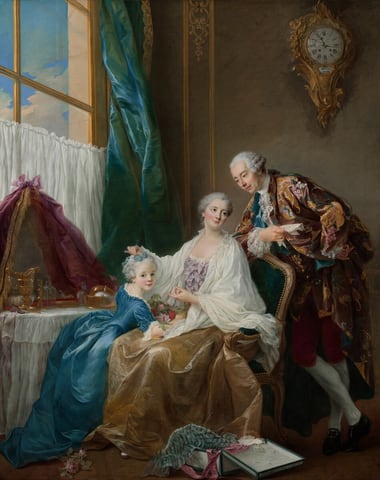
A woman sitting in an upholstered chair near a vanity table touches the hair of the little girl leaning against her lap to our left, as a man leans onto the back of her chair to our right in this vertical portrait painting. The people all have pale skin, flushed cheeks, and their pale gray hair is pulled back and curled. Their pink lips curve in slight smiles, and light glinting off of much of the fabric suggests they wear satin or silk. The woman’s body is angled to our left, toward the girl, but she turns her head back to look up over her other shoulder with gray eyes. A voluminous, cream-white cloth drapes over her shoulders and lap, over a bodice covered in lilac-purple bows and ribbons. Her gold satin skirt falls around her feet. The little girl leans onto one arm on the woman’s lap as she turns to look at us with pale blue eyes. The girl’s forget-me-not-blue dress has a fitted bodice, elbow-length sleeves over white cuffs, a long, full skirt, and white ruffles along the collar. The woman holds blue flowers in the girl’s hair, and the girl’s forearm wraps around a bundle of pink and red flowers in the woman’s lap. The chair is upholstered in teal blue and has a gold frame and a row of gold nail heads along the padded back and arm. The man leans one forearm against the back of the chair as he looks down at the girl. In that hand, he holds a folded piece of paper with writing. He wears a loose jacket decorated with gold pagodas, pink and yellow flowers, and spruce-green leaves against a brown background. Foamy white lace falls back from his cuffs and hangs down from the high white collar of his undershirt. He wears brick-red, knee-length britches, white stockings, and black shoes with silver buckles. His other hand is planted against his hip, and one ankle is crossed in front of the other. A vanity draped with a white cloth sits on the far side of the woman and girl, along the left edge of the painting. It holds gold and glass vessels and boxes, and a rounded mirror at the back is draped with dark pink cloth. The lower half of a window behind the vanity is covered by a white cloth, and the panes continue beyond the top of the canvas. A teal-blue curtain hangs along the right edge of the window, at the corner of the room. A clock with a gold case of swirling, carved designs hangs high on the peanut-brown wall behind the man. On the floor near the chair, blue and white striped tissue paper, a rose-pink ribbon, and a strand of pearls drape over the edges of an open box. Writing along the front edge of the lid of the box reads, “Fs. Drouais. Ce 1 avril. 1756.” A pink rose lies near the girl’s feet, to our left.
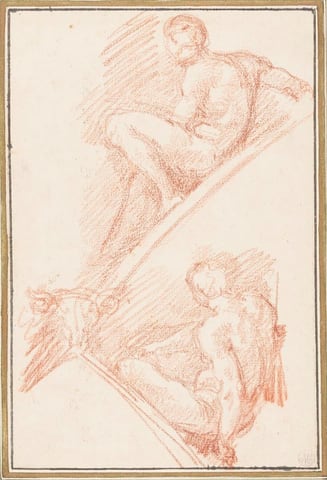
FIGURES FROM SISTINE CHAPEL CEILING
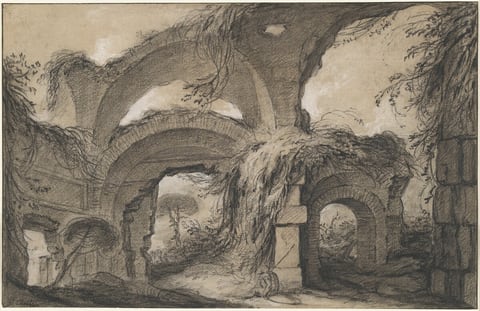
The image shows an ancient ruin with arches and crumbling stonework surrounded by overgrown vegetation. The horizon is slightly elevated, emphasizing the towering remnants of the architecture. Expressive brushstrokes and textures are notable, especially in the vines and leaves on the stone. The color palette is subdued, mainly earthy tones and black, creating contrast and suggesting openings into the distance, enhancing the old, abandoned feel of the ruins.
A work made of oil on canvas.
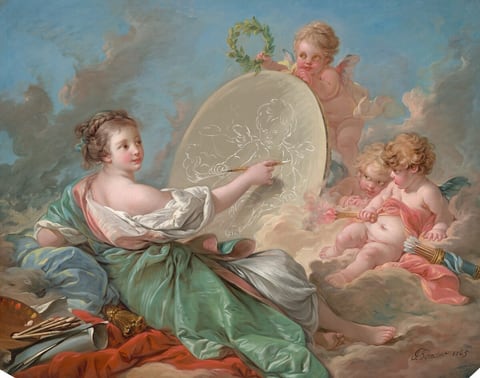
A young woman draws on an oval surface with white chalk while three winged, baby-like putti gather nearby, all on a bank of pale pink clouds in this horizontal painting. The woman and putti have pale, rosy skin, flushed cheeks, and hazel-brown eyes. To our left, the woman reclines with her upper body propped up on her far elbow, which rests on a steel-blue cushion as her legs stretch out to our right. Her light brown hair is braided and wrapped across the top of her head. She wears a loose, seafoam-green robe over a billowing ivory-white garment that has slipped off the shoulder closer to us. A round paint palette with brushes sticking out of its thumb hole and a roll of blue and white paper sit in the lower left corner, behind the woman. The woman and the objects are on a red cloth. In front of the woman is a rounded surface, perhaps a canvas, on which she draws. She holds up a gold-colored stylus with her right hand, closer to us, with a pointed piece of white chalk in one end and black chalk in the other. The canvas is taller than her head, so the child-like putto she draws on it is life-sized. The three nude putti on the far side of the canvas have copper or golden-blond, curly hair, flushed, rounded cheeks, short wings in white or peacock blue, pudgy torsos, and dimpled limbs. One putto, presumably the one the woman draws, sits back on the bank of clouds with a carnation-pink sash across his chest. He pulls his chin back and looks at her from under his eyebrows. He holds a gold-colored torch with a pink flame in one hand, and the other hand rests near a cylindrical quiver of arrows. Another putto peeks around the side of the canvas, and the third stands and props the canvas up. That third putto holds up a wreath of laurel leaves up over the canvas, above the woman’s drawing hand. The bank of clouds is parchment-brown with muted pink and blue highlights against a vivid blue sky. The artist signed and dated the lower right, “F Boucher – 1765.”

The works in this room are listed below.

Works in this room

Works made in France in the 18th century.

Section 1, north wall

  1. In a room filled with easels, white plaster heads and statuettes, a box of paints, books, and papers, a young woman stands looking at a sketch and a young girl looks on, seated in an armchair, in this vertical painting. The scene is lit from the upper left, presumably from a window out of our view. Both women have smooth, pale skin, and their hair is swept up with curls framing their faces. They face our right in profile so their faces are in gentle shadow. They have straight noses, and their rose-pink lips are closed. They wear gowns with short sleeves, low, scooped necks, and floor-length skirts cinched under the bust. In the center of the painting, the young woman has chestnut-brown hair and wears a white gown tied with a sky-blue ribbon. She stands in front of a portfolio propped up against a tall easel. The portfolio is made of two stiff boards that tie together with pale blue ribbon to secure large sheets of paper. She rests her right hand, closer to us, on the front board of the portfolio and looks down at the sketch on a gray piece of paper she holds with her other hand. Next to her and closer to us, the younger girl sits in a gold chair upholstered with olive-green velvet. She faces our right almost in profile, and she looks up toward the drawing the other woman holds. The girl in the chair has blond hair and a gold-colored dress. Her feet are propped on a gold footstool, and she holds another portfolio on her lap. She supports the portfolio and holds a piece of paper with one hand, and a stylus or brush in the other hand, up by her chin. To the right of the easel, a wooden table holds a collection of plaster casts of faces, a hand, and small-scale bodies along with a glass vessel and a few other tools. Two translucent green bottles, boxes, a book, and a terracotta vase are collected on the footstool and the floor around the base of the easel. Garnet-red cloths are draped down the front of the table to our right and behind the girl on the chair. Next to her chair, in the lower left corner of the composition, is a wooden box with a paint palette and a handful of thin paintbrushes. A scroll of paper lies next to the box. A shelf at the standing girl’s shoulder height and behind the pair, to our left, is piled with white busts of a man, child, and woman, more figurines, and a brush in a small cup, all arranged across a moss-green cloth. The space with the girls and artist’s tools is enclosed by a large, dark brown form, presumably a canvas in shadow, that leans against the tall easels and mostly cuts off a view into the rest of the room. A glimpse of shadowy capitals is seen over the board, across the top of the painting, to suggest that a row of columns recedes into the space beyond. The artist signed the work as if he had painted his name on the floor next to the scroll, “L. Boilly.”
    A Painter's StudioLouis-Léopold Boilly, c. 1800Courtesy National Gallery of Art, Washington
  2. A woman sitting in an upholstered chair near a vanity table touches the hair of the little girl leaning against her lap to our left, as a man leans onto the back of her chair to our right in this vertical portrait painting. The people all have pale skin, flushed cheeks, and their pale gray hair is pulled back and curled. Their pink lips curve in slight smiles, and light glinting off of much of the fabric suggests they wear satin or silk. The woman’s body is angled to our left, toward the girl, but she turns her head back to look up over her other shoulder with gray eyes. A voluminous, cream-white cloth drapes over her shoulders and lap, over a bodice covered in lilac-purple bows and ribbons. Her gold satin skirt falls around her feet. The little girl leans onto one arm on the woman’s lap as she turns to look at us with pale blue eyes. The girl’s forget-me-not-blue dress has a fitted bodice, elbow-length sleeves over white cuffs, a long, full skirt, and white ruffles along the collar. The woman holds blue flowers in the girl’s hair, and the girl’s forearm wraps around a bundle of pink and red flowers in the woman’s lap. The chair is upholstered in teal blue and has a gold frame and a row of gold nail heads along the padded back and arm. The man leans one forearm against the back of the chair as he looks down at the girl. In that hand, he holds a folded piece of paper with writing. He wears a loose jacket decorated with gold pagodas, pink and yellow flowers, and spruce-green leaves against a brown background. Foamy white lace falls back from his cuffs and hangs down from the high white collar of his undershirt. He wears brick-red, knee-length britches, white stockings, and black shoes with silver buckles. His other hand is planted against his hip, and one ankle is crossed in front of the other. A vanity draped with a white cloth sits on the far side of the woman and girl, along the left edge of the painting. It holds gold and glass vessels and boxes, and a rounded mirror at the back is draped with dark pink cloth. The lower half of a window behind the vanity is covered by a white cloth, and the panes continue beyond the top of the canvas. A teal-blue curtain hangs along the right edge of the window, at the corner of the room. A clock with a gold case of swirling, carved designs hangs high on the peanut-brown wall behind the man. On the floor near the chair, blue and white striped tissue paper, a rose-pink ribbon, and a strand of pearls drape over the edges of an open box. Writing along the front edge of the lid of the box reads, “Fs. Drouais. Ce 1 avril. 1756.” A pink rose lies near the girl’s feet, to our left.
    Family PortraitFrançois Hubert Drouais, 1756Courtesy National Gallery of Art, Washington
  3. FIGURES FROM SISTINE CHAPEL CEILING
    Figures from Sistine Chapel ceilingJean-Robert Ango, ca. 1759–70Courtesy of Cooper Hewitt, Smithsonian Design Museum

Section 1, south wall

  1. The image shows an ancient ruin with arches and crumbling stonework surrounded by overgrown vegetation. The horizon is slightly elevated, emphasizing the towering remnants of the architecture. Expressive brushstrokes and textures are notable, especially in the vines and leaves on the stone. The color palette is subdued, mainly earthy tones and black, creating contrast and suggesting openings into the distance, enhancing the old, abandoned feel of the ruins.
    Arches of the Larger Baths at Hadrian's VillaCharles Michel-Ange Challe, c. 1748Courtesy National Gallery of Art, Washington
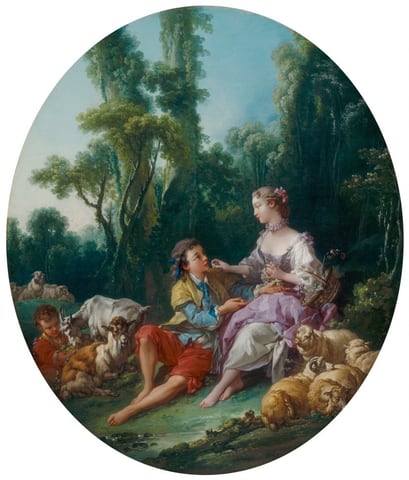
  2. A work made of oil on canvas.
    Are They Thinking about the Grape? (Pensent-ils au raisin?)François Boucher, 1747Courtesy of the Art Institute of Chicago
  3. A young woman draws on an oval surface with white chalk while three winged, baby-like putti gather nearby, all on a bank of pale pink clouds in this horizontal painting. The woman and putti have pale, rosy skin, flushed cheeks, and hazel-brown eyes. To our left, the woman reclines with her upper body propped up on her far elbow, which rests on a steel-blue cushion as her legs stretch out to our right. Her light brown hair is braided and wrapped across the top of her head. She wears a loose, seafoam-green robe over a billowing ivory-white garment that has slipped off the shoulder closer to us. A round paint palette with brushes sticking out of its thumb hole and a roll of blue and white paper sit in the lower left corner, behind the woman. The woman and the objects are on a red cloth. In front of the woman is a rounded surface, perhaps a canvas, on which she draws. She holds up a gold-colored stylus with her right hand, closer to us, with a pointed piece of white chalk in one end and black chalk in the other. The canvas is taller than her head, so the child-like putto she draws on it is life-sized. The three nude putti on the far side of the canvas have copper or golden-blond, curly hair, flushed, rounded cheeks, short wings in white or peacock blue, pudgy torsos, and dimpled limbs. One putto, presumably the one the woman draws, sits back on the bank of clouds with a carnation-pink sash across his chest. He pulls his chin back and looks at her from under his eyebrows. He holds a gold-colored torch with a pink flame in one hand, and the other hand rests near a cylindrical quiver of arrows. Another putto peeks around the side of the canvas, and the third stands and props the canvas up. That third putto holds up a wreath of laurel leaves up over the canvas, above the woman’s drawing hand. The bank of clouds is parchment-brown with muted pink and blue highlights against a vivid blue sky. The artist signed and dated the lower right, “F Boucher – 1765.”
    Allegory of PaintingFrançois Boucher, 1765Courtesy National Gallery of Art, Washington

Section 2, south wall

  1. A work made of oil on canvas.
    Alexander at the Tomb of Cyrus the GreatPierre Henri de Valenciennes, 1796Courtesy of the Art Institute of Chicago
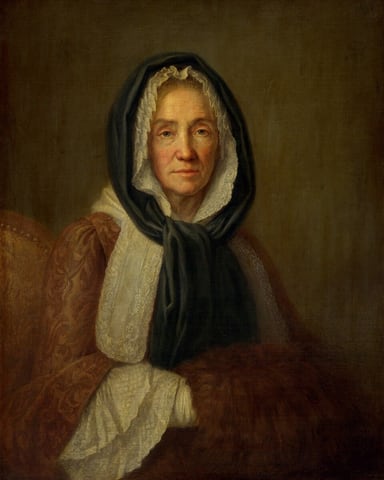
  2. This painting shows a seated elderly woman from the waist up. She faces us with a neutral expression. She has a fair complexion with visible wrinkles, rosy cheeks, and pink lips. Her hair is mostly covered by a white lace cap and a black headscarf. She wears a patterned reddish-brown garment with lace around the collar and sleeves, and her hands rest on a brown fur muff. The background is a dark gray-brown color with visible brushstrokes.
    Old Woman with a MuffUnrecorded French maker, second half 18th centuryCourtesy National Gallery of Art, Washington
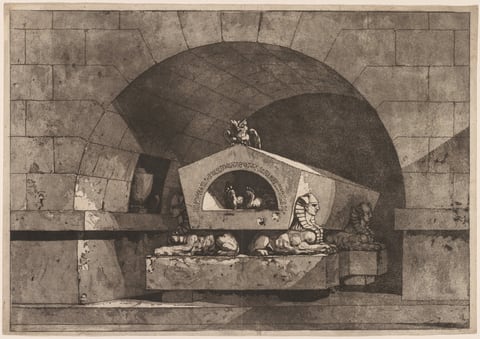
  3. Tomb with Sphinxes and an Owl, by Louis Jean Desprez, c. 1779–84
    Tomb with Sphinxes and an OwlLouis Jean Desprez, c. 1779–84Courtesy of the Cleveland Museum of Art
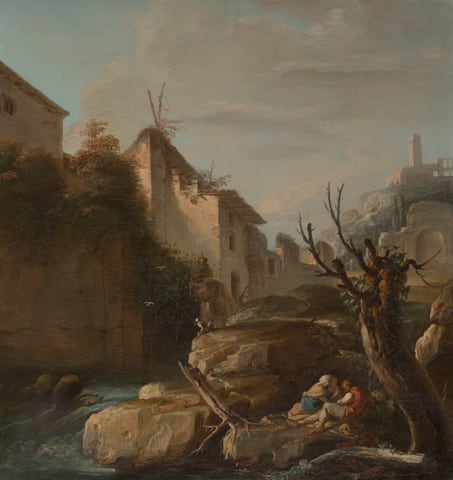
  4. A work made of oil on canvas.
    Appenine LandscapeFrançois Le Moyne, c. 1730Courtesy of the Art Institute of Chicago

Section 2, north wall
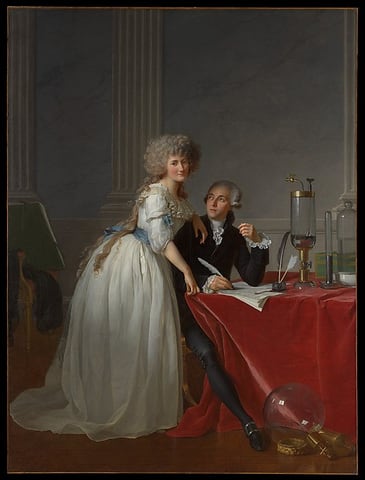
  1. Antoine Laurent Lavoisier (1743–1794) and Marie Anne Lavoisier (Marie Anne Pierrette Paulze, 1758–1836), by Jacques-Louis David, 1788
    Antoine Laurent Lavoisier (1743–1794) and Marie Anne Lavoisier (Marie Anne Pierrette Paulze, 1758–1836)Jacques-Louis David, 1788Courtesy of The Metropolitan Museum of Art
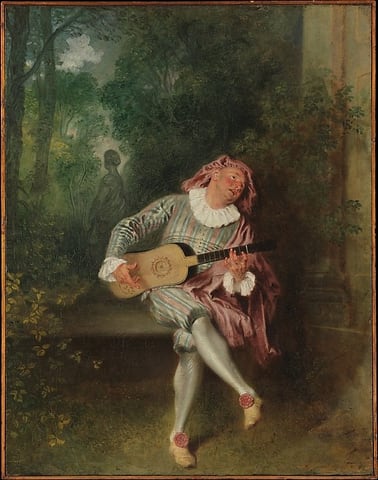
  2. Mezzetin, by Antoine Watteau, ca. 1718–20
    MezzetinAntoine Watteau, ca. 1718–20Courtesy of The Metropolitan Museum of Art
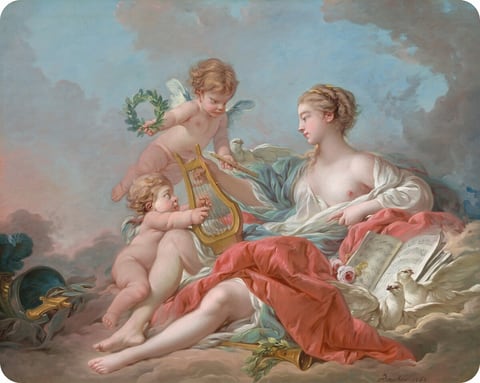
  3. A woman wearing flowing, pastel-colored robes and two, winged, child-like putti gather on a bank of clouds among musical instruments and sheet music in this horizontal painting. The people all have pale, pink-tinged skin. The woman sits to our right of center, facing our left in profile. She has straight nose, a rounded chin, and her small, pink lips are closed. Her ash-blond hair is pulled back under a yellow band. A voluminous white robe falls away over her left shoulder, to our right, to reveal a firm breast and small pink nipple. Sky-blue drapery wraps over her far arm, and deep rose-pink cloth falls across her lap and onto the clouds around her. Her legs extend to our left, her toes pointed. She leans back on her left elbow, closer to us, and points with that index finger to a lyre she props against her knee with her other hand. One chubby, nude putto reaches forward to strum the strings. The other putto hovers above, holding a ring of laurel leaves up in one hand and a flute in the other. Both putti have chubby limbs and torsos, blond curls lifted as if in a breeze, and short, ice-blue wings. Both look at the woman. In the lower left corner, a helmet with a topaz-blue feather and the gold hilt of a sword sit near the woman’s feet. Beneath the woman’s lower leg, at the bottom center of the painting, is a gold horn encircled by another wreath of laurel leaves. Two white doves with wings spread support an open book of sheet music and two pink roses tucked under the woman’s bent elbow. Fog-gray clouds billow up both sides of the scene against a pale blue sky. The clouds on which the trio gathers are parchment brown shaded with mauve pink. The outer corners of the image are white, indicating that the corners of the canvas were rounded. The artist signed and dated the painting in the lower right corner, “F Boucher 1764.”
    Allegory of MusicFrançois Boucher, 1764Courtesy National Gallery of Art, Washington

Section 3, north wall
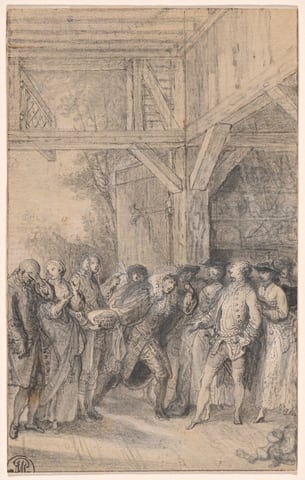
  1. A work made of graphite and pen and black ink, with touches of opaque, white watercolor on cream laid paper.
    Farmer Requesting Permission to Marry a Nobleman's DaughterGabriel de Saint-Aubin, 1761Courtesy of the Art Institute of Chicago
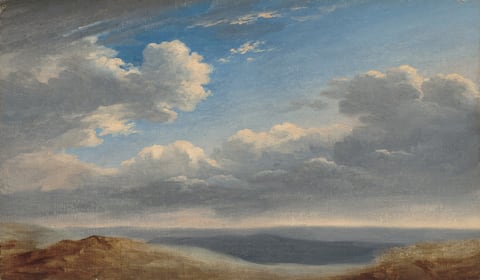
  2. A sliver of land across the bottom of this composition gives way to a procession of puffy gray and white clouds sweeping up across a vivid blue, panoramic sky in this horizontal landscape painting. An area of darker gray beyond the brown land could be a valley, mountain, or shadows from the billowing clouds. About one-fifth of the way up the composition, the horizon glows the faintest peach. The clouds trundle from our left up and to our right. The view is loosely painted, especially in the land.
    Study of Clouds over the Roman CampagnaPierre Henri de Valenciennes, c. 1782/1785Courtesy National Gallery of Art, Washington
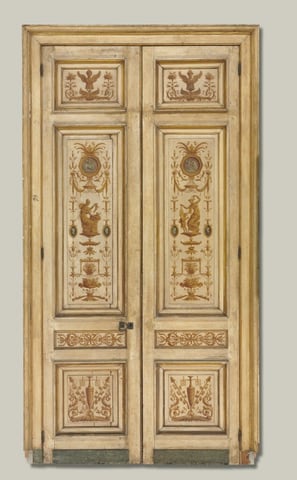
  3. Overdoor Painting, by Pierre Rousseau, 1790s
    Overdoor PaintingPierre Rousseau, 1790sCourtesy of the Cleveland Museum of Art