Floor plan

Time and placeThe 17th century

The 17th century

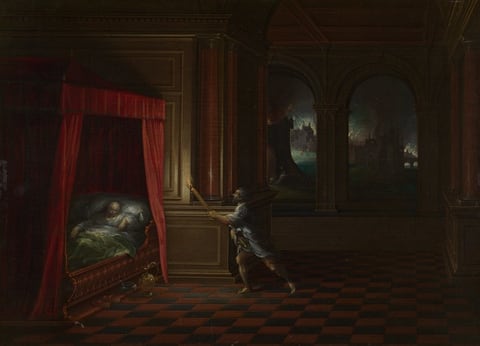
A work made of oil on panel.
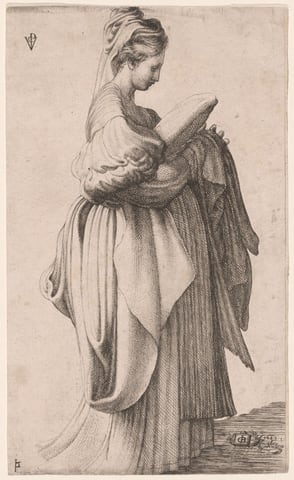
A work made of etching in black ink on cream laid paper.
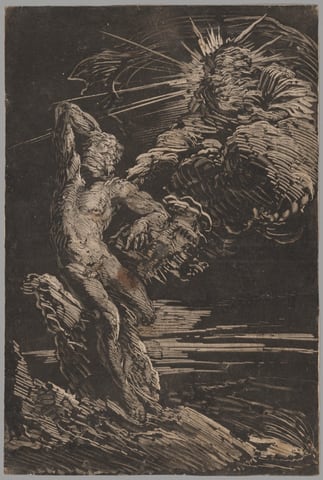
Drawing of god, radiating light, reaching down from clouds, touching male figure.
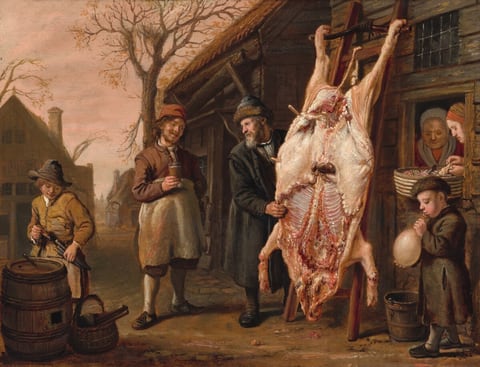
In the center of this painting, a large animal carcass is hanging upside down from a wooden frame, with several people attending to it. The carcass is light pink and has been cut open to reveal white ribs, red muscles, and purple organs. On the far left, a young boy stands next to a barrel and a basket, holding several small knives. To the right, a man in a red cap and white apron observes the carcass while holding a drink. An older man in a furred cap and dark clothing looks towards him and holds one edge of the carcass. On the other side of the animal, a young boy blows up a round object. Two women peer out from the doorway of a wooden building in the background, one holding a basket full of what looks like meat. Behind this group of people are several brown structures and a bare tree against a light pink sky.
A work made of oil on canvas.
The image shows a pastoral scene in black and white with fine line work. A small bridge with a circular archway crosses a stream. A dirt path winds through the landscape flanked by grass and bushes. A rocky cliff ascends on the left with a tower-like structure partially obscured by vegetation. The horizon features a cloudy sky, with swirling lines indicating motion. In the distance, a tall, thin structure, possibly a spire or chimney, stands amid faint hills and trees. The scene conveys a serene atmosphere through hatching and cross-hatching techniques.

The works in this room are listed below.

Works in this room

Works made in the 17th century, anywhere in the world.

Section 1, north wall

  1. A work made of oil on panel.
    Aeneas Rescuing Anchises from Burning TroyHendrick van Steenwijck, the Younger, c. 1610Courtesy of the Art Institute of Chicago
  2. A work made of etching in black ink on cream laid paper.
    A Young Woman Holding a CushionMonogrammist VCP, 1643Courtesy of the Art Institute of Chicago
  3. Drawing of god, radiating light, reaching down from clouds, touching male figure.
    The Creation of AdamGiovanni Benedetto Castiglione, c. 1645/50Courtesy of the Art Institute of Chicago
  4. In the center of this painting, a large animal carcass is hanging upside down from a wooden frame, with several people attending to it. The carcass is light pink and has been cut open to reveal white ribs, red muscles, and purple organs. On the far left, a young boy stands next to a barrel and a basket, holding several small knives. To the right, a man in a red cap and white apron observes the carcass while holding a drink. An older man in a furred cap and dark clothing looks towards him and holds one edge of the carcass. On the other side of the animal, a young boy blows up a round object. Two women peer out from the doorway of a wooden building in the background, one holding a basket full of what looks like meat. Behind this group of people are several brown structures and a bare tree against a light pink sky.
    The Slaughtered HogJan Victors, 1653Courtesy National Gallery of Art, Washington

Section 1, south wall

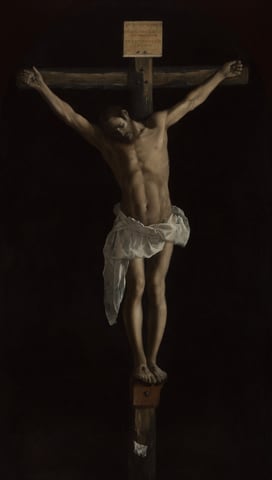
  1. A work made of oil on canvas.
    The CrucifixionFrancisco de Zurbarán, 1627Courtesy of the Art Institute of Chicago
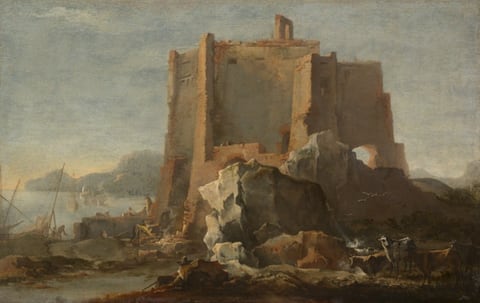
  2. A work made of oil on canvas.
    Landscape with Rock and FortressDomenico Gargiuli (Micco Spadaro), c. 1645Courtesy of the Art Institute of Chicago
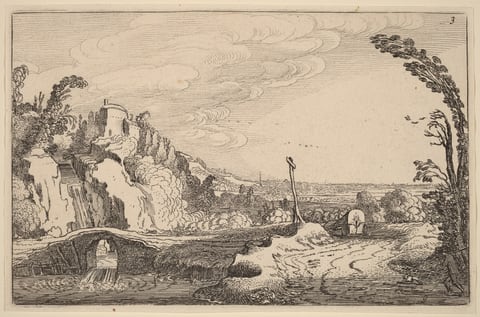
  3. The image shows a pastoral scene in black and white with fine line work. A small bridge with a circular archway crosses a stream. A dirt path winds through the landscape flanked by grass and bushes. A rocky cliff ascends on the left with a tower-like structure partially obscured by vegetation. The horizon features a cloudy sky, with swirling lines indicating motion. In the distance, a tall, thin structure, possibly a spire or chimney, stands amid faint hills and trees. The scene conveys a serene atmosphere through hatching and cross-hatching techniques.
    Cascade under a Stone BridgeJan van de Velde II, c. 1616Courtesy National Gallery of Art, Washington

Section 2, south wall
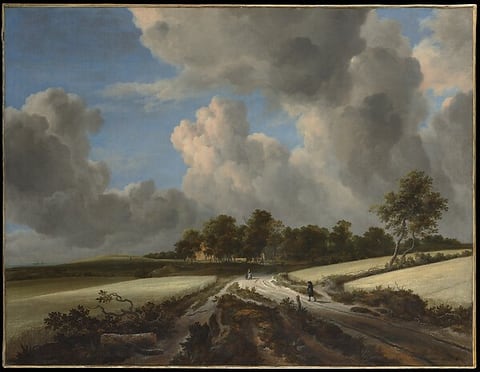
  1. Wheat Fields, by Jacob van Ruisdael, ca. 1670
    Wheat FieldsJacob van Ruisdael, ca. 1670Courtesy of The Metropolitan Museum of Art
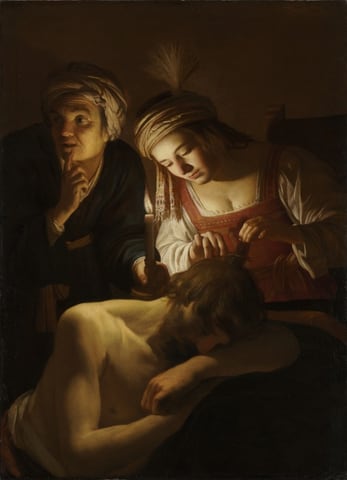
  2. Samson and Delilah, by Gerrit van Honthorst, c. 1616
    Samson and DelilahGerrit van Honthorst, c. 1616Courtesy of the Cleveland Museum of Art
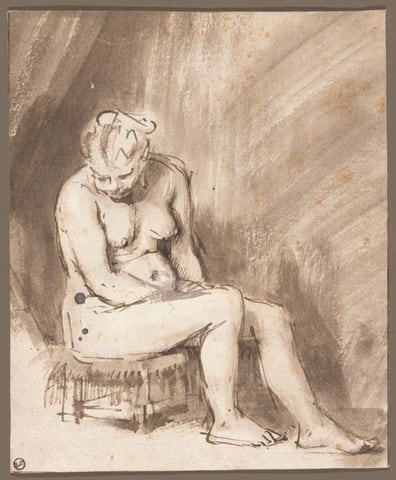
  3. Brown-tone drawing of a nude woman seated on a small stool, looking downward.
    Seated Female NudeRembrandt van Rijn, 1660/62Courtesy of the Art Institute of Chicago
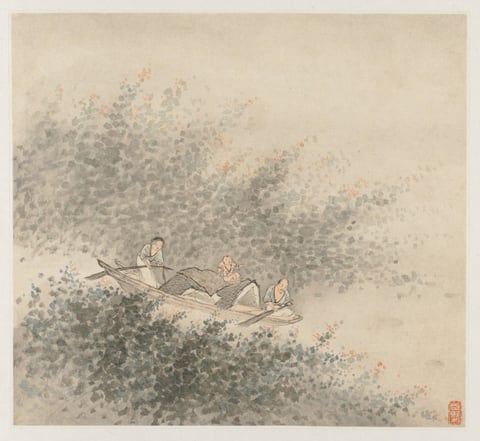
  4. Album of Landscapes: Leaf 6, by Wang Gai, 1677
    Album of Landscapes: Leaf 6Wang Gai, 1677Courtesy of the Cleveland Museum of Art

Section 2, north wall
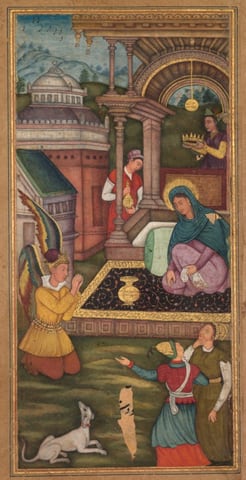
  1. The Annunciation (folio 15 recto), from a Mirror of Holiness (Mir’at al-quds) of Father Jerome Xavier, 1602–4
    The Annunciation (folio 15 recto), from a Mirror of Holiness (Mir’at al-quds) of Father Jerome XavierUnrecorded Indian maker, 1602–4Courtesy of the Cleveland Museum of Art
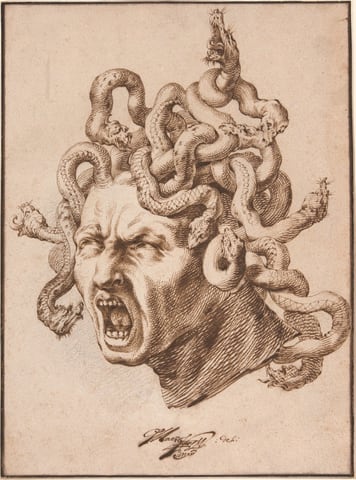
  2. A work made of pen and brown ink, with traces of black chalk, on cream laid paper.
    Head of MedusaGodfried Maes, 1680Courtesy of the Art Institute of Chicago
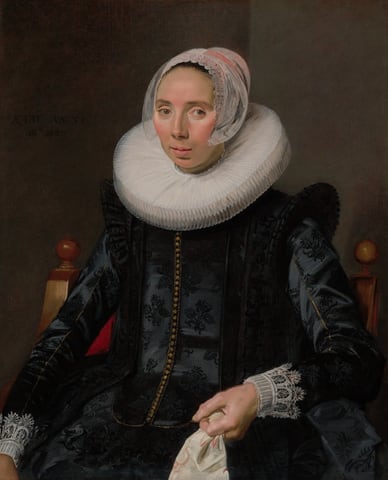
  3. A work made of oil on canvas.
    Portrait of a LadyFrans Hals, 1627Courtesy of the Art Institute of Chicago

Section 3, north wall
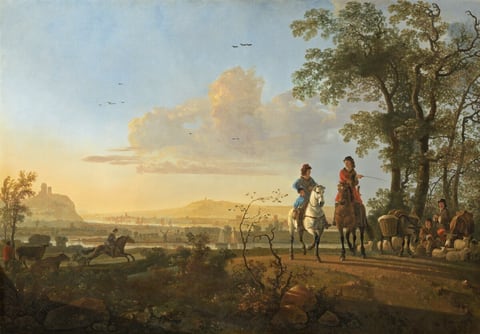
  1. Golden sunlight pours across a landscape with three people on horseback and two more people near a flock of sheep, a cow, and a mule in this horizontal painting. The people all have pale, peachy skin. The horizon is about a third of the way up the composition and is lined with towers on distant, hazy, pale yellow hills. Two of the horses are to the right of center, both facing us. The horse on the left is white, and the rider wears an azure-blue tunic and red brimless cap. The other horse is brown with a white blaze, and its rider wears a red tunic and black cap. That second rider points with a whip to the sitting and standing people near the sheep, to the right. Those two people wear brown jackets, and the standing man has a mustache. The seated person rests a long staff over one shoulder. About half of the nine sheep there lie on the ground, and the others stand. The cow dips her head down to the sheep, and the splay-footed donkey has baskets hung to each side. This grouping is in front of a copse of tall trees that nearly reach the top edge of the composition. The third rider is to our left and a short distance away. That dark brown horse gallops to our right. A short distance away, another herdsman along the left edge of the composition wears a red tunic and brown pants, and he rests a long staff on one shoulder. One cow stands and one lies down next to that herdsman. Sunlight rakes across twigs, leafy plants, scrubby growth, and rocks in the foreground, closest to us. Sailboats float on the waterways that stretch horizontally across the painting in the distance, and the land separating those bodies of water is dotted with spires, windmills, towers, and other structures. A dozen dark birds fly high in the sky, which takes up the top two-thirds of the picture. A bank of iridescent yellow and pearly white clouds trundle across the pale blue sky. The artist signed the painting in the lower right corner, “A.cuijp.”
    Horsemen and Herdsmen with CattleAelbert Cuyp, 1655/1660Courtesy National Gallery of Art, Washington
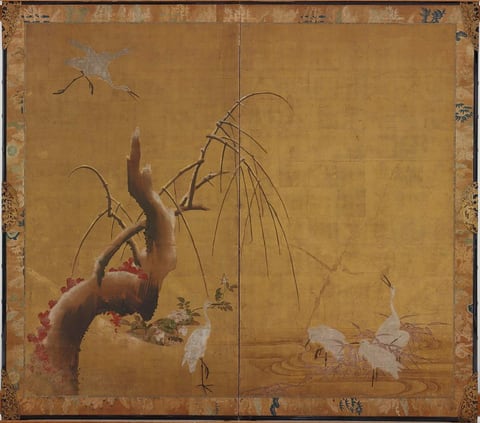
  2. Screen (two-panel)
    Herons and Old WIllowKano Sadanobu, 1615-1868Courtesy of the National Museum of Asian Art, Smithsonian Institution