Floor plan

Time and placeThe 17th century

The 17th century

A work made of oil on canvas.
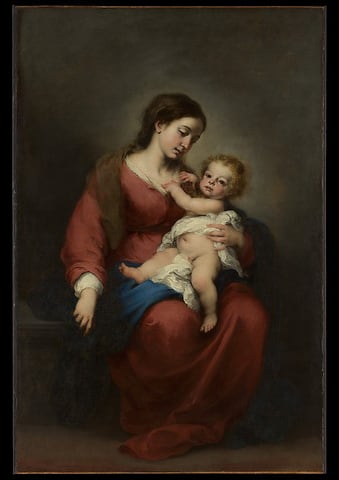
Virgin and Child, by Bartolomé Esteban Murillo, 1670s
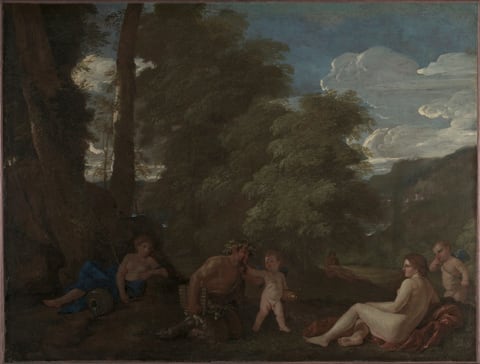
Nymphs and a Satyr (Amor Vincit Omnia), by Nicolas Poussin, c. 1625–27
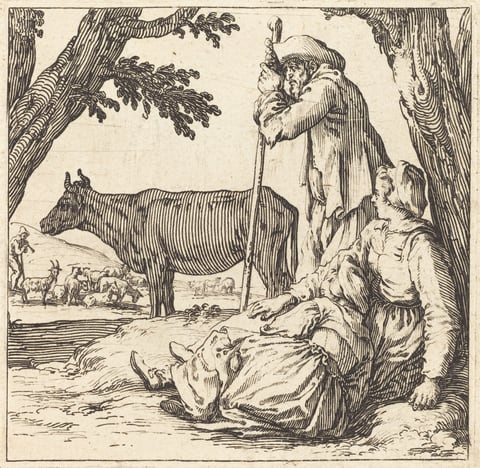
The image has an elevated perspective showing two figures with animals in the scene. One person is leaning against a tree with a stick, while the other is seated on the ground. A cow is between them and other livestock in the middle distance. A person in the distance is tending to the animals. The horizon is low in the image, hidden by rolling hills. The artwork is in monochrome with fine linework, creating texture through hatching and cross-hatching, emphasizing depth and dimensionality.
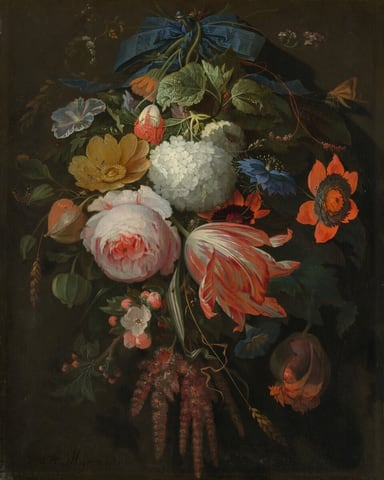
A bouquet of flowers against a dark brown background hangs from a sapphire-blue bow to fill this vertical still life painting. The three largest blooms make a pyramid at the center. A pale pink, flat-leaved carnation is to the lower right of this trio. A red and white striped tulip with flame-shaped petals is next to it, to our right, and a white viburnum bloom, which is made of dozens of smaller clusters, is above. A tan-colored spider builds a web at the center of these three blossoms. Using the face of a clock to work around this trio, we find a spotted bug on a smaller viburnum and some frosty green leaves at noon. A muted orange moth rests on a stalk nearby. Down the right side, the layered vivid blue petals of a love-in-the-mist explode like a starburst. Two coral-red peonies, a mostly closed peony, a topaz-blue morning glory, and the fuzzy fingers of amaranth bring us to six o’clock. Up the left side are delicate pink crab apple blossoms, a spray of Chinese lanterns, a yellow rose with ants crawling across its splayed petals, a striped morning glory, and a few blue, orange, and red buds. A caterpillar rears up on a Chinese lantern bud and a ladybug sits on a leaf nearby. A few stalks of wheat are scattered throughout. Stems weave through the blue ribbon at the top, which is tied around a protruding nail. The artist signed the lower left corner, “AB Mignon f,” with the AB conjoined in a monogram.
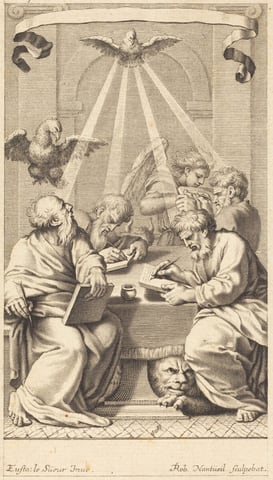
The image shows four elderly men around a table. They have long hair and beards, and appear focused as they write or take notes on tablets. They wear classical robes and sit in different postures, engaged in writing or possibly calculating. Two hold writing implements and tablets, while a third holds a scroll. Above them, a seated figure with wings is present. Light rays emanate from a dove at the top, highlighting a celestial influence. An eagle is perched nearby. Architectural elements like columns and arches are in the background. A lion's head is under the table.

The works in this room are listed below.

Works in this room

Works made in the 17th century, anywhere in the world.

Section 1, north wall

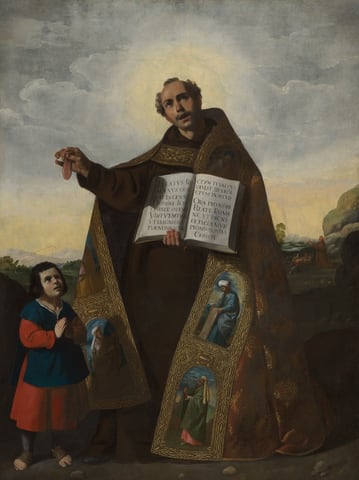
  1. A work made of oil on canvas.
    Saint Romanus of Antioch and Saint BarulasFrancisco de Zurbarán, 1638Courtesy of the Art Institute of Chicago
  2. Virgin and Child, by Bartolomé Esteban Murillo, 1670s
    Virgin and ChildBartolomé Esteban Murillo, 1670sCourtesy of The Metropolitan Museum of Art

Section 1, south wall

  1. Nymphs and a Satyr (Amor Vincit Omnia), by Nicolas Poussin, c. 1625–27
    Nymphs and a Satyr (Amor Vincit Omnia)Nicolas Poussin, c. 1625–27Courtesy of the Cleveland Museum of Art
  2. The image has an elevated perspective showing two figures with animals in the scene. One person is leaning against a tree with a stick, while the other is seated on the ground. A cow is between them and other livestock in the middle distance. A person in the distance is tending to the animals. The horizon is low in the image, hidden by rolling hills. The artwork is in monochrome with fine linework, creating texture through hatching and cross-hatching, emphasizing depth and dimensionality.
    Peasant Couple with CowJacques Callot, c. 1621Courtesy National Gallery of Art, Washington
  3. A bouquet of flowers against a dark brown background hangs from a sapphire-blue bow to fill this vertical still life painting. The three largest blooms make a pyramid at the center. A pale pink, flat-leaved carnation is to the lower right of this trio. A red and white striped tulip with flame-shaped petals is next to it, to our right, and a white viburnum bloom, which is made of dozens of smaller clusters, is above. A tan-colored spider builds a web at the center of these three blossoms. Using the face of a clock to work around this trio, we find a spotted bug on a smaller viburnum and some frosty green leaves at noon. A muted orange moth rests on a stalk nearby. Down the right side, the layered vivid blue petals of a love-in-the-mist explode like a starburst. Two coral-red peonies, a mostly closed peony, a topaz-blue morning glory, and the fuzzy fingers of amaranth bring us to six o’clock. Up the left side are delicate pink crab apple blossoms, a spray of Chinese lanterns, a yellow rose with ants crawling across its splayed petals, a striped morning glory, and a few blue, orange, and red buds. A caterpillar rears up on a Chinese lantern bud and a ladybug sits on a leaf nearby. A few stalks of wheat are scattered throughout. Stems weave through the blue ribbon at the top, which is tied around a protruding nail. The artist signed the lower left corner, “AB Mignon f,” with the AB conjoined in a monogram.
    A Hanging Bouquet of FlowersAbraham Mignon, probably 1665/1670Courtesy National Gallery of Art, Washington
  4. The image shows four elderly men around a table. They have long hair and beards, and appear focused as they write or take notes on tablets. They wear classical robes and sit in different postures, engaged in writing or possibly calculating. Two hold writing implements and tablets, while a third holds a scroll. Above them, a seated figure with wings is present. Light rays emanate from a dove at the top, highlighting a celestial influence. An eagle is perched nearby. Architectural elements like columns and arches are in the background. A lion's head is under the table.
    The Four EvangelistsRobert NanteuilCourtesy National Gallery of Art, Washington

Section 2, south wall
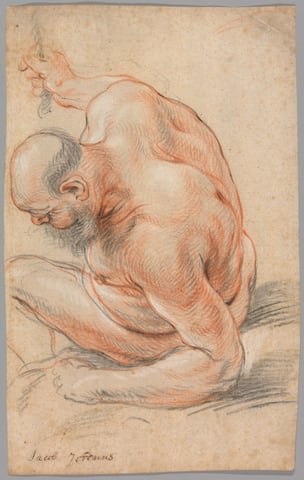
  1. A work made of red and black chalk, with touches of white chalk, on cream laid paper.
    Nude Old Man Seated, Leaning on His Forearm, Facing LeftJacob Jordaens, c. 1640Courtesy of the Art Institute of Chicago
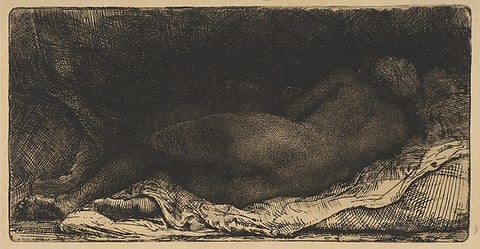
  2. Reclining Female Nude, by Rembrandt van Rijn, 1658
    Reclining Female NudeRembrandt van Rijn, 1658Courtesy of The Metropolitan Museum of Art
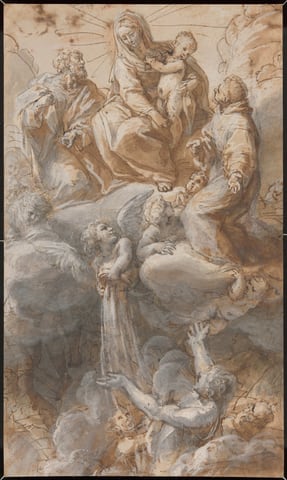
  3. A work made of pen and brown ink, brown and gray wash, and white opaque watercolor (recto) and pen and brown-black ink (verso) on laid paper.
    The Virgin and Saint Joseph with Saint Anthony of Padua Seated in the Heavens Interceding for the Souls in Purgatory, While an Angel Pours Fluid from a Vase onto the Crowd Below (recto and verso)Pietro Antonio di Pietri, 1690/1710Courtesy of the Art Institute of Chicago
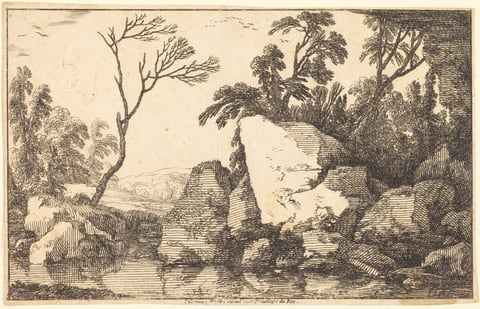
  4. The image is a landscape view with a natural scene depicted in fine etching. The horizon is situated towards the middle of the composition, where the land gently rises, and a subtle outline of distant hills is visible. Large rocks and foliage are depicted close to us, with a lone, barren tree extending upwards on the left side. The etching features intricate and well-defined brushstrokes, including thin lines and cross-hatching to create texture and depth. The color palette is monochromatic, with dark tones against a lighter background. In the distance, additional clusters of trees can be seen, rendered with similar linework to convey movement and detail.
    A Rocky PondLaurent de La Hyre, 1640Courtesy National Gallery of Art, Washington

Section 2, north wall
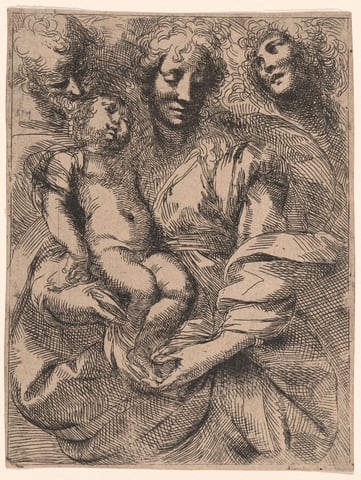
  1. A work made of etching in black on tan laid paper.
    The Holy FamilyGiulio Cesare Procaccini, 1613/15Courtesy of the Art Institute of Chicago
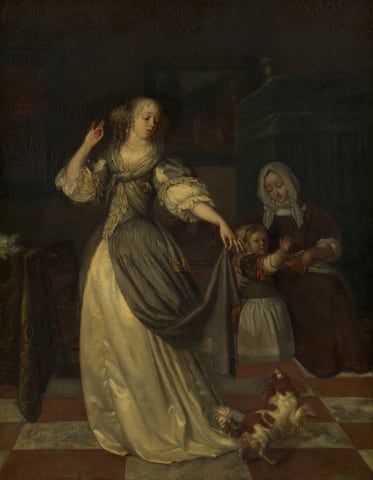
  2. A work made of oil on canvas.
    Lady Playing with a DogEglon van der Neer, c. 1670Courtesy of the Art Institute of Chicago
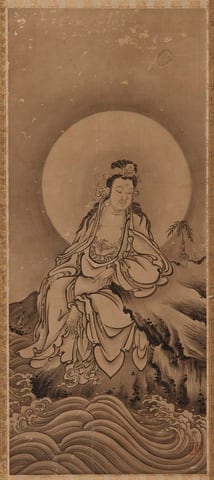
  3. Hanging scrolls (pair)
    KwannonUnrecorded Japanese maker, 1615-1868Courtesy of the National Museum of Asian Art, Smithsonian Institution
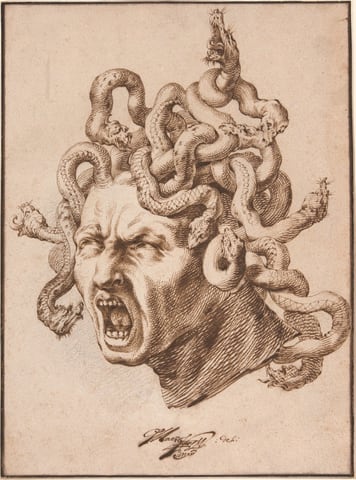
  4. A work made of pen and brown ink, with traces of black chalk, on cream laid paper.
    Head of MedusaGodfried Maes, 1680Courtesy of the Art Institute of Chicago

Section 3, north wall
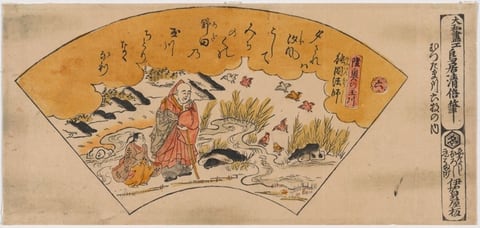
  1. A work made of woodblock print in black ink and watercolor on cream japanese paper.
    The Priest Kobo Daishi at the Tama River in Kii Province from the series The Six Tama RiversTorii Kiyomasu, c. 1725-1735Courtesy of the Art Institute of Chicago
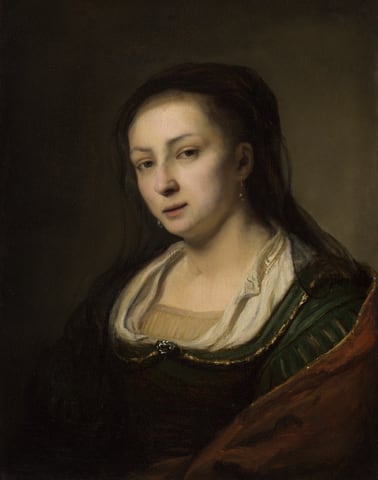
  2. A work made of oil on canvas.
    Portrait of a womanFerdinand Bol, c. 1655Courtesy of the Art Institute of Chicago