Floor plan

Time and placeThe 17th century

The 17th century

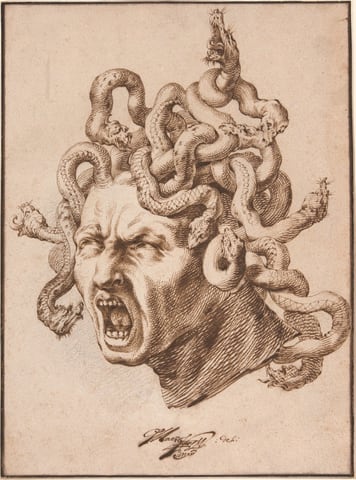
A work made of pen and brown ink, with traces of black chalk, on cream laid paper.
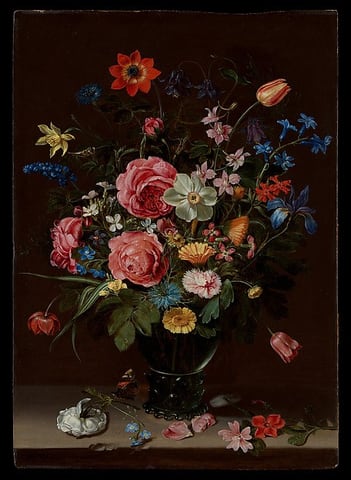
A Bouquet of Flowers, by Clara Peeters, ca. 1612
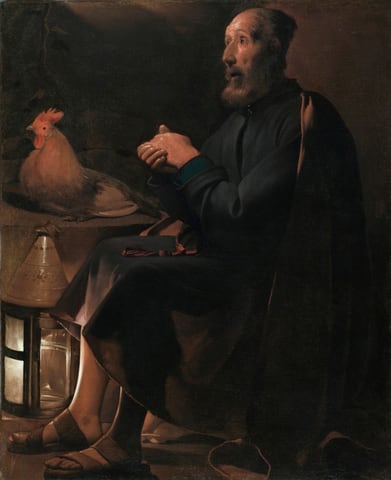
Saint Peter Repentant, by Georges de La Tour, 1645
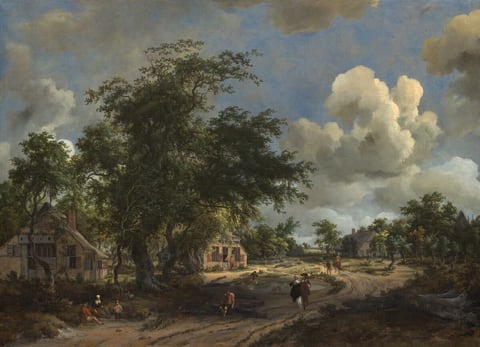
Several people sit, stand, or stroll along a dirt road that winds from the lower left corner of this horizontal landscape painting into the distance, past trees and cottages under a vivid blue sky. The horizon line comes about a third of the way up the canvas, and the cloud studded, azure-blue sky fills the space above. Sunlight filtered through puffy white and steel-gray clouds illuminates the scene from the upper right, creating patches of light and shadow throughout. The road meanders through the center of the composition and is lined with dark and sage-green shrubs, scrubby growth, and gnarled, crooked trees. Closest to us and to our left, two tan cottages are tucked into deep shade created by a grove of several tall trees. The cottages have steeply pitched roofs and windows flanked by gray or brick-red shutters. Three people sit and stand near the path outside the closest building. A short distance to our right, a man sitting on a fallen log carries walking stick and a bundle on his back. His body faces us but his head is turned to our right to gaze toward the man and woman about to stroll past him, headed in our direction. The woman wears a black dress over a white skirt, and a white head covering and shawl. The man wears a brimmed hat with a red decoration, a brown coat with gold buttons down the front and a wide white collar, and heeled shoes. Beyond them, the road curves to our left around a small pond in front of the second cottage. Two people crouch to set a toy sailboat afloat by the edge of the pond, and a brown dog sniffs the ground nearby. Two more people stand talking at the doorway to the second cottage and another dog leaps up at the half-door. Further along the road, the light becomes stronger, illuminating a horse, rider, and another person walking alongside the horse. The road continues to curve around a butter-yellow cottage nestled in a grove of trees on the right. A sunny field is visible in the far distance.
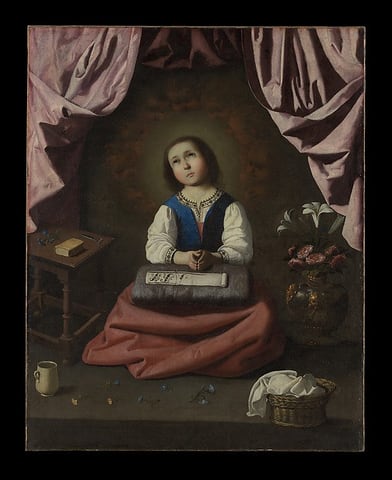
The Young Virgin, by Francisco de Zurbarán, ca. 1632–33
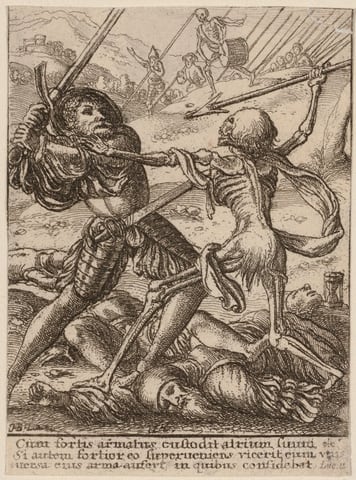
A work made of etching in black on ivory wove paper.
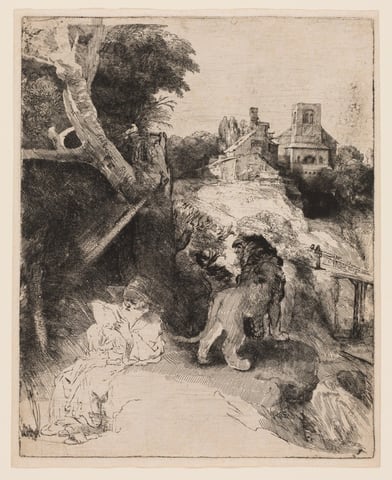
A work made of etching, burin, and drypoint on ivory laid paper.
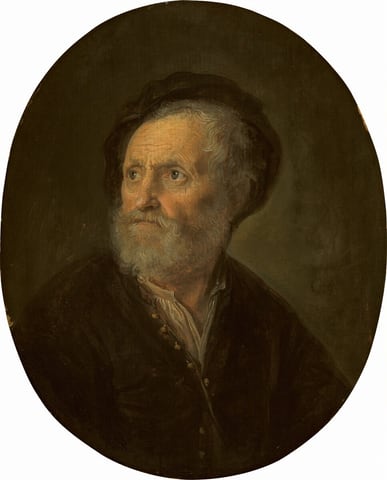
Shown from the chest up, a light-skinned man with a wrinkled face and a silvery gray beard and hair gazes into the distance in this oval portrait painting. His chest is angled to our right but he turns his head to look off over his other shoulder, to our left. His slate-blue eyes are a little sunken and lined with wrinkles. Shading marks the hollows of the temple and cheek we can see. His thin lips are closed and framed by his curly mustache and beard. A dark, mahogany-brown cap is pushed back on his head, and his brown jacket has gold-colored buttons down the front. The collar of a cream-colored shirt shows through at the neckline. The background is dark olive green. The artist signed the work near the man’s shoulder, to our right: “GDOV.”

The works in this room are listed below.

Works in this room

Works made in the 17th century, anywhere in the world.

Section 1, north wall

  1. A work made of pen and brown ink, with traces of black chalk, on cream laid paper.
    Head of MedusaGodfried Maes, 1680Courtesy of the Art Institute of Chicago
  2. A Bouquet of Flowers, by Clara Peeters, ca. 1612
    A Bouquet of FlowersClara Peeters, ca. 1612Courtesy of The Metropolitan Museum of Art
  3. Saint Peter Repentant, by Georges de La Tour, 1645
    Saint Peter RepentantGeorges de La Tour, 1645Courtesy of the Cleveland Museum of Art
  4. Several people sit, stand, or stroll along a dirt road that winds from the lower left corner of this horizontal landscape painting into the distance, past trees and cottages under a vivid blue sky. The horizon line comes about a third of the way up the canvas, and the cloud studded, azure-blue sky fills the space above. Sunlight filtered through puffy white and steel-gray clouds illuminates the scene from the upper right, creating patches of light and shadow throughout. The road meanders through the center of the composition and is lined with dark and sage-green shrubs, scrubby growth, and gnarled, crooked trees. Closest to us and to our left, two tan cottages are tucked into deep shade created by a grove of several tall trees. The cottages have steeply pitched roofs and windows flanked by gray or brick-red shutters. Three people sit and stand near the path outside the closest building. A short distance to our right, a man sitting on a fallen log carries walking stick and a bundle on his back. His body faces us but his head is turned to our right to gaze toward the man and woman about to stroll past him, headed in our direction. The woman wears a black dress over a white skirt, and a white head covering and shawl. The man wears a brimmed hat with a red decoration, a brown coat with gold buttons down the front and a wide white collar, and heeled shoes. Beyond them, the road curves to our left around a small pond in front of the second cottage. Two people crouch to set a toy sailboat afloat by the edge of the pond, and a brown dog sniffs the ground nearby. Two more people stand talking at the doorway to the second cottage and another dog leaps up at the half-door. Further along the road, the light becomes stronger, illuminating a horse, rider, and another person walking alongside the horse. The road continues to curve around a butter-yellow cottage nestled in a grove of trees on the right. A sunny field is visible in the far distance.
    A View on a High RoadMeindert Hobbema, 1665Courtesy National Gallery of Art, Washington

Section 1, south wall

  1. The Young Virgin, by Francisco de Zurbarán, ca. 1632–33
    The Young VirginFrancisco de Zurbarán, ca. 1632–33Courtesy of The Metropolitan Museum of Art
  2. A work made of etching in black on ivory wove paper.
    The Knight and Death, from The Dance of DeathWenceslaus Hollar, 1651Courtesy of the Art Institute of Chicago
  3. A work made of etching, burin, and drypoint on ivory laid paper.
    Saint Jerome Reading in an Italian LandscapeRembrandt van Rijn, c. 1653Courtesy of the Art Institute of Chicago
  4. Shown from the chest up, a light-skinned man with a wrinkled face and a silvery gray beard and hair gazes into the distance in this oval portrait painting. His chest is angled to our right but he turns his head to look off over his other shoulder, to our left. His slate-blue eyes are a little sunken and lined with wrinkles. Shading marks the hollows of the temple and cheek we can see. His thin lips are closed and framed by his curly mustache and beard. A dark, mahogany-brown cap is pushed back on his head, and his brown jacket has gold-colored buttons down the front. The collar of a cream-colored shirt shows through at the neckline. The background is dark olive green. The artist signed the work near the man’s shoulder, to our right: “GDOV.”
    Bust of a Bearded ManGerrit Dou, c. 1642/1645Courtesy National Gallery of Art, Washington

Section 2, south wall
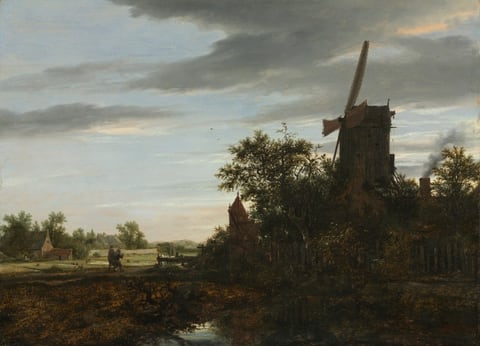
  1. Landscape with a Windmill, by Jacob van Ruisdael, 1646
    Landscape with a WindmillJacob van Ruisdael, 1646Courtesy of the Cleveland Museum of Art
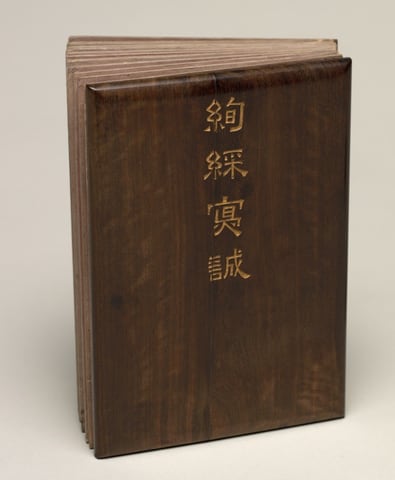
  2. Desk Album: Flower and Bird Paintings, by Zhang Ruoai, 1700s
    Desk Album: Flower and Bird PaintingsZhang Ruoai, 1700sCourtesy of the Cleveland Museum of Art
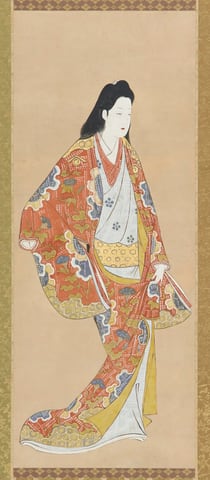
  3. Hanging scroll (mounted on panel)
    Girl in an orange vermillion dressUnrecorded Japanese maker, 1661-1673Courtesy of the National Museum of Asian Art, Smithsonian Institution
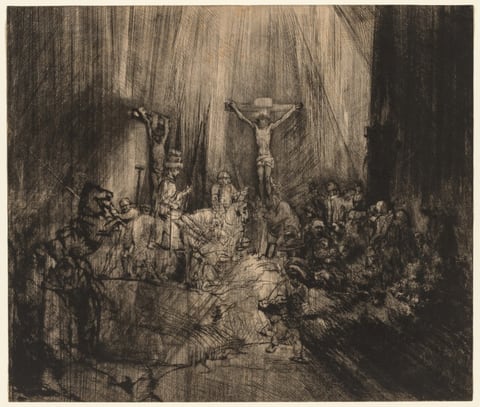
  4. Christ Crucified Between the Two Thieves: 'The Three Crosses', by Rembrandt van Rijn, 1653-c.1660
    Christ Crucified Between the Two Thieves: 'The Three Crosses'Rembrandt van Rijn, 1653-c.1660Courtesy of the Cleveland Museum of Art

Section 2, north wall
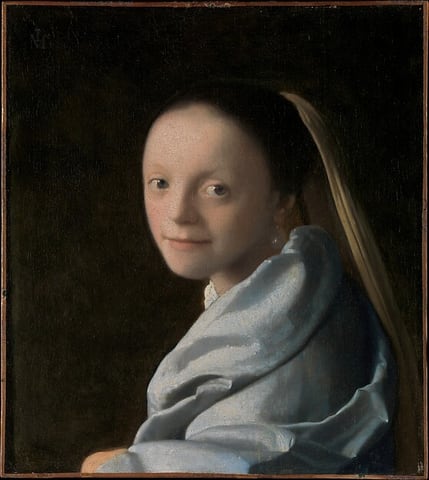
  1. Study of a Young Woman, by Johannes Vermeer, ca. 1665–67
    Study of a Young WomanJohannes Vermeer, ca. 1665–67Courtesy of The Metropolitan Museum of Art
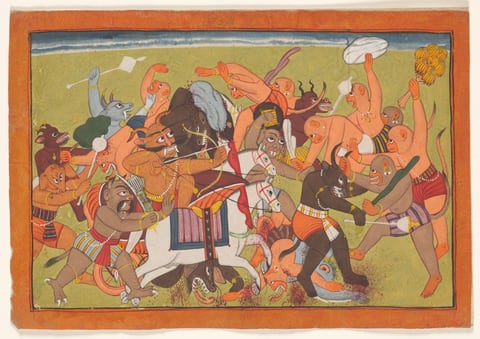
  2. Battle between monkeys and demons, from the “Shangri” Ramayana, c. 1700
    Battle between monkeys and demons, from the “Shangri” RamayanaUnrecorded Indian maker, c. 1700Courtesy of the Cleveland Museum of Art

Section 3, north wall
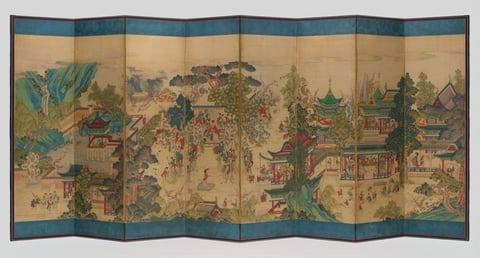
  1. A work made of ink and color on silk.
    Joyous Banquet of Guo Ziyi (곽분양행락도)Unrecorded Korean maker, Joseon dynasty (1392–1910), 19th centuryCourtesy of the Art Institute of Chicago
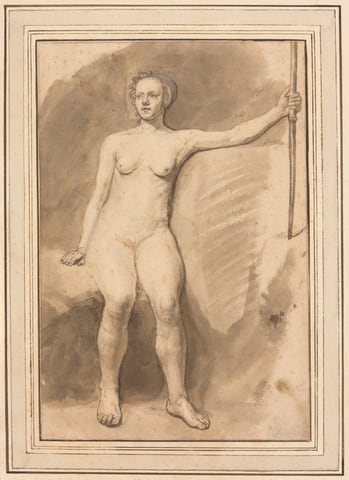
  2. A work made of pen and brown ink and brush and brown wash, with traces of black chalk and opaque white watercolor, on cream laid paper, laid down on cream laid paper.
    Seated Female NudeSamuel van Hoogstraten, 1647/78Courtesy of the Art Institute of Chicago