Floor plan

Time and place17th-century Netherlands
17th-century Netherlands
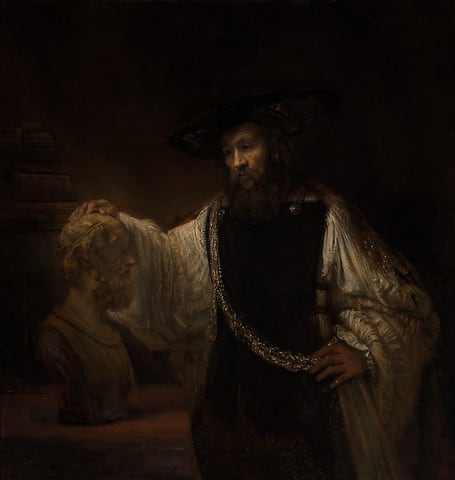
Aristotle with a Bust of Homer, by Rembrandt van Rijn, 1653
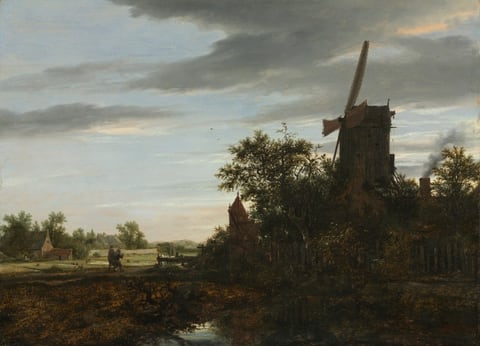
Landscape with a Windmill, by Jacob van Ruisdael, 1646
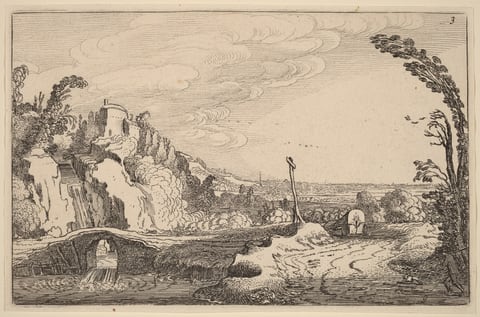
The image shows a pastoral scene in black and white with fine line work. A small bridge with a circular archway crosses a stream. A dirt path winds through the landscape flanked by grass and bushes. A rocky cliff ascends on the left with a tower-like structure partially obscured by vegetation. The horizon features a cloudy sky, with swirling lines indicating motion. In the distance, a tall, thin structure, possibly a spire or chimney, stands amid faint hills and trees. The scene conveys a serene atmosphere through hatching and cross-hatching techniques.
A work made of oil on canvas.
Portrait of Gerard de Lairesse, by Rembrandt van Rijn, 1665–67
A work made of oil on panel.
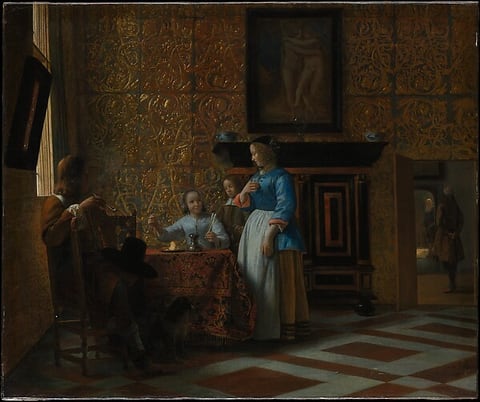
Leisure Time in an Elegant Setting, by Pieter de Hooch, ca. 1663–65

The works in this room are listed below.

Works in this room

Works made in the Netherlands in the 17th century.

First room, north wall

  1. Aristotle with a Bust of Homer, by Rembrandt van Rijn, 1653
    Aristotle with a Bust of HomerRembrandt van Rijn, 1653Courtesy of The Metropolitan Museum of Art
  2. Landscape with a Windmill, by Jacob van Ruisdael, 1646
    Landscape with a WindmillJacob van Ruisdael, 1646Courtesy of the Cleveland Museum of Art
  3. The image shows a pastoral scene in black and white with fine line work. A small bridge with a circular archway crosses a stream. A dirt path winds through the landscape flanked by grass and bushes. A rocky cliff ascends on the left with a tower-like structure partially obscured by vegetation. The horizon features a cloudy sky, with swirling lines indicating motion. In the distance, a tall, thin structure, possibly a spire or chimney, stands amid faint hills and trees. The scene conveys a serene atmosphere through hatching and cross-hatching techniques.
    Cascade under a Stone BridgeJan van de Velde II, c. 1616Courtesy National Gallery of Art, Washington

First room, south wall

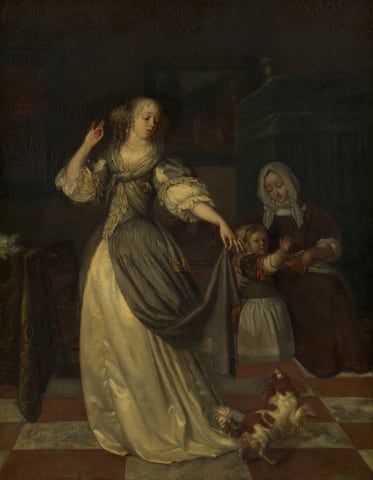
  1. A work made of oil on canvas.
    Lady Playing with a DogEglon van der Neer, c. 1670Courtesy of the Art Institute of Chicago
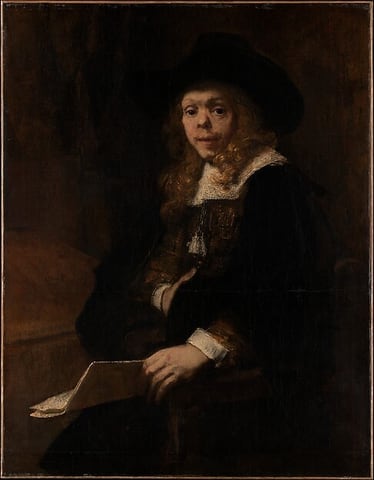
  2. Portrait of Gerard de Lairesse, by Rembrandt van Rijn, 1665–67
    Portrait of Gerard de LairesseRembrandt van Rijn, 1665–67Courtesy of The Metropolitan Museum of Art
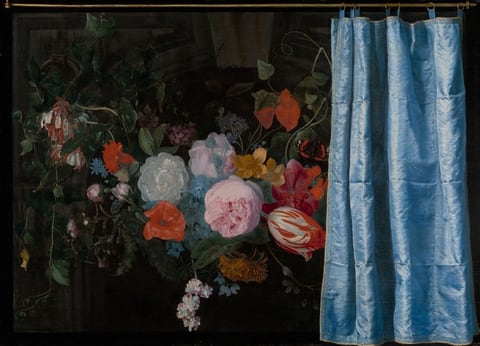
  3. A work made of oil on panel.
    Trompe-l'Oeil Still Life with a Flower Garland and a CurtainAdriaen van der Spelt, 1658Courtesy of the Art Institute of Chicago
  4. Leisure Time in an Elegant Setting, by Pieter de Hooch, ca. 1663–65
    Leisure Time in an Elegant SettingPieter de Hooch, ca. 1663–65Courtesy of The Metropolitan Museum of Art

Second room, south wall
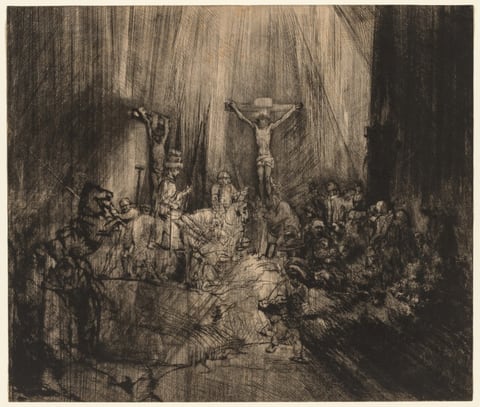
  1. Christ Crucified Between the Two Thieves: 'The Three Crosses', by Rembrandt van Rijn, 1653-c.1660
    Christ Crucified Between the Two Thieves: 'The Three Crosses'Rembrandt van Rijn, 1653-c.1660Courtesy of the Cleveland Museum of Art
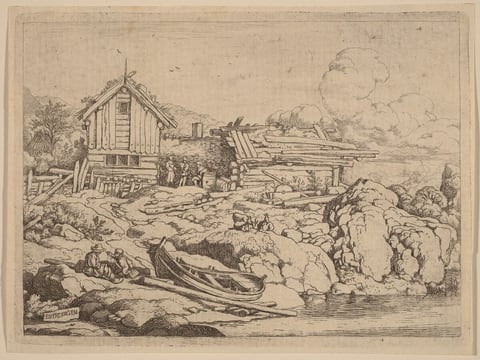
  2. The image shows a landscape with figures near a body of water. There are buildings made of logs, people gathered near a structure, and trees in the background. The style is detailed with precise linework, shading, and hatching. The color palette is monochrome, emphasizing light and shadow.
    Boat at a River Bank with Three GoatsAllart van Everdingen, probably c. 1645/1656Courtesy National Gallery of Art, Washington
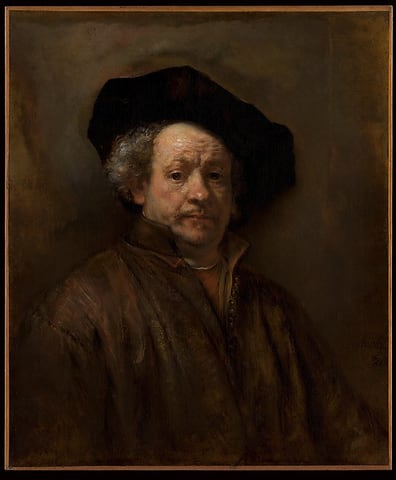
  3. Self-Portrait, by Rembrandt van Rijn, 1660
    Self-PortraitRembrandt van Rijn, 1660Courtesy of The Metropolitan Museum of Art
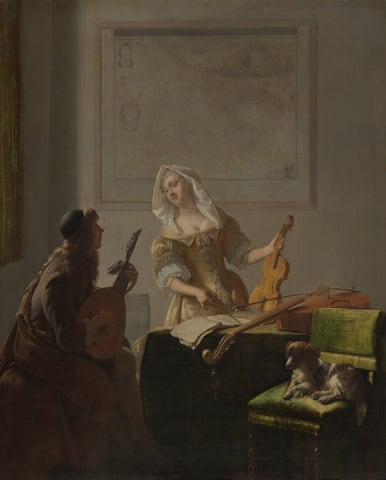
  4. A work made of oil on canvas.
    The Music LessonJacob Ochtervelt, 1671Courtesy of the Art Institute of Chicago

Second room, north wall
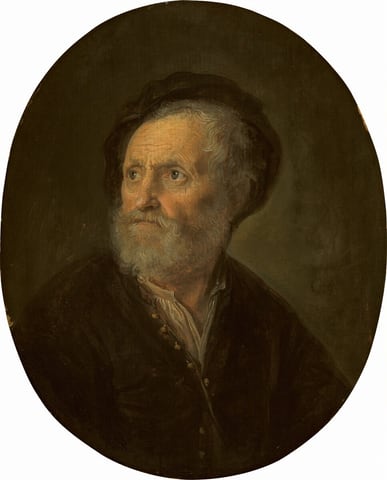
  1. Shown from the chest up, a light-skinned man with a wrinkled face and a silvery gray beard and hair gazes into the distance in this oval portrait painting. His chest is angled to our right but he turns his head to look off over his other shoulder, to our left. His slate-blue eyes are a little sunken and lined with wrinkles. Shading marks the hollows of the temple and cheek we can see. His thin lips are closed and framed by his curly mustache and beard. A dark, mahogany-brown cap is pushed back on his head, and his brown jacket has gold-colored buttons down the front. The collar of a cream-colored shirt shows through at the neckline. The background is dark olive green. The artist signed the work near the man’s shoulder, to our right: “GDOV.”
    Bust of a Bearded ManGerrit Dou, c. 1642/1645Courtesy National Gallery of Art, Washington
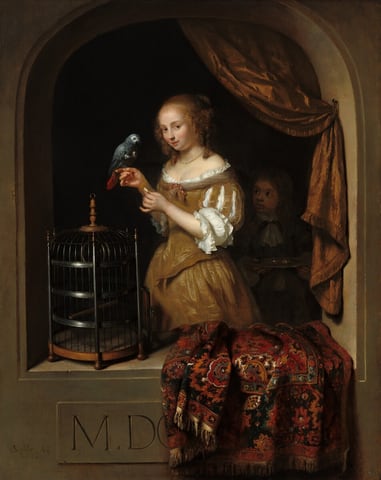
  2. Shown from about the knees up, a pale-skinned young woman stands within a stone niche, with a parrot perched on her finger as she gazes out at us in this vertical painting. The woman’s hands are raised to chest height, and she balances the spruce-blue parrot on the index finger of her far hand while her other hand holds an indistinct, white object. Her body is angled to our left, and she looks at us from the corner of her green eyes under faint brows. Her round face has a small nose, flushed cheeks, and her coral-red mouth curls up in a slight smile, her lips parted. Her honey-blond hair is gathered at the back of her head with curly tendrils framing her face and falling to her shoulders. She wears a golden-brown gown trimmed with a narrow ruffle of white fabric along the low neckline that reveals her décolletage. The bird faces the woman and lifts something, presumably a bit of food, up with one dark claw. The underside of its tail is crimson red. A light-skinned boy stands in deep shadow just to the right of the woman. He looks up at her and holds a silver tray in both hands. They stand within a light brown, arched, stone opening beyond a ledge, which comes up to about the woman’s knees. A carpet patterned with stylized flowers in ruby red, burnt orange, teal blue, white, and black is bunched up and draped over the parapet, to our right. A tall, iron-gray cage sits to our left. The rug partly covers an inscription on the front face of the niche that reads, “M. DO,” with the O cut off. A copper-colored, fringe-lined drapery hangs from the upper right of the arch and is fastened to the inner edge of the opening to create a swag. The woman is brightly lit from the upper left, and the space behind her and the boy is ink black. The artist signed and dated the lower left corner as if he had carved into the front face of the arch. It reads, “CNetscher .Ao. 16.66,” with the C and N overlapping to make a monogram.
    A Woman Feeding a Parrot, with a PageCaspar Netscher, 1666Courtesy National Gallery of Art, Washington
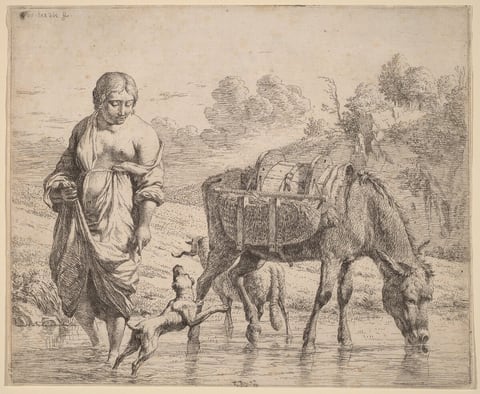
  3. The image shows a woman standing close to us, slightly turned to the side, looking down, with a hand supporting her draped attire and the other grasping a stick. Next to her, a donkey drinks from a shallow stream, carrying a large wicker basket with barrels inside. A dog is splashing in the water beside them. The horizon is low, meeting a rise of land with trees and shrubs, leading the eye to a distant pathway where a couple of small figures can be seen. The sky above has sketchily rendered clouds. The style involves fine, detailed linework, characteristic of etching, emphasizing textures such as the fur of the donkey and the folds of the fabric. The color palette is monochromatic, relying on various intensities of ink and line density to render shadows and highlights.
    Woman Crossing a StreamKarel Dujardin, 1662Courtesy National Gallery of Art, Washington

Third room, north wall
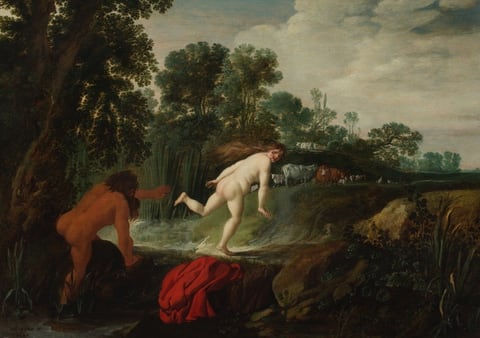
  1. A work made of oil on panel.
    Alpheus and ArethusaMoses van Uyttenbroeck, 1626Courtesy of the Art Institute of Chicago
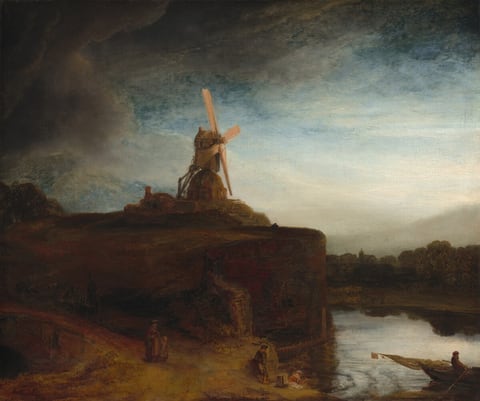
  2. A windmill stands on a promontory cutting into a waterway under a partially stormy sky in this square landcape painting. The promontory and mill are painted in muted tones of brown and rust orange, while steel-gray and white clouds encircle a topaz-blue sky above. The promontory juts into the scene from our left, and the front of the windmill is angled to our right so its golden-tan sails catch the light. Silvery water winds around the base of the promontory and extends to a dark green, shadowy bank on the far side. A boat in the lower right corner of the composition is rowed by a man wearing a red jacket and cap. A path runs to the water’s edge from the left edge of the painting, in front of the promontory’s retaining wall, which is shored up with stones or panels. A person in dark clothing close to the windmill seems to rest their arms on the retaining wall, their back to us. Closer to us, a woman holds a child’s hand as they walk down the path to the bank. A bearded man with tattered brown clothes and bare feet stands leaning against the wall near a woman wearing burnt-orange garment. She sits or kneels at the water’s edge in front of a basket of clothes and holds up a brown cloth. The olive-green forms of the trees on the far bank are reflected in the water, and closer inspection reveals two cows near the water there. Charcoal-gray clouds pile up along the left of the painting and span the top edge. There is a brilliant blue sky beyond and a screen of white clouds near the horizon, which comes about a third of the way up the canvas.
    The MillRembrandt van Rijn, 1645/1648Courtesy National Gallery of Art, Washington