Floor plan

Time and place17th-century Netherlands
17th-century Netherlands
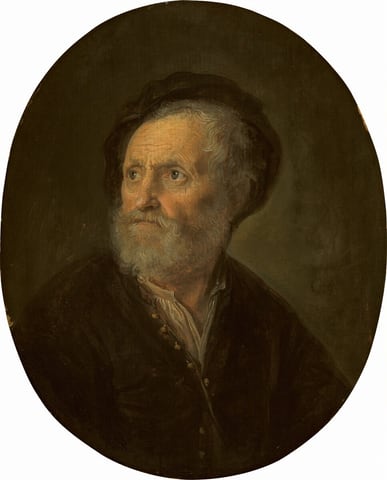
Shown from the chest up, a light-skinned man with a wrinkled face and a silvery gray beard and hair gazes into the distance in this oval portrait painting. His chest is angled to our right but he turns his head to look off over his other shoulder, to our left. His slate-blue eyes are a little sunken and lined with wrinkles. Shading marks the hollows of the temple and cheek we can see. His thin lips are closed and framed by his curly mustache and beard. A dark, mahogany-brown cap is pushed back on his head, and his brown jacket has gold-colored buttons down the front. The collar of a cream-colored shirt shows through at the neckline. The background is dark olive green. The artist signed the work near the man’s shoulder, to our right: “GDOV.”
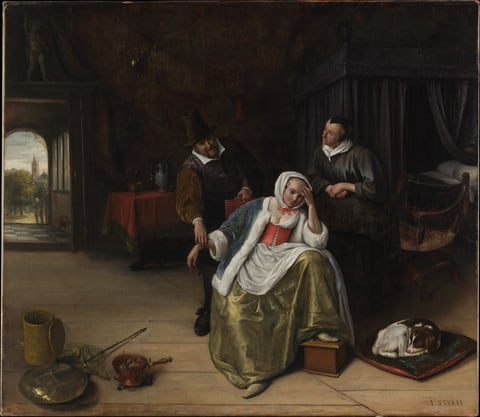
The Lovesick Maiden, by Jan Steen, ca. 1660
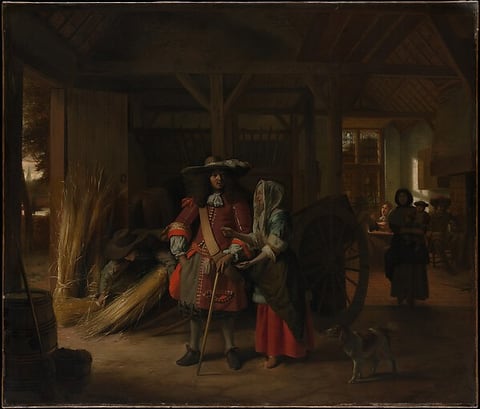
Paying the Hostess, by Pieter de Hooch, ca. 1670
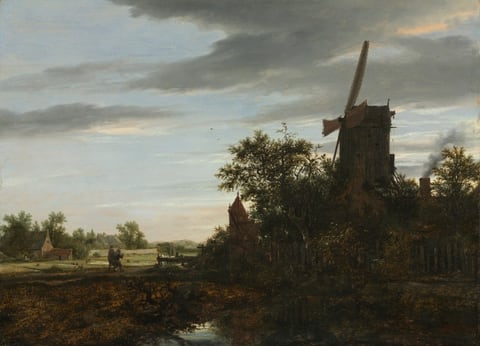
Landscape with a Windmill, by Jacob van Ruisdael, 1646
A work made of oil on canvas.
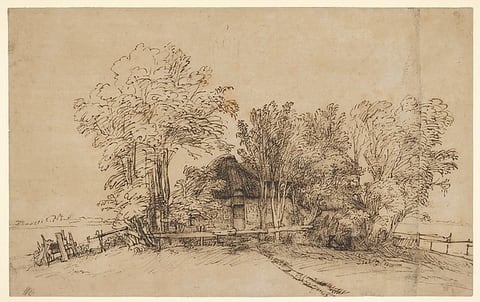
Cottage among Trees, by Rembrandt van Rijn, ca. 1650

The works in this room are listed below.

Works in this room

Works made in the Netherlands in the 17th century.

First room, north wall

  1. Shown from the chest up, a light-skinned man with a wrinkled face and a silvery gray beard and hair gazes into the distance in this oval portrait painting. His chest is angled to our right but he turns his head to look off over his other shoulder, to our left. His slate-blue eyes are a little sunken and lined with wrinkles. Shading marks the hollows of the temple and cheek we can see. His thin lips are closed and framed by his curly mustache and beard. A dark, mahogany-brown cap is pushed back on his head, and his brown jacket has gold-colored buttons down the front. The collar of a cream-colored shirt shows through at the neckline. The background is dark olive green. The artist signed the work near the man’s shoulder, to our right: “GDOV.”
    Bust of a Bearded ManGerrit Dou, c. 1642/1645Courtesy National Gallery of Art, Washington
  2. The Lovesick Maiden, by Jan Steen, ca. 1660
    The Lovesick MaidenJan Steen, ca. 1660Courtesy of The Metropolitan Museum of Art
  3. Paying the Hostess, by Pieter de Hooch, ca. 1670
    Paying the HostessPieter de Hooch, ca. 1670Courtesy of The Metropolitan Museum of Art

First room, south wall

  1. Landscape with a Windmill, by Jacob van Ruisdael, 1646
    Landscape with a WindmillJacob van Ruisdael, 1646Courtesy of the Cleveland Museum of Art
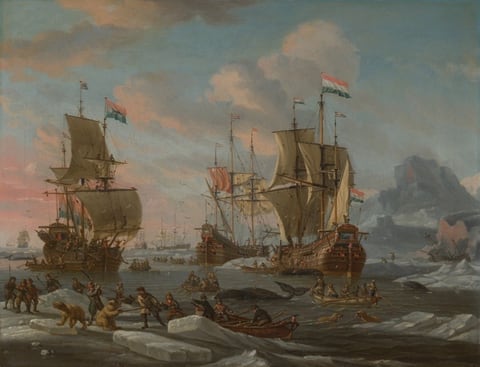
  2. A work made of oil on canvas.
    The Dutch Whaling FleetAbraham Storck, c. 1695Courtesy of the Art Institute of Chicago
  3. Cottage among Trees, by Rembrandt van Rijn, ca. 1650
    Cottage among TreesRembrandt van Rijn, ca. 1650Courtesy of The Metropolitan Museum of Art

Second room, south wall
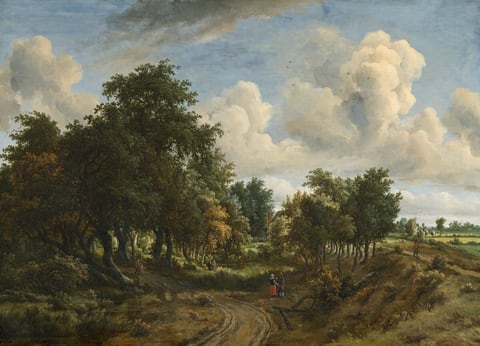
  1. A rutted, dirt road curves from the bottom center of the canvas toward and behind a grove of tall trees to our left, beneath a pale blue sky with fluffy white clouds that fills the top two-thirds of this horizontal landscape painting. The broad, green canopies of the trees to our left create deep shade over twisting trunks, shrubs, and grasses. A narrow stream meandering alongside the road to our left reflects the moss, pine, and sage greens of the leaves. The land rises in a sloping bank to our right, and leads back to open fields with hedgerows that stretch to the horizon. Shorter, more spindly trees cluster along the bank in the distance. Tiny in scale, people are sprinkled throughout the landscape, either singly or in small groups. In the shade of the grove to our left, a man with dark pantaloons, a brown hat and coat, and a walking stick strolls along the road with a woman wearing a red skirt, a dark shirt, and a white apron and cap. Just off the curve of the road to our right, another man with a walking stick, tan hat, and dark gray pantaloons talks to a woman also wearing red, black, and white. Another person, slightly smaller in stature, stands between them. At a pond farther back from this trio, a man with a broad-brimmed hat sits fishing at the edge of the water. Barely visible, a house with a pitched roof, a tall, brick-red chimney, and a white picket fence peeks out from behind the trees beyond the pond. Finally, a man wearing a rust-orange coat, gray pantaloons with white stockings, and a tall hat, carrying a pole propped on his shoulder, walks toward us on a footpath running alongside the fields. Tall, cream-white clouds dot the pale blue sky above, and tiny dots of dark paint suggest flying birds. Soft sunlight pours across the countryside. The artist signed and dated the painting in small script in the lower right corner: “meijndert Hobbema F 1663.”
    A Wooded LandscapeMeindert Hobbema, 1663Courtesy National Gallery of Art, Washington
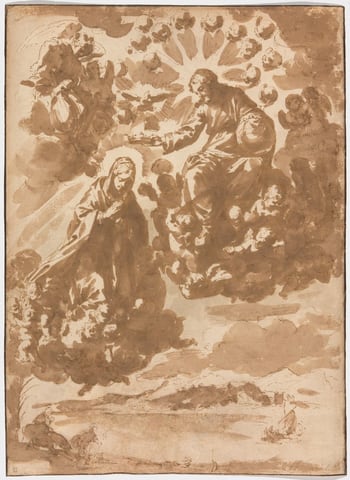
  2. A work made of pen and brown ink and brush and brown wash on ivory laid paper, laid down on cream laid paper.
    The Coronation of the Virgin and The Flight into EgyptJan de Bisschop, 1648/71Courtesy of the Art Institute of Chicago
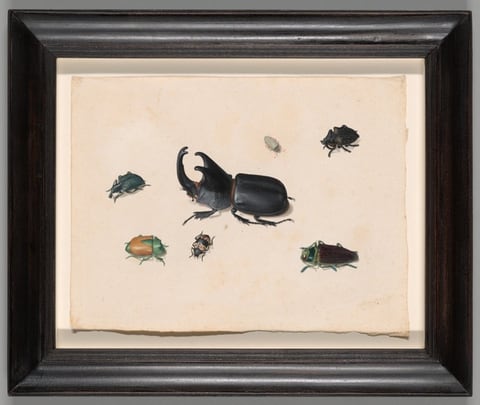
  3. A work made of watercolor and opaque watercolor on cream laid paper.
    Megasoma Elephas or Megaceras Jason and Six Other InsectsPieter Holsteyn, the younger, 1640/80Courtesy of the Art Institute of Chicago

Second room, north wall
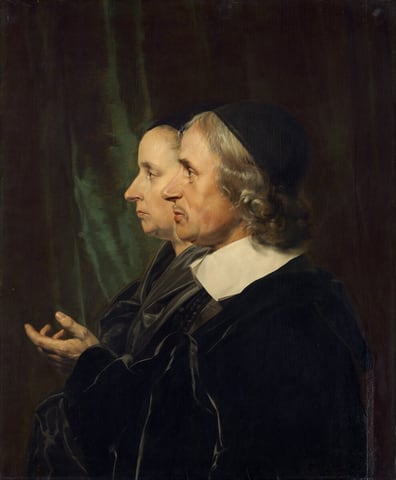
  1. Shown from the shoulders up, a man and woman face our left in profile against a shadowy, dark green curtain in this vertical portrait painting. They both look steadily to our left, they and have pale skin and wear black. The man is closer to us so he overlaps the woman, whose profile is shifted to our left. A black cap sits on the man's curly, silver, shoulder-length hair. He has a slight double chin and soft jowls. A thin mustache curves over his upper lip, and a line of hair runs down his chin as a narrow beard. A broad, flat, white collar lies across his shoulders over a velvety black coat. He lifts his left hand, closer to us, in front of his chest with the fingers curled gently inward. The woman also has a double chin and soft jowls. Her thin lips are closed and downturned. Her hair is pulled back under a black covering, and her black garment has a sheen, suggesting satin.
    Portrait of the Artist's Parents, Salomon de Bray and Anna WesterbaenJan de Bray, 1664Courtesy National Gallery of Art, Washington
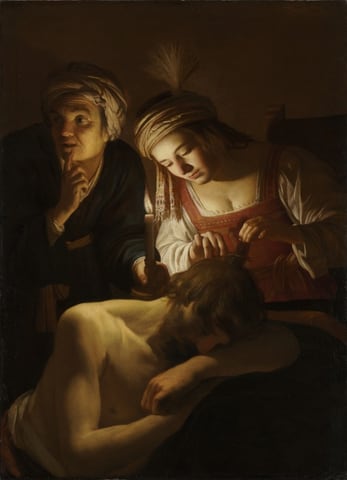
  2. Samson and Delilah, by Gerrit van Honthorst, c. 1616
    Samson and DelilahGerrit van Honthorst, c. 1616Courtesy of the Cleveland Museum of Art
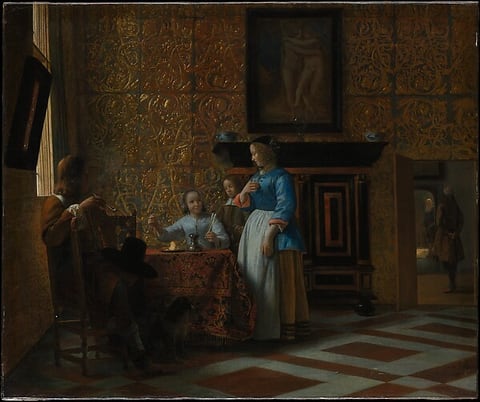
  3. Leisure Time in an Elegant Setting, by Pieter de Hooch, ca. 1663–65
    Leisure Time in an Elegant SettingPieter de Hooch, ca. 1663–65Courtesy of The Metropolitan Museum of Art

Third room, north wall
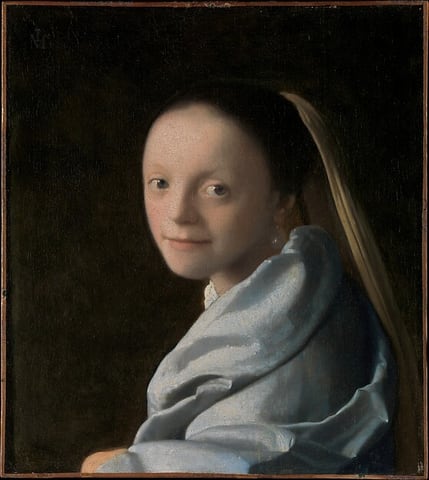
  1. Study of a Young Woman, by Johannes Vermeer, ca. 1665–67
    Study of a Young WomanJohannes Vermeer, ca. 1665–67Courtesy of The Metropolitan Museum of Art
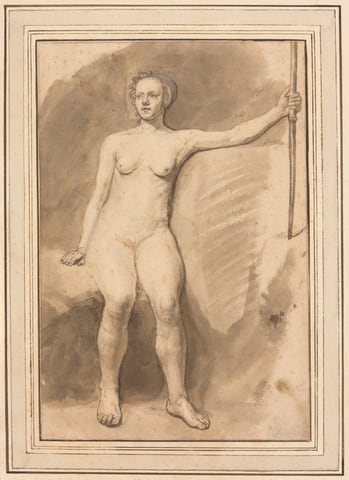
  2. A work made of pen and brown ink and brush and brown wash, with traces of black chalk and opaque white watercolor, on cream laid paper, laid down on cream laid paper.
    Seated Female NudeSamuel van Hoogstraten, 1647/78Courtesy of the Art Institute of Chicago
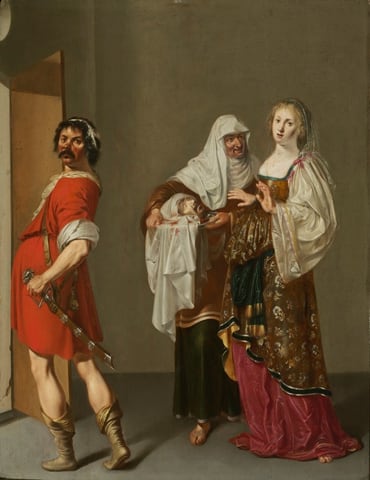
  3. Salome with the Head of Saint John the Baptist, by Jacob Duck, mid-1600s
    Salome with the Head of Saint John the BaptistJacob Duck, mid-1600sCourtesy of the Cleveland Museum of Art
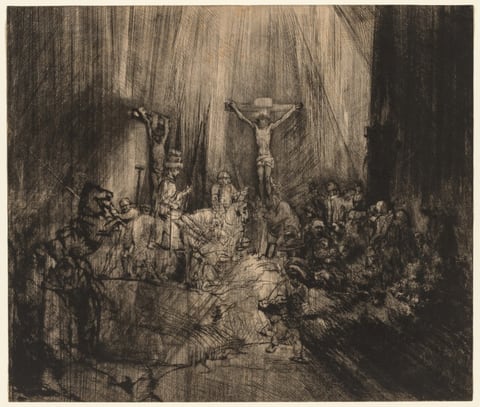
  4. Christ Crucified Between the Two Thieves: 'The Three Crosses', by Rembrandt van Rijn, 1653-c.1660
    Christ Crucified Between the Two Thieves: 'The Three Crosses'Rembrandt van Rijn, 1653-c.1660Courtesy of the Cleveland Museum of Art