Floor plan

Time and placeThe 16th century

The 16th century

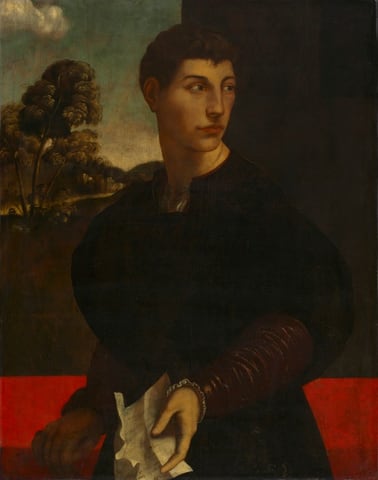
Portrait of a Young Man, by Dosso Dossi, c. 1530
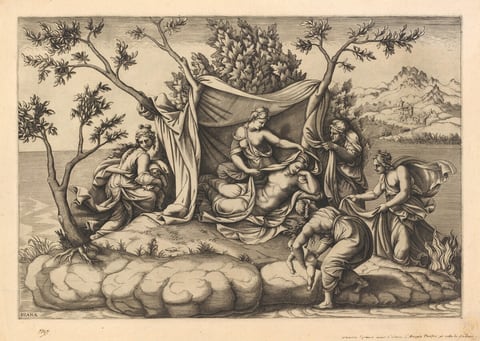
Latona Giving Birth to Apollo and Diana on the Island of Delos, by Diana Scultori, 1561-1565
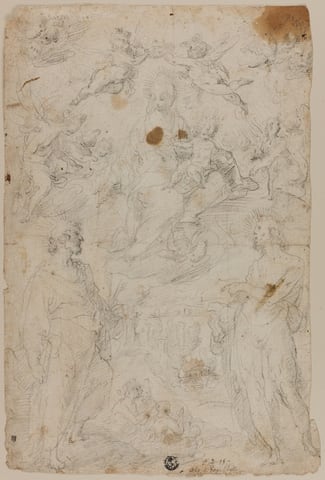
A work made of black chalk (recto), and black chalk and pen and black ink (verso), on ivory laid paper.
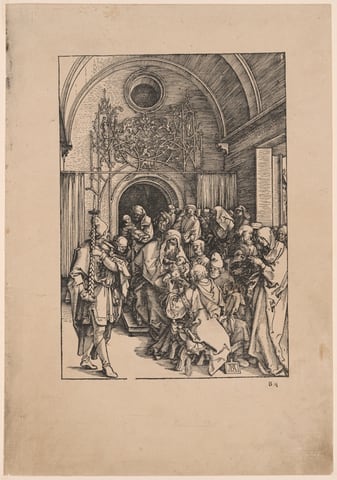
A work made of woodcut in black on tan laid paper.
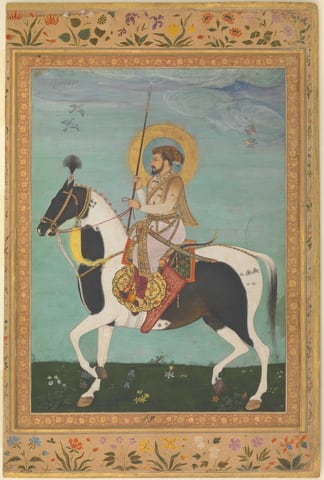
"Shah Jahan on Horseback", Folio from the Shah Jahan Album, by Payag, verso: ca. 1630; recto: ca. 1530–50
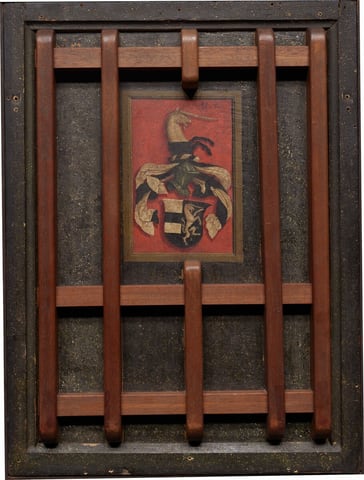
This is a painting depicting a heraldic coat of arms. The image features a detailed coat of arms with a central shield, adorned with black and gold sections, and additional decorative elements above it. There is a figure resembling a unicorn emerging from the crest. The background is a deep red hue. The artwork is displayed within a wooden frame with crossbars. This style is associated with displaying family crests and lineage.
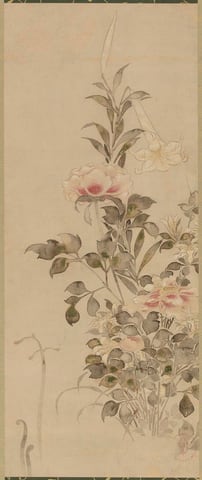
Hanging scroll
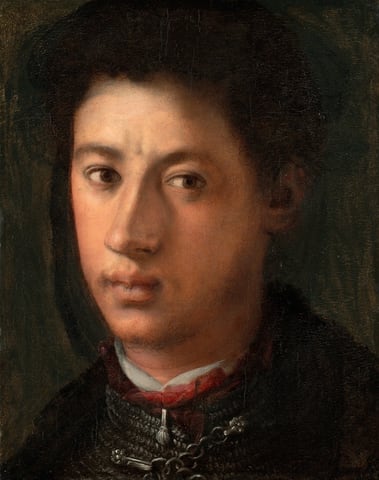
A work made of oil on panel.

The works in this room are listed below.

Works in this room

Works made in the 16th century, anywhere in the world.

First room, north wall

  1. Portrait of a Young Man, by Dosso Dossi, c. 1530
    Portrait of a Young ManDosso Dossi, c. 1530Courtesy of the Cleveland Museum of Art
  2. Latona Giving Birth to Apollo and Diana on the Island of Delos, by Diana Scultori, 1561-1565
    Latona Giving Birth to Apollo and Diana on the Island of DelosDiana Scultori, 1561-1565Courtesy National Gallery of Art, Washington
  3. A work made of black chalk (recto), and black chalk and pen and black ink (verso), on ivory laid paper.
    Virgin and Child with Saints Peter and John the Baptist (recto); Saint John the Baptist (verso)Pietro d' Asaro, n.d.Courtesy of the Art Institute of Chicago
  4. A work made of woodcut in black on tan laid paper.
    The Circumcision of Christ, from The Life of the VirginAlbrecht Dürer, c. 1505, published 1511Courtesy of the Art Institute of Chicago

First room, south wall

  1. "Shah Jahan on Horseback", Folio from the Shah Jahan Album, by Payag, verso: ca. 1630; recto: ca. 1530–50
    "Shah Jahan on Horseback", Folio from the Shah Jahan AlbumPayag, verso: ca. 1630; recto: ca. 1530–50Courtesy of The Metropolitan Museum of Art
  2. This is a painting depicting a heraldic coat of arms. The image features a detailed coat of arms with a central shield, adorned with black and gold sections, and additional decorative elements above it. There is a figure resembling a unicorn emerging from the crest. The background is a deep red hue. The artwork is displayed within a wooden frame with crossbars. This style is associated with displaying family crests and lineage.
    Hans Roth [reverse]Bernhard Strigel, 1527Courtesy National Gallery of Art, Washington
  3. Hanging scroll
    Peonies and lilies 芍薬と百合図Tawaraya Sotatsu, 1568-1615Courtesy of the National Museum of Asian Art, Smithsonian Institution
  4. A work made of oil on panel.
    Alessandro de' MediciPontormo, (Jacopo Carrucci), 1534–35Courtesy of the Art Institute of Chicago

Second room, south wall
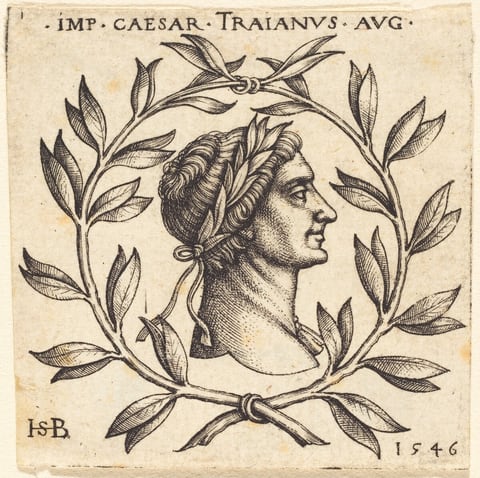
  1. The image shows a profile of a person's head and partial neck within a circular laurel wreath. The individual has distinct facial features, including a prominent nose and chin. The hairstyle is tight, wavy locks pulled back, and a laurel wreath crowns the head. The background is plain, with an inscription reading "IMP. CAESAR. TRAIANVS. AVG." Below the portrait are the initials "ISB" and the year "1546". The overall style resembles a classical engraving, featuring detailed line work and traditional iconography.
    TrajanSebald Beham, 1546Courtesy National Gallery of Art, Washington
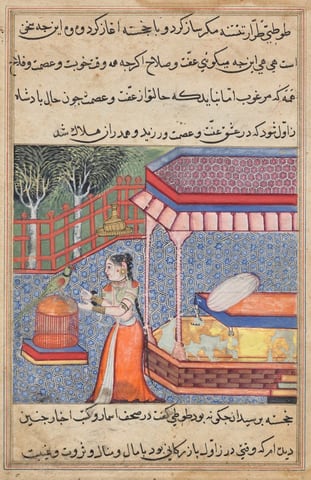
  2. The parrot addresses Khujasta at the beginning of the thirty-sixth night, from a Tuti-nama (Tales of a Parrot), c. 1560
    The parrot addresses Khujasta at the beginning of the thirty-sixth night, from a Tuti-nama (Tales of a Parrot)Unrecorded Indian maker, c. 1560Courtesy of the Cleveland Museum of Art
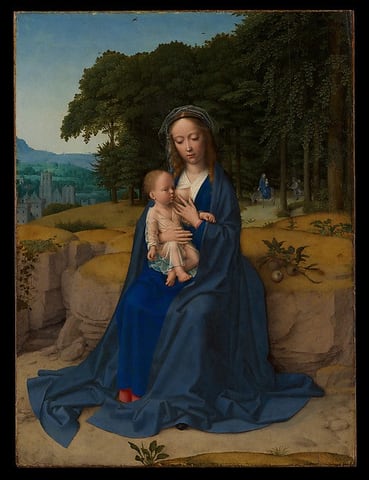
  3. The Rest on the Flight into Egypt, by Gerard David, ca. 1512–15
    The Rest on the Flight into EgyptGerard David, ca. 1512–15Courtesy of The Metropolitan Museum of Art
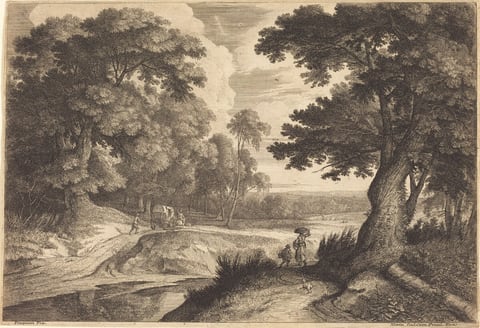
  4. The image shows an etching of a rural landscape with trees obscuring the horizon. In the distance, there is a cart on a winding path with a person walking beside it. Closer to the viewer, there is a person with a child under a tree, accompanied by a small dog. The artwork features fine and detailed brushwork with cross-hatching for texture and shadows. The color scheme is monochromatic in muted browns, emphasizing details and creating a peaceful scene under soft light filtered through the trees. The trees form a canopy framing the serene setting.
    Edge of a Wood with Peasants Going to MarketJean MorinCourtesy National Gallery of Art, Washington

Second room, north wall
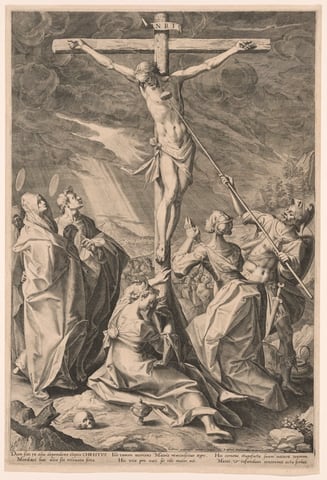
  1. A work made of engraving in black on cream laid paper.
    Christ on the CrossRaphael Sadeler, I, 1590Courtesy of the Art Institute of Chicago
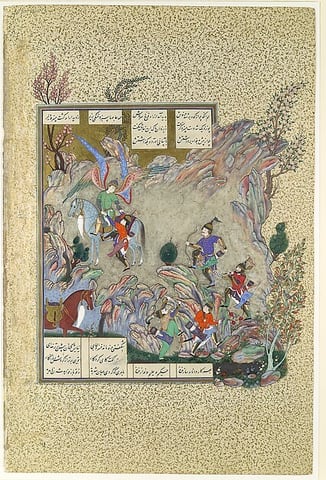
  2. "The Angel Surush Rescues Khusrau Parviz from a Cul-de-sac", Folio 708v from the Shahnama (Book of Kings) of Shah Tahmasp, by Abu'l Qasim Firdausi, ca. 1530–35
    "The Angel Surush Rescues Khusrau Parviz from a Cul-de-sac", Folio 708v from the Shahnama (Book of Kings) of Shah TahmaspAbu'l Qasim Firdausi, ca. 1530–35Courtesy of The Metropolitan Museum of Art
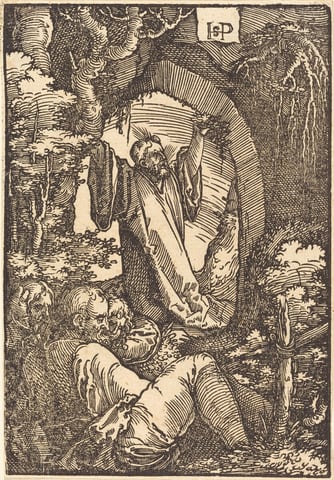
  3. The image shows a central person standing with both arms raised. They have a long beard, aged appearance, long hair, and wear a robe. Three other individuals are around them, reclining or lying on the ground. The setting is an outdoor scene with detailed trees and vegetation. There are initials "I.SP" in the top right corner.
    The Agony in the GardenSebald Beham, 1522Courtesy National Gallery of Art, Washington
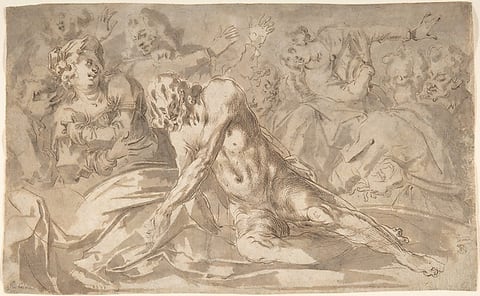
  4. The Raising of Lazarus, by Jacques Bellange, ca. 1606–8
    The Raising of LazarusJacques Bellange, ca. 1606–8Courtesy of The Metropolitan Museum of Art