Floor plan

Time and place16th-century Italy

16th-century Italy

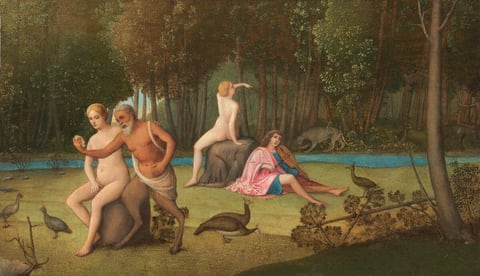
Two women, a man, and a satyr, a man with goat’s legs, are in two pairs in a forested landscape in this horizontal painting. The pale-skinned women are nude, and their blond hair is tied up and back. One woman sits on a brown boulder to the left of center. One hand covers her groin, and the other hand rests on the satyr’s shoulder. The satyr has deeply tanned skin, short white hair, and a long white beard. A white cloth wraps over one shoulder and across his hips. He holds up an object, perhaps a shell, with one hand. That arm crosses over the woman’s breasts. His other hand is by his lower belly, and he looks at the shell. A bit farther back and to our right, a second nude woman also sits on a boulder. She faces away from us and holds up a long stick with her left arm, which arcs over her body. A clean-shaven, pale-skinned man sits with his back against the boulder. He has long brown hair and looks off to the distance to our right. He wears a carnation-pink robe over a sapphire-blue tunic. His legs splay in front of him, his feet bare, as he holds a bow to a violin-like instrument tucked under his chin. The two pairs sit in a grassy glade occupied also by five pheasant- or peacock-like birds. A thin river running behind the glade is lined with spindly trees that together make an impenetrable bronze-brown and laurel-green canopy. The second woman’s stick points or is directed to a gray, mountain lion-like cat on the far bank. Closer inspection reveals deer and another person, who points, tucked among the trunks. A glimpse of blue sky is visible through a break in the tree trunks.
Death of the Virgin, mid-1500s
Mars and Venus United by Love, by Paolo Veronese (Paolo Caliari), 1570s
Farmhouse on the Slope of a Hill, by Fra Bartolommeo, c. 1508
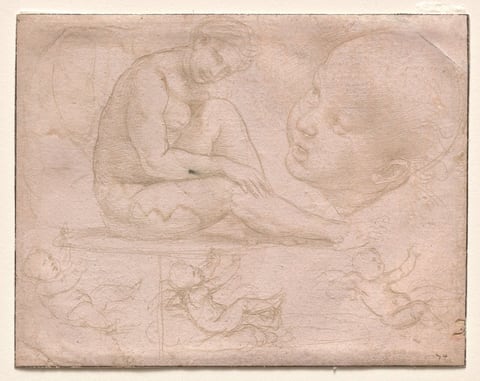
Studies of a Seated Female, Child's Head, and Three Studies of a Baby, by Raphael, c. 1507–8
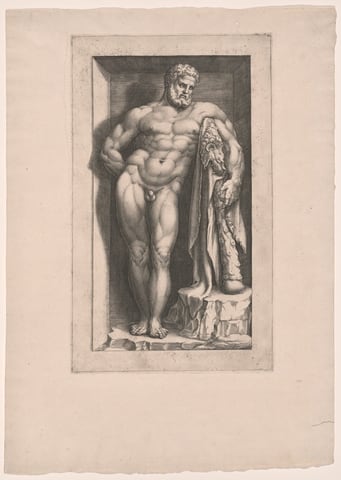
A work made of engraving in black on cream laid paper.
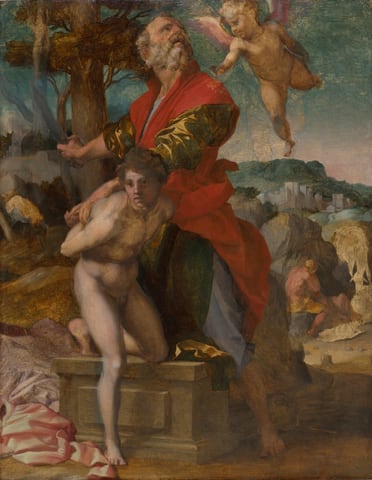
The Sacrifice of Isaac, by Andrea del Sarto, c. 1527

The works in this room are listed below.

Works in this room

Works made in Italy in the 16th century.

First room, north wall

  1. Two women, a man, and a satyr, a man with goat’s legs, are in two pairs in a forested landscape in this horizontal painting. The pale-skinned women are nude, and their blond hair is tied up and back. One woman sits on a brown boulder to the left of center. One hand covers her groin, and the other hand rests on the satyr’s shoulder. The satyr has deeply tanned skin, short white hair, and a long white beard. A white cloth wraps over one shoulder and across his hips. He holds up an object, perhaps a shell, with one hand. That arm crosses over the woman’s breasts. His other hand is by his lower belly, and he looks at the shell. A bit farther back and to our right, a second nude woman also sits on a boulder. She faces away from us and holds up a long stick with her left arm, which arcs over her body. A clean-shaven, pale-skinned man sits with his back against the boulder. He has long brown hair and looks off to the distance to our right. He wears a carnation-pink robe over a sapphire-blue tunic. His legs splay in front of him, his feet bare, as he holds a bow to a violin-like instrument tucked under his chin. The two pairs sit in a grassy glade occupied also by five pheasant- or peacock-like birds. A thin river running behind the glade is lined with spindly trees that together make an impenetrable bronze-brown and laurel-green canopy. The second woman’s stick points or is directed to a gray, mountain lion-like cat on the far bank. Closer inspection reveals deer and another person, who points, tucked among the trunks. A glimpse of blue sky is visible through a break in the tree trunks.
    OrpheusUnrecorded Italian maker, c. 1515Courtesy National Gallery of Art, Washington
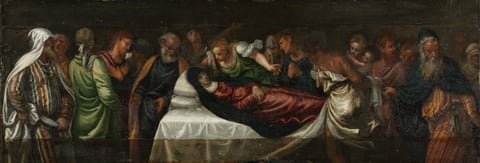
  2. Death of the Virgin, mid-1500s
    Death of the VirginUnrecorded Italian maker, mid-1500sCourtesy of the Cleveland Museum of Art
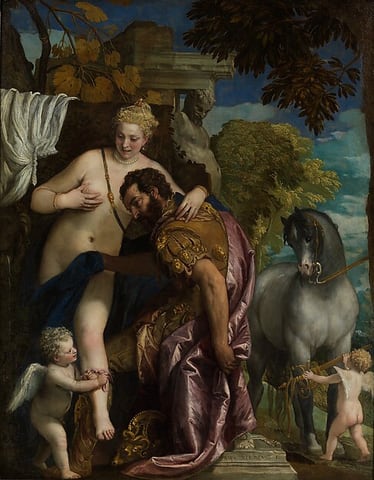
  3. Mars and Venus United by Love, by Paolo Veronese (Paolo Caliari), 1570s
    Mars and Venus United by LovePaolo Veronese (Paolo Caliari), 1570sCourtesy of The Metropolitan Museum of Art

First room, south wall

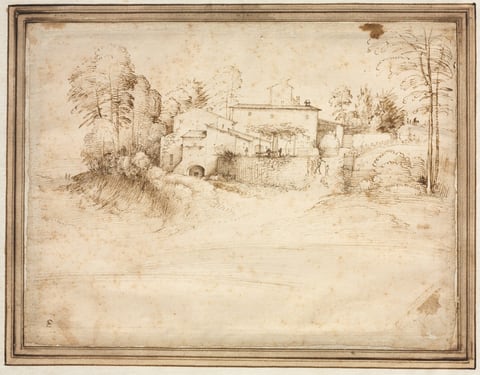
  1. Farmhouse on the Slope of a Hill, by Fra Bartolommeo, c. 1508
    Farmhouse on the Slope of a HillFra Bartolommeo, c. 1508Courtesy of the Cleveland Museum of Art
  2. Studies of a Seated Female, Child's Head, and Three Studies of a Baby, by Raphael, c. 1507–8
    Studies of a Seated Female, Child's Head, and Three Studies of a BabyRaphael, c. 1507–8Courtesy of the Cleveland Museum of Art
  3. A work made of engraving in black on cream laid paper.
    The Farnese HerculesGiorgio Ghisi, c. 1577Courtesy of the Art Institute of Chicago
  4. The Sacrifice of Isaac, by Andrea del Sarto, c. 1527
    The Sacrifice of IsaacAndrea del Sarto, c. 1527Courtesy of the Cleveland Museum of Art

Second room, south wall
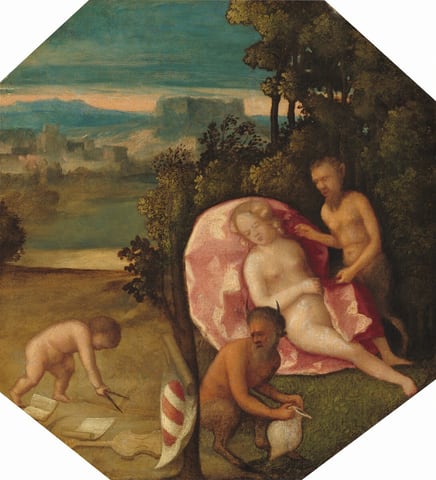
  1. A nude woman, pudgy child, and two satyrs, which have men’s heads and torsos with goat’s legs and horns, are in a landscape in this octagonal painting. The scene is divided in half by a tree stump which only reaches to the center of the composition. To the left of the stump, the pale-skinned, nude child stands and hunches over to draw on the ground with a V-shaped compass. Two pieces of paper and a violin lie nearby. The landscape behind him has a body of water leading back to a town with buildings streaked with peach, perhaps flames. A band of peach sky separates the blue silhouettes of mountains lining the horizon from the vivid blue sky above. At the bottom center of the painting, a shield with an oval horizontally striped with red and white leans on the boy’s side of the tree, which has one leafy branch growing on the left side. One satyr holds a jug and kneels close to the tree with his back to it as he looks back over one shoulder. He and the other satyr both have dark, peach-toned skin and full beards. The second satyr hovers to the right of the nude, sleeping woman, both hands reaching for her or the rose-pink cloth surrounding her. The woman has blond curls, a round face, and she sleeps with one hand resting across her belly and her head tipped to our left. The trio are on a grassy area enclosed by dense, dark-green bushes and trees.
    AllegoryPietro degli Ingannati, c. 1515-1525Courtesy National Gallery of Art, Washington
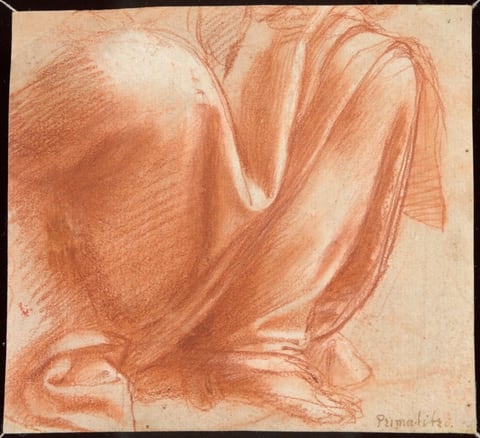
  2. A work made of red chalk and brush and red chalk wash (recto) and black chalk, with black chalk grid lines, (verso) on cream laid paper.
    A Drapery Study for the Knees of a Seated Allegorical Figure of Charity (recto); Bust of a Naked Allegorical Figure of Charity with Two Putti (verso)Giovanni Antonio di Francesco Sogliani, 1520/30Courtesy of the Art Institute of Chicago
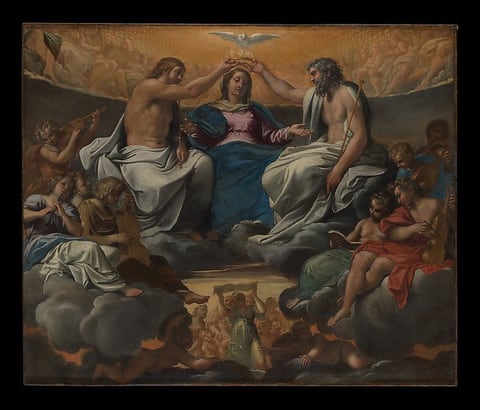
  3. The Coronation of the Virgin, by Annibale Carracci, after 1595
    The Coronation of the VirginAnnibale Carracci, after 1595Courtesy of The Metropolitan Museum of Art
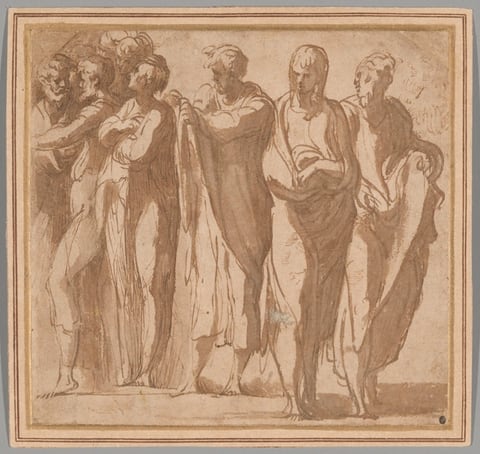
  4. A work made of pen and brown ink and brush and brown wash, on tan laid paper, laid down on tan laid card.
    Group of Nine Standing FiguresParmigianino, 1524/27Courtesy of the Art Institute of Chicago

Second room, north wall
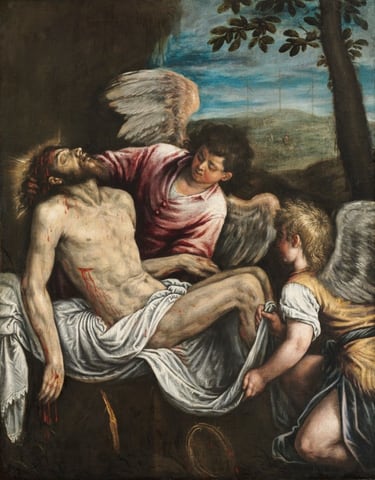
  1. The Dead Christ with Angels, by Leandro Bassano, c. 1580
    The Dead Christ with AngelsLeandro Bassano, c. 1580Courtesy of the Cleveland Museum of Art
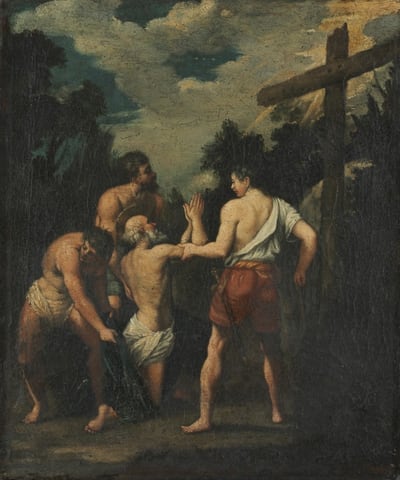
  2. Martyrdom of Saint Andrew, by Guido Reni, 1600s
    Martyrdom of Saint AndrewGuido Reni, 1600sCourtesy of the Cleveland Museum of Art
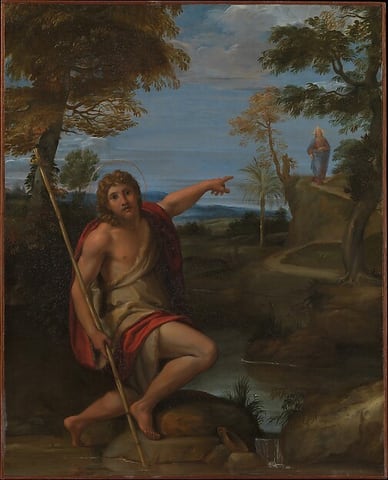
  3. Saint John the Baptist Bearing Witness, by Annibale Carracci, ca. 1600
    Saint John the Baptist Bearing WitnessAnnibale Carracci, ca. 1600Courtesy of The Metropolitan Museum of Art

Third room, north wall
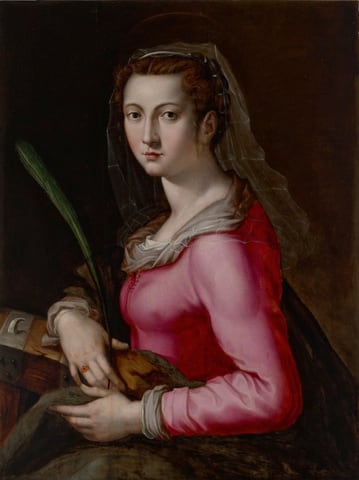
  1. Portrait of a Woman as Saint Catherine, by Pier Francesco Foschi, c. 1560
    Portrait of a Woman as Saint CatherinePier Francesco Foschi, c. 1560Courtesy of the Cleveland Museum of Art
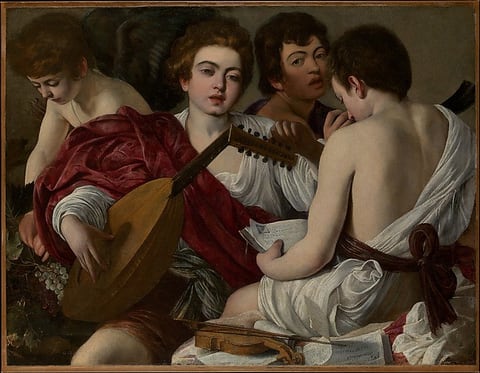
  2. The Musicians, by Caravaggio, 1597
    The MusiciansCaravaggio, 1597Courtesy of The Metropolitan Museum of Art