Floor plan

Time and placeThe 15th century

The 15th century

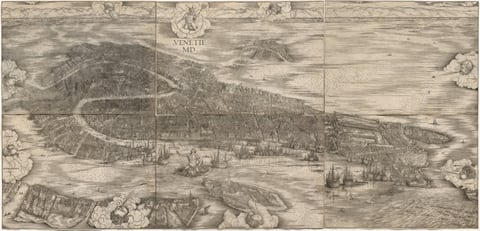
View of Venice, by Jacopo de' Barbari, 1500
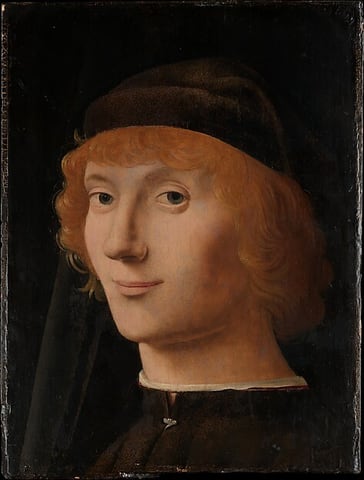
Portrait of a Young Man, by Antonello da Messina (Antonello di Giovanni d'Antonio), ca. 1470
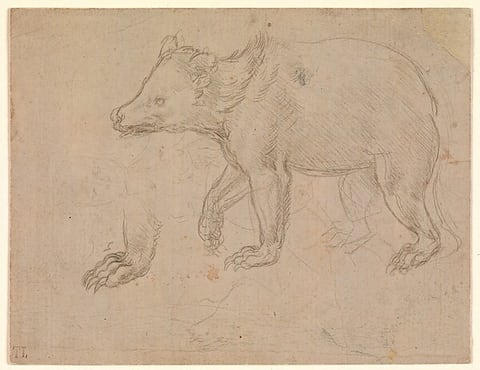
A Bear Walking, by Leonardo da Vinci, ca. 1482–85
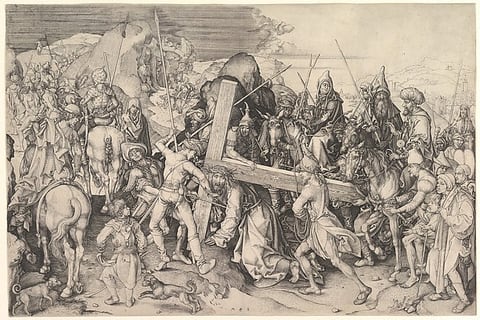
Christ Carrying the Cross, by Martin Schongauer, ca. 1475–80
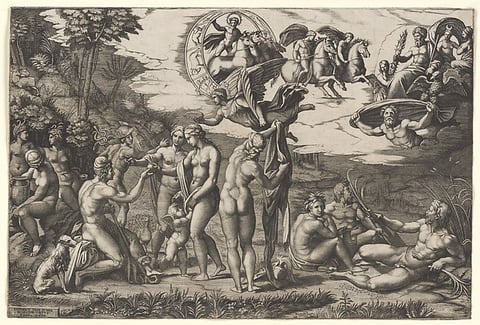
The Judgment of Paris: he is sitting at left with Venus, Juno and Pallas Athena, a winged victory above. In the upper section the Sun in his chariot preceeded by Castor and Pollux on horseback, at lower right two river gods and a naiad above whom Jupiter, an eagle, Ganymede, Diana and another goddess, by Marcantonio Raimondi, ca. 1510–20
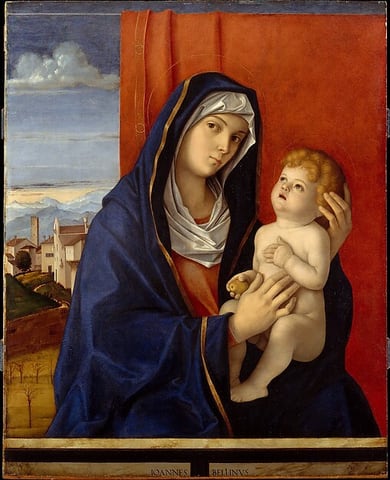
Madonna and Child, by Giovanni Bellini, late 1480s

The works in this room are listed below.

Works in this room

Works made in the 15th century, anywhere in the world.

First room, north wall

  1. View of Venice, by Jacopo de' Barbari, 1500
    View of VeniceJacopo de' Barbari, 1500Courtesy of the Cleveland Museum of Art
  2. Portrait of a Young Man, by Antonello da Messina (Antonello di Giovanni d'Antonio), ca. 1470
    Portrait of a Young ManAntonello da Messina (Antonello di Giovanni d'Antonio), ca. 1470Courtesy of The Metropolitan Museum of Art
  3. A Bear Walking, by Leonardo da Vinci, ca. 1482–85
    A Bear WalkingLeonardo da Vinci, ca. 1482–85Courtesy of The Metropolitan Museum of Art

First room, south wall

  1. Christ Carrying the Cross, by Martin Schongauer, ca. 1475–80
    Christ Carrying the CrossMartin Schongauer, ca. 1475–80Courtesy of The Metropolitan Museum of Art
  2. The Judgment of Paris: he is sitting at left with Venus, Juno and Pallas Athena, a winged victory above. In the upper section the Sun in his chariot preceeded by Castor and Pollux on horseback, at lower right two river gods and a naiad above whom Jupiter, an eagle, Ganymede, Diana and another goddess, by Marcantonio Raimondi, ca. 1510–20
    The Judgment of Paris: he is sitting at left with Venus, Juno and Pallas Athena, a winged victory above. In the upper section the Sun in his chariot preceeded by Castor and Pollux on horseback, at lower right two river gods and a naiad above whom Jupiter, an eagle, Ganymede, Diana and another goddessMarcantonio Raimondi, ca. 1510–20Courtesy of The Metropolitan Museum of Art
  3. Madonna and Child, by Giovanni Bellini, late 1480s
    Madonna and ChildGiovanni Bellini, late 1480sCourtesy of The Metropolitan Museum of Art

Second room, south wall
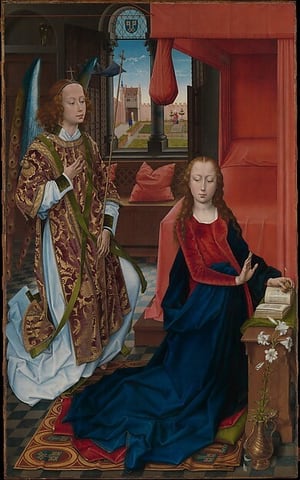
  1. The Annunciation, by Hans Memling, ca. 1465–70
    The AnnunciationHans Memling, ca. 1465–70Courtesy of The Metropolitan Museum of Art
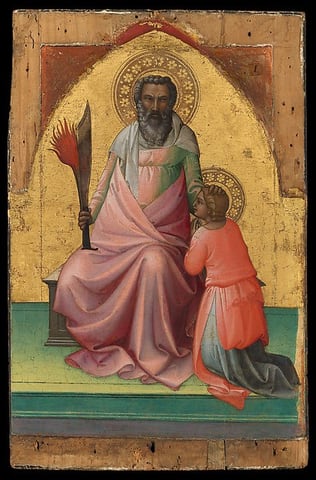
  2. Abraham, by Lorenzo Monaco, ca. 1408–10
    AbrahamLorenzo Monaco, ca. 1408–10Courtesy of The Metropolitan Museum of Art
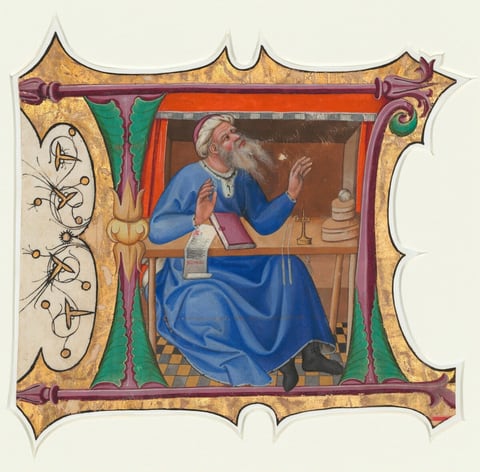
  3. The image shows an elderly man seated at a table. He is turned slightly to the side, with his right hand raised as if in conversation. The man has a long, white beard and fair complexion, wearing a blue robe with white trim. He wears a white cap and holds a pink book in his left hand. A scroll of paper hangs off the table, which also holds a globe, balance scale, and round objects. The background has a wooden panel, and the scene is framed by an ornate border with gold, green, and purple colors, typical of medieval manuscripts.
    Initial L with Old Testament ProphetMaster of the Cypresses, 1430sCourtesy National Gallery of Art, Washington
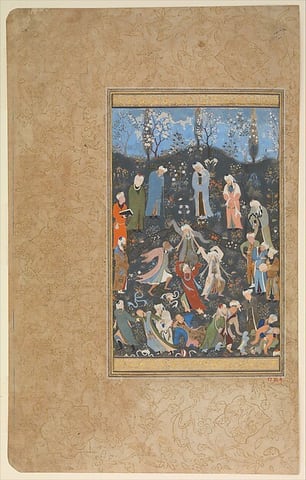
  4. "Dancing Dervishes", Folio from a Divan of Hafiz, by Hafiz, ca. 1480
    "Dancing Dervishes", Folio from a Divan of HafizHafiz, ca. 1480Courtesy of The Metropolitan Museum of Art

Second room, north wall
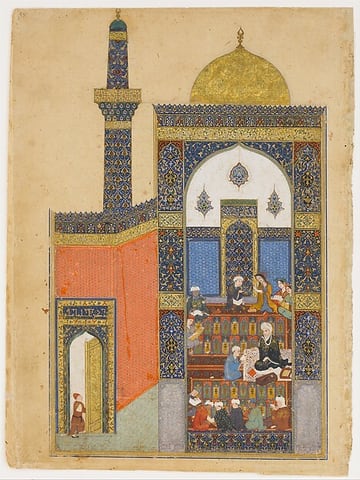
  1. "Laila and Majnun at School", Folio from a Khamsa (Quintet) of Nizami of Ganja, by Ja'far Baisunghuri, 835 AH/1431–32 CE
    "Laila and Majnun at School", Folio from a Khamsa (Quintet) of Nizami of GanjaJa'far Baisunghuri, 835 AH/1431–32 CECourtesy of The Metropolitan Museum of Art
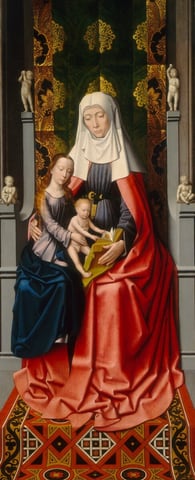
  2. Two women and a baby, all with pale skin, sit together on a gray, stone throne with patterned fabric hanging behind them and a patterned rug below in this narrow, vertical painting. The woman sitting on the throne, Saint Anne, is the largest. A second woman, Mary, is smaller in scale, and she sits on Saint Anne’s lap. Mary, in turn, holds a nude baby boy on her lap. Both women have light brown eyes under faint, arched brows, smooth skin, long straight noses, and their shell-pink lips are closed. Saint Anne sits with her body facing us and she looks down with her head slightly tilted to our left. Her white head covering drapes over her shoulders and hangs down from her chin to cover her neck. She wears a marine-blue dress cinched at her waist with a black and gold belt, and a crimson-red robe that falls to and puddles around her feet. Her right arm, on our left, wraps around and holds Mary’s hip, and she supports a book with gold-edged pages with her other hand. Mary sits on Saint Anne’s right thigh, to our left, and leans toward the baby, who sits on her left knee, to our right. Her long, wavy, brown hair falls over her shoulders, and she wears a cobalt-blue robe over a lilac-purple dress. The baby has short, curly blond hair and reaches to turn the pages of the book. He has rounded cheeks and a pudgy torso. The stone throne is ornamented on the arms and at the top corners with ivory-white, nude children that are presumably also carved out of stone. The cloth hanging behind Saint Anne is decorated with glimmering gold, ornamental leaf designs against a pine-green background. The rug beneath her feet is a geometric pattern of red, tan, black, and white.
    The Saint Anne Altarpiece: Saint Anne with the Virgin and Child [middle panel]Gerard David, c. 1500/1520Courtesy National Gallery of Art, Washington
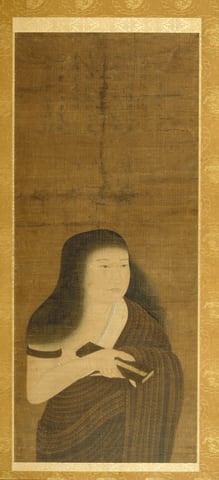
  3. A work made of hanging scroll; ink and color on paper.
    Monju Dressed in a Robe of Braided Grass (Nawa Monju)Japanese, dated 1415Courtesy of the Art Institute of Chicago
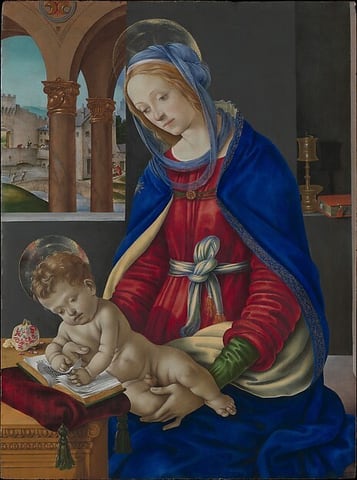
  4. Madonna and Child, by Filippino Lippi, ca. 1483–84
    Madonna and ChildFilippino Lippi, ca. 1483–84Courtesy of The Metropolitan Museum of Art

Third room, north wall
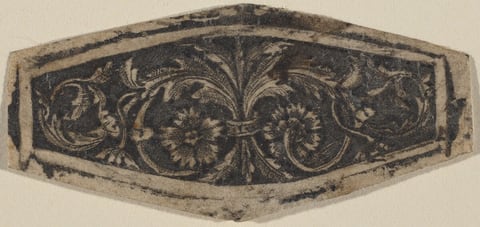
  1. This is a drawing of an ornamental floral design. The image shows a central floral motif resembling a flower with radiating petals, surrounded by swirling leaf patterns. The background is dark, contrasting with the lighter line work of the floral design. The drawing's borders are uneven and have an antique appearance.
    Ornament in Hexagonal ShapeUnrecorded Italian maker, c. 1480/1510Courtesy National Gallery of Art, Washington
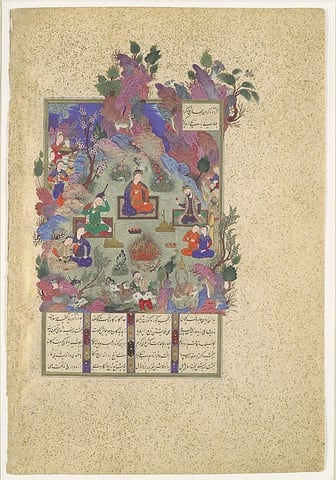
  2. "The Feast of Sada", Folio 22v from the Shahnama (Book of Kings) of Shah Tahmasp, by Abu'l Qasim Firdausi, ca. 1525
    "The Feast of Sada", Folio 22v from the Shahnama (Book of Kings) of Shah TahmaspAbu'l Qasim Firdausi, ca. 1525Courtesy of The Metropolitan Museum of Art