Floor plan

Time and placeThe 15th century

The 15th century

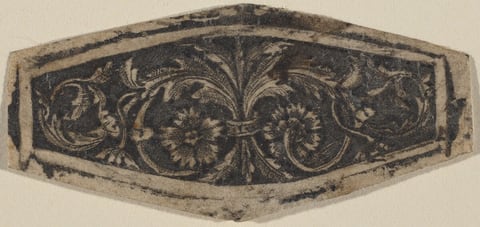
This is a drawing of an ornamental floral design. The image shows a central floral motif resembling a flower with radiating petals, surrounded by swirling leaf patterns. The background is dark, contrasting with the lighter line work of the floral design. The drawing's borders are uneven and have an antique appearance.
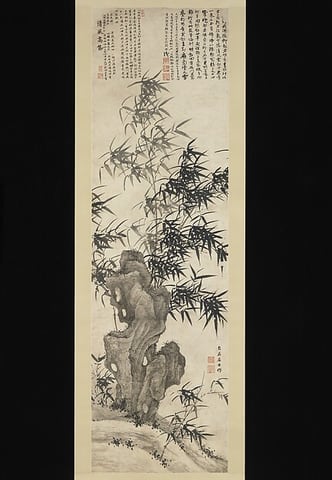
Windblown bamboo, by Xia Chang, ca. 1460
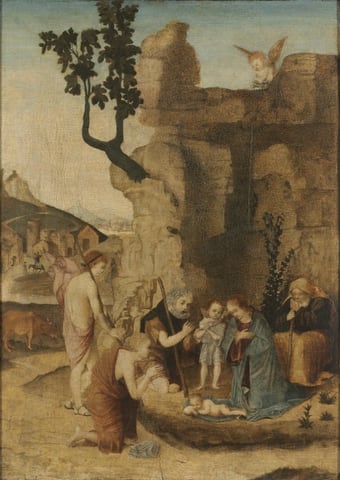
Adoration of the Shepherds, c. 1500
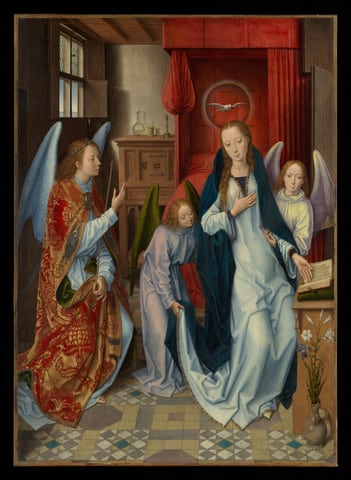
The Annunciation, by Hans Memling, 1480–89
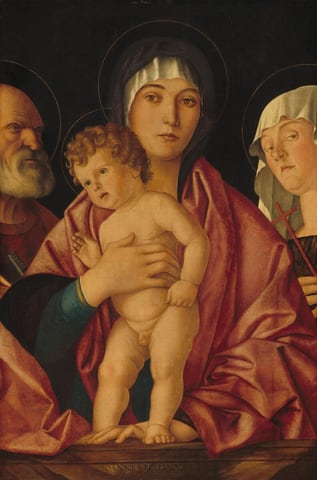
The painting depicts three adults and a child. The central adult, a woman, holds the child securely to her chest. The woman has pale skin and a white cloth covering her head, and she is wearing a dark cloak over a red robe. The child has curly light brown hair and is unclothed, looking towards the left. A bald man with a white beard, wearing a red garment and holding a key is on the left. On the right, another woman wears a white headscarf and a dark garment, holding a red cross. The background is dark, highlighting the people and their attire. All four of them have thin halos around their heads.
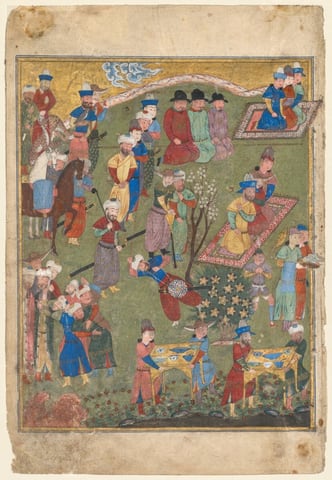
Royal Reception in a Landscape, left folio from the double frontispiece of a Shahnama (Book of Kings) of Firdausi (Persian, about 940–1019 or 1025), 1444
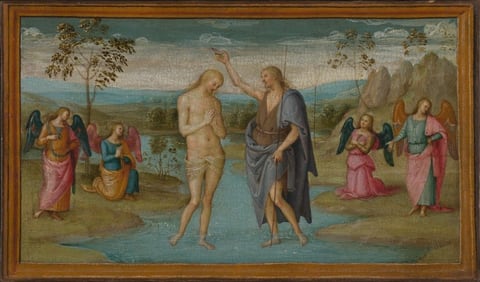
A work made of tempera on panel, transferred to canvas.
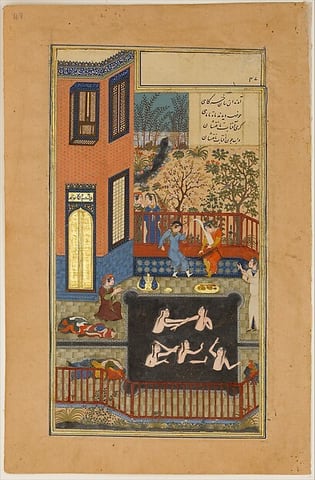
"The Eavesdropper", Folio 47r from a Haft Paikar (Seven Portraits) of the Khamsa (Quintet) of Nizami of Ganja, by Maulana Azhar, ca. 1430

The works in this room are listed below.

Works in this room

Works made in the 15th century, anywhere in the world.

First room, north wall

  1. This is a drawing of an ornamental floral design. The image shows a central floral motif resembling a flower with radiating petals, surrounded by swirling leaf patterns. The background is dark, contrasting with the lighter line work of the floral design. The drawing's borders are uneven and have an antique appearance.
    Ornament in Hexagonal ShapeUnrecorded Italian maker, c. 1480/1510Courtesy National Gallery of Art, Washington
  2. Windblown bamboo, by Xia Chang, ca. 1460
    Windblown bambooXia Chang, ca. 1460Courtesy of The Metropolitan Museum of Art
  3. Adoration of the Shepherds, c. 1500
    Adoration of the ShepherdsUnrecorded Italian maker, c. 1500Courtesy of the Cleveland Museum of Art
  4. The Annunciation, by Hans Memling, 1480–89
    The AnnunciationHans Memling, 1480–89Courtesy of The Metropolitan Museum of Art

First room, south wall

  1. The painting depicts three adults and a child. The central adult, a woman, holds the child securely to her chest. The woman has pale skin and a white cloth covering her head, and she is wearing a dark cloak over a red robe. The child has curly light brown hair and is unclothed, looking towards the left. A bald man with a white beard, wearing a red garment and holding a key is on the left. On the right, another woman wears a white headscarf and a dark garment, holding a red cross. The background is dark, highlighting the people and their attire. All four of them have thin halos around their heads.
    Madonna and Child with SaintsUnrecorded maker, c. 1490/1500Courtesy National Gallery of Art, Washington
  2. Royal Reception in a Landscape, left folio from the double frontispiece of a Shahnama (Book of Kings) of Firdausi (Persian, about 940–1019 or 1025), 1444
    Royal Reception in a Landscape, left folio from the double frontispiece of a Shahnama (Book of Kings) of Firdausi (Persian, about 940–1019 or 1025)Unrecorded Persian maker, 1444Courtesy of the Cleveland Museum of Art
  3. A work made of tempera on panel, transferred to canvas.
    The Baptism of ChristPerugino, 1500–05Courtesy of the Art Institute of Chicago
  4. "The Eavesdropper", Folio 47r from a Haft Paikar (Seven Portraits) of the Khamsa (Quintet) of Nizami of Ganja, by Maulana Azhar, ca. 1430
    "The Eavesdropper", Folio 47r from a Haft Paikar (Seven Portraits) of the Khamsa (Quintet) of Nizami of GanjaMaulana Azhar, ca. 1430Courtesy of The Metropolitan Museum of Art

Second room, south wall
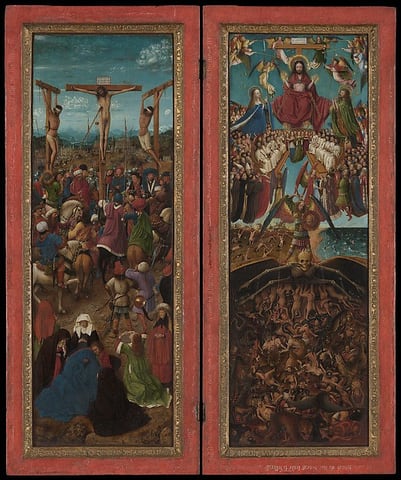
  1. The Crucifixion; The Last Judgment, by Jan van Eyck, ca. 1436–38
    The Crucifixion; The Last JudgmentJan van Eyck, ca. 1436–38Courtesy of The Metropolitan Museum of Art
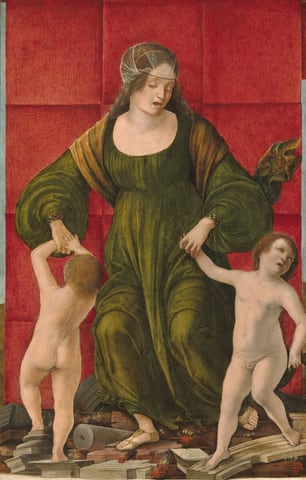
  2. A woman holds the hands of two nude children in front of a crimson-red cloth in this vertical painting. All three have pale skin and brown hair. The woman wears a forest-green dress with voluminous sleeves and a gauzy white headdress that wraps around her hair and is fastened with a band across her forehead. She stands crouching with one foot extended slightly forward in a sandal, surrounded by broken chunks of masonry and bits of burning logs. Her body faces us but she turns her head to the right. Her mouth is wide open, and her eyes cut back to our left. The woman clutches the children’s hands in both of her own. The child to our left turns away from us and reaches one hand up to touch the back of the woman’s hand. The child on the right twists away from the woman, eyes squinted up and to the right and mouth open. Behind them, fold lines create a grid across the red cloth. Slivers of grass and blue sky line each side of the composition.
    The Wife of Hasdrubal and Her ChildrenErcole de' Roberti, c. 1490/1493Courtesy National Gallery of Art, Washington
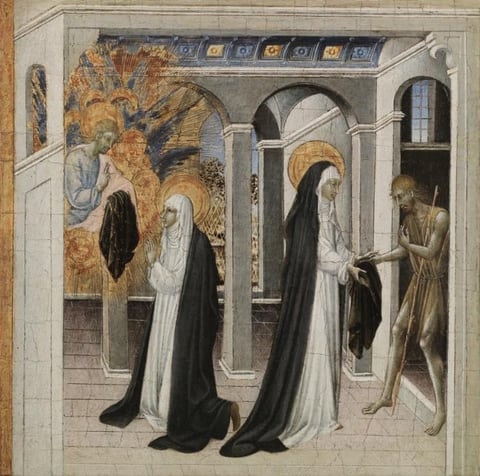
  3. St. Catherine of Siena and the Beggar, by Giovanni di Paolo, 1460s
    St. Catherine of Siena and the BeggarGiovanni di Paolo, 1460sCourtesy of the Cleveland Museum of Art
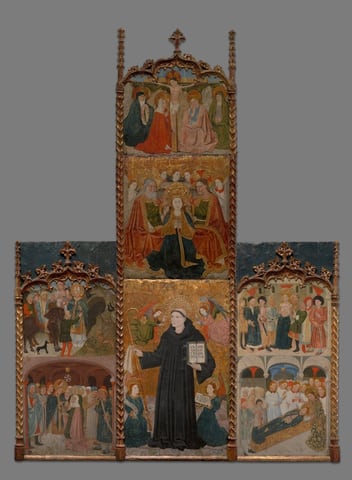
  4. A work made of tempera on panel.
    Retable of Saints Athanasius, Blaise, and AgathaMaster of Riglos, c. 1440–c. 1445Courtesy of the Art Institute of Chicago

Second room, north wall
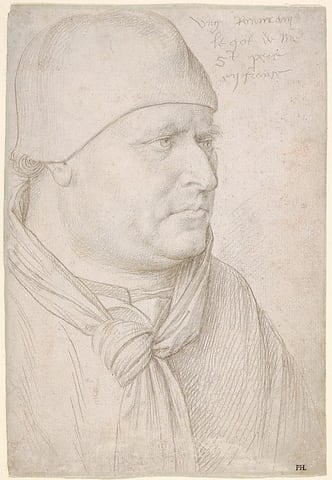
  1. Portrait of Alain de Coëtivy (1407–1474), by Jean Fouquet, ca. 1451–55
    Portrait of Alain de Coëtivy (1407–1474)Jean Fouquet, ca. 1451–55Courtesy of The Metropolitan Museum of Art
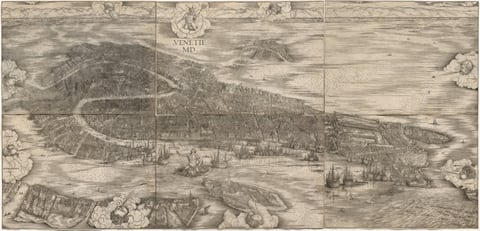
  2. View of Venice, by Jacopo de' Barbari, 1500
    View of VeniceJacopo de' Barbari, 1500Courtesy of the Cleveland Museum of Art

Third room, north wall
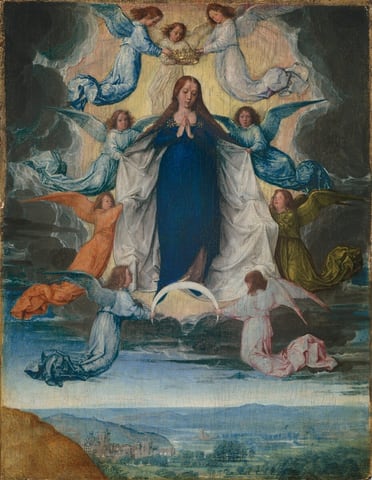
  1. A woman wearing a long, royal-blue dress is surrounded by nine winged angels as she floats on a thin, bright white, downward-pointing crescent moon above a deep landscape with a town tucked into rolling hills in this vertical painting. The woman, Mary, and all the angels have pale, peachy skin and long, brown hair. Mary and the angels float against a pale yellow and pale peach field of light enclosed within a mass of steel-gray clouds. She presses her fingertips together in front of her chest and gazes down and to our right, her dark eyes almost closed. She has a delicate, straight nose, and her small mouth is closed. Her brown hair parts in the middle and flows down over her shoulders. The angels wear flowing gowns in sky or topaz blue, olive green, tangerine orange, white, or light pink, each with matching wings. Three angels place a gold crown on Mary's head. Four others hold up the edges of a silvery white cape, which is fastened across her shoulders with brooches of white pearls surrounding ruby-red stones. The final two angels hold up the downward-facing points of the crescent moon beneath her. In the landscape below, groupings of trees are dotted among the rolling hills, with a village in the distance to our left. The blue, hazy horizon comes about a sixth of the way up the composition. A brown boulder sits in the bottom left corner, closer to us. The paint is visibly cracked throughout.
    The Assumption of the VirginMichel Sittow, c. 1500Courtesy National Gallery of Art, Washington
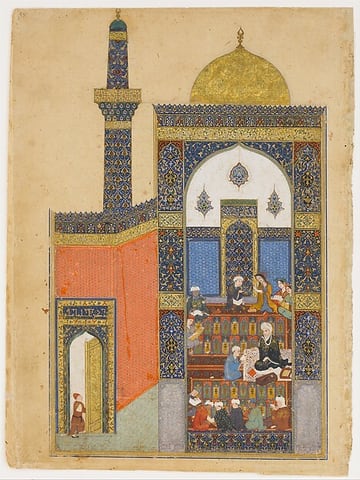
  2. "Laila and Majnun at School", Folio from a Khamsa (Quintet) of Nizami of Ganja, by Ja'far Baisunghuri, 835 AH/1431–32 CE
    "Laila and Majnun at School", Folio from a Khamsa (Quintet) of Nizami of GanjaJa'far Baisunghuri, 835 AH/1431–32 CECourtesy of The Metropolitan Museum of Art