Floor plan

Time and placeThe 15th century

The 15th century

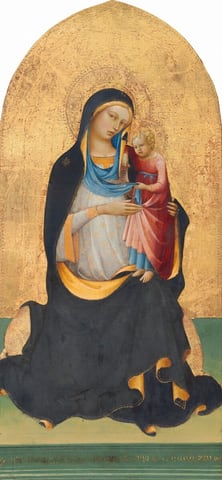
A woman sits and supports a baby standing on her lap, both against a gold background in this arched, vertical painting. The woman and baby’s light skin is shaded with faint green, and they have pale pink cheeks. The woman’s body faces us. She tips her head toward the baby who stands on her knee, to our right. The woman looks at us with light brown eyes under curving brows. She has a long, straight nose, and her small pink lips are closed. Her blond hair is mostly covered by a midnight-blue robe that drapes over her shoulders, across her lap, and pools on the floor. The robe is lined with goldenrod yellow, edged with bright gold, and has gold starburst-like designs on the shoulder we can see and top of the head. The dress she wears underneath has more gold stars creating a pattern across the pearl-white fabric. A sky-blue scarf wraps over her head and loops across her shoulders. The baby holds one end of the scarf, and his other elbow rests on the woman’s shoulder. She props him up with both hands. He has a cap of blond curls and chubby cheeks with delicate features. His geranium-red garment falls over a pale blue skirt that reaches his bare feet. In the hand near the woman’s shoulder, he holds a scroll with the letters “EGO S.” The floor beneath them is mint green and has gold writing across the front, reading, “AVE.G ANN O.D M.CCCC.XIII.” The woman and baby’s disc-like gold halos blend into the gold background, which is visibly cracked in some areas. The panel comes to a pointed arch at the top.
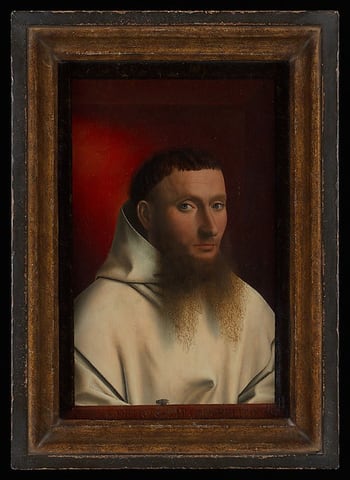
Portrait of a Carthusian, by Petrus Christus, 1446
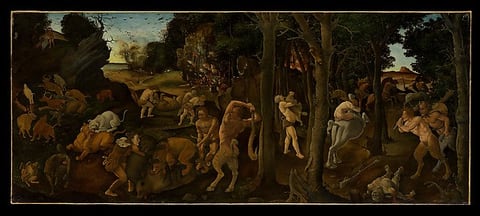
A Hunting Scene, by Piero di Cosimo (Piero di Lorenzo di Piero d'Antonio), ca. 1494–1500
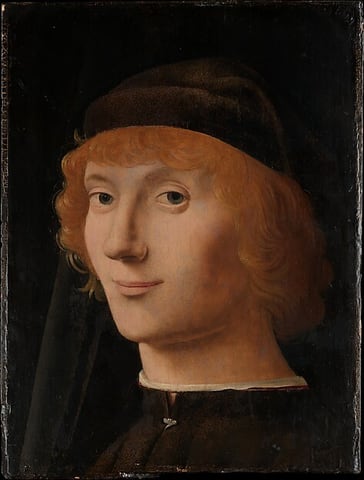
Portrait of a Young Man, by Antonello da Messina (Antonello di Giovanni d'Antonio), ca. 1470
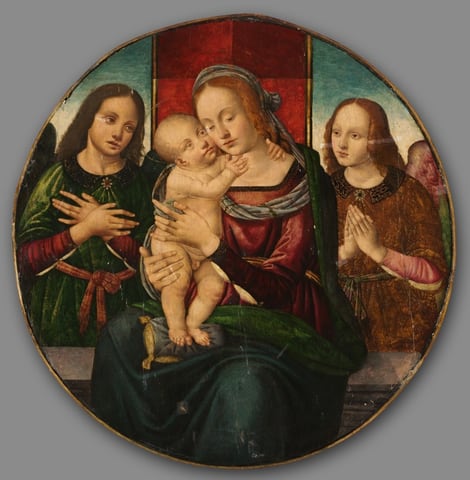
Virgin and Child with Angels, by Master of the Holden Tondo, early 1500s
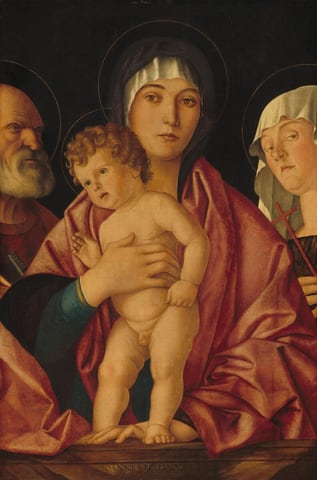
The painting depicts three adults and a child. The central adult, a woman, holds the child securely to her chest. The woman has pale skin and a white cloth covering her head, and she is wearing a dark cloak over a red robe. The child has curly light brown hair and is unclothed, looking towards the left. A bald man with a white beard, wearing a red garment and holding a key is on the left. On the right, another woman wears a white headscarf and a dark garment, holding a red cross. The background is dark, highlighting the people and their attire. All four of them have thin halos around their heads.
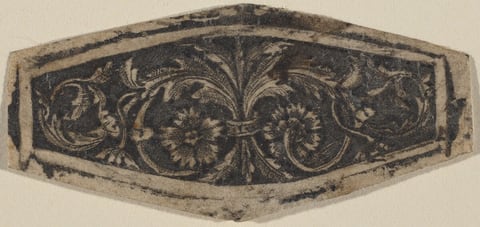
This is a drawing of an ornamental floral design. The image shows a central floral motif resembling a flower with radiating petals, surrounded by swirling leaf patterns. The background is dark, contrasting with the lighter line work of the floral design. The drawing's borders are uneven and have an antique appearance.

The works in this room are listed below.

Works in this room

Works made in the 15th century, anywhere in the world.

First room, north wall

  1. A woman sits and supports a baby standing on her lap, both against a gold background in this arched, vertical painting. The woman and baby’s light skin is shaded with faint green, and they have pale pink cheeks. The woman’s body faces us. She tips her head toward the baby who stands on her knee, to our right. The woman looks at us with light brown eyes under curving brows. She has a long, straight nose, and her small pink lips are closed. Her blond hair is mostly covered by a midnight-blue robe that drapes over her shoulders, across her lap, and pools on the floor. The robe is lined with goldenrod yellow, edged with bright gold, and has gold starburst-like designs on the shoulder we can see and top of the head. The dress she wears underneath has more gold stars creating a pattern across the pearl-white fabric. A sky-blue scarf wraps over her head and loops across her shoulders. The baby holds one end of the scarf, and his other elbow rests on the woman’s shoulder. She props him up with both hands. He has a cap of blond curls and chubby cheeks with delicate features. His geranium-red garment falls over a pale blue skirt that reaches his bare feet. In the hand near the woman’s shoulder, he holds a scroll with the letters “EGO S.” The floor beneath them is mint green and has gold writing across the front, reading, “AVE.G ANN O.D M.CCCC.XIII.” The woman and baby’s disc-like gold halos blend into the gold background, which is visibly cracked in some areas. The panel comes to a pointed arch at the top.
    Madonna and ChildLorenzo Monaco, 1413Courtesy National Gallery of Art, Washington
  2. Portrait of a Carthusian, by Petrus Christus, 1446
    Portrait of a CarthusianPetrus Christus, 1446Courtesy of The Metropolitan Museum of Art
  3. A Hunting Scene, by Piero di Cosimo (Piero di Lorenzo di Piero d'Antonio), ca. 1494–1500
    A Hunting ScenePiero di Cosimo (Piero di Lorenzo di Piero d'Antonio), ca. 1494–1500Courtesy of The Metropolitan Museum of Art

First room, south wall

  1. Portrait of a Young Man, by Antonello da Messina (Antonello di Giovanni d'Antonio), ca. 1470
    Portrait of a Young ManAntonello da Messina (Antonello di Giovanni d'Antonio), ca. 1470Courtesy of The Metropolitan Museum of Art
  2. Virgin and Child with Angels, by Master of the Holden Tondo, early 1500s
    Virgin and Child with AngelsMaster of the Holden Tondo, early 1500sCourtesy of the Cleveland Museum of Art
  3. The painting depicts three adults and a child. The central adult, a woman, holds the child securely to her chest. The woman has pale skin and a white cloth covering her head, and she is wearing a dark cloak over a red robe. The child has curly light brown hair and is unclothed, looking towards the left. A bald man with a white beard, wearing a red garment and holding a key is on the left. On the right, another woman wears a white headscarf and a dark garment, holding a red cross. The background is dark, highlighting the people and their attire. All four of them have thin halos around their heads.
    Madonna and Child with SaintsUnrecorded maker, c. 1490/1500Courtesy National Gallery of Art, Washington
  4. This is a drawing of an ornamental floral design. The image shows a central floral motif resembling a flower with radiating petals, surrounded by swirling leaf patterns. The background is dark, contrasting with the lighter line work of the floral design. The drawing's borders are uneven and have an antique appearance.
    Ornament in Hexagonal ShapeUnrecorded Italian maker, c. 1480/1510Courtesy National Gallery of Art, Washington

Second room, south wall
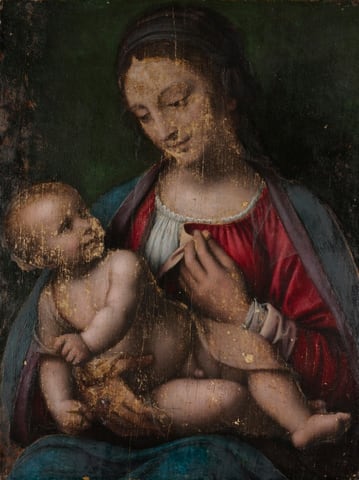
  1. Virgin and Child, by Bernardino Luini, 1500s
    Virgin and ChildBernardino Luini, 1500sCourtesy of the Cleveland Museum of Art
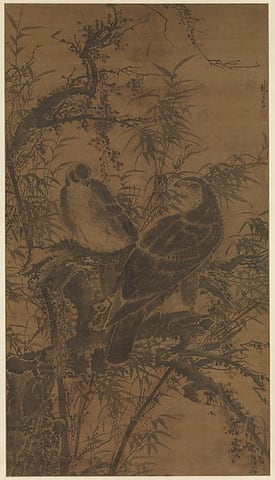
  2. Two hawks in a thicket, by Lin Liang, mid- 15th century
    Two hawks in a thicketLin Liang, mid- 15th centuryCourtesy of The Metropolitan Museum of Art
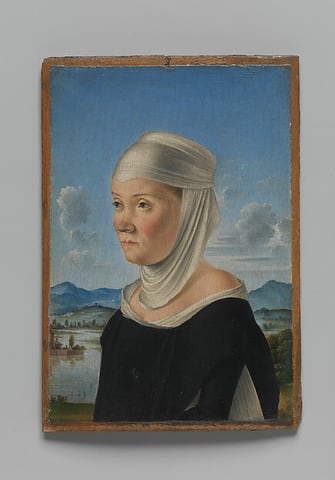
  3. Portrait of a Woman, Possibly a Nun of San Secondo; (verso) Scene in Grisaille, by Jacometto (Jacometto Veneziano), ca. 1485–95
    Portrait of a Woman, Possibly a Nun of San Secondo; (verso) Scene in GrisailleJacometto (Jacometto Veneziano), ca. 1485–95Courtesy of The Metropolitan Museum of Art
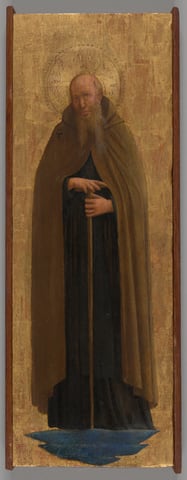
  4. A work made of tempera on panel.
    Saint Anthony AbbotFra Angelico, 1440–41Courtesy of the Art Institute of Chicago

Second room, north wall
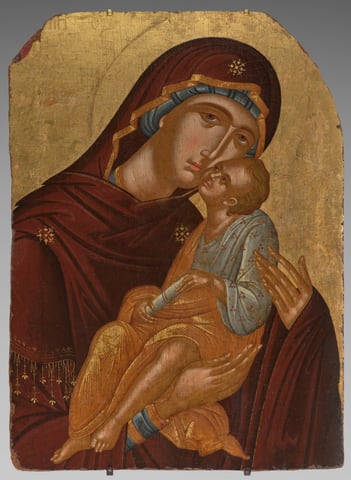
  1. Icon of the Mother of God and Infant Christ (Virgin Eleousa), by Angelos Akotantos, c. 1425–50
    Icon of the Mother of God and Infant Christ (Virgin Eleousa)Angelos Akotantos, c. 1425–50Courtesy of the Cleveland Museum of Art
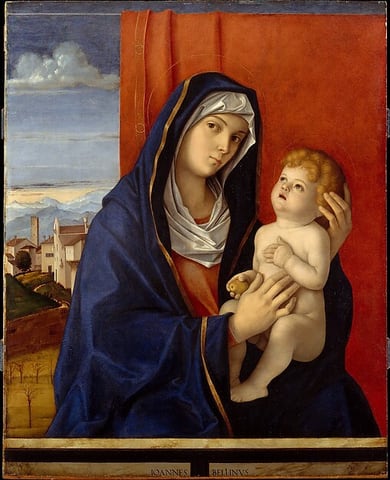
  2. Madonna and Child, by Giovanni Bellini, late 1480s
    Madonna and ChildGiovanni Bellini, late 1480sCourtesy of The Metropolitan Museum of Art
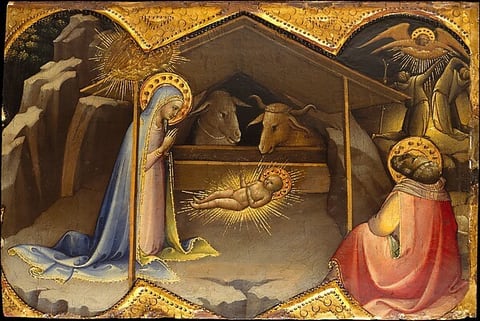
  3. The Nativity, by Lorenzo Monaco, ca. 1406–10
    The NativityLorenzo Monaco, ca. 1406–10Courtesy of The Metropolitan Museum of Art

Third room, north wall
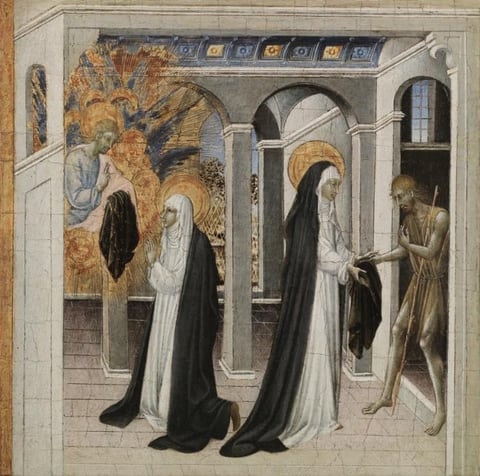
  1. St. Catherine of Siena and the Beggar, by Giovanni di Paolo, 1460s
    St. Catherine of Siena and the BeggarGiovanni di Paolo, 1460sCourtesy of the Cleveland Museum of Art
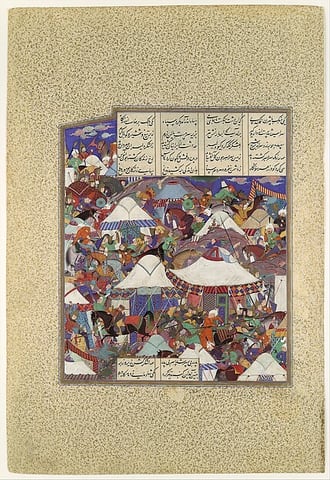
  2. "The Besotted Iranian Camp Attacked by Night", Folio 241r from the Shahnama (Book of Kings) of Shah Tahmasp, by Abu'l Qasim Firdausi, ca. 1525–30
    "The Besotted Iranian Camp Attacked by Night", Folio 241r from the Shahnama (Book of Kings) of Shah TahmaspAbu'l Qasim Firdausi, ca. 1525–30Courtesy of The Metropolitan Museum of Art