Floor plan

Time and place15th-century Netherlands
15th-century Netherlands
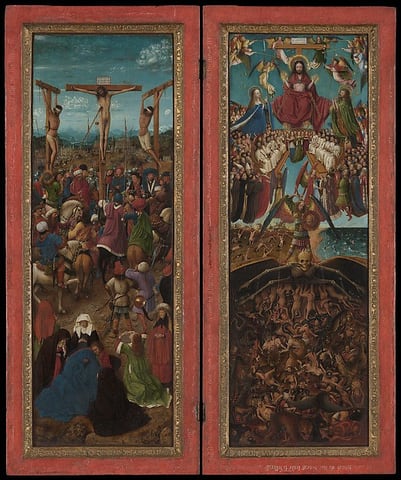
The Crucifixion; The Last Judgment, by Jan van Eyck, ca. 1436–38
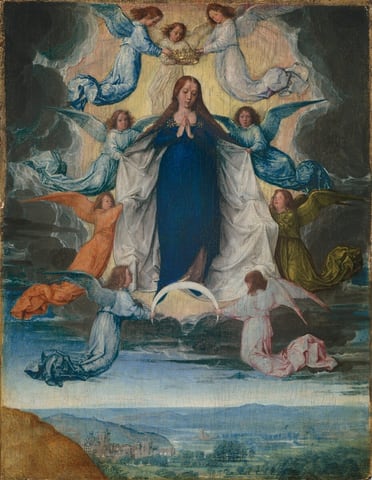
A woman wearing a long, royal-blue dress is surrounded by nine winged angels as she floats on a thin, bright white, downward-pointing crescent moon above a deep landscape with a town tucked into rolling hills in this vertical painting. The woman, Mary, and all the angels have pale, peachy skin and long, brown hair. Mary and the angels float against a pale yellow and pale peach field of light enclosed within a mass of steel-gray clouds. She presses her fingertips together in front of her chest and gazes down and to our right, her dark eyes almost closed. She has a delicate, straight nose, and her small mouth is closed. Her brown hair parts in the middle and flows down over her shoulders. The angels wear flowing gowns in sky or topaz blue, olive green, tangerine orange, white, or light pink, each with matching wings. Three angels place a gold crown on Mary's head. Four others hold up the edges of a silvery white cape, which is fastened across her shoulders with brooches of white pearls surrounding ruby-red stones. The final two angels hold up the downward-facing points of the crescent moon beneath her. In the landscape below, groupings of trees are dotted among the rolling hills, with a village in the distance to our left. The blue, hazy horizon comes about a sixth of the way up the composition. A brown boulder sits in the bottom left corner, closer to us. The paint is visibly cracked throughout.
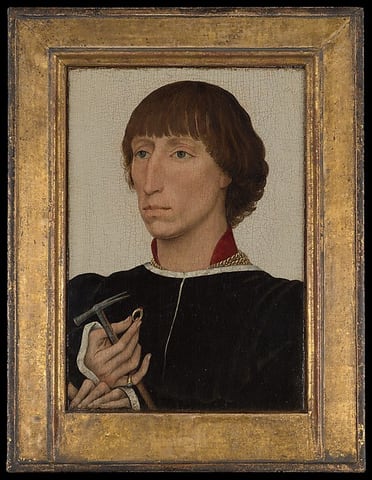
Francesco d'Este (born ca. 1429, died after 1486), by Rogier van der Weyden, ca. 1460
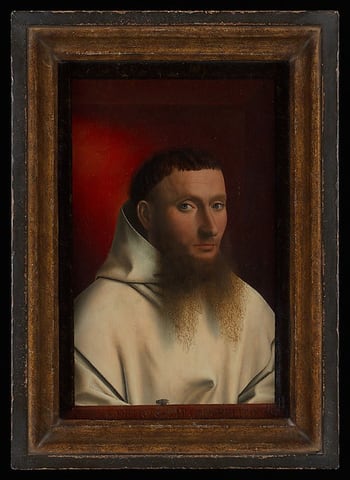
Portrait of a Carthusian, by Petrus Christus, 1446
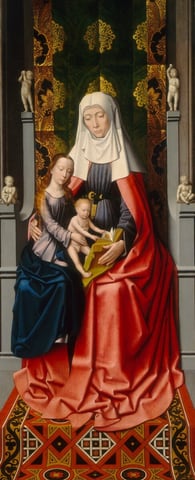
Two women and a baby, all with pale skin, sit together on a gray, stone throne with patterned fabric hanging behind them and a patterned rug below in this narrow, vertical painting. The woman sitting on the throne, Saint Anne, is the largest. A second woman, Mary, is smaller in scale, and she sits on Saint Anne’s lap. Mary, in turn, holds a nude baby boy on her lap. Both women have light brown eyes under faint, arched brows, smooth skin, long straight noses, and their shell-pink lips are closed. Saint Anne sits with her body facing us and she looks down with her head slightly tilted to our left. Her white head covering drapes over her shoulders and hangs down from her chin to cover her neck. She wears a marine-blue dress cinched at her waist with a black and gold belt, and a crimson-red robe that falls to and puddles around her feet. Her right arm, on our left, wraps around and holds Mary’s hip, and she supports a book with gold-edged pages with her other hand. Mary sits on Saint Anne’s right thigh, to our left, and leans toward the baby, who sits on her left knee, to our right. Her long, wavy, brown hair falls over her shoulders, and she wears a cobalt-blue robe over a lilac-purple dress. The baby has short, curly blond hair and reaches to turn the pages of the book. He has rounded cheeks and a pudgy torso. The stone throne is ornamented on the arms and at the top corners with ivory-white, nude children that are presumably also carved out of stone. The cloth hanging behind Saint Anne is decorated with glimmering gold, ornamental leaf designs against a pine-green background. The rug beneath her feet is a geometric pattern of red, tan, black, and white.
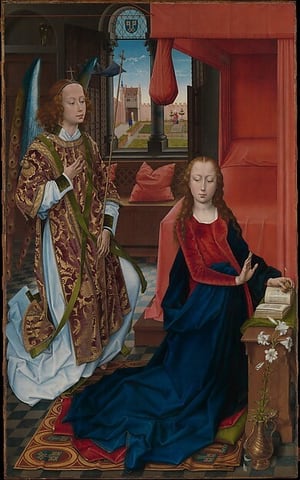
The Annunciation, by Hans Memling, ca. 1465–70
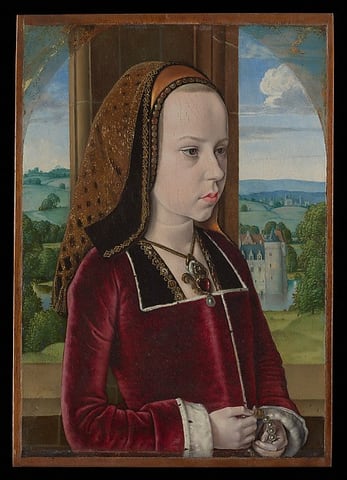
Margaret of Austria, by Jean Hey (called Master of Moulins), ca. 1490

The works in this room are listed below.

Works in this room

Works made in the Netherlands in the 15th century.

First room, north wall

  1. The Crucifixion; The Last Judgment, by Jan van Eyck, ca. 1436–38
    The Crucifixion; The Last JudgmentJan van Eyck, ca. 1436–38Courtesy of The Metropolitan Museum of Art
  2. A woman wearing a long, royal-blue dress is surrounded by nine winged angels as she floats on a thin, bright white, downward-pointing crescent moon above a deep landscape with a town tucked into rolling hills in this vertical painting. The woman, Mary, and all the angels have pale, peachy skin and long, brown hair. Mary and the angels float against a pale yellow and pale peach field of light enclosed within a mass of steel-gray clouds. She presses her fingertips together in front of her chest and gazes down and to our right, her dark eyes almost closed. She has a delicate, straight nose, and her small mouth is closed. Her brown hair parts in the middle and flows down over her shoulders. The angels wear flowing gowns in sky or topaz blue, olive green, tangerine orange, white, or light pink, each with matching wings. Three angels place a gold crown on Mary's head. Four others hold up the edges of a silvery white cape, which is fastened across her shoulders with brooches of white pearls surrounding ruby-red stones. The final two angels hold up the downward-facing points of the crescent moon beneath her. In the landscape below, groupings of trees are dotted among the rolling hills, with a village in the distance to our left. The blue, hazy horizon comes about a sixth of the way up the composition. A brown boulder sits in the bottom left corner, closer to us. The paint is visibly cracked throughout.
    The Assumption of the VirginMichel Sittow, c. 1500Courtesy National Gallery of Art, Washington
  3. Francesco d'Este (born ca. 1429, died after 1486), by Rogier van der Weyden, ca. 1460
    Francesco d'Este (born ca. 1429, died after 1486)Rogier van der Weyden, ca. 1460Courtesy of The Metropolitan Museum of Art
  4. Portrait of a Carthusian, by Petrus Christus, 1446
    Portrait of a CarthusianPetrus Christus, 1446Courtesy of The Metropolitan Museum of Art

First room, south wall

  1. Two women and a baby, all with pale skin, sit together on a gray, stone throne with patterned fabric hanging behind them and a patterned rug below in this narrow, vertical painting. The woman sitting on the throne, Saint Anne, is the largest. A second woman, Mary, is smaller in scale, and she sits on Saint Anne’s lap. Mary, in turn, holds a nude baby boy on her lap. Both women have light brown eyes under faint, arched brows, smooth skin, long straight noses, and their shell-pink lips are closed. Saint Anne sits with her body facing us and she looks down with her head slightly tilted to our left. Her white head covering drapes over her shoulders and hangs down from her chin to cover her neck. She wears a marine-blue dress cinched at her waist with a black and gold belt, and a crimson-red robe that falls to and puddles around her feet. Her right arm, on our left, wraps around and holds Mary’s hip, and she supports a book with gold-edged pages with her other hand. Mary sits on Saint Anne’s right thigh, to our left, and leans toward the baby, who sits on her left knee, to our right. Her long, wavy, brown hair falls over her shoulders, and she wears a cobalt-blue robe over a lilac-purple dress. The baby has short, curly blond hair and reaches to turn the pages of the book. He has rounded cheeks and a pudgy torso. The stone throne is ornamented on the arms and at the top corners with ivory-white, nude children that are presumably also carved out of stone. The cloth hanging behind Saint Anne is decorated with glimmering gold, ornamental leaf designs against a pine-green background. The rug beneath her feet is a geometric pattern of red, tan, black, and white.
    The Saint Anne Altarpiece: Saint Anne with the Virgin and Child [middle panel]Gerard David, c. 1500/1520Courtesy National Gallery of Art, Washington
  2. The Annunciation, by Hans Memling, ca. 1465–70
    The AnnunciationHans Memling, ca. 1465–70Courtesy of The Metropolitan Museum of Art
  3. Margaret of Austria, by Jean Hey (called Master of Moulins), ca. 1490
    Margaret of AustriaJean Hey (called Master of Moulins), ca. 1490Courtesy of The Metropolitan Museum of Art

Second room, south wall
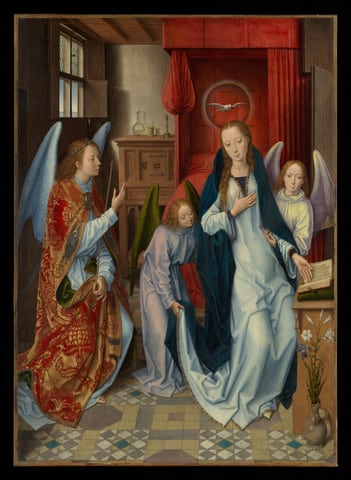
  1. The Annunciation, by Hans Memling, 1480–89
    The AnnunciationHans Memling, 1480–89Courtesy of The Metropolitan Museum of Art
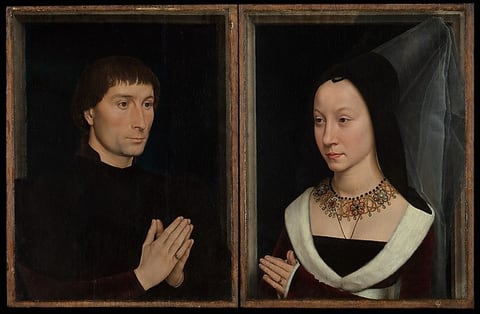
  2. Tommaso di Folco Portinari (1428–1501); Maria Portinari (Maria Maddalena Baroncelli, born 1456), by Hans Memling, ca. 1470
    Tommaso di Folco Portinari (1428–1501); Maria Portinari (Maria Maddalena Baroncelli, born 1456)Hans Memling, ca. 1470Courtesy of The Metropolitan Museum of Art
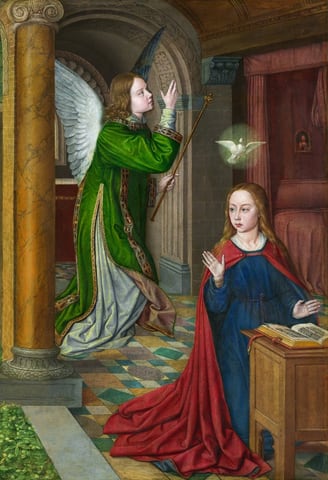
  3. Painting of the Annunciation, dove flying above Mary with angel.
    The AnnunciationJean Hey (called Master of Moulins), 1490–95Courtesy of the Art Institute of Chicago

Second room, north wall
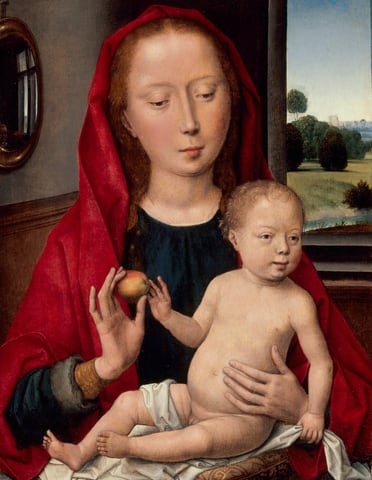
  1. A work made of oil on panel.
    Virgin and ChildHans Memling, c. 1485Courtesy of the Art Institute of Chicago
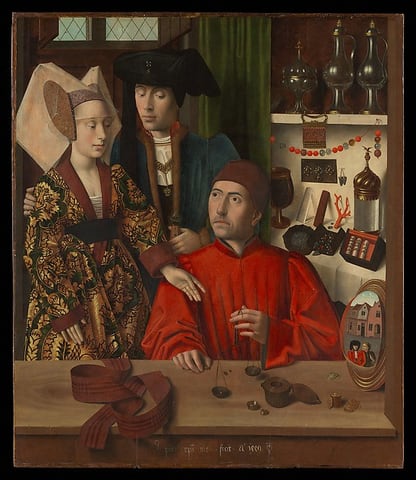
  2. A Goldsmith in his Shop, by Petrus Christus, 1449
    A Goldsmith in his ShopPetrus Christus, 1449Courtesy of The Metropolitan Museum of Art