Floor plan

Time and place15th-century Italy

15th-century Italy

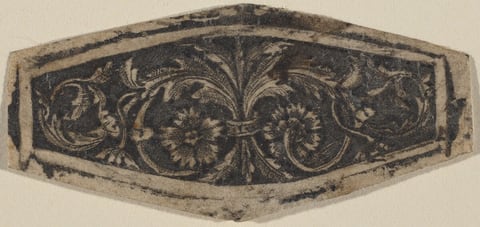
This is a drawing of an ornamental floral design. The image shows a central floral motif resembling a flower with radiating petals, surrounded by swirling leaf patterns. The background is dark, contrasting with the lighter line work of the floral design. The drawing's borders are uneven and have an antique appearance.
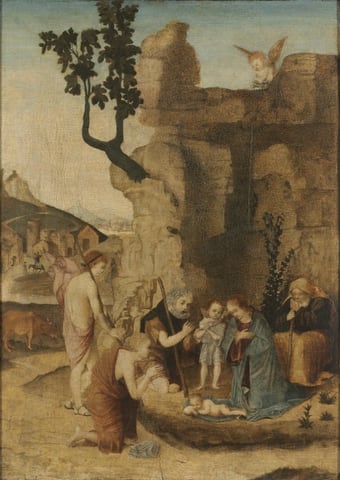
Adoration of the Shepherds, c. 1500
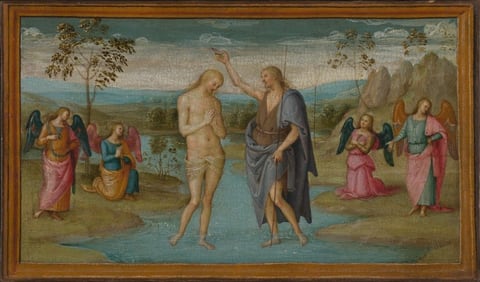
A work made of tempera on panel, transferred to canvas.
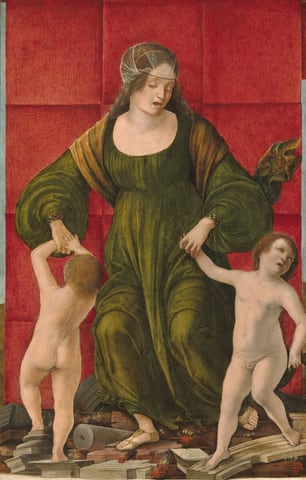
A woman holds the hands of two nude children in front of a crimson-red cloth in this vertical painting. All three have pale skin and brown hair. The woman wears a forest-green dress with voluminous sleeves and a gauzy white headdress that wraps around her hair and is fastened with a band across her forehead. She stands crouching with one foot extended slightly forward in a sandal, surrounded by broken chunks of masonry and bits of burning logs. Her body faces us but she turns her head to the right. Her mouth is wide open, and her eyes cut back to our left. The woman clutches the children’s hands in both of her own. The child to our left turns away from us and reaches one hand up to touch the back of the woman’s hand. The child on the right twists away from the woman, eyes squinted up and to the right and mouth open. Behind them, fold lines create a grid across the red cloth. Slivers of grass and blue sky line each side of the composition.
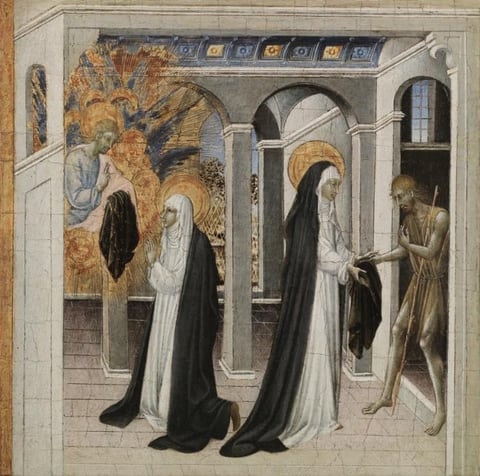
St. Catherine of Siena and the Beggar, by Giovanni di Paolo, 1460s
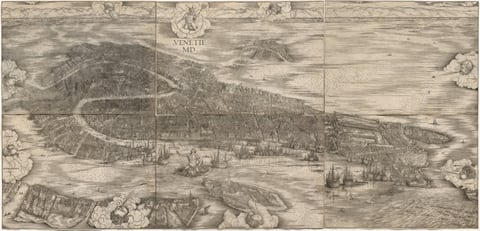
View of Venice, by Jacopo de' Barbari, 1500
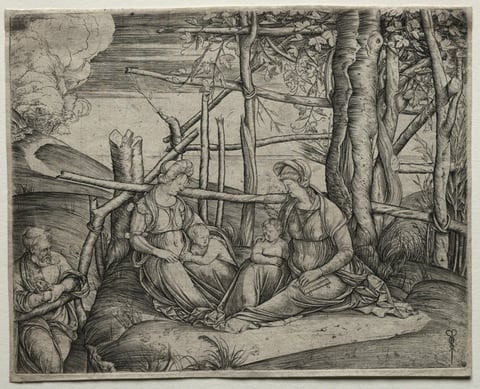
The Holy Family with Saint Elizabeth, by Jacopo de' Barbari, c. 1503

The works in this room are listed below.

Works in this room

Works made in Italy in the 15th century.

Section 1, north wall

  1. This is a drawing of an ornamental floral design. The image shows a central floral motif resembling a flower with radiating petals, surrounded by swirling leaf patterns. The background is dark, contrasting with the lighter line work of the floral design. The drawing's borders are uneven and have an antique appearance.
    Ornament in Hexagonal ShapeUnrecorded Italian maker, c. 1480/1510Courtesy National Gallery of Art, Washington
  2. Adoration of the Shepherds, c. 1500
    Adoration of the ShepherdsUnrecorded Italian maker, c. 1500Courtesy of the Cleveland Museum of Art
  3. A work made of tempera on panel, transferred to canvas.
    The Baptism of ChristPerugino, 1500–05Courtesy of the Art Institute of Chicago
  4. A woman holds the hands of two nude children in front of a crimson-red cloth in this vertical painting. All three have pale skin and brown hair. The woman wears a forest-green dress with voluminous sleeves and a gauzy white headdress that wraps around her hair and is fastened with a band across her forehead. She stands crouching with one foot extended slightly forward in a sandal, surrounded by broken chunks of masonry and bits of burning logs. Her body faces us but she turns her head to the right. Her mouth is wide open, and her eyes cut back to our left. The woman clutches the children’s hands in both of her own. The child to our left turns away from us and reaches one hand up to touch the back of the woman’s hand. The child on the right twists away from the woman, eyes squinted up and to the right and mouth open. Behind them, fold lines create a grid across the red cloth. Slivers of grass and blue sky line each side of the composition.
    The Wife of Hasdrubal and Her ChildrenErcole de' Roberti, c. 1490/1493Courtesy National Gallery of Art, Washington

Section 1, south wall

  1. St. Catherine of Siena and the Beggar, by Giovanni di Paolo, 1460s
    St. Catherine of Siena and the BeggarGiovanni di Paolo, 1460sCourtesy of the Cleveland Museum of Art
  2. View of Venice, by Jacopo de' Barbari, 1500
    View of VeniceJacopo de' Barbari, 1500Courtesy of the Cleveland Museum of Art
  3. The Holy Family with Saint Elizabeth, by Jacopo de' Barbari, c. 1503
    The Holy Family with Saint ElizabethJacopo de' Barbari, c. 1503Courtesy of the Cleveland Museum of Art

Section 2, south wall
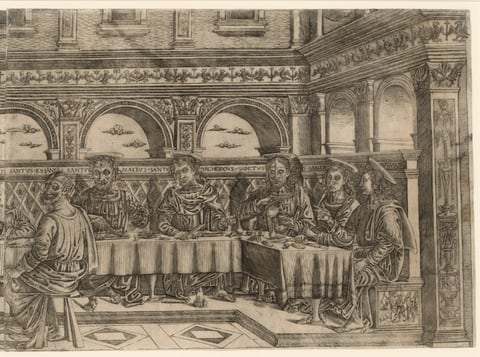
  1. The Last Supper, by Lucantonio degli Uberti, c. 1500
    The Last SupperLucantonio degli Uberti, c. 1500Courtesy of the Cleveland Museum of Art
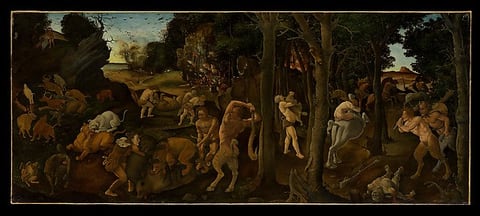
  2. A Hunting Scene, by Piero di Cosimo (Piero di Lorenzo di Piero d'Antonio), ca. 1494–1500
    A Hunting ScenePiero di Cosimo (Piero di Lorenzo di Piero d'Antonio), ca. 1494–1500Courtesy of The Metropolitan Museum of Art

Section 2, north wall
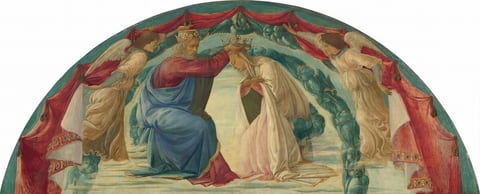
  1. In a wide, arched panel, a bearded man wearing a crown places another crown on the head of a woman. To our right, the woman bows her head with her eyes nearly closed and crosses her wrists over her chest. A white cloak covers her head, drapes over her shoulders, and pools in deep folds around her feet. The cloak is lined with pine green, and she wears a shell-pink dress. To our left, the man has shoulder-length, curly gray hair and a beard. His robe is dark rose pink, and the cloak is azure blue lined with pine green. Two winged angels have brown hair, short, white wings, and wear voluminous white robes. They stand to either side of the man and woman and hold up a swag of raspberry-red cloth hung with gold tassels. All the people have pale, peachy skin. Winged baby heads encircled with gold rays create an arch behind the man and woman, who sit on clouds. The background is pale blue sky.
    The Coronation of the VirginFilippino Lippi, c. 1475Courtesy National Gallery of Art, Washington
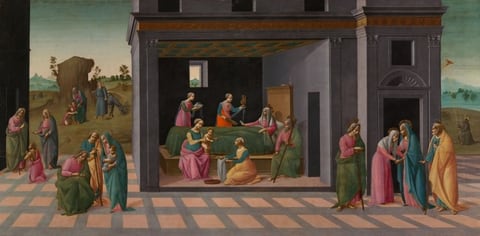
  2. Outdoors, distinct groupings of adult men and women, some with halos, gather near a building. The front-facing wall of the building is not depicted, allowing for a view inside, where a woman sits in bed with two women nearby and two other women dress a baby. A bearded man sits near the bed.
    Scenes from the Life of Saint John the BaptistBartolomeo di Giovanni, 1490/95Courtesy of the Art Institute of Chicago

Section 3, north wall
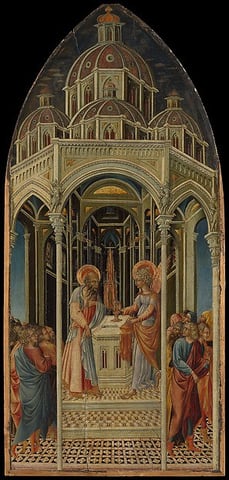
  1. The Annunciation to Zacharias; (verso) The Angel of the Annunciation, by Giovanni di Paolo, ca. 1455–60
    The Annunciation to Zacharias; (verso) The Angel of the AnnunciationGiovanni di Paolo, ca. 1455–60Courtesy of The Metropolitan Museum of Art
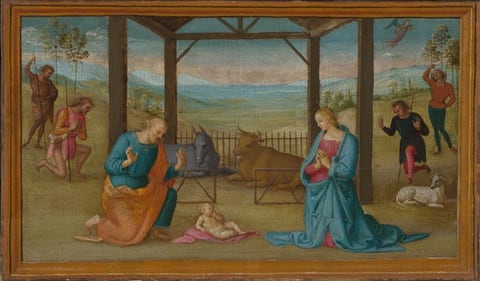
  2. A work made of tempera on panel, transferred to canvas.
    The NativityPerugino, 1500–05Courtesy of the Art Institute of Chicago
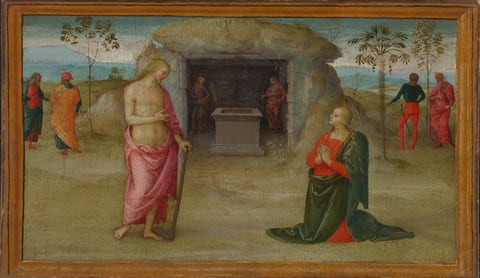
  3. A work made of tempera on panel, transferred to canvas.
    Noli Me TangerePerugino, 1500–05Courtesy of the Art Institute of Chicago

Section 3, south wall
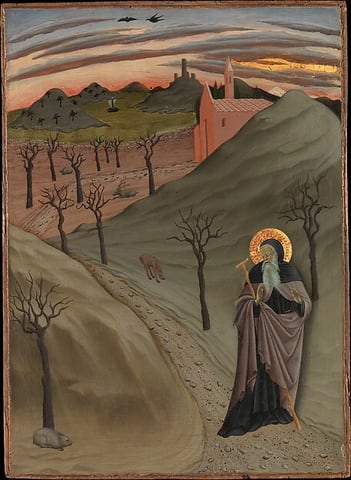
  1. Saint Anthony the Abbot in the Wilderness, by Sano di Pietro (Ansano di Pietro di Mencio), ca. 1440
    Saint Anthony the Abbot in the WildernessSano di Pietro (Ansano di Pietro di Mencio), ca. 1440Courtesy of The Metropolitan Museum of Art
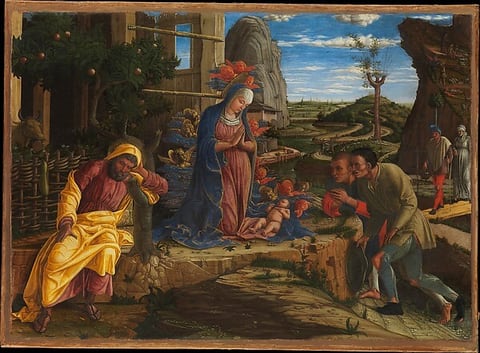
  2. The Adoration of the Shepherds, by Andrea Mantegna, shortly after 1450
    The Adoration of the ShepherdsAndrea Mantegna, shortly after 1450Courtesy of The Metropolitan Museum of Art