Floor plan

South wing: ThemesCities and Views

Cities and Views

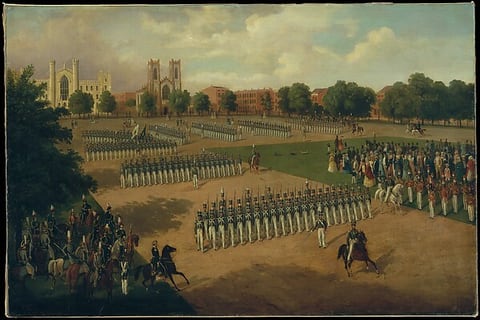
Seventh Regiment on Review, Washington Square, New York, by Otto Boetticher, 1851
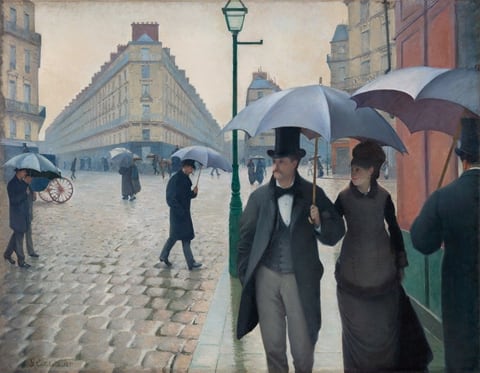
Life-size painting of an urban scene in Paris. A man in a top hat holding an umbrella and a woman in a long fashionable dark dress walk arm in arm toward the viewer as other city dwellers with umbrellas walk in various directions across cobblestone roads and sidewalks.
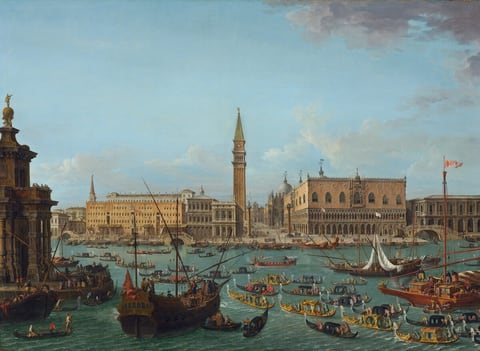
The painting depicts many large and small ships on blue-green water. Gondolas in shades of gold, black, red, and blue drift across the water, small people on them pushing long poles through the water. There are also large sailboats and long boats with several rowers. They create a colorful mix. On the left, a large brown building with columns is visible. Some of the boats pull up to it, and many people in colorful clothing are visible on the shore. Behind the water are more large buildings in shades of brown, cream, and tan, with even more people visible on the streets below them. There is a large tower in the center of the painting, and several blue domes are visible in the distance. The sky is light blue, with white and gray clouds drifting across it.
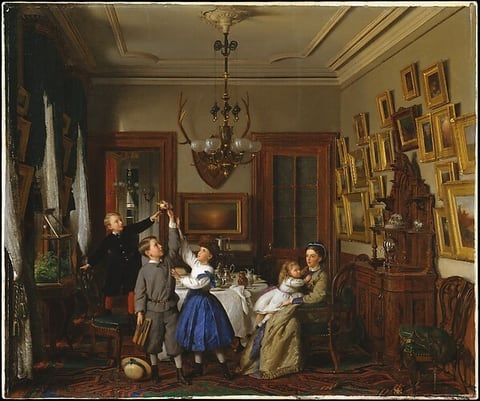
The Contest for the Bouquet: The Family of Robert Gordon in Their New York Dining-Room, by Seymour Joseph Guy, 1866
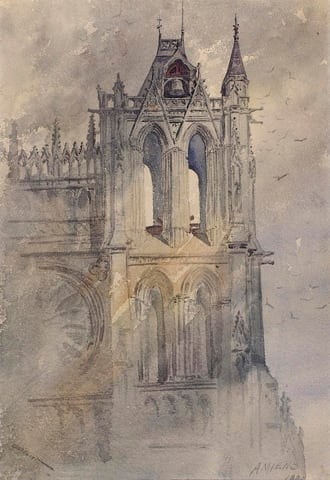
Southwest Tower, Amiens Cathedral, by Cass Gilbert, 1880

The works in this room are listed below.

Works in this room

Streets, bridges, skylines and squares: the city as painters and engravers saw it, often before photography could. Views of Venice, Paris, New York and Edo sit together here, made for travellers, for civic pride and for the plain pleasure of looking at a place.

Section 1, north wall

  1. Seventh Regiment on Review, Washington Square, New York, by Otto Boetticher, 1851
    Seventh Regiment on Review, Washington Square, New YorkOtto Boetticher, 1851Courtesy of The Metropolitan Museum of Art
  2. Life-size painting of an urban scene in Paris. A man in a top hat holding an umbrella and a woman in a long fashionable dark dress walk arm in arm toward the viewer as other city dwellers with umbrellas walk in various directions across cobblestone roads and sidewalks.
    Paris Street; Rainy DayGustave Caillebotte, 1877Courtesy of the Art Institute of Chicago

Section 1, south wall

  1. The painting depicts many large and small ships on blue-green water. Gondolas in shades of gold, black, red, and blue drift across the water, small people on them pushing long poles through the water. There are also large sailboats and long boats with several rowers. They create a colorful mix. On the left, a large brown building with columns is visible. Some of the boats pull up to it, and many people in colorful clothing are visible on the shore. Behind the water are more large buildings in shades of brown, cream, and tan, with even more people visible on the streets below them. There is a large tower in the center of the painting, and several blue domes are visible in the distance. The sky is light blue, with white and gray clouds drifting across it.
    Procession of Gondolas in the Bacino di San Marco, VeniceAntonio Joli, 1742 or afterCourtesy National Gallery of Art, Washington
  2. The Contest for the Bouquet: The Family of Robert Gordon in Their New York Dining-Room, by Seymour Joseph Guy, 1866
    The Contest for the Bouquet: The Family of Robert Gordon in Their New York Dining-RoomSeymour Joseph Guy, 1866Courtesy of The Metropolitan Museum of Art
  3. Southwest Tower, Amiens Cathedral, by Cass Gilbert, 1880
    Southwest Tower, Amiens CathedralCass Gilbert, 1880Courtesy of the Smithsonian American Art Museum

Section 2, south wall
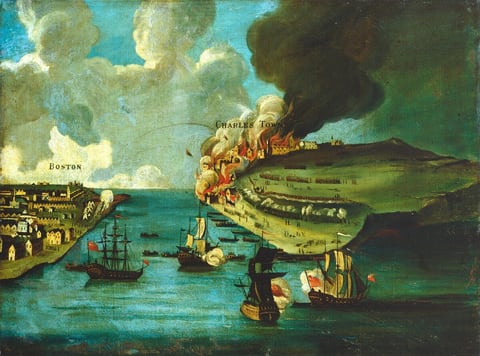
  1. We look across and down at a channel of water separating two landmasses labeled "Boston" and "Charles Town" in this horizontal landscape painting. Four three-masted ships are in the aquamarine-blue harbor between us and the land. Three of them have their sails unfurled and smoke billows from the broad, starboard side of each. Tidy rows of brown houses line the area of Boston. A puff of white smoke rises from the farthest point. Two arrow-shaped missiles, perhaps projectiles on fire, arc toward Charles Town, where billowing gray plumes of smoke rise from vivid orange fire on the far side of the landmass. Rowboats bring soldiers to the shore of Charles Town, close to where hundreds of soldiers line up and fire at each other. Much of the rest of Charles Town is a hill leading to sheer cliffs to our right. Tan and gray-colored smoke mixes among bright white clouds against a pale blue sky on the top half of the painting.
    Attack on Bunker's Hill, with the Burning of Charles TownUnrecorded American maker, 1783 or afterCourtesy National Gallery of Art, Washington
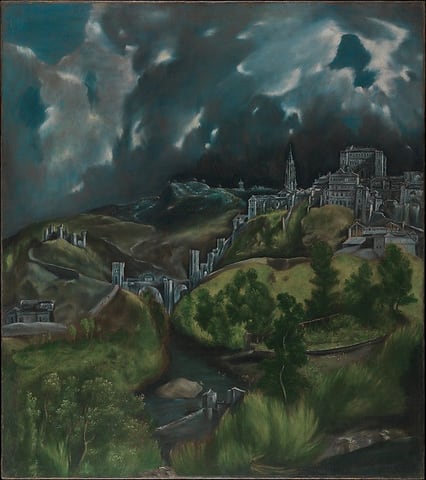
  2. View of Toledo, by El Greco, ca. 1599–1600
    View of ToledoEl Greco, ca. 1599–1600Courtesy of The Metropolitan Museum of Art
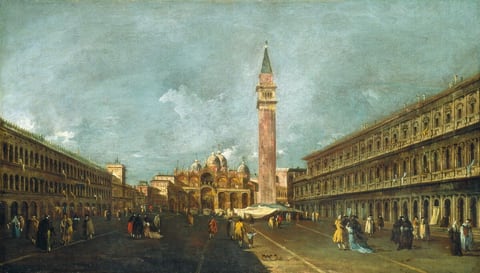
  3. The Square of Saint Mark's, Venice, c. 1770/1800
    The Square of Saint Mark's, VeniceUnrecorded maker, c. 1770/1800Courtesy National Gallery of Art, Washington
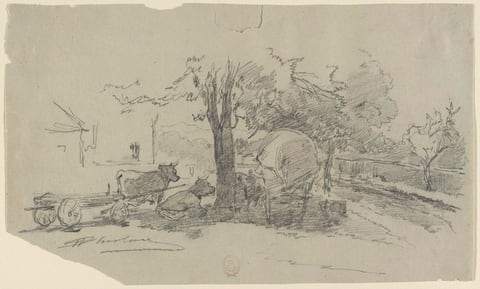
  4. A VILLAGE SQUARE
    A Village SquareWalter Shirlaw, 1875–80Courtesy of Cooper Hewitt, Smithsonian Design Museum

Section 2, north wall
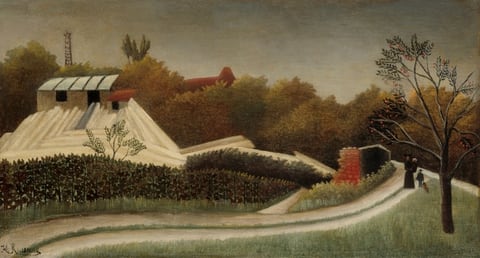
  1. A work made of oil on canvas.
    Sawmill, Outskirts of ParisHenri Rousseau, c. 1893/95Courtesy of the Art Institute of Chicago
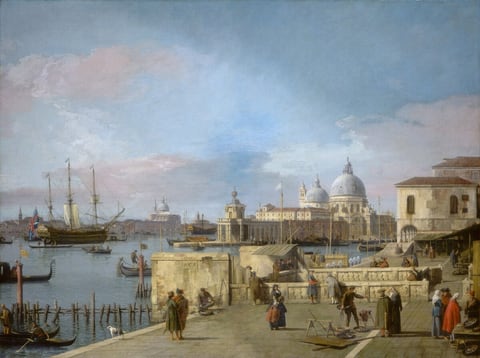
  2. We look slightly down onto a port-side town along a canal, with a church across the water from us in this horizontal landscape painting. A bright blue sky with billowing white, pink, and gray clouds fills the top two-thirds of the painting. Below, a three-masted ship with all but one sail furled is surrounded by a couple dozen black long, low boats, gondolas, and one or two other sailboats. People stand and walk mostly in pairs and trios along the stone walkway under us, which extends into the distance to our right. The women all wear long dresses and most of the men wear suits with knee-length jackets with tails or capes, and hats. The clothing is painted in shades of brick and terracotta red, pine green, royal blue, and gray. The walkway is interrupted by two low walls that partition off an area near us. The angled roofs of stalls line the walkway in the farther distance before it is again interrupted, this time by a two-story, cream-colored building. The walkway continues as a narrower path under an arched arcade on the lower level of that building, alongside the water. On the far side of the canal, to our left and in the distance, a cluster of ivory-white buildings includes a structure with two stone-blue domes. More buildings extend into the deep distance to our left.
    Entrance to the Grand Canal from the Molo, VeniceCanaletto, 1742/1744Courtesy National Gallery of Art, Washington
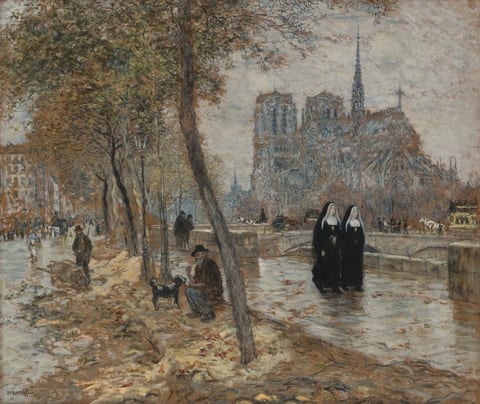
  3. A work made of oil on composition board.
    Notre Dame de ParisJean-François Rafaëlli, c. 1890Courtesy of the Art Institute of Chicago

Section 3, north wall
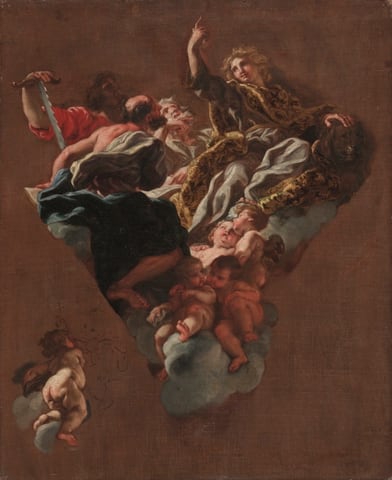
  1. Sketch for "The Four Prophets of Israel" (for Il Gesù, Rome), by Giovanni Battista Gaulli, c. 1675–1677
    Sketch for "The Four Prophets of Israel" (for Il Gesù, Rome)Giovanni Battista Gaulli, c. 1675–1677Courtesy of the Cleveland Museum of Art
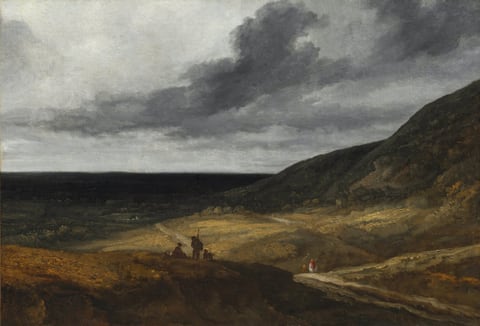
  2. Landscape Near Paris, by Georges Michel, c. 1840
    Landscape Near ParisGeorges Michel, c. 1840Courtesy of the Cleveland Museum of Art

Section 3, south wall
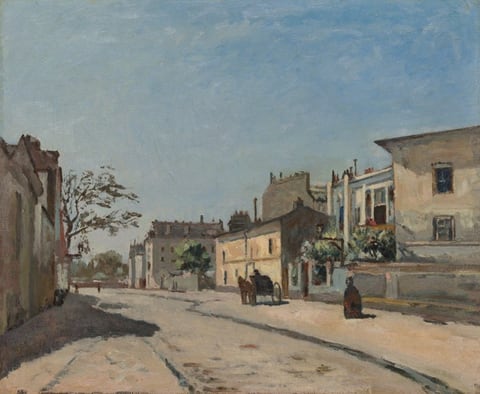
  1. A work made of oil on panel.
    French Street SceneEdouard Béliard, 1873–77Courtesy of the Art Institute of Chicago
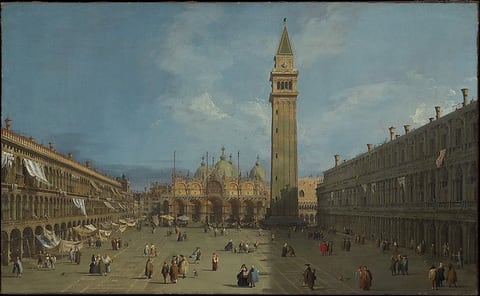
  2. Piazza San Marco, by Canaletto, late 1720s
    Piazza San MarcoCanaletto, late 1720sCourtesy of The Metropolitan Museum of Art