Floor plan

Artist galleriesMartin Johnson Heade
Martin Johnson Heade
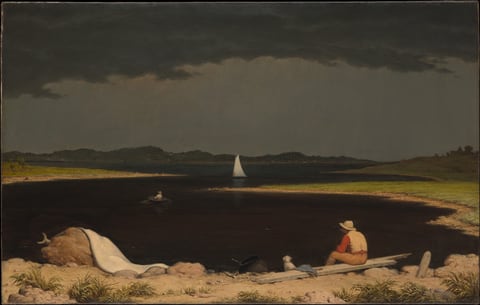
Approaching Thunder Storm, by Martin Johnson Heade, 1859
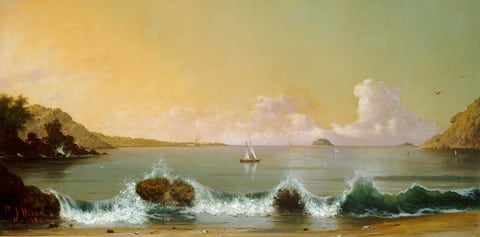
Across a short stretch of sand in front of us, waves of bottle-green water break over two boulders on the shoreline, with sailboats in the water beyond, in this wide, horizontal painting. One boulder is at the left edge of the painting; the other is a short distance away, about a quarter of the way across. The water cascades down between those large rocks. Across the rest of the beach, the waves flare up to break toward us in white, foamy surf. The land curves back into view on both sides of the canvas with muted, sage-green hills and, to our left, dark green trees on more craggy boulders. A more distant finger of land to our left stretches nearly halfway across the horizon, which comes about halfway up the composition. Minuscule in scale there, smoke pours out of a chimney, which is surrounded by pale yellow buildings. A mound emerges from the horizon to our right of center. About ten sailboats float on the water. The closest one to us is near the center of the painting, and the tiny forms of people aboard can just barely be made out. The other boats become smaller as they move back to the horizon, and some are only a touch of white or gray on the canvas. White and pale lavender-purple clouds sweep up from the horizon into the sky, which glows butter yellow along the left edge. The sky cools to mint green in the upper right corner. Several white or brown birds fly across the sky or low over the water. The artist signed and dated the lower left, “M. J. Heade 1864.”
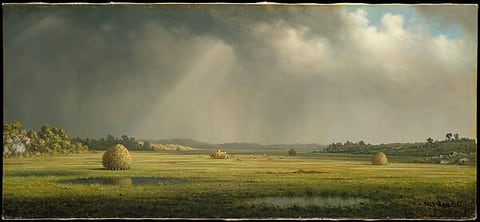
Newburyport Meadows, by Martin Johnson Heade, ca. 1876–81
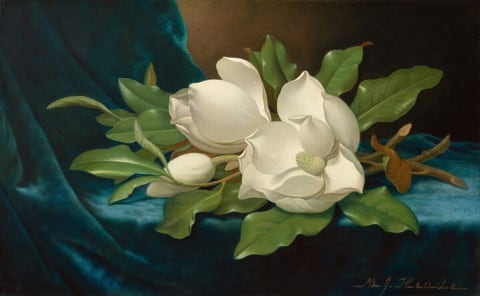
Twigs of a magnolia tree with light green, glossy leaves and three cream-white blossoms lie on a sapphire-blue cloth in this horizontal still life painting. Brightly lit from our left, the blossoms and leaves nearly fill the composition, and the cut ends lie on the fabric to our right. The blue fabric cascades from the upper left and across the table or ledge. The three flowers are in various stages of bloom. The tightest bud is to our left, overlapped by a stem and the tender, unfurling leaves of a branch. The blossom next to it, at the center, is starting to open. The petals of the third blossom, to our right, splay open around the flower’s oval-shaped stamen. Light glints off the waxy leaves surrounding the flowers. The tawny-brown underside of one leaf is visible where it turns over, near the cut ends of the branches. Light shimmering on the fabric darkens from bright blue to our right, to deep royal blue in the shadows to the upper left, suggesting the fabric is velvet. The background is streaked with tan and pine green behind the fabric, and becomes nearly black in the shadows of the upper right corner and along the bottom edge. The artist signed the lower right corner, "MJ. Heade."

The works in this room are listed below.

Works in this room

Martin Johnson Heade (1819–1904). Every work of theirs in the collection, in today's hang.
First room, north wall

  1. Approaching Thunder Storm, by Martin Johnson Heade, 1859
    Approaching Thunder StormMartin Johnson Heade, 1859Courtesy of The Metropolitan Museum of Art
  2. Across a short stretch of sand in front of us, waves of bottle-green water break over two boulders on the shoreline, with sailboats in the water beyond, in this wide, horizontal painting. One boulder is at the left edge of the painting; the other is a short distance away, about a quarter of the way across. The water cascades down between those large rocks. Across the rest of the beach, the waves flare up to break toward us in white, foamy surf. The land curves back into view on both sides of the canvas with muted, sage-green hills and, to our left, dark green trees on more craggy boulders. A more distant finger of land to our left stretches nearly halfway across the horizon, which comes about halfway up the composition. Minuscule in scale there, smoke pours out of a chimney, which is surrounded by pale yellow buildings. A mound emerges from the horizon to our right of center. About ten sailboats float on the water. The closest one to us is near the center of the painting, and the tiny forms of people aboard can just barely be made out. The other boats become smaller as they move back to the horizon, and some are only a touch of white or gray on the canvas. White and pale lavender-purple clouds sweep up from the horizon into the sky, which glows butter yellow along the left edge. The sky cools to mint green in the upper right corner. Several white or brown birds fly across the sky or low over the water. The artist signed and dated the lower left, “M. J. Heade 1864.”
    Rio de Janeiro BayMartin Johnson Heade, 1864Courtesy National Gallery of Art, Washington

First room, south wall

  1. Newburyport Meadows, by Martin Johnson Heade, ca. 1876–81
    Newburyport MeadowsMartin Johnson Heade, ca. 1876–81Courtesy of The Metropolitan Museum of Art
  2. Twigs of a magnolia tree with light green, glossy leaves and three cream-white blossoms lie on a sapphire-blue cloth in this horizontal still life painting. Brightly lit from our left, the blossoms and leaves nearly fill the composition, and the cut ends lie on the fabric to our right. The blue fabric cascades from the upper left and across the table or ledge. The three flowers are in various stages of bloom. The tightest bud is to our left, overlapped by a stem and the tender, unfurling leaves of a branch. The blossom next to it, at the center, is starting to open. The petals of the third blossom, to our right, splay open around the flower’s oval-shaped stamen. Light glints off the waxy leaves surrounding the flowers. The tawny-brown underside of one leaf is visible where it turns over, near the cut ends of the branches. Light shimmering on the fabric darkens from bright blue to our right, to deep royal blue in the shadows to the upper left, suggesting the fabric is velvet. The background is streaked with tan and pine green behind the fabric, and becomes nearly black in the shadows of the upper right corner and along the bottom edge. The artist signed the lower right corner, "MJ. Heade."
    Giant Magnolias on a Blue Velvet ClothMartin Johnson Heade, c. 1890Courtesy National Gallery of Art, Washington