Floor plan

Artist galleriesFrederick Kemmelmeyer's contemporaries
Frederick Kemmelmeyer's contemporaries
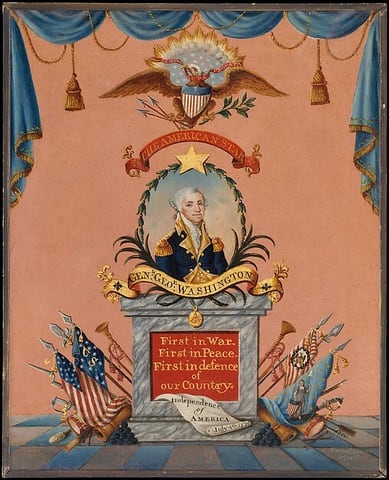
The American Star (George Washington), by Frederick Kemmelmeyer, ca. 1803
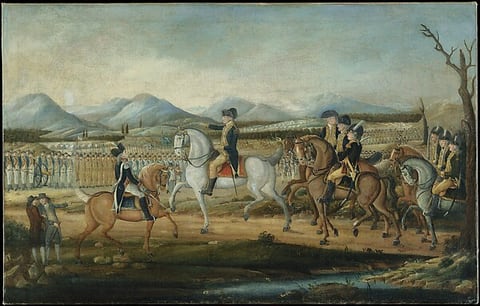
Washington Reviewing the Western Army at Fort Cumberland, Maryland, by Frederick Kemmelmeyer, after 1795
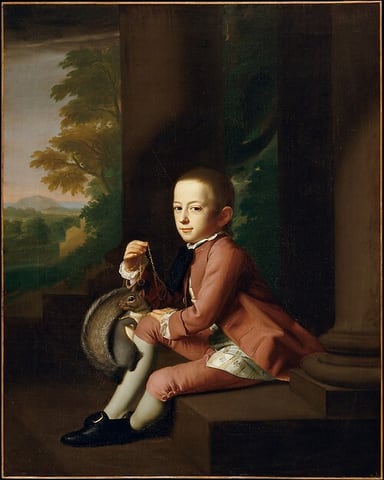
Daniel Crommelin Verplanck, by John Singleton Copley, 1771
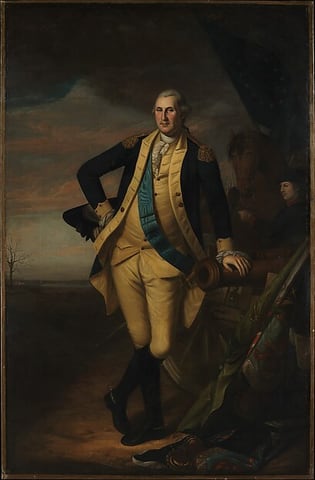
George Washington, by Charles Willson Peale, ca. 1779–81
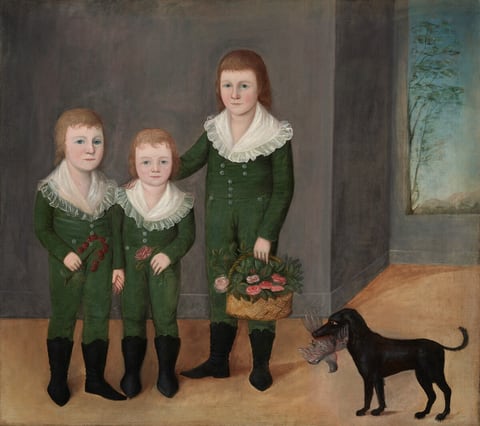
Three pale-skinned, blue-eyed children wearing green suits stand in a row facing us in this horizontal portrait painting. They all have round faces and full, pink cheeks. The tallest child is to the right, and he has shoulder-length cinnamon-brown hair. The other two come up to his shoulder and have blond hair. The tallest puts one arm on the far shoulder of the middle child, and the two smaller children hold hands. Each wears a pine-green, one-piece outfit with pewter-gray buttons, a wide, ivory-white collar lined with ruffles, and black, shin-high boots. The boy on our left holds a branch of dark red cherries. The middle child holds a pink rose, and the tallest a basket filled with pink roses. A black dog holding a gray and mauve-pink bird in its mouth stands in profile facing our left in the lower right corner of the canvas. The room around them has a tan-colored floor and gray walls. The room opens onto an alcove to our right with a rectangular window. A slender tree is along the left edge of the opening and a few pale, pink-tinged gray mountains line the bottom edge. Clear blue sky fills the rest of the window.

The works in this room are listed below.

Works in this room

A few works by Frederick Kemmelmeyer, then their contemporaries: makers of the same nationality born within 25 years of them, then works from the same century and place.

Section 1, north wall

  1. The American Star (George Washington), by Frederick Kemmelmeyer, ca. 1803
    The American Star (George Washington)Frederick Kemmelmeyer, ca. 1803Courtesy of The Metropolitan Museum of Art
  2. Washington Reviewing the Western Army at Fort Cumberland, Maryland, by Frederick Kemmelmeyer, after 1795
    Washington Reviewing the Western Army at Fort Cumberland, MarylandFrederick Kemmelmeyer, after 1795Courtesy of The Metropolitan Museum of Art

Their contemporaries

  1. Daniel Crommelin Verplanck, by John Singleton Copley, 1771
    Daniel Crommelin VerplanckJohn Singleton Copley, 1771Courtesy of The Metropolitan Museum of Art
  2. George Washington, by Charles Willson Peale, ca. 1779–81
    George WashingtonCharles Willson Peale, ca. 1779–81Courtesy of The Metropolitan Museum of Art
  3. Three pale-skinned, blue-eyed children wearing green suits stand in a row facing us in this horizontal portrait painting. They all have round faces and full, pink cheeks. The tallest child is to the right, and he has shoulder-length cinnamon-brown hair. The other two come up to his shoulder and have blond hair. The tallest puts one arm on the far shoulder of the middle child, and the two smaller children hold hands. Each wears a pine-green, one-piece outfit with pewter-gray buttons, a wide, ivory-white collar lined with ruffles, and black, shin-high boots. The boy on our left holds a branch of dark red cherries. The middle child holds a pink rose, and the tallest a basket filled with pink roses. A black dog holding a gray and mauve-pink bird in its mouth stands in profile facing our left in the lower right corner of the canvas. The room around them has a tan-colored floor and gray walls. The room opens onto an alcove to our right with a rectangular window. A slender tree is along the left edge of the opening and a few pale, pink-tinged gray mountains line the bottom edge. Clear blue sky fills the rest of the window.
    The Westwood ChildrenJoshua Johnson, c. 1807Courtesy National Gallery of Art, Washington

Their contemporaries, second
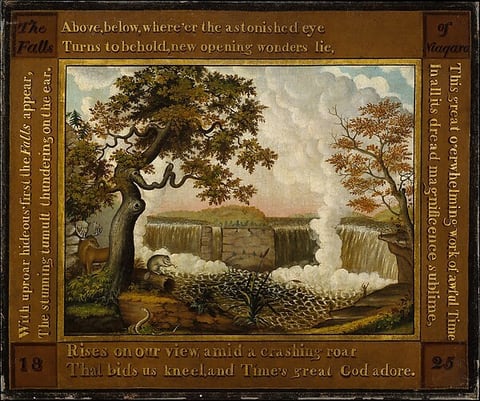
  1. The Falls of Niagara, by Edward Hicks, ca. 1825
    The Falls of NiagaraEdward Hicks, ca. 1825Courtesy of The Metropolitan Museum of Art
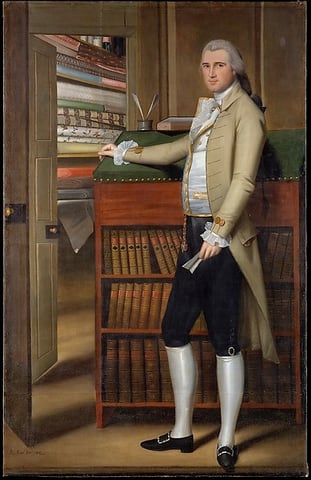
  2. Elijah Boardman, by Ralph Earl, 1789
    Elijah BoardmanRalph Earl, 1789Courtesy of The Metropolitan Museum of Art
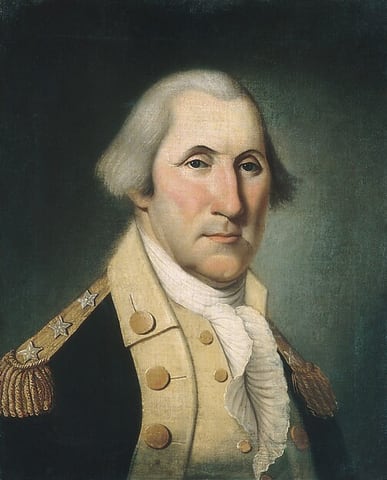
  3. George Washington, by Charles Peale Polk, ca. 1790
    George WashingtonCharles Peale Polk, ca. 1790Courtesy of The Metropolitan Museum of Art