Floor plan

South wing: ThemesThe Sea, room 2

The Sea, room 2

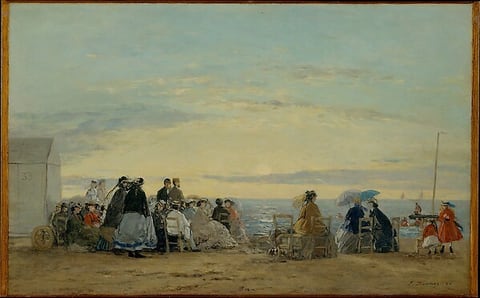
On the Beach, Sunset, by Eugène Boudin, 1865
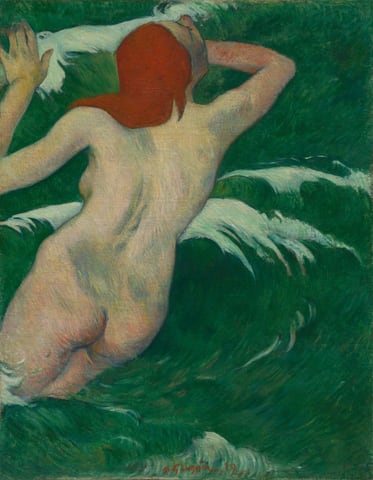
In the Waves (Dans les Vagues), by Paul Gauguin, 1889
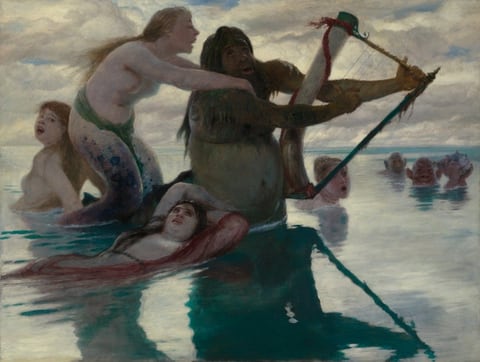
Painting of centaur with harp, in water, surrounded by mermaids and mermen.
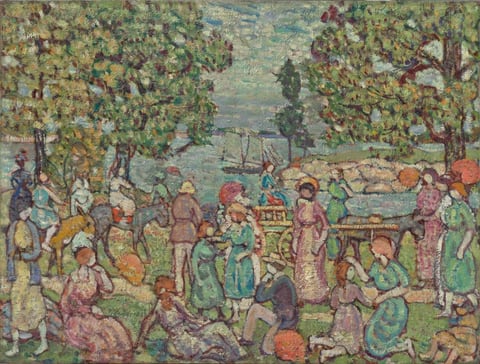
On the Beach, No. 3, by Maurice Prendergast, c. 1915–18
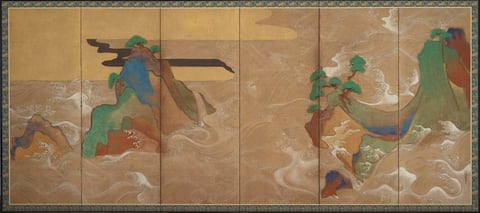
Screens (six-panel)

The works in this room are listed below.

Works in this room

Harbours, beaches and open water, from Dutch ships under heavy cloud to American coasts at midday. Painters went to the sea for its weather as much as its boats, and the shoreline became one of the places where open-air painting was worked out.

Section 1, north wall

  1. On the Beach, Sunset, by Eugène Boudin, 1865
    On the Beach, SunsetEugène Boudin, 1865Courtesy of The Metropolitan Museum of Art
  2. In the Waves (Dans les Vagues), by Paul Gauguin, 1889
    In the Waves (Dans les Vagues)Paul Gauguin, 1889Courtesy of the Cleveland Museum of Art
  3. Painting of centaur with harp, in water, surrounded by mermaids and mermen.
    In the SeaArnold Böcklin, 1883Courtesy of the Art Institute of Chicago

Section 1, south wall

  1. On the Beach, No. 3, by Maurice Prendergast, c. 1915–18
    On the Beach, No. 3Maurice Prendergast, c. 1915–18Courtesy of the Cleveland Museum of Art
  2. Screens (six-panel)
    Waves at Matsushima 松島図屏風Tawaraya Sotatsu, 17th centuryCourtesy of the National Museum of Asian Art, Smithsonian Institution

Section 2, south wall
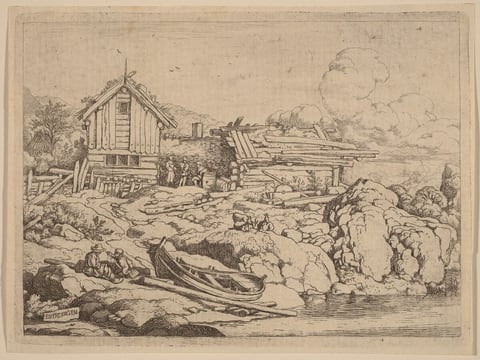
  1. The image shows a landscape with figures near a body of water. There are buildings made of logs, people gathered near a structure, and trees in the background. The style is detailed with precise linework, shading, and hatching. The color palette is monochrome, emphasizing light and shadow.
    Boat at a River Bank with Three GoatsAllart van Everdingen, probably c. 1645/1656Courtesy National Gallery of Art, Washington
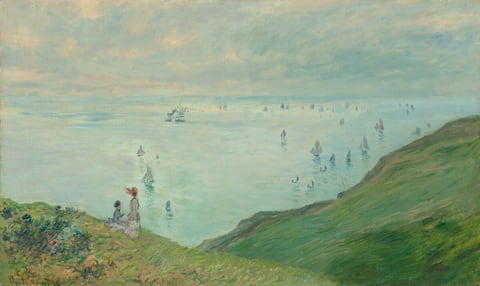
  2. From a high perspective, we look beyond two overlapping, emerald-green hills to a body of powder-blue water dotted with sailboats in this loosely painted horizontal landscape. Closest to us, the hills create a shallow V that spans the lower third of the composition, with the right-hand hill rising to more than halfway up the right edge. The hills are painted with dashes and long strokes mostly in seafoam, shamrock, and celery green, with some swipes of peach, goldenrod yellow, and royal blue. On the hill to our left, one woman sits and the other stands next to her. They wear hats, long-sleeved, fitted jackets, and long skirts in tones of dusky pink and dove gray. A touch of peach on the seated woman, to our left, gives the impression of a pale face. A red veil or scarf at the back of the other woman’s hat is lifted, as if in the wind. The water is painted with blended strokes of pale blue, light turquoise, smoky mauve pink, and touches of soft peach. The horizon comes two-thirds of the way up the composition, and the sky is painted with the same tones of blue, green, and peach to suggest a screen of clouds. Triangles and dashes of slate blue suggest about three dozen sailboats, rowboats, and one steamship in the rippling water. Squiggles of teal and sage green create reflections for some of the boats. The brushstrokes are visible throughout. In some areas, the paint is so thinly applied that the texture of the canvas shows through, especially in the sky. The artist signed the work in the lower left corner: “Claude Monet 82.”
    Cliffs at PourvilleClaude Monet, 1882Courtesy National Gallery of Art, Washington
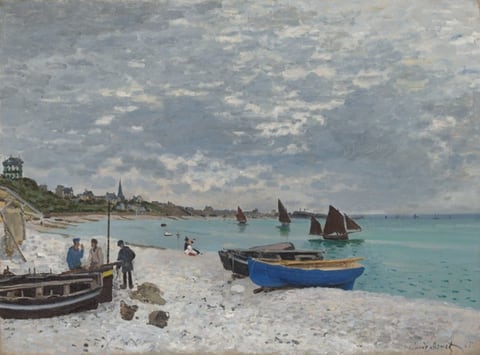
  3. Painting of a beach on a cloudy day with several sailboats on the water, a few rowboats on the shore, and two groupings of people on the sand.
    The Beach at Sainte-AdresseClaude Monet, 1867Courtesy of the Art Institute of Chicago