Floor plan

The RotundaThe Rotunda

The Rotunda

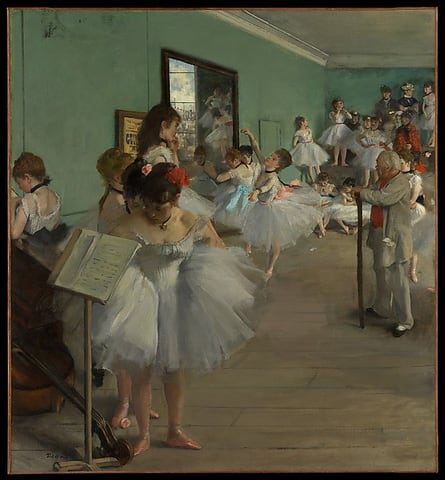
The Dance Class, by Edgar Degas, 1874
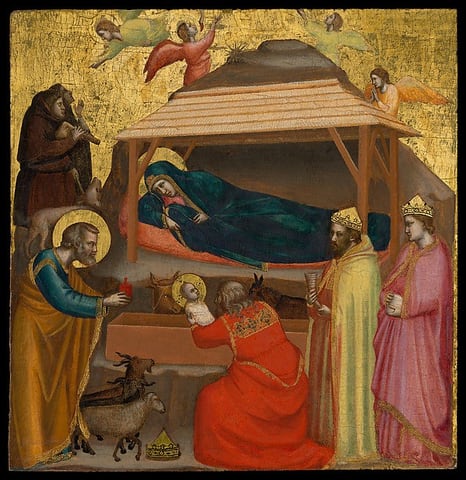
The Adoration of the Magi, by Giotto di Bondone, possibly ca. 1320
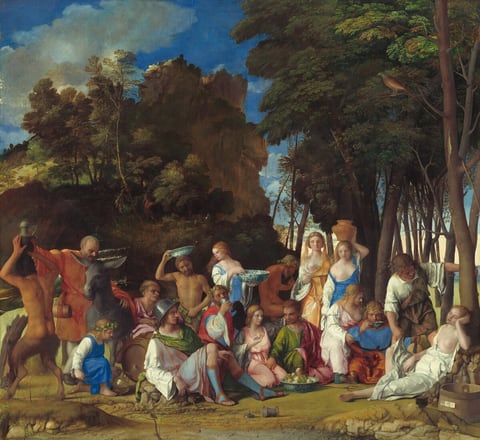
Six women, eight men, two satyrs, and one child gather in pairs and trios in a loose row that spans the width of this nearly square painting. They are set within a landscape with craggy rocks, cliffs, and trees. Most of the people face us, and the men, women, and child have pale skin. The two satyrs have men’s torsos and furry goat’s legs, and they have darker, olive complexions. Most of the men wear voluminous, knee-length togas wrapped in short robes in shades of white, topaz blue, grass green, coral orange, or rose pink. Most of the women wear long, dress-like garments in tones of shell pink, apricot orange, or lapis blue over white sleeves. For all but one woman, their garments have fallen off one shoulder to reveal a round, firm breast. Several objects are strewn on the rocky, dirt ground in front of the group, including a wide, wooden bucket with a piece of paper affixed to its front to our right, a glass goblet, a pitchfork, a large blue and white ceramic dish filled with grapes and small yellow fruits, and an overturned cup near the center. Cliff-like, craggy rocks rise steeply behind the group to our left, filling much of the sky opposite a tall grove of leafy, dark green trees to our right. A few puffy white clouds float across the vivid blue sky. The slip of paper on the barrel has been inscribed, “joannes bellinus venetus p MDXIIII.”
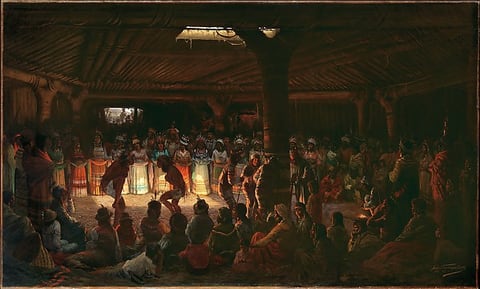
Dance in a Subterranean Roundhouse at Clear Lake, California, by Jules Tavernier, 1878

The works in this room are listed below.

Works in this room

The entrance hall. Its bays hold the works that show each museum at its fullest: large paintings first, a few from each collection, rehung every day.

Bay 1

  1. The Dance Class, by Edgar Degas, 1874
    The Dance ClassEdgar Degas, 1874Courtesy of The Metropolitan Museum of Art
  2. The Adoration of the Magi, by Giotto di Bondone, possibly ca. 1320
    The Adoration of the MagiGiotto di Bondone, possibly ca. 1320Courtesy of The Metropolitan Museum of Art

Bay 2

  1. Six women, eight men, two satyrs, and one child gather in pairs and trios in a loose row that spans the width of this nearly square painting. They are set within a landscape with craggy rocks, cliffs, and trees. Most of the people face us, and the men, women, and child have pale skin. The two satyrs have men’s torsos and furry goat’s legs, and they have darker, olive complexions. Most of the men wear voluminous, knee-length togas wrapped in short robes in shades of white, topaz blue, grass green, coral orange, or rose pink. Most of the women wear long, dress-like garments in tones of shell pink, apricot orange, or lapis blue over white sleeves. For all but one woman, their garments have fallen off one shoulder to reveal a round, firm breast. Several objects are strewn on the rocky, dirt ground in front of the group, including a wide, wooden bucket with a piece of paper affixed to its front to our right, a glass goblet, a pitchfork, a large blue and white ceramic dish filled with grapes and small yellow fruits, and an overturned cup near the center. Cliff-like, craggy rocks rise steeply behind the group to our left, filling much of the sky opposite a tall grove of leafy, dark green trees to our right. A few puffy white clouds float across the vivid blue sky. The slip of paper on the barrel has been inscribed, “joannes bellinus venetus p MDXIIII.”
    The Feast of the GodsGiovanni Bellini, 1514/1529Courtesy National Gallery of Art, Washington
  2. Dance in a Subterranean Roundhouse at Clear Lake, California, by Jules Tavernier, 1878
    Dance in a Subterranean Roundhouse at Clear Lake, CaliforniaJules Tavernier, 1878Courtesy of The Metropolitan Museum of Art

Bay 3
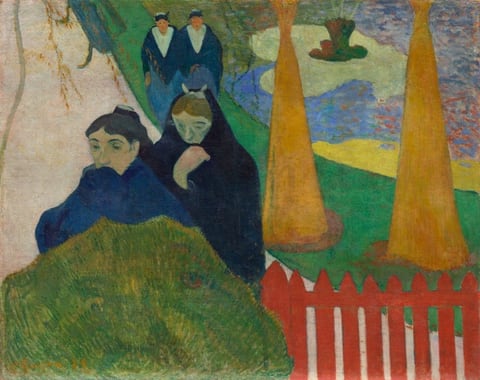
  1. Painting of four women with blue shawls walking near red fence.
    Arlésiennes (Mistral)Paul Gauguin, 1888Courtesy of the Art Institute of Chicago
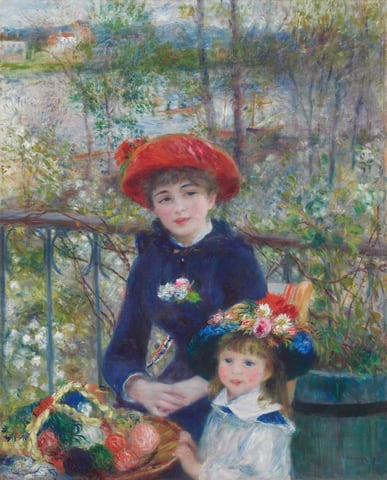
  2. Impressionist painting of two girls on balcony, bright flower hat, knitting basket.
    Two Sisters (On the Terrace)Pierre-Auguste Renoir, 1881Courtesy of the Art Institute of Chicago

Bay 4
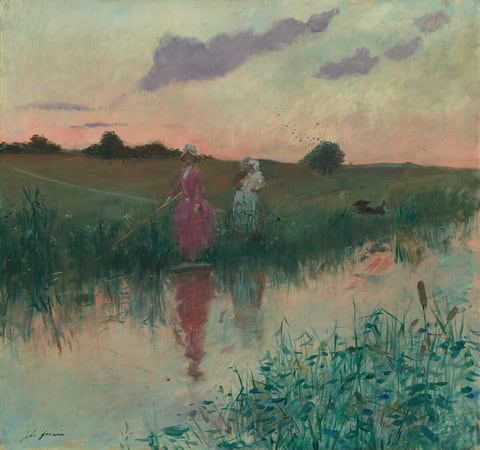
  1. In this painting, there are two women standing near a body of water, surrounded by tall green grass and white flowers. One woman wears a bright pink dress, while the other wears a brown dress with a white apron. The woman in pink holds a long, thin rod outwards, its other end connected to a thin string and a small red lure floating on the water. The other woman stands behind her and holds a baby wearing white clothes and a white bonnet. Behind both women, on the right, is a brown shape like a small dog running towards them. The reflection of the women is visible against the still, blue water. The sky is light blue at the top, transitioning to a warm pink by the horizon, crossed by purple clouds and a flock of small birds. In the bottom right corner, across the water from the women, is a patch of more tall blue-and-green grass. The brushstrokes of the painting are light and feathery.
    The Artist's Wife FishingJean Louis Forain, 1896Courtesy National Gallery of Art, Washington
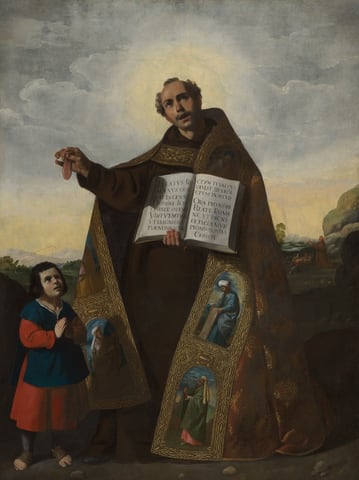
  2. A work made of oil on canvas.
    Saint Romanus of Antioch and Saint BarulasFrancisco de Zurbarán, 1638Courtesy of the Art Institute of Chicago