Floor plan

The RotundaThe Rotunda

The Rotunda

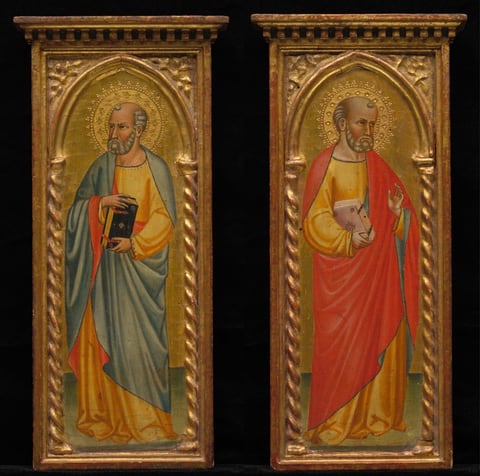
Standing Saint and Saint in Red Cloak (pair), late 19th - early 20th century
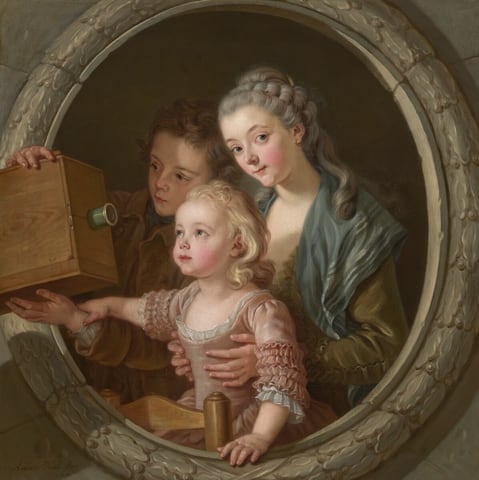
A young woman and two children are shown from the waist up through an oval, stone opening, holding and looking at a wooden box with a lens protruding from one side in this square painting. All three people have pale skin with rosy cheeks. To our right, the young woman’s body is angled to our left as she braces the torso of a young girl. The young woman looks at us from the corners of her sage-green eyes, under lifted brows. Her small, pink mouth is pursed in a slight smile, and she has a faint dimple in her rounded chin. Her heather-gray hair is partially plaited over the crown of her head, and long curls fall over her shoulders. She wears a spruce-blue shawl over the shoulders of her low-cut, olive-green dress. The child she braces has chubby cheeks, and her wavy blond hair is brushed back from her forehead and falls loosely to her shoulders. She wears a blush-pink dress with ruffles on the half-length sleeves and gossamer-white trim around the neckline and cuffs. The top and side rails of a wooden, ladderback chair up against the inside of the opening suggests she stands or kneels on a backward-facing chair. She rests her left hand on the edge of the stone opening and her other hand on the wrist of the boy standing close behind her. Mostly in the shadow behind the others, the boy has small, pointed features and short, curly, sable-brown hair. He wears a tan coat, and a muted blue scarf is tied at his throat. The two children gaze at the wooden box the boy holds, which is about the size of a toaster. A short, cylindrical, brass-lined lens pokes out of the center of the side facing the trio. The oval opening through which we see them is carved on our side with stylized leaves and berries, and the wall around it is the same elephant gray as the carvings. The girl and the box cast a shadow across the opening. The artist signed and dated the painting in the lower left corner, “Amedee Can Loo./1764.”
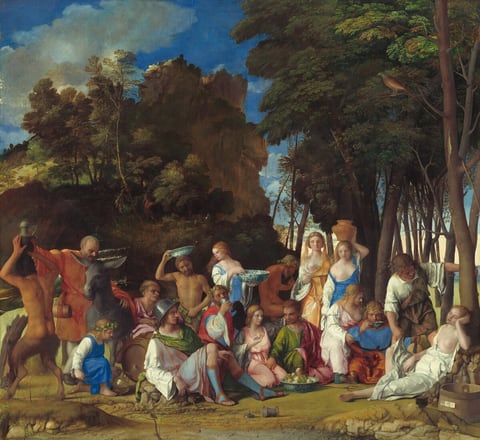
Six women, eight men, two satyrs, and one child gather in pairs and trios in a loose row that spans the width of this nearly square painting. They are set within a landscape with craggy rocks, cliffs, and trees. Most of the people face us, and the men, women, and child have pale skin. The two satyrs have men’s torsos and furry goat’s legs, and they have darker, olive complexions. Most of the men wear voluminous, knee-length togas wrapped in short robes in shades of white, topaz blue, grass green, coral orange, or rose pink. Most of the women wear long, dress-like garments in tones of shell pink, apricot orange, or lapis blue over white sleeves. For all but one woman, their garments have fallen off one shoulder to reveal a round, firm breast. Several objects are strewn on the rocky, dirt ground in front of the group, including a wide, wooden bucket with a piece of paper affixed to its front to our right, a glass goblet, a pitchfork, a large blue and white ceramic dish filled with grapes and small yellow fruits, and an overturned cup near the center. Cliff-like, craggy rocks rise steeply behind the group to our left, filling much of the sky opposite a tall grove of leafy, dark green trees to our right. A few puffy white clouds float across the vivid blue sky. The slip of paper on the barrel has been inscribed, “joannes bellinus venetus p MDXIIII.”
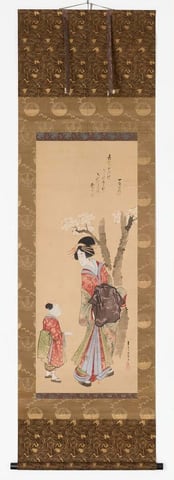
Hanging scroll

The works in this room are listed below.

Works in this room

The entrance hall. Its bays hold the works that show each museum at its fullest: large paintings first, a few from each collection, rehung every day.

Bay 1

  1. Standing Saint and Saint in Red Cloak (pair), late 19th - early 20th century
    Standing Saint and Saint in Red Cloak (pair)Unrecorded Italian maker, late 19th - early 20th centuryCourtesy of the Cleveland Museum of Art
  2. A young woman and two children are shown from the waist up through an oval, stone opening, holding and looking at a wooden box with a lens protruding from one side in this square painting. All three people have pale skin with rosy cheeks. To our right, the young woman’s body is angled to our left as she braces the torso of a young girl. The young woman looks at us from the corners of her sage-green eyes, under lifted brows. Her small, pink mouth is pursed in a slight smile, and she has a faint dimple in her rounded chin. Her heather-gray hair is partially plaited over the crown of her head, and long curls fall over her shoulders. She wears a spruce-blue shawl over the shoulders of her low-cut, olive-green dress. The child she braces has chubby cheeks, and her wavy blond hair is brushed back from her forehead and falls loosely to her shoulders. She wears a blush-pink dress with ruffles on the half-length sleeves and gossamer-white trim around the neckline and cuffs. The top and side rails of a wooden, ladderback chair up against the inside of the opening suggests she stands or kneels on a backward-facing chair. She rests her left hand on the edge of the stone opening and her other hand on the wrist of the boy standing close behind her. Mostly in the shadow behind the others, the boy has small, pointed features and short, curly, sable-brown hair. He wears a tan coat, and a muted blue scarf is tied at his throat. The two children gaze at the wooden box the boy holds, which is about the size of a toaster. A short, cylindrical, brass-lined lens pokes out of the center of the side facing the trio. The oval opening through which we see them is carved on our side with stylized leaves and berries, and the wall around it is the same elephant gray as the carvings. The girl and the box cast a shadow across the opening. The artist signed and dated the painting in the lower left corner, “Amedee Can Loo./1764.”
    The Camera ObscuraCharles Amédée Philippe Van Loo, 1764Courtesy National Gallery of Art, Washington

Bay 2

  1. Six women, eight men, two satyrs, and one child gather in pairs and trios in a loose row that spans the width of this nearly square painting. They are set within a landscape with craggy rocks, cliffs, and trees. Most of the people face us, and the men, women, and child have pale skin. The two satyrs have men’s torsos and furry goat’s legs, and they have darker, olive complexions. Most of the men wear voluminous, knee-length togas wrapped in short robes in shades of white, topaz blue, grass green, coral orange, or rose pink. Most of the women wear long, dress-like garments in tones of shell pink, apricot orange, or lapis blue over white sleeves. For all but one woman, their garments have fallen off one shoulder to reveal a round, firm breast. Several objects are strewn on the rocky, dirt ground in front of the group, including a wide, wooden bucket with a piece of paper affixed to its front to our right, a glass goblet, a pitchfork, a large blue and white ceramic dish filled with grapes and small yellow fruits, and an overturned cup near the center. Cliff-like, craggy rocks rise steeply behind the group to our left, filling much of the sky opposite a tall grove of leafy, dark green trees to our right. A few puffy white clouds float across the vivid blue sky. The slip of paper on the barrel has been inscribed, “joannes bellinus venetus p MDXIIII.”
    The Feast of the GodsGiovanni Bellini, 1514/1529Courtesy National Gallery of Art, Washington
  2. Hanging scroll
    A courtesan and her attendant under a cherry treeTawaraya Sori III, late 18th-early 19th centuryCourtesy of the National Museum of Asian Art, Smithsonian Institution

Bay 3
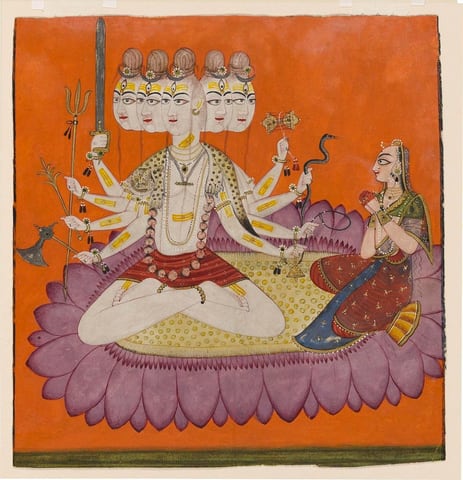
  1. Painting
    Sadashiva worshipped by ParvatiDevidasa, ca. 1690Courtesy of the National Museum of Asian Art, Smithsonian Institution
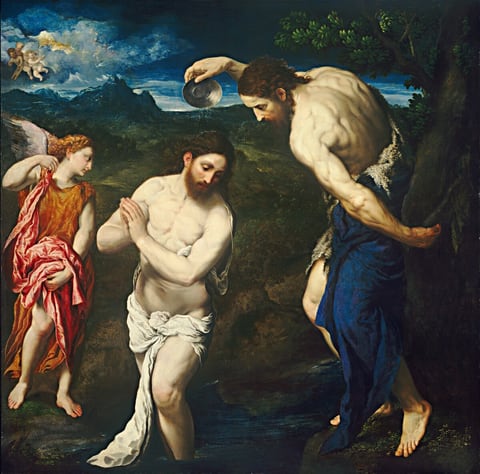
  2. Bright light from the upper left illuminates two muscular men and a winged angel against a dim landscape in this square painting. They all have pale skin, and the two men have dark brown hair and beards. One man, Jesus, stands ankle-deep in a rippling dark blue stream in the center of the composition facing us with downcast eyes. He is nude except for a white cloth that drapes over one shoulder and is tied around his hips. The other end of the cloth drops into the water. Jesus’s hands are pressed together in prayer at chest-height closer to his right shoulder, to our left. He leans his torso in the other direction and looks down at the water. The second man stands on the riverbank to our right. His body faces our left but his left shoulder, closer to us, dips down so his broad back is angled toward us. His lower body is wrapped in a cobalt-blue garment bordered with what looks like sheepskin. His near hand swings back to clutch the trunk of a tree growing immediately behind him. In his other hand, he holds up a pewter-grey dish that dribbles water onto Jesus’s head. On the left riverbank, the copper-haired angel looks on, facing our right in profile but the body faces us. The angel wears a sleeveless, pumpkin-orange robe with a shimmering salmon-pink mantle draped over the right shoulder, to our left. Petal-pink and dark grey wings extend from the shoulders, and the lower legs and feet are bare. The shadowy landscape has a dark green field stretching back to jagged, sapphire-blue mountains along the horizon, which comes four-fifths of the way up this composition. Pale blue clouds skim across the vivid blue sky, where three chubby, winged babies float. One holds a triangle and a rod with which to strike it, and another might hold a rectangular musical instrument. Blue clouds split nearby to show a sliver of golden yellow light, and possibly more angels.
    The Baptism of ChristParis Bordone, c. 1535/1540Courtesy National Gallery of Art, Washington

Bay 4
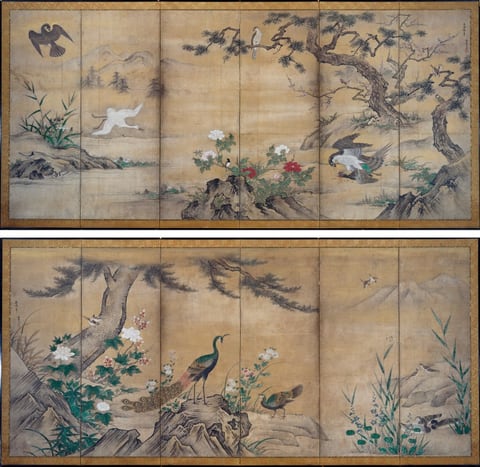
  1. Birds and Flowers, by Kano Mitsunobu, late 1500s
    Birds and FlowersKano Mitsunobu, late 1500sCourtesy of the Cleveland Museum of Art
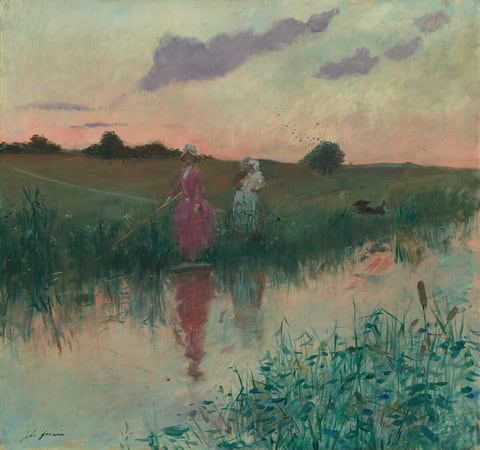
  2. In this painting, there are two women standing near a body of water, surrounded by tall green grass and white flowers. One woman wears a bright pink dress, while the other wears a brown dress with a white apron. The woman in pink holds a long, thin rod outwards, its other end connected to a thin string and a small red lure floating on the water. The other woman stands behind her and holds a baby wearing white clothes and a white bonnet. Behind both women, on the right, is a brown shape like a small dog running towards them. The reflection of the women is visible against the still, blue water. The sky is light blue at the top, transitioning to a warm pink by the horizon, crossed by purple clouds and a flock of small birds. In the bottom right corner, across the water from the women, is a patch of more tall blue-and-green grass. The brushstrokes of the painting are light and feathery.
    The Artist's Wife FishingJean Louis Forain, 1896Courtesy National Gallery of Art, Washington