
Floor plan

North wing: East AsiaThe Floating World

The Floating World

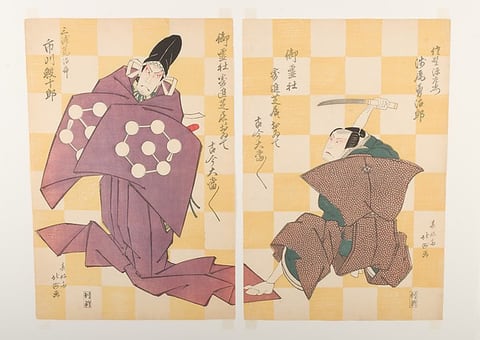
Kabuki Actors Asao Yūjirō as Sano Genzaemon and Ichikawa Ebijūrō I as Miura Arajirō, in the play Keisei Sano no Funabashi, by Shunkōsai Hokushū, 1822
The Actor Segawa Tomisaburo II as the Otomos' Maid Wakakusa, Actually Prince Korehito, by Tōshūsai Sharaku, 1794–75
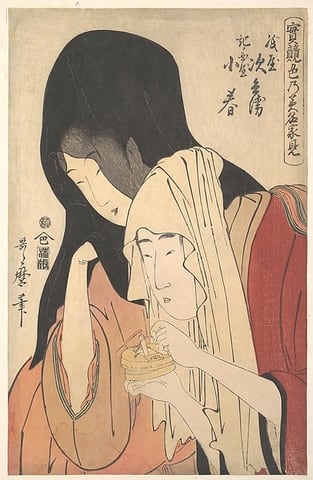
Jihei of Kamiya Eloping with the Geisha Koharu of Kinokuniya, from the series “True Feelings Compared: The Founts of Love” (Jitsu kurabe iro no Minakami), by Kitagawa Utamaro, ca. 1798–99
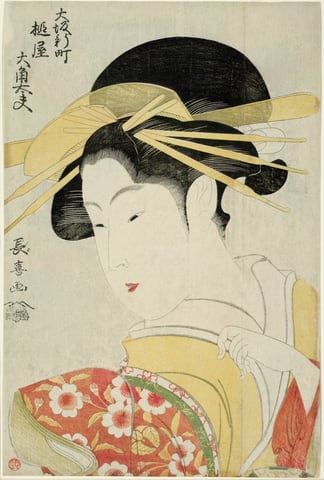
A work made of color woodblock print; oban.
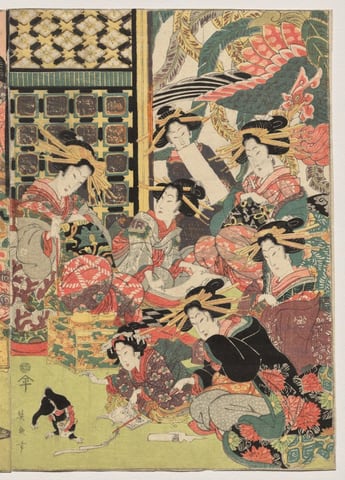
A Picture of the Viewing in the Pleasure Quarters, by Kikukawa Eizan, 1810s
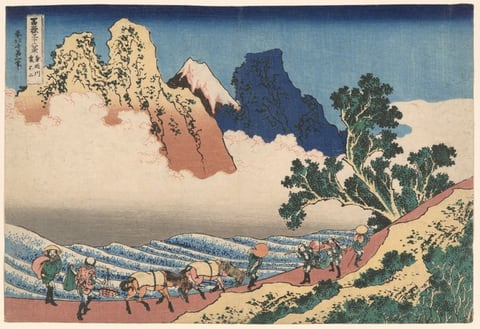
Print showing a string of travelers with horses walking along a narrow hillside path beneath an enormous craggy beige mountain at left and an equally massive and craggy deep-blue mountain at right. A brown snow-covered peak appears between these mountains. A mass of cream-colored clouds and a river with rounded ripples fill the middle plane of the composition.

The works in this room are listed below.

Works in this room

Japanese woodblock prints of the floating world: actors, courtesans, landscapes and the sea.

Section 1, north wall

  1. Kabuki Actors Asao Yūjirō as Sano Genzaemon and Ichikawa Ebijūrō I as Miura Arajirō, in the play Keisei Sano no Funabashi, by Shunkōsai Hokushū, 1822
    Kabuki Actors Asao Yūjirō as Sano Genzaemon and Ichikawa Ebijūrō I as Miura Arajirō, in the play Keisei Sano no FunabashiShunkōsai Hokushū, 1822Courtesy of The Metropolitan Museum of Art
  2. The Actor Segawa Tomisaburo II as the Otomos' Maid Wakakusa, Actually Prince Korehito, by Tōshūsai Sharaku, 1794–75
    The Actor Segawa Tomisaburo II as the Otomos' Maid Wakakusa, Actually Prince KorehitoTōshūsai Sharaku, 1794–75Courtesy of The Metropolitan Museum of Art
  3. Jihei of Kamiya Eloping with the Geisha Koharu of Kinokuniya, from the series “True Feelings Compared: The Founts of Love” (Jitsu kurabe iro no Minakami), by Kitagawa Utamaro, ca. 1798–99
    Jihei of Kamiya Eloping with the Geisha Koharu of Kinokuniya, from the series “True Feelings Compared: The Founts of Love” (Jitsu kurabe iro no Minakami)Kitagawa Utamaro, ca. 1798–99Courtesy of The Metropolitan Museum of Art

Section 1, south wall

  1. A work made of color woodblock print; oban.
    Osumi, a Tayu of the Tsuchiya in the Shinmachi Quarter in OsakaEishosai Choki, c. 1796/97Courtesy of the Art Institute of Chicago
  2. A Picture of the Viewing in the Pleasure Quarters, by Kikukawa Eizan, 1810s
    A Picture of the Viewing in the Pleasure QuartersKikukawa Eizan, 1810sCourtesy of the Cleveland Museum of Art
  3. Print showing a string of travelers with horses walking along a narrow hillside path beneath an enormous craggy beige mountain at left and an equally massive and craggy deep-blue mountain at right. A brown snow-covered peak appears between these mountains. A mass of cream-colored clouds and a river with rounded ripples fill the middle plane of the composition.
    The Back of Mount Fuji Seen from Minobu River (Minobugawa Urafuji), from the series Thirty-Six Views of Mount Fuji (Fugaku sanjūrokkei)Katsushika Hokusai, 1830-33Courtesy of the Art Institute of Chicago

Section 2, south wall
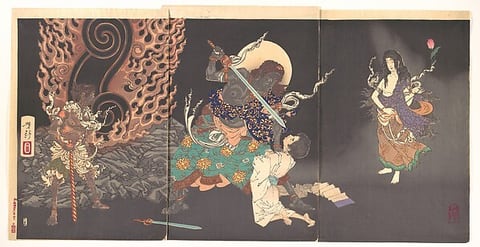
  1. Fudō Myōō Threatening a Novice, by Tsukioka Yoshitoshi, 1885
    Fudō Myōō Threatening a NoviceTsukioka Yoshitoshi, 1885Courtesy of The Metropolitan Museum of Art
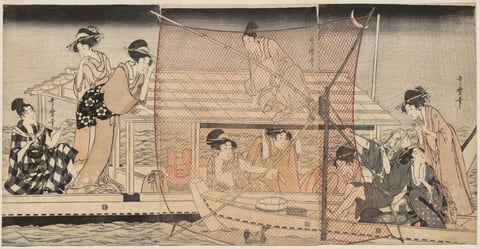
  2. Net Fishing at Night on the Sumida River, by Kitagawa Utamaro, c. 1800
    Net Fishing at Night on the Sumida RiverKitagawa Utamaro, c. 1800Courtesy of the Cleveland Museum of Art
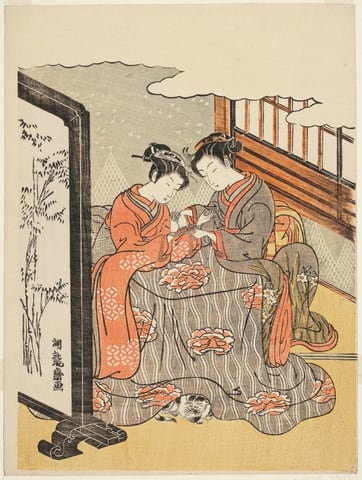
  3. A work made of color woodblock print; chuban.
    Two Young Women Playing Cat's CradleIsoda Koryusai, c. 1769Courtesy of the Art Institute of Chicago

Section 2, north wall
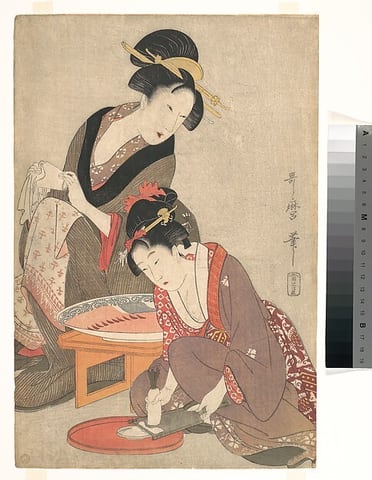
  1. Women Grating Radish for Sashimi, by Kitagawa Utamaro, ca. 1798–99
    Women Grating Radish for SashimiKitagawa Utamaro, ca. 1798–99Courtesy of The Metropolitan Museum of Art
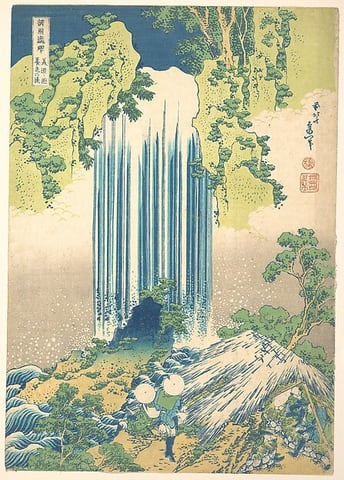
  2. Yōrō Waterfall in Mino Province (Mino no Yōrō no taki), from the series A Tour of Waterfalls in Various Provinces (Shokoku taki meguri), by Katsushika Hokusai, ca. 1832
    Yōrō Waterfall in Mino Province (Mino no Yōrō no taki), from the series A Tour of Waterfalls in Various Provinces (Shokoku taki meguri)Katsushika Hokusai, ca. 1832Courtesy of The Metropolitan Museum of Art
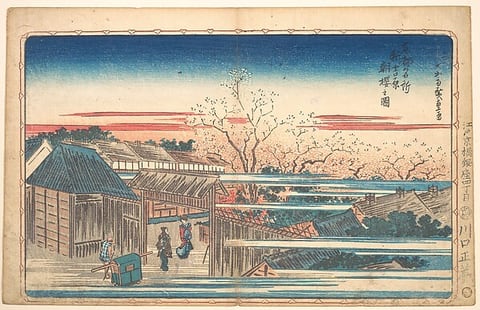
  3. Morning Cherries at Yoshiwara, by Utagawa Hiroshige
    Morning Cherries at YoshiwaraUtagawa HiroshigeCourtesy of The Metropolitan Museum of Art

Section 3, north wall
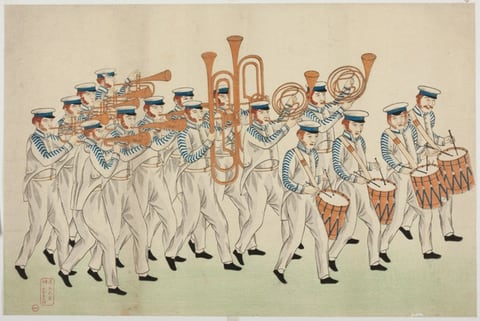
  1. A work made of color woodblock print.
    Procession of Russian Marching Band, from the Album of seven prints of Russian Army and Warship (Roshia seigi shashin kan), 1853Keiga, 1853Courtesy of the Art Institute of Chicago
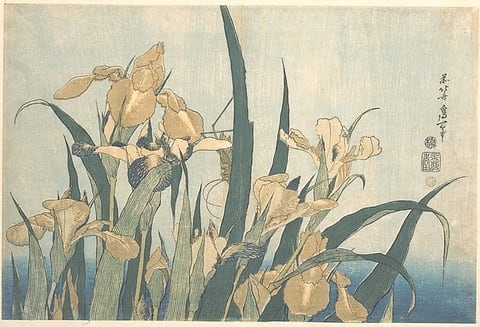
  2. Grasshopper and Iris, by Katsushika Hokusai, late 1820s
    Grasshopper and IrisKatsushika Hokusai, late 1820sCourtesy of The Metropolitan Museum of Art

Section 3, south wall
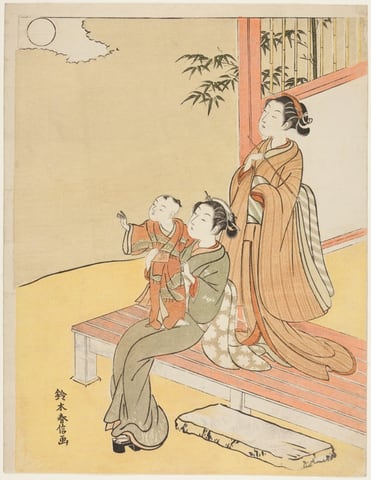
  1. A work made of color woodblock print; chuban.
    Viewing the MoonSuzuki Harunobu, c. 1767/68Courtesy of the Art Institute of Chicago
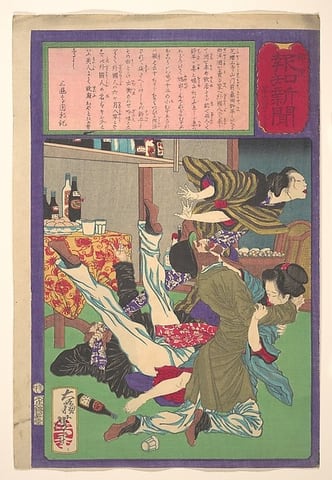
  2. Postal Hōchi Newspaper no. 645, Englishman raping a wine shopkeeper's daughter (Yūbin Hōchi shinbun, roppyaku yonjū gogō), by Tsukioka Yoshitoshi, August, 1875
    Postal Hōchi Newspaper no. 645, Englishman raping a wine shopkeeper's daughter (Yūbin Hōchi shinbun, roppyaku yonjū gogō)Tsukioka Yoshitoshi, August, 1875Courtesy of The Metropolitan Museum of Art