Floor plan

Style galleriesUkiyo-e

Ukiyo-e

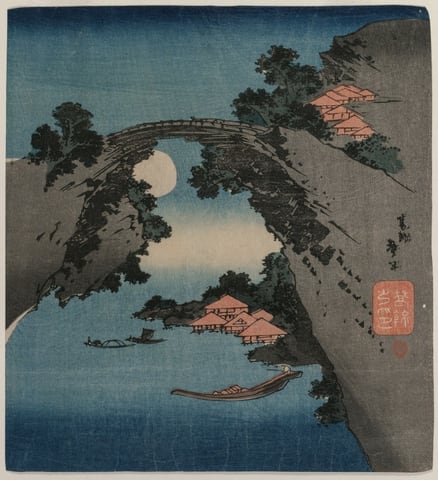
The Monkey Bridge, by Katsushika Taito II, early 1830s
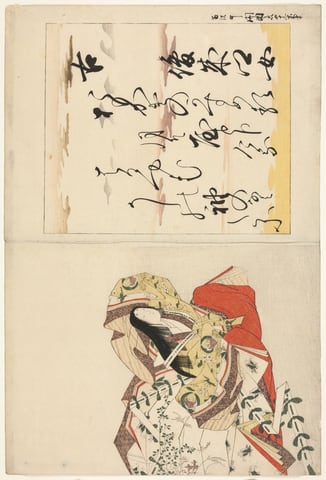
A work made of page from a color woodblock-printed volume.
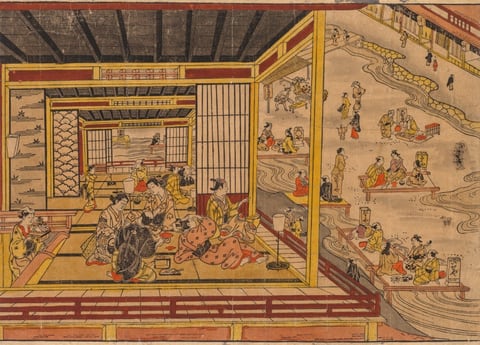
Tea House Beside the Kamo River in Kyoto, by Nishimura Shigenaga (Japanese, 1697(?)-1756), 1740s
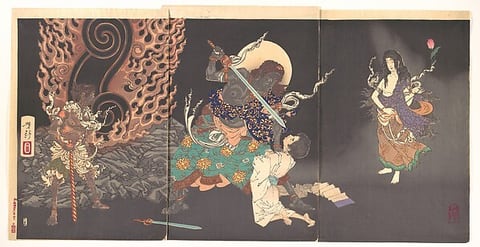
Fudō Myōō Threatening a Novice, by Tsukioka Yoshitoshi, 1885
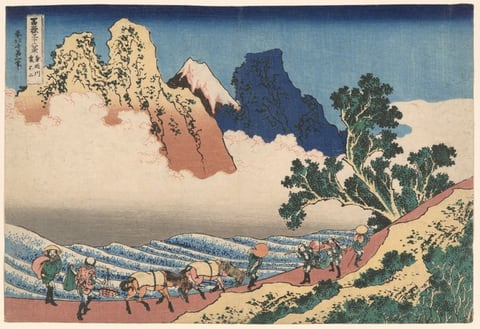
Print showing a string of travelers with horses walking along a narrow hillside path beneath an enormous craggy beige mountain at left and an equally massive and craggy deep-blue mountain at right. A brown snow-covered peak appears between these mountains. A mass of cream-colored clouds and a river with rounded ripples fill the middle plane of the composition.

The works in this room are listed below.

Works in this room

Japanese woodblock prints of the floating world: actors, courtesans, landscapes and the sea.

Section 1, north wall

  1. The Monkey Bridge, by Katsushika Taito II, early 1830s
    The Monkey BridgeKatsushika Taito II, early 1830sCourtesy of the Cleveland Museum of Art
  2. A work made of page from a color woodblock-printed volume.
    The Poetess Shunzei no Musume, from the series The Thirty-six Immortal Women Poets (Nishikizuri onna sanjurokkasen)Chôbunsai Eishi, Edo period (1615–1868), 1801Courtesy of the Art Institute of Chicago
  3. Tea House Beside the Kamo River in Kyoto, by Nishimura Shigenaga (Japanese, 1697(?)-1756), 1740s
    Tea House Beside the Kamo River in KyotoNishimura Shigenaga (Japanese, 1697(?)-1756), 1740sCourtesy of the Cleveland Museum of Art

Section 1, south wall

  1. Fudō Myōō Threatening a Novice, by Tsukioka Yoshitoshi, 1885
    Fudō Myōō Threatening a NoviceTsukioka Yoshitoshi, 1885Courtesy of The Metropolitan Museum of Art
  2. Print showing a string of travelers with horses walking along a narrow hillside path beneath an enormous craggy beige mountain at left and an equally massive and craggy deep-blue mountain at right. A brown snow-covered peak appears between these mountains. A mass of cream-colored clouds and a river with rounded ripples fill the middle plane of the composition.
    The Back of Mount Fuji Seen from Minobu River (Minobugawa Urafuji), from the series Thirty-Six Views of Mount Fuji (Fugaku sanjūrokkei)Katsushika Hokusai, 1830-33Courtesy of the Art Institute of Chicago

Section 2, south wall
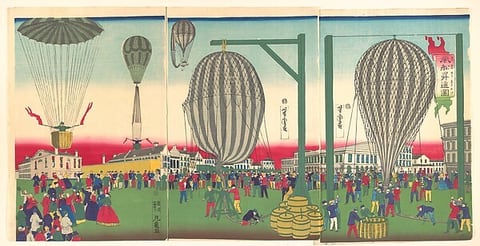
  1. Illustration of a Balloon Ascending (Fūsen shōyō no zu), by Utagawa Yoshitora, November, 1872
    Illustration of a Balloon Ascending (Fūsen shōyō no zu)Utagawa Yoshitora, November, 1872Courtesy of The Metropolitan Museum of Art
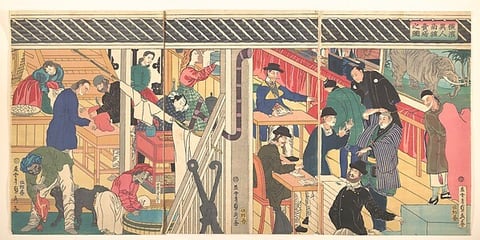
  2. Foreign Business Establishment in Yokohama (Yokohama ijin shōkan uriba no zu), by Utagawa (Gountei) Sadahide, 9th month, 1861
    Foreign Business Establishment in Yokohama (Yokohama ijin shōkan uriba no zu)Utagawa (Gountei) Sadahide, 9th month, 1861Courtesy of The Metropolitan Museum of Art
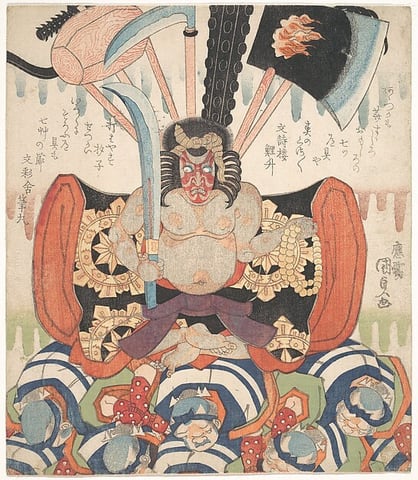
  3. Danjūrō VII's Benkei as Fudō Myōō, by Utagawa Kunisada, ca. 1824
    Danjūrō VII's Benkei as Fudō MyōōUtagawa Kunisada, ca. 1824Courtesy of The Metropolitan Museum of Art

Section 2, north wall
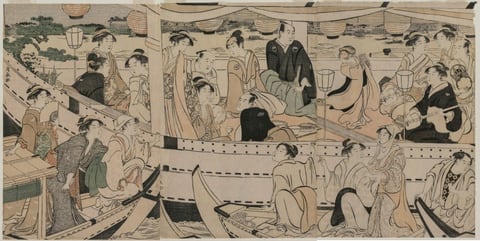
  1. Boating Party on the Sumida River, by Torii Kiyonaga, 1789
    Boating Party on the Sumida RiverTorii Kiyonaga, 1789Courtesy of the Cleveland Museum of Art
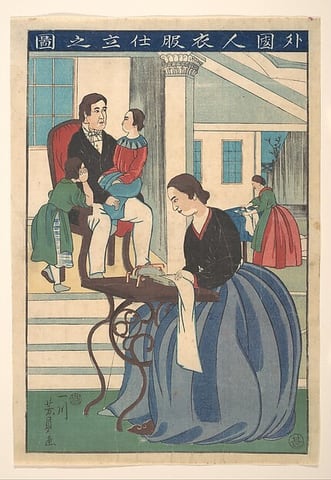
  2. Foreign Family with Wife Making Clothes (Gaikokujin ifuku shitate no zu), by Utagawa Yoshikazu, 1860
    Foreign Family with Wife Making Clothes (Gaikokujin ifuku shitate no zu)Utagawa Yoshikazu, 1860Courtesy of The Metropolitan Museum of Art
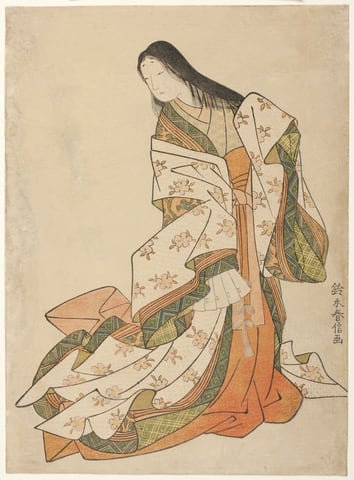
  3. A work made of color woodblock print; chuban.
    The Poetess Ono no KomachiSuzuki Harunobu, Edo period (1615–1868), 1767/68Courtesy of the Art Institute of Chicago

Section 3, north wall
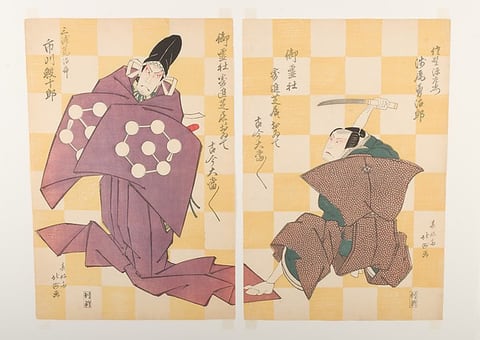
  1. Kabuki Actors Asao Yūjirō as Sano Genzaemon and Ichikawa Ebijūrō I as Miura Arajirō, in the play Keisei Sano no Funabashi, by Shunkōsai Hokushū, 1822
    Kabuki Actors Asao Yūjirō as Sano Genzaemon and Ichikawa Ebijūrō I as Miura Arajirō, in the play Keisei Sano no FunabashiShunkōsai Hokushū, 1822Courtesy of The Metropolitan Museum of Art
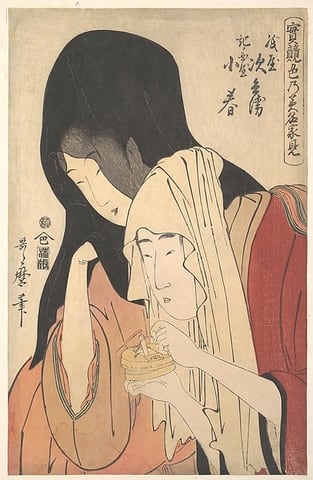
  2. Jihei of Kamiya Eloping with the Geisha Koharu of Kinokuniya, from the series “True Feelings Compared: The Founts of Love” (Jitsu kurabe iro no Minakami), by Kitagawa Utamaro, ca. 1798–99
    Jihei of Kamiya Eloping with the Geisha Koharu of Kinokuniya, from the series “True Feelings Compared: The Founts of Love” (Jitsu kurabe iro no Minakami)Kitagawa Utamaro, ca. 1798–99Courtesy of The Metropolitan Museum of Art
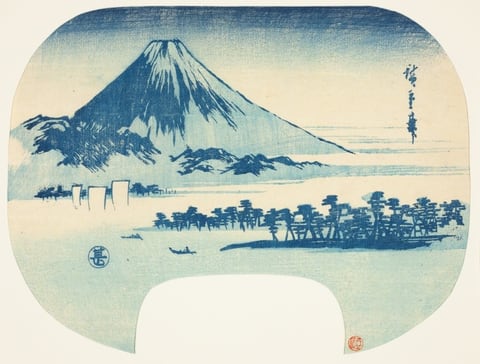
  3. A work made of color woodblock print; uchiwa-e, aizuri-e.
    Mount Fuji Rising beyond Miho BeachUtagawa Hiroshige, c. 1838/42Courtesy of the Art Institute of Chicago

Section 3, south wall
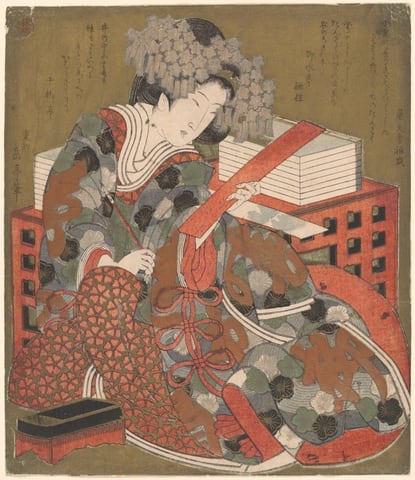
  1. A work made of color woodblock print with metallic pigments; surimono shikishiban.
    Woman About to Write a PoemYashima Gakutei, c. 1824Courtesy of the Art Institute of Chicago
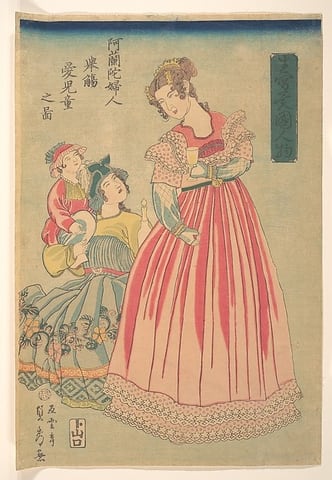
  2. Dutch Woman and Child (Seisha ikoku jinbutsu Oranda fujin aijidō no zu), by Utagawa (Gountei) Sadahide, 1860
    Dutch Woman and Child (Seisha ikoku jinbutsu Oranda fujin aijidō no zu)Utagawa (Gountei) Sadahide, 1860Courtesy of The Metropolitan Museum of Art