Floor plan

Style galleriesPrints of the 18th century
Prints of the 18th century
A work made of color woodblock print; hosoban.
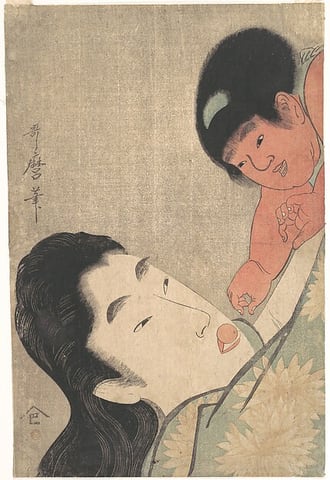
Yamauba and Kintarō Playing with a Cherry, by Kitagawa Utamaro, ca. 1795
A work made of color woodblock print.
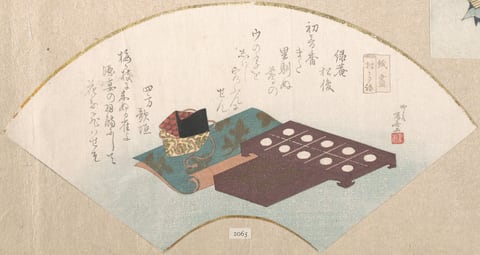
Outfit for the Game of Incense, by Ryūryūkyo Shinsai, 19th century
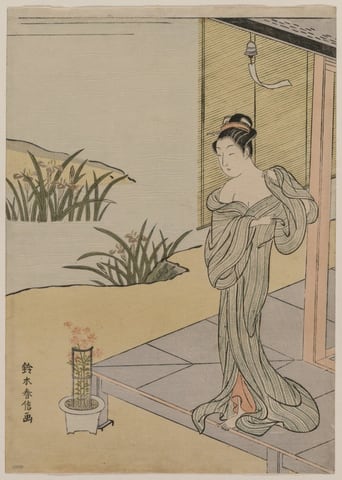
Young Woman Looking at a Pot of Pinks, by Suzuki Harunobu, c. 1767
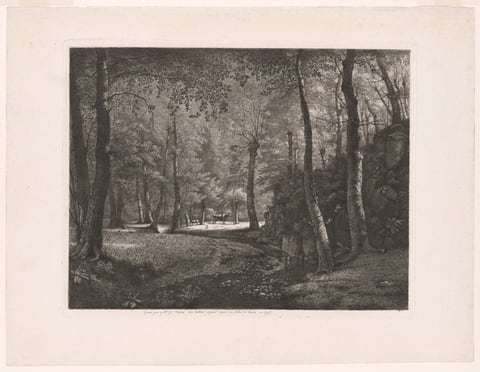
A work made of etching with roulette in black on ivory wove paper.

The works in this room are listed below.

Works in this room

Prints made in the 18th century, from every museum.

Section 1, north wall

  1. A work made of color woodblock print; hosoban.
    Actor Ichikawa Monnosuke II in an Unidentified RoleKatsukawa Shunkо̄, About 1785Courtesy of the Art Institute of Chicago
  2. Yamauba and Kintarō Playing with a Cherry, by Kitagawa Utamaro, ca. 1795
    Yamauba and Kintarō Playing with a CherryKitagawa Utamaro, ca. 1795Courtesy of The Metropolitan Museum of Art
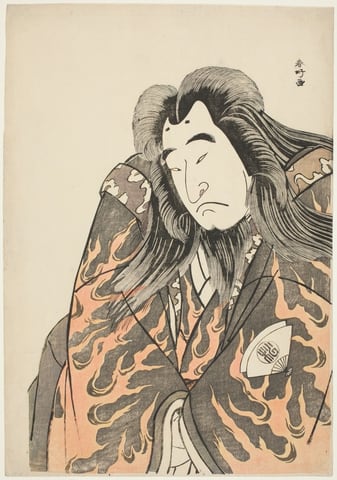
  3. A work made of color woodblock print.
    Actor Onoe Matsusuke I as Retired Emperor SutokuKatsukawa Shunkо̄, About 1780Courtesy of the Art Institute of Chicago

Section 1, south wall

  1. Outfit for the Game of Incense, by Ryūryūkyo Shinsai, 19th century
    Outfit for the Game of IncenseRyūryūkyo Shinsai, 19th centuryCourtesy of The Metropolitan Museum of Art
  2. Young Woman Looking at a Pot of Pinks, by Suzuki Harunobu, c. 1767
    Young Woman Looking at a Pot of PinksSuzuki Harunobu, c. 1767Courtesy of the Cleveland Museum of Art
  3. A work made of etching with roulette in black on ivory wove paper.
    The Forest of RochecardonJean-Michel Grobon, 1800Courtesy of the Art Institute of Chicago

Section 2, south wall
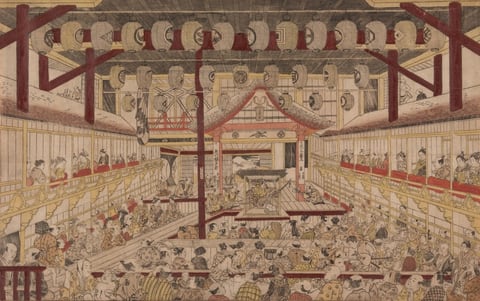
  1. Perspective View of the Interior of the Nakamura Theater with Ichikawa Ebizo II as Yanone Goro, by Okumura Masanobu, 1740
    Perspective View of the Interior of the Nakamura Theater with Ichikawa Ebizo II as Yanone GoroOkumura Masanobu, 1740Courtesy of the Cleveland Museum of Art
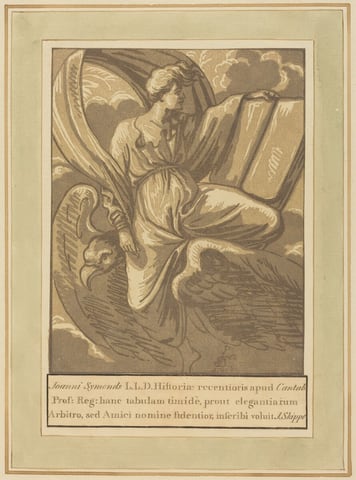
  2. This is a drawing of a seated figure on a large bird. The image depicts a classically draped figure seated on a stylized bird. The figure holds an open book and gazes into the distance. The bird has sharp features and spread wings. The background contains swirling clouds. The scene is framed with a border, and there is text at the bottom. The lines are bold and the shades are muted.
    Saint John the EvangelistJohn Skippe, 1771Courtesy National Gallery of Art, Washington
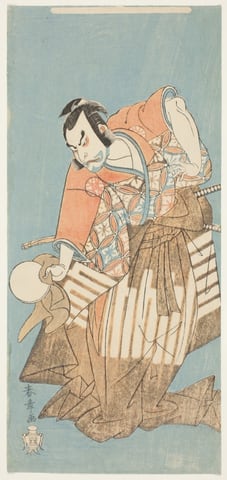
  3. A work made of color woodblock print; hosoban.
    Actor Nakamura Nakazô I as Osada no Tarô in The Genji Clan Now at Its Zenith (Ima o sakari suehiro Genji)Katsukawa Shunshō, About 1768Courtesy of the Art Institute of Chicago

Section 2, north wall
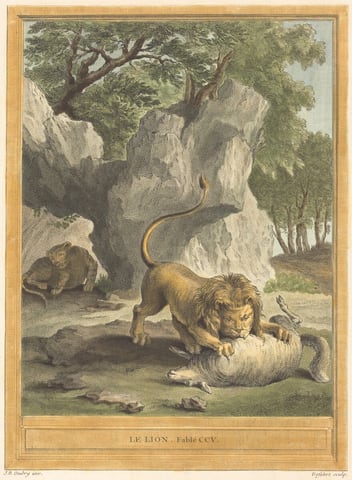
  1. This is a drawing of a lion in a forested rocky landscape. The lion is seen standing over a defeated animal. In the background, a forest with dense trees frames the scene. One monkey is visible among the rocks watching the lion. The setting conveys a wild, rugged terrain with rocky formations and scattered vegetation. Light and shadow emphasize textures in the lion's mane and the surrounding rocks. The composition focuses on the lion and its prey.
    Le lion (The Lion)A.-J. de Fehrt, published 1759Courtesy National Gallery of Art, Washington
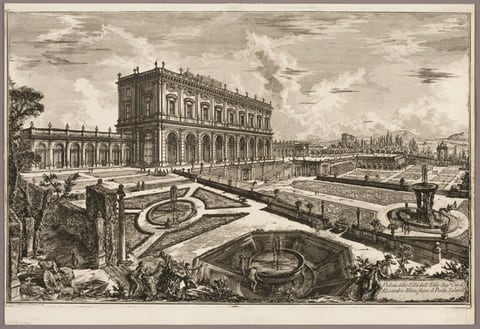
  2. A work made of etching on ivory laid paper.
    View of the Villa of His Eminence Cardinal Alessandro Albani, outside Porta Salaria, from Views of RomeGiovanni Battista Piranesi, 1769, published 1800–07Courtesy of the Art Institute of Chicago

Section 3, north wall
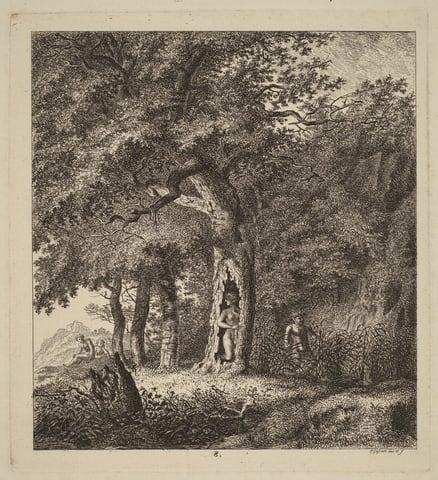
  1. The image shows an etching of a forest scene with towering trees dominating the upper half. The horizon is not clearly visible due to dense foliage, but a line of trees and rocky outcrops in the distance provide a boundary. The fine lines and cross-hatching technique create detailed textures in the tree bark and foliage. The color palette is monochromatic, in shades of black and white emphasizing light and shadow. A large tree with a partially hollow trunk and figures scattered throughout the scene give a sense of scale and activity within the forest setting.
    Wooded Landscape with a Nymph and a SatyrSalomon Gessner, 1764Courtesy National Gallery of Art, Washington
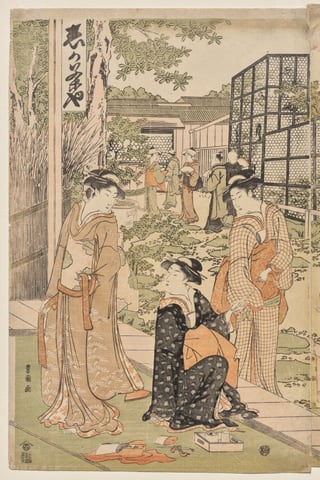
  2. The Shika Teahouse, by Utagawa Toyokuni, early 1790s
    The Shika TeahouseUtagawa Toyokuni, early 1790sCourtesy of the Cleveland Museum of Art
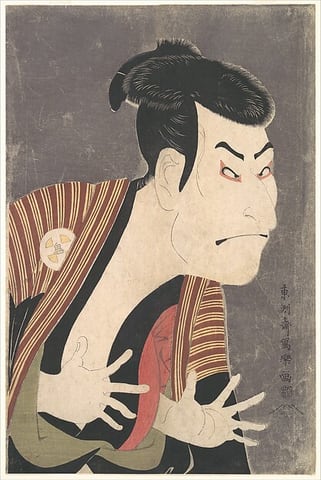
  3. Kabuki Actor Ōtani Oniji III as Yakko Edobei, by Tōshūsai Sharaku, 1794
    Kabuki Actor Ōtani Oniji III as Yakko EdobeiTōshūsai Sharaku, 1794Courtesy of The Metropolitan Museum of Art

Section 3, south wall
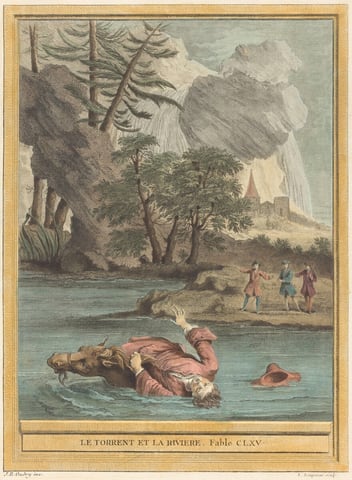
  1. The image shows a man in a red coat in a river, holding on to a horse. A hat floats nearby. Three figures in 18th-century clothing stand on a rocky riverbank looking concerned. In the background, there are trees, a castle-like structure, and large clouds. The brushstrokes are detailed, capturing movement and textures. The color palette includes muted tones like earthy browns, greens, soft blue, and subtle reds.
    Le torrent et la riviere (The Torrent and theRiver)Louis-Simon Lempereur, published 1756Courtesy National Gallery of Art, Washington
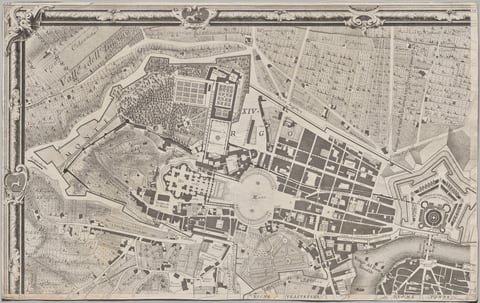
  2. Nuova pianta di Roma data in luce da Giambattista Nolli l’anno MDCCXLVII, known as La Pianta Grande di Roma, by Giovanni Battista Nolli, 1748
    Nuova pianta di Roma data in luce da Giambattista Nolli l’anno MDCCXLVII, known as La Pianta Grande di RomaGiovanni Battista Nolli, 1748Courtesy of the Cleveland Museum of Art