Floor plan

Style galleriesThe Northern Renaissance
The Northern Renaissance
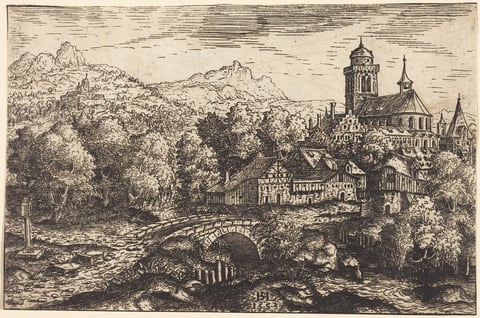
The image features a landscape view of a medieval village scene. It includes a stone bridge over a river, buildings, a church with a tower, trees, hills, mountains, and cloudy sky. The image is depicted in intricate detail using a monochromatic palette, focusing on contrasts of light and shadow.
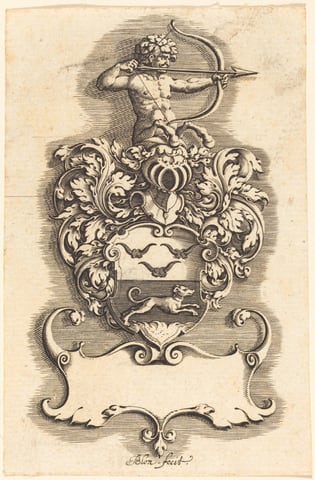
This is a drawing of a heraldic emblem. The image shows a centaur-like figure holding a bow and arrow, with leaves around its head. Below, there is a shield divided into two sections: the upper part shows shapes resembling birds, while the lower part shows a hound-like animal in a running pose. The shield is surrounded by swirling acanthus-like leaves, with additional decorative elements and a blank scroll space below it.
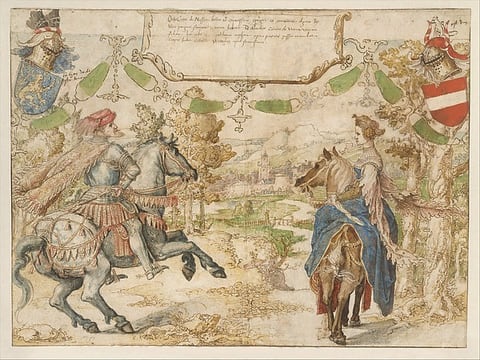
Otto, Count of Nassau and his Wife Adelheid van Vianen, by Bernard van Orley, 1530–35
A work made of pen and brown ink and brush and black and green washes, over black chalk, on cream laid paper.

The works in this room are listed below.

Works in this room

Dürer's prints, Holbein's portraits and the art of northern Europe in the 1500s.

Section 1, north wall

  1. The image features a landscape view of a medieval village scene. It includes a stone bridge over a river, buildings, a church with a tower, trees, hills, mountains, and cloudy sky. The image is depicted in intricate detail using a monochromatic palette, focusing on contrasts of light and shadow.
    Mountainous Landscape with a VillageHanns Lautensack, 1553Courtesy National Gallery of Art, Washington
  2. This is a drawing of a heraldic emblem. The image shows a centaur-like figure holding a bow and arrow, with leaves around its head. Below, there is a shield divided into two sections: the upper part shows shapes resembling birds, while the lower part shows a hound-like animal in a running pose. The shield is surrounded by swirling acanthus-like leaves, with additional decorative elements and a blank scroll space below it.
    CrestMichel Le BlonCourtesy National Gallery of Art, Washington

Section 1, south wall

  1. Otto, Count of Nassau and his Wife Adelheid van Vianen, by Bernard van Orley, 1530–35
    Otto, Count of Nassau and his Wife Adelheid van VianenBernard van Orley, 1530–35Courtesy of The Metropolitan Museum of Art
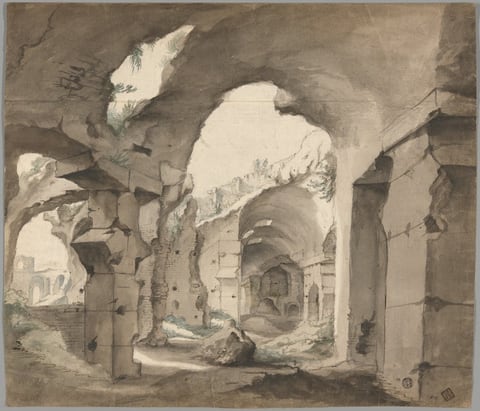
  2. A work made of pen and brown ink and brush and black and green washes, over black chalk, on cream laid paper.
    Interior View of the ColiseumLodewijk Toeput, c. 1580Courtesy of the Art Institute of Chicago

Section 2, south wall
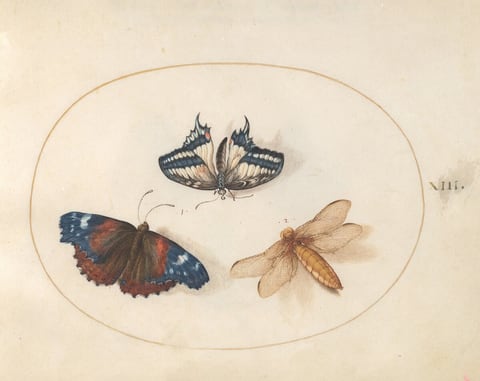
  1. Three insects are depicted in the image: a butterfly with dark blue and red wings on the bottom left, a larger butterfly with white, black, and blue patterns at the top center, and a dragonfly with brown and gold tones on the bottom right. The color palette includes rich blues, reds, browns, and golds against a neutral background. The central butterfly is positioned higher than the other two insects, with the left butterfly and right dragonfly symmetrically arranged below.
    Plate 13: Yellow Swallowtail and Red Admiral Butterflies with a Dragonfly (Broad-Bodied Chaser?)Joris Hoefnagel, c.1575/1590sCourtesy National Gallery of Art, Washington
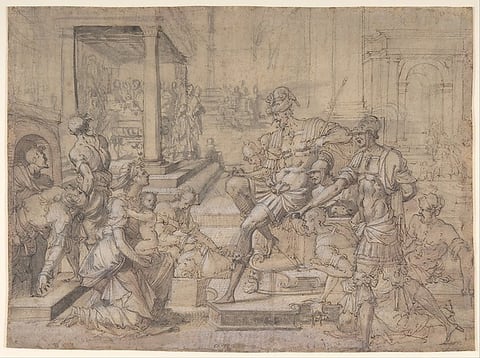
  2. Amya Petitioning Faustus for the Custody of Saint Mamas, by Jean Cousin the Elder, ca. 1543
    Amya Petitioning Faustus for the Custody of Saint MamasJean Cousin the Elder, ca. 1543Courtesy of The Metropolitan Museum of Art

Section 2, north wall
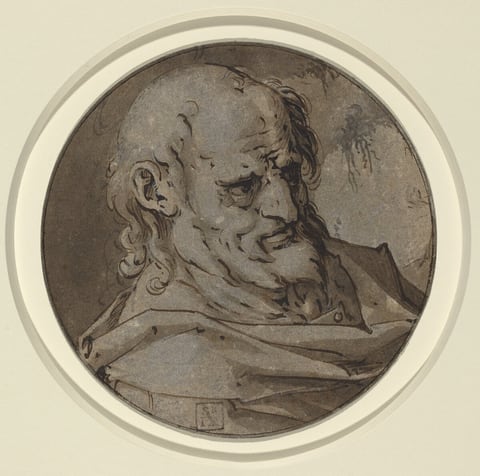
  1. The image features the upper body and head of a man in a circular frame. The man is facing slightly to the side and downward, with his body oriented to the left and his head turned towards the viewer. He has a prominent forehead, a defined nose, a furrowed brow, and a scrunched face. His hair is thinning on top, with longer strands curling around the back and sides of his head. The man has a beard with similar curled texture as his hair. He is wearing a garment that drapes over his shoulders, with visible folds and a texture that suggests a substantial fabric. No jewelry or objects are in his hands, as they are not visible in this image. The background is plain with a light, sketchy look, focusing attention on the man as the central figure in the circular composition.
    Head of an ApostleHendrick GoltziusCourtesy National Gallery of Art, Washington
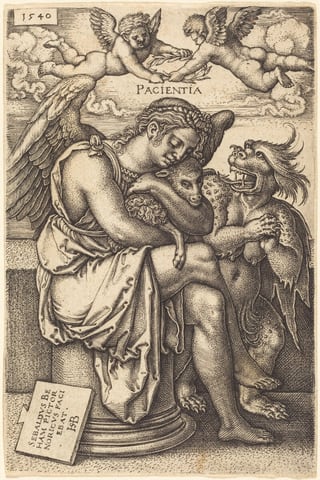
  2. This is a drawing of a winged figure with a sheep, accompanied by a mythical creature and cherubs. The central figure is holding the sheep tenderly. On the left, two cherubs are flying with a laurel branch, under the word "PACIENTIA." On the right is a mythical creature with dragon-like features. Below the scene, a plaque with an inscription is placed against the pedestal. The artwork is detailed with lines, cross-hatching, and shading, accentuating textures and forms.
    Pacientia (Patience)Sebald Beham, 1540Courtesy National Gallery of Art, Washington

Section 3, north wall
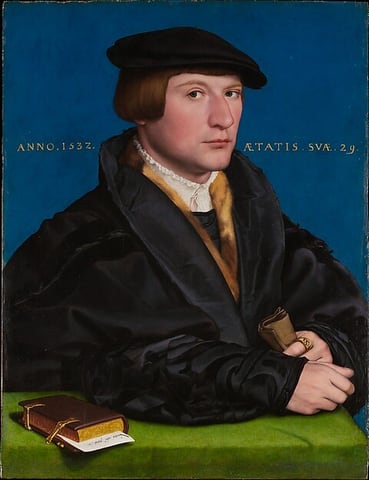
  1. Hermann von Wedigh III (died 1560), by Hans Holbein the Younger, 1532
    Hermann von Wedigh III (died 1560)Hans Holbein the Younger, 1532Courtesy of The Metropolitan Museum of Art
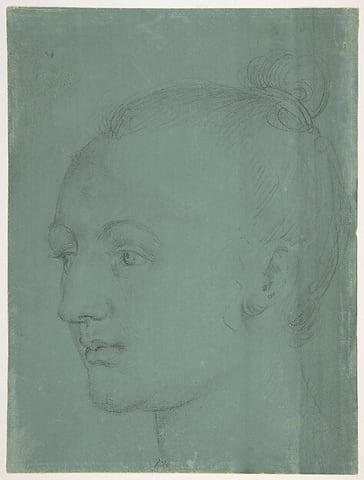
  2. Head of a Young Woman, by Albrecht Dürer, 1522
    Head of a Young WomanAlbrecht Dürer, 1522Courtesy of The Metropolitan Museum of Art
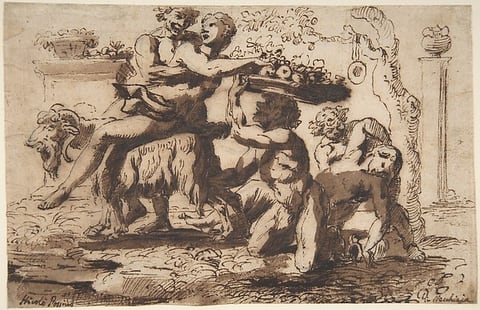
  3. Bacchanal, by Nicolas Poussin, ca. 1635–36
    BacchanalNicolas Poussin, ca. 1635–36Courtesy of The Metropolitan Museum of Art

Section 3, south wall
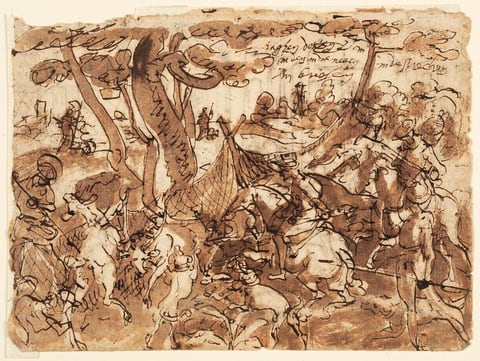
  1. DEER HUNT WITH NETS
    Deer Hunt with NetsJan van der Straet, called Stradanus, ca. 1590 – 1599Courtesy of Cooper Hewitt, Smithsonian Design Museum
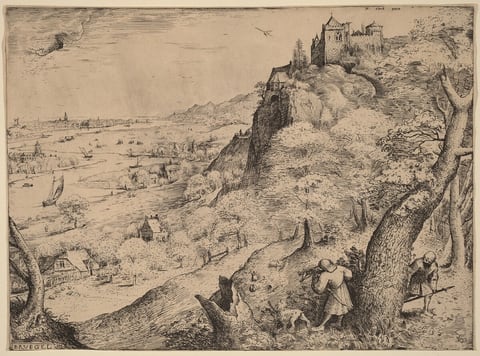
  2. The image shows a landscape with a city in the distance, a castle on a cliff, fields, forests, and two figures with a dog hunting. There are sailboats on water and houses on farmland. The style is detailed with etching lines in sepia tones.
    The Rabbit HuntersPieter Bruegel, 1560Courtesy National Gallery of Art, Washington

Section 4, south wall
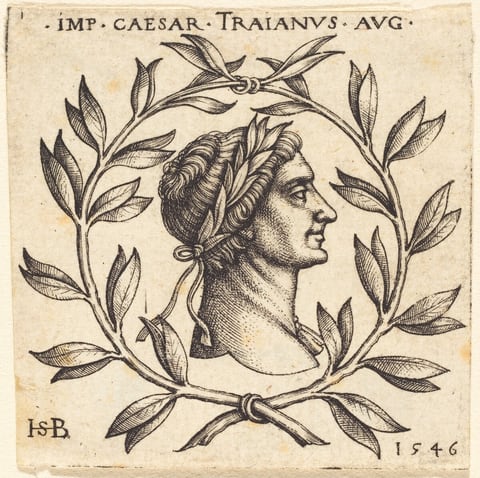
  1. The image shows a profile of a person's head and partial neck within a circular laurel wreath. The individual has distinct facial features, including a prominent nose and chin. The hairstyle is tight, wavy locks pulled back, and a laurel wreath crowns the head. The background is plain, with an inscription reading "IMP. CAESAR. TRAIANVS. AVG." Below the portrait are the initials "ISB" and the year "1546". The overall style resembles a classical engraving, featuring detailed line work and traditional iconography.
    TrajanSebald Beham, 1546Courtesy National Gallery of Art, Washington
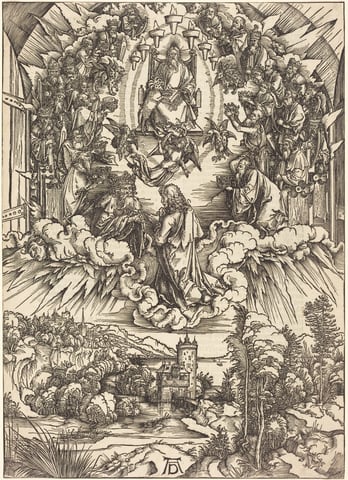
  2. The image features a celestial scene with multiple figures depicted from head to waist. Two central figures are engaged in a conversation amidst clouds. One figure appears seated, possibly on a throne, holding a book. Both figures have long hair and beards. The robes worn by the figures are detailed. Other figures surround them in a semi-circle, some wearing crowns, holding items like bowls. Heavenly hosts with wings are seen above. The background shows a detailed landscape with trees, a river, and castles nestled in hills.
    Saint John before God and the EldersAlbrecht Dürer, probably c. 1496/1498Courtesy National Gallery of Art, Washington
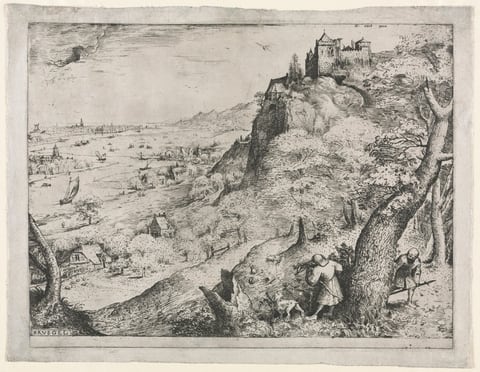
  3. The Rabbit Hunt, by Pieter Bruegel, 1560
    The Rabbit HuntPieter Bruegel, 1560Courtesy of the Cleveland Museum of Art