Floor plan

Style galleriesThe Northern Renaissance
The Northern Renaissance
A work made of engraving in black on cream laid paper.
A work made of engraving on ivory laid paper.
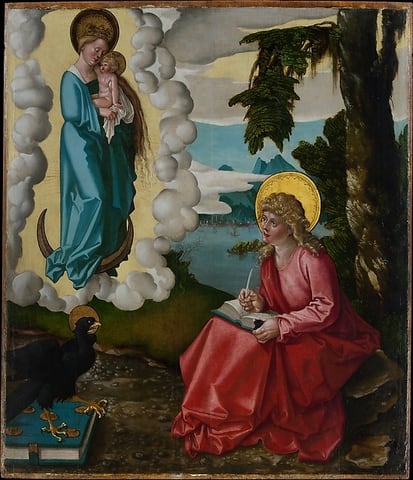
Saint John on Patmos, by Hans Baldung (called Hans Baldung Grien), ca. 1511
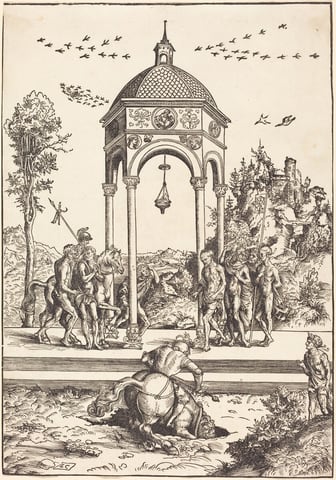
This print features a detailed scene. In the center is a classical-style pavilion with arched openings and a domed roof adorned with intricate designs. A group of mostly-nude people is gathered around the pavilion, with one on horseback, holding a spear, and another holding a flag. In front of the pavilion, a knight on horseback appears to be falling into a dark hole in the ground. Vegetation, including trees and shrubs, is scattered throughout the landscape, and birds are seen flying in the sky above the pavilion. The horizon shows hills leading to a distant castle on a rocky formation on the right.

The works in this room are listed below.

Works in this room

Dürer's prints, Holbein's portraits and the art of northern Europe in the 1500s.

Section 1, north wall

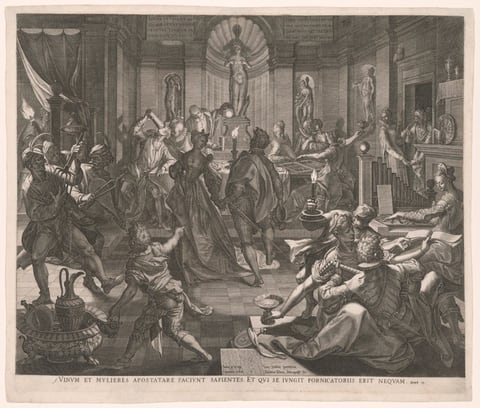
  1. A work made of engraving in black on cream laid paper.
    The Carnival (or the Prodigal Son)Jan Sadeler, I, 1588Courtesy of the Art Institute of Chicago
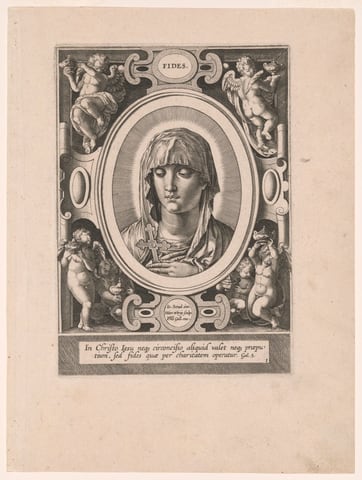
  2. A work made of engraving on ivory laid paper.
    Fides, plate 1 from The Seven VirtuesHieronymous Wierix, c. 1598Courtesy of the Art Institute of Chicago

Section 1, south wall

  1. Saint John on Patmos, by Hans Baldung (called Hans Baldung Grien), ca. 1511
    Saint John on PatmosHans Baldung (called Hans Baldung Grien), ca. 1511Courtesy of The Metropolitan Museum of Art
  2. This print features a detailed scene. In the center is a classical-style pavilion with arched openings and a domed roof adorned with intricate designs. A group of mostly-nude people is gathered around the pavilion, with one on horseback, holding a spear, and another holding a flag. In front of the pavilion, a knight on horseback appears to be falling into a dark hole in the ground. Vegetation, including trees and shrubs, is scattered throughout the landscape, and birds are seen flying in the sky above the pavilion. The horizon shows hills leading to a distant castle on a rocky formation on the right.
    Marcus Curtius Plunging into the ChasmLucas Cranach the ElderCourtesy National Gallery of Art, Washington

Section 2, south wall
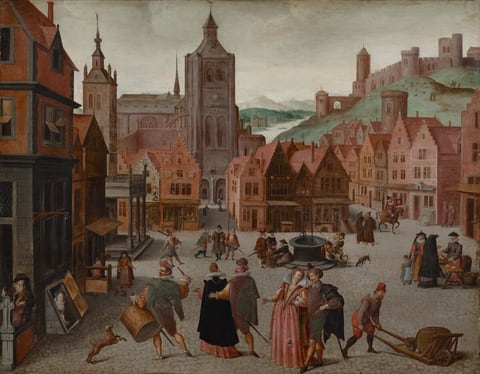
  1. We look slightly down onto a scene with people gathering in small groups in a cobblestone town square lined with rows of brick, wood, and stone buildings, many with stepped rooflines, in this horizontal painting. Singly or in pairs or trios, men, women, and children walk across the square, move goods around, or talk to merchants. All the people have light skin. Many of the men have mustaches and wear hats, and some carry swords. In tones of black, olive green, brick red, and plum purple, they wear hip-length cloaks over jackets, with white collars or ruffs and brass buttons, and knee-length breeches over yellow or black stockings. The women all wear long dresses in salmon pink, coral red, or golden yellow, with white collars or ruffs, and many wear black, ankle-length cloaks, some with hoods. Closest to us, a sumptuously dressed man and woman walk toward us while another similarly elegant couple walks away. Also facing away from us, to our left, a man wearing a large drum strapped around his waist raises one drumstick as he looks over his left shoulder. Nearby, a woman peers up out of a cellar door that opens on an angle to the street. More couples gather around a well across the square, and two women and a child talk to a third woman selling wares at a wooden table to our right. A pair of hooded priests or monks walk near a man blowing on a trumpet on horseback. The buildings are mostly shades of brick red and brown, and most have three or four stories with steeply pitched roofs. More people walk along side streets leading off the main square. One gap in the buildings across from us leads to a nickel-gray stone church with a pointed spire and square tower. A grassy, green hill rises steeply beyond the buildings to our right, leading down to a waterway that extends up and away into the distance. A few boats float in the water, which reflects the leaden-gray sky. Beyond the town square, a brown stone structure like a fortress with turret towers and crenellated walls looms along the ridge of the hill to our right. Tiny in scale, people on horseback and tending sheep dot the hillside below. The date “1590” is painted on the front of one of the buildings across from us while another date, “1597,” is painted on the end of a short wall near the lower left corner.
    The Marketplace in Bergen op ZoomAbel Grimmer, probably 1590 and 1597Courtesy National Gallery of Art, Washington
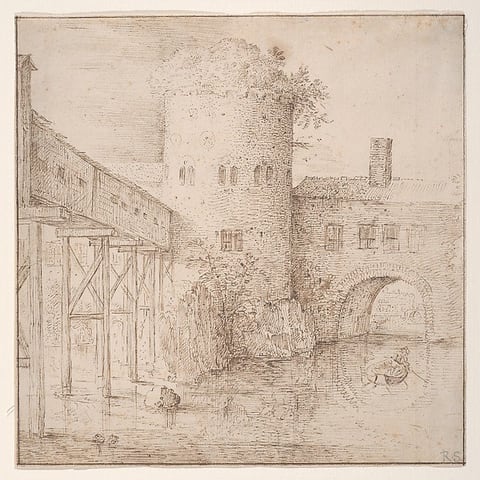
  2. A Mill with a Fortified Bridge, a Rowing Boat in the Foreground, by Roelandt Savery, 1596–1639
    A Mill with a Fortified Bridge, a Rowing Boat in the ForegroundRoelandt Savery, 1596–1639Courtesy of The Metropolitan Museum of Art

Section 2, north wall
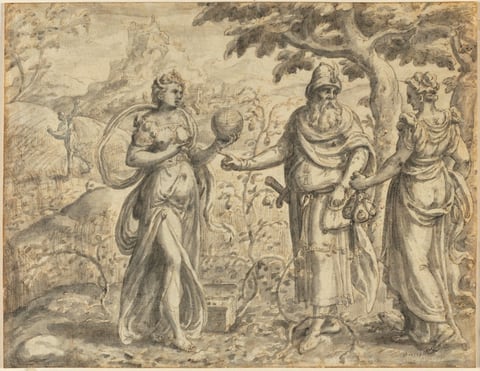
  1. The Seed Received among the Thorns, from the Parable of the Sower, by Gerard P. van Groningen, c. 1573
    The Seed Received among the Thorns, from the Parable of the SowerGerard P. van Groningen, c. 1573Courtesy of the Cleveland Museum of Art
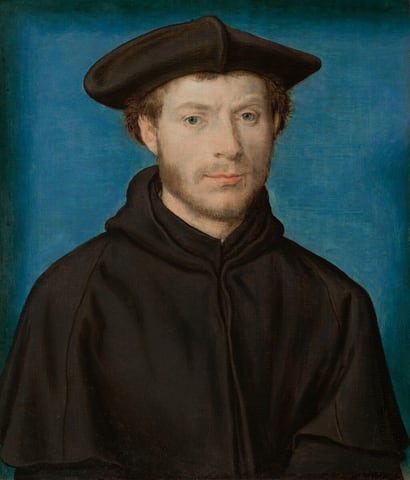
  2. This painting shows a man from the waist up. He is facing forward and gazes out at us. He has fair skin, light brown hair, a thin mustache and beard, and light green eyes. His expression is mostly neutral, although his peach lips are slightly turned up at the edges. He is wearing a black garment with a high collar and a hood and a black flat cap on his head. The background is plain blue, fading to black around the edges of the painting.
    Portrait of a ManCorneille de Lyon, c. 1536/1540Courtesy National Gallery of Art, Washington
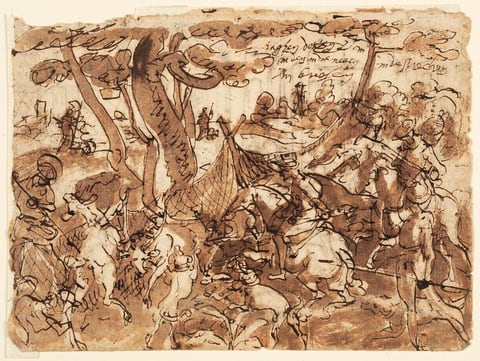
  3. DEER HUNT WITH NETS
    Deer Hunt with NetsJan van der Straet, called Stradanus, ca. 1590 – 1599Courtesy of Cooper Hewitt, Smithsonian Design Museum

Section 3, north wall
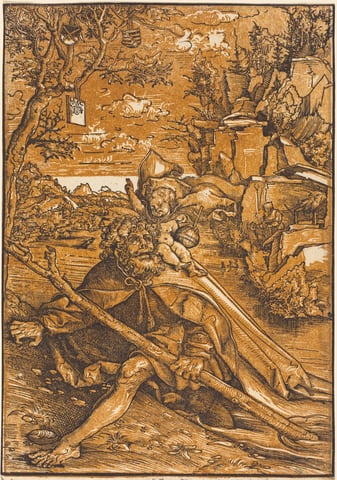
  1. This is a drawing of a wilderness setting by a river. The scene features rocky cliffs, lush vegetation, a large bearded figure holding a staff, and a small cherubic figure beside them. In the background, there is a village against a mountainous backdrop. The drawing has rich texture and intricate details, with a contrast of dark lines and lighter hues.
    Saint ChristopherLucas Cranach the Elder, 1506Courtesy National Gallery of Art, Washington
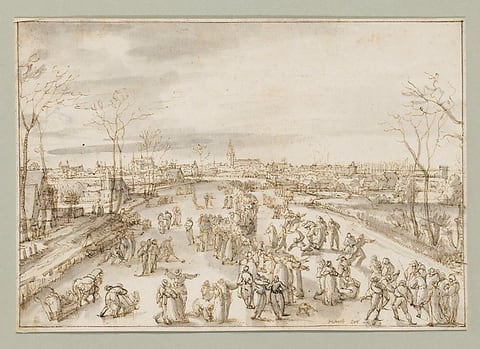
  2. Ice skaters on the Amstel in Amsterdam, by Hans Bol, 1589
    Ice skaters on the Amstel in AmsterdamHans Bol, 1589Courtesy of The Metropolitan Museum of Art
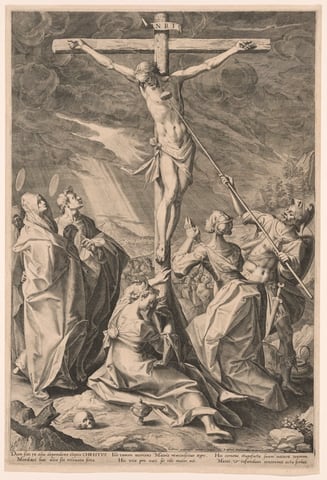
  3. A work made of engraving in black on cream laid paper.
    Christ on the CrossRaphael Sadeler, I, 1590Courtesy of the Art Institute of Chicago

Section 3, south wall
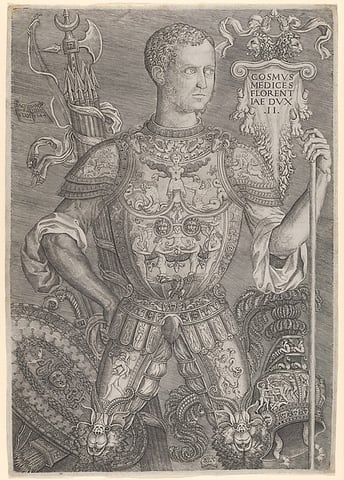
  1. Portrait of Cosimo de' Medici in full armor, his left hand resting on a staff, by Niccolò della Casa, 1544
    Portrait of Cosimo de' Medici in full armor, his left hand resting on a staffNiccolò della Casa, 1544Courtesy of The Metropolitan Museum of Art
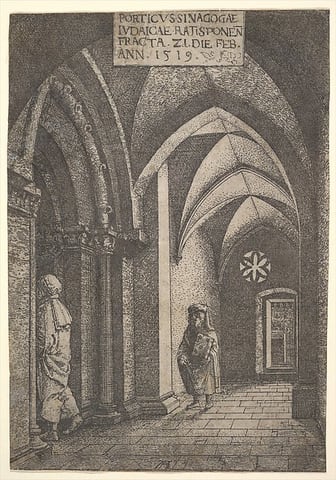
  2. The Entrance Hall of the Regensburg Synagogue, by Albrecht Altdorfer, 1519
    The Entrance Hall of the Regensburg SynagogueAlbrecht Altdorfer, 1519Courtesy of The Metropolitan Museum of Art

Section 4, south wall
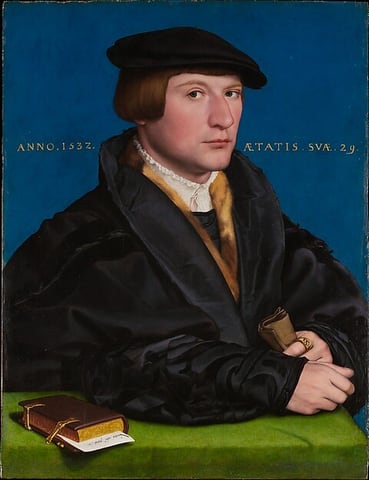
  1. Hermann von Wedigh III (died 1560), by Hans Holbein the Younger, 1532
    Hermann von Wedigh III (died 1560)Hans Holbein the Younger, 1532Courtesy of The Metropolitan Museum of Art
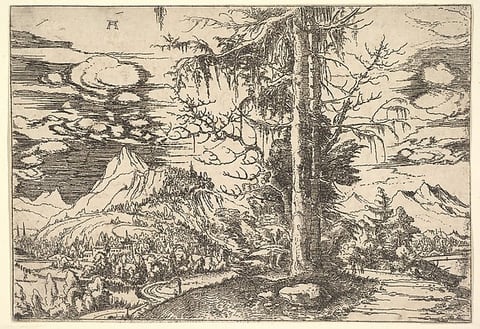
  2. Landscape with a Double Spruce, by Albrecht Altdorfer, ca. 1521–22
    Landscape with a Double SpruceAlbrecht Altdorfer, ca. 1521–22Courtesy of The Metropolitan Museum of Art