Floor plan

Style galleriesNeoclassicism

Neoclassicism

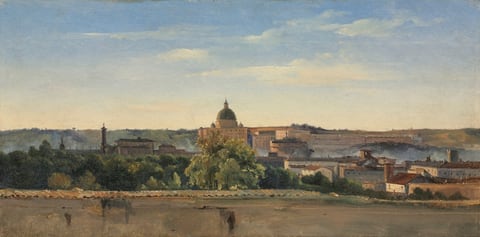
View of Rome, by Pierre Henri de Valenciennes, c. 1782–84
A work made of oil on panel.
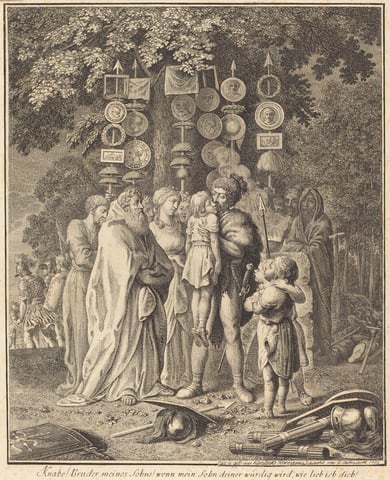
The image depicts a group of people in varying poses and outfits. A central figure, possibly a child, is being held up by a man. Those around them are positioned differently, some standing closely. The figures have detailed faces and wear garments resembling classical attire. Shields and banners decorated with symbols are present in the background. Armor and helmets are scattered on the ground. Trees and a group of people in the distance are part of the background.
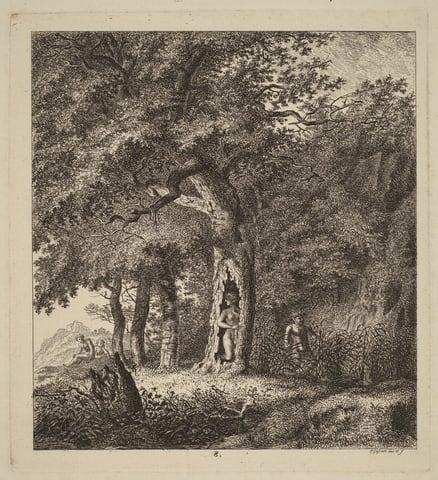
The image shows an etching of a forest scene with towering trees dominating the upper half. The horizon is not clearly visible due to dense foliage, but a line of trees and rocky outcrops in the distance provide a boundary. The fine lines and cross-hatching technique create detailed textures in the tree bark and foliage. The color palette is monochromatic, in shades of black and white emphasizing light and shadow. A large tree with a partially hollow trunk and figures scattered throughout the scene give a sense of scale and activity within the forest setting.

The works in this room are listed below.

Works in this room

Europe turns back to Greece and Rome: clear line, calm figures and civic virtue.

Section 1, north wall

  1. View of Rome, by Pierre Henri de Valenciennes, c. 1782–84
    View of RomePierre Henri de Valenciennes, c. 1782–84Courtesy of the Cleveland Museum of Art
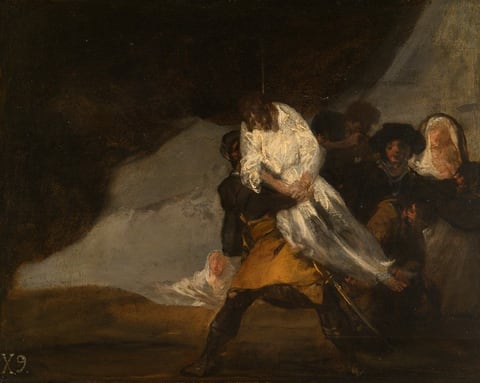
  2. A work made of oil on panel.
    The Hanged MonkFrancisco Goya, c. 1810Courtesy of the Art Institute of Chicago

Section 1, south wall

  1. The image depicts a group of people in varying poses and outfits. A central figure, possibly a child, is being held up by a man. Those around them are positioned differently, some standing closely. The figures have detailed faces and wear garments resembling classical attire. Shields and banners decorated with symbols are present in the background. Armor and helmets are scattered on the ground. Trees and a group of people in the distance are part of the background.
    Ancient TeutonsDaniel Nikolaus Chodowiecki, 1782Courtesy National Gallery of Art, Washington
  2. The image shows an etching of a forest scene with towering trees dominating the upper half. The horizon is not clearly visible due to dense foliage, but a line of trees and rocky outcrops in the distance provide a boundary. The fine lines and cross-hatching technique create detailed textures in the tree bark and foliage. The color palette is monochromatic, in shades of black and white emphasizing light and shadow. A large tree with a partially hollow trunk and figures scattered throughout the scene give a sense of scale and activity within the forest setting.
    Wooded Landscape with a Nymph and a SatyrSalomon Gessner, 1764Courtesy National Gallery of Art, Washington

Section 2, south wall
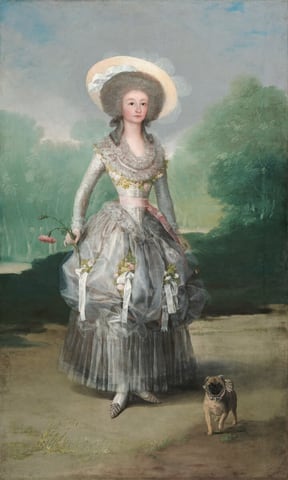
  1. A woman with pale skin, wearing a silvery-gray dress adorned with white ribbons and light pink roses, stands looking out at us with a small, pug dog by her feet in this vertical portrait painting. The woman’s body is angled slightly to our right but she looks at us with dark eyes under faint, arched brows. Her nose is rounded, her cheeks smooth and flushed, and her pale pink lips are closed. Her face is framed in a cloud of nickel-gray hair, and tendrils curl down over her shoulders. She wears a wide-brimmed straw hat with a white ribbon set on the back of her head and slightly off to one side. The bodice of her dress has a low, curving neck. This area is loosely painted to create the impression of layers of lace. A band of intertwined pale pink roses and delicate green leaves borders the outer edge of the lace. The dress has long, tight sleeves with lace at the cuffs and the notably narrow waist is tied with a blush-pink ribbon. The full, silver skirt is picked up to create a row of puffs, like the top of a muffin, around her knees. Bunches of pink roses and white ribbons are nestled into the puffs, and below, the skirt falls in long, vertical pleats to her ankles. She wears white stockings and pointed, petal-pink shoes. In her left arm, on our right, she holds a closed fan loosely at her side, almost lost behind the skirt. She holds a pink carnation with a full bloom and a bud on a long, curving stem in her other hand, by her hip. A caramel-brown pug with a black face, wearing a pink collar lined with three bells, stands facing us with one front paw lifted, to our right of the woman's feet. The landscape is painted in tones of mint and sage green for grass beneath trees enclosing the space the woman stands in, sand brown for the ground, and icy blue for the sky above.
    The Marquesa de PontejosFrancisco Goya, c. 1786Courtesy National Gallery of Art, Washington
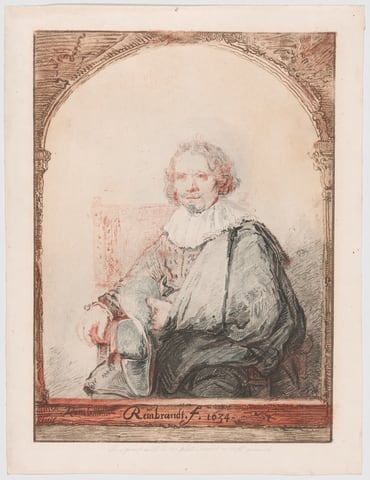
  2. A work made of soft ground etching from two plates, with roulette, on paper.
    Portrait of a Man in an Armchair, from Collection d'imitations de Dessins d'après les Principaux Maîtres Hollandais et FlamandsChristian Josi, 1826Courtesy of the Art Institute of Chicago

Section 2, north wall
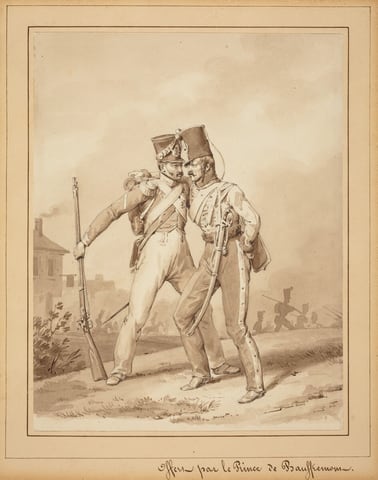
  1. The image features two men in military uniform engaging closely with each other. Both are shown from head to toe. The man on the left stands with his left leg forward, holding a rifle, and has his right arm around the shoulder of the other man. The man on the right has his right leg slightly bent, supporting his weight, and is holding a sword in his left hand. Each man has distinctive facial features. Both wear tall, elaborate military hats and detailed uniforms. The man on the left displays a strap over his shoulder, while the man on the right has intricate decorations on his jacket and trousers. In the background, there are a few more soldiers and part of a building to the left. The setting is monochromatic.
    Two GrenadiersVictor AdamCourtesy National Gallery of Art, Washington
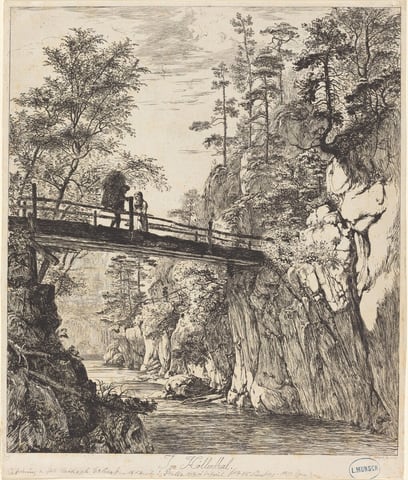
  2. The image shows a landscape with a wooden bridge crossing over a river in a valley. The scenery includes cliffs, trees, and flowing water below. The artwork features fine, detailed brushstrokes depicting the texture of the cliffs, foliage, and water. The color scheme is monochromatic with various shades of gray and sepia tones. Two figures are seen on the bridge, contributing to the sense of scale and activity in the serene setting.
    Im Höllenthal (In the Höllen Valley)Johann Christoph Erhard, 1818Courtesy National Gallery of Art, Washington
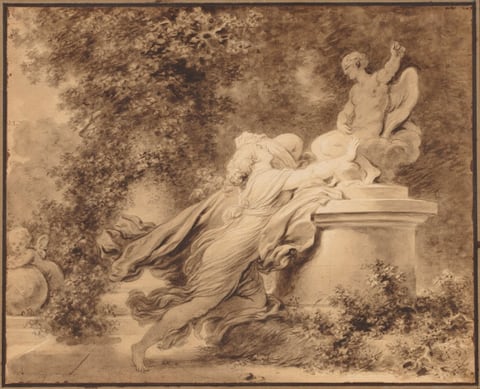
  3. Invocation to Love, by Jean Honoré Fragonard, c. 1781
    Invocation to LoveJean Honoré Fragonard, c. 1781Courtesy of the Cleveland Museum of Art

Section 3, north wall
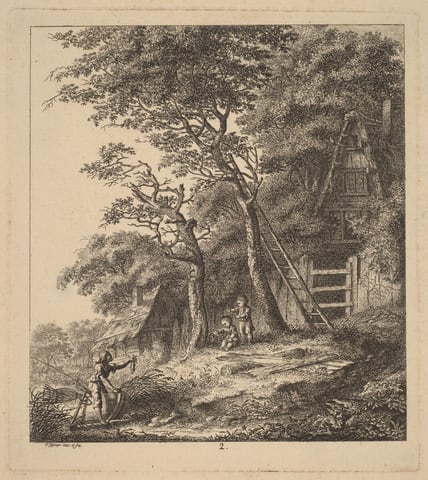
  1. The image shows a rustic scene with a house, trees, and a figure washing near a stream. Two children stand in the middle distance next to a ladder. In the background are two thatched houses among trees. The drawing style is detailed with fine lines and cross-hatching, creating texture. The color palette is monochromatic in shades of black and gray, emphasizing light and shadow.
    A Fisherman and Two Children in a Landscape with Thatched CottagesSalomon Gessner, 1764Courtesy National Gallery of Art, Washington
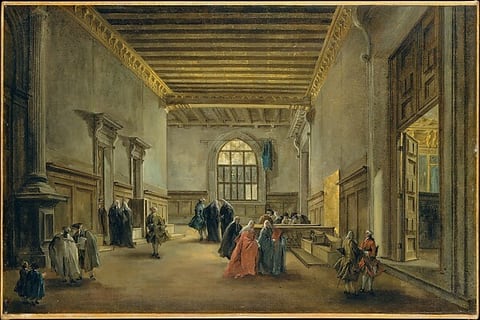
  2. The Antechamber of the Sala del Maggior Consiglio, by Francesco Guardi, ca. 1765–68
    The Antechamber of the Sala del Maggior ConsiglioFrancesco Guardi, ca. 1765–68Courtesy of The Metropolitan Museum of Art
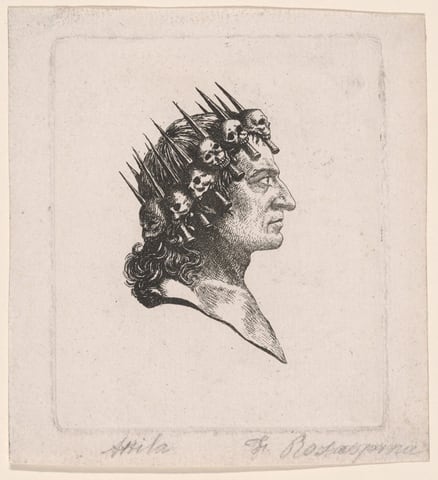
  3. A work made of etching in black on ivory laid paper.
    Portrait of Le Roi MaratViller, c. 1795Courtesy of the Art Institute of Chicago

Section 3, south wall
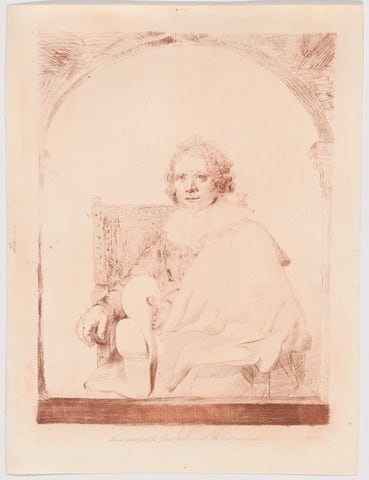
  1. A work made of soft ground etching, with roulette, printed in red on white wove paper.
    Portrait of a Man in an Armchair, from Collection d'imitations de Dessins d'après les Principaux Maîtres Hollandais et FlamandsChristian Josi, 1826Courtesy of the Art Institute of Chicago
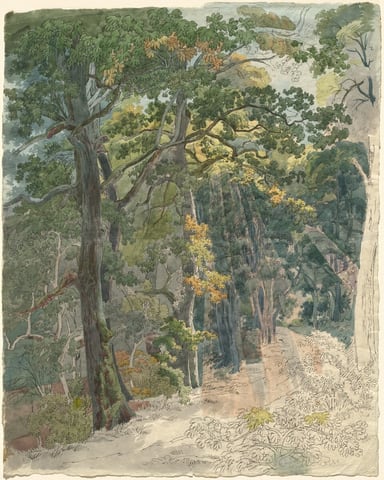
  2. The image shows a dense, forested area with towering trees. The composition leads the eye along a pathway into the distance, without a distinct horizon line. The intricate brushstrokes depict the texture and foliage of the trees, suggesting movement and light filtering through the leaves. The color palette is rich and earthy, with shades of green, brown, yellow, and orange, creating a vibrant yet tranquil atmosphere emphasizing light and shadow.
    Rays of Sunlight Striking a Woodland PathFriedrich Salathé, c. 1815Courtesy National Gallery of Art, Washington

Section 4, south wall
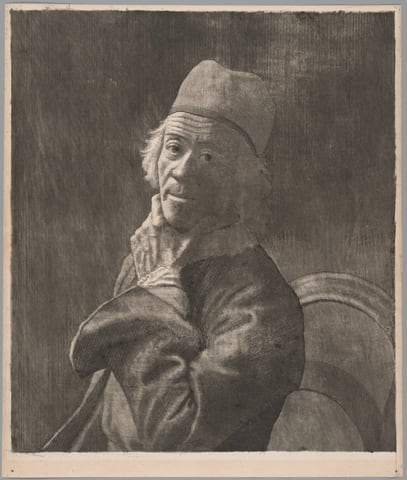
  1. A work made of etching, roulette, and mezzotint in black on cream laid paper.
    The Large Self-PortraitJean Etienne Liotard, 1778/81Courtesy of the Art Institute of Chicago
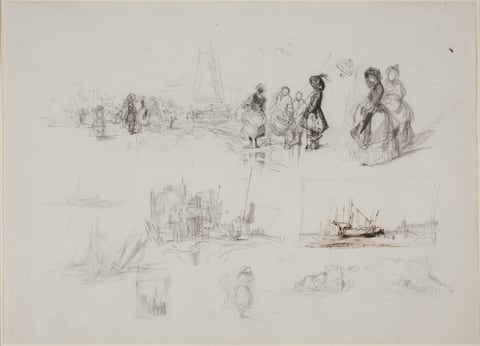
  2. This image is a pencil sketch on paper with a monochrome palette of graphite gray. The viewer sees various scenes without a defined horizon line. The upper section shows figures in period clothing, possibly mid-19th century women's fashion. The middle area has abstract architectural forms. In the lower right corner, a sailing ship or boat is sketched with more detail than the rest. The drawing style consists of quick, expressive strokes. The image conveys multiple narrative or compositional ideas on a single sheet.
    Seaside StudiesEugène Isabey, 1830sCourtesy National Gallery of Art, Washington