Floor plan

Style galleriesNeoclassicism

Neoclassicism

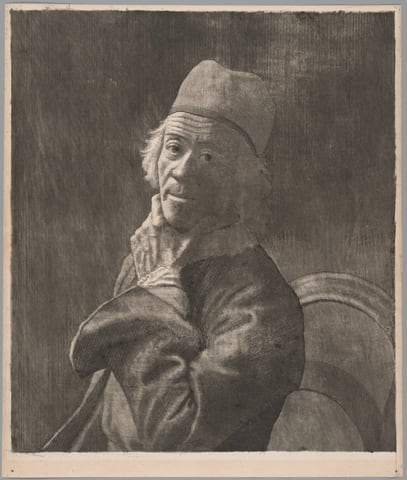
A work made of etching, roulette, and mezzotint in black on cream laid paper.
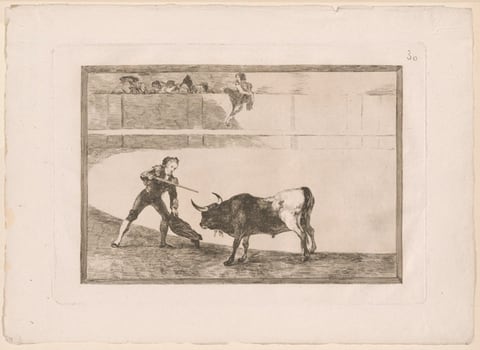
A work made of etching, aquatint, drypoint and burin on ivory laid paper.
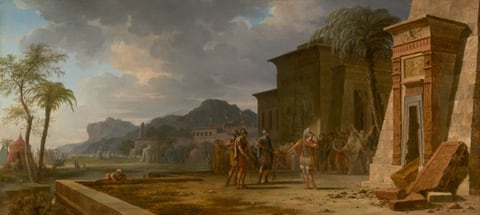
A work made of oil on canvas.
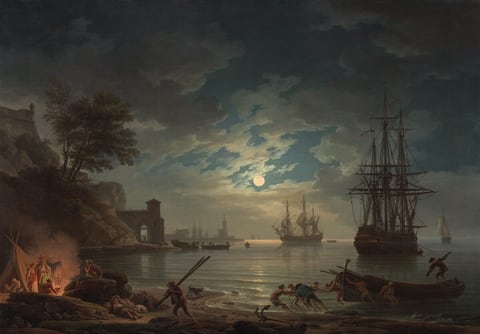
Moonlight falls across several masted ships near a rocky shoreline in this horizontal painting. The sky fills the top three-quarters of the picture. A veil of slate-gray clouds is lit to pearl white around the crisp, full moon at the center of the composition. Patches of denim-blue sky are seen through breaks in the blanket of clouds. Moonlight reflects down the center of rippling, silvery-gray water that laps against a beach close to us, along the bottom edge of the painting. A tent is set up in the lower left corner of the composition. There, two women and one man stand looking at a glowing fire next to the tent. One woman holds a basket on her head, the other tucks a flat basket under one arm. The man stands between the two women, and a fourth man crouches near the fire, his back to us. In the opening of the tent, another woman kneels over a large bowl as she looks at the fire. A fifth person, a man, gazes at the fire as he sits smoking a long-stemmed pipe on a boulder. At the foot of the boulders, a man lies back against some bundles, one arm thrown up over his head. A dog curls up next to his hip. Not far from the sleeping man and in the center of the foreground, a man carries several long wooden objects, possibly oars, over one shoulder while a dog beyond him barks at the lapping surf. The beach curves like a C away from us, along the left. At the point of the curve in the middle distance, a structure like a city wall and gate jut out to the water’s edge. More buildings atop steep cliffs rise vertically beyond the gate. The shoreline curves into the distance again, and more buildings, including a lighthouse, and masted ships there are smoke-gray silhouettes. Near the lower right corner of the painting, four men pull on ropes tied around the prow of a small wooden boat while three others push it toward the land. Another man stands in the far end. A short distance beyond that boat is a tall wooden ship with three masts and rigging outlined against the night sky. Windows along the decks of that boat’s wide stern, angled toward us, glow with golden light. Beyond it and a bit to our left, another ship, smaller in scale, sails away from us. Several more ships move back to the horizon until we only see strokes of white and gray to indicate their unfurled sails.
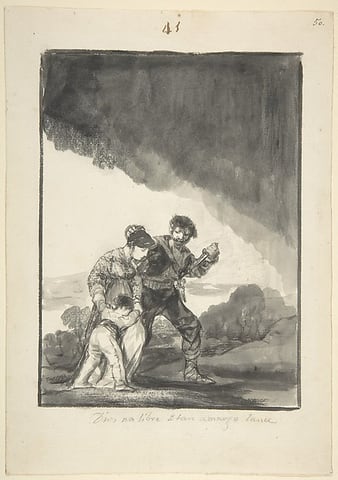
God save us from such a bitter fate; a bandit threatening a woman and a child with a knife, page 41 from the "Black Border Album" (E), by Francisco Goya, ca. 1816–20
A work made of oil on canvas.

The works in this room are listed below.

Works in this room

Europe turns back to Greece and Rome: clear line, calm figures and civic virtue.

First room, north wall

  1. A work made of etching, roulette, and mezzotint in black on cream laid paper.
    The Large Self-PortraitJean Etienne Liotard, 1778/81Courtesy of the Art Institute of Chicago
  2. A work made of etching, aquatint, drypoint and burin on ivory laid paper.
    Pedro Romero killing the halted bull, plate 30 from The Art of BullfightingFrancisco Goya, 1814/16, published 1816Courtesy of the Art Institute of Chicago
  3. A work made of oil on canvas.
    Alexander at the Tomb of Cyrus the GreatPierre Henri de Valenciennes, 1796Courtesy of the Art Institute of Chicago

First room, south wall

  1. Moonlight falls across several masted ships near a rocky shoreline in this horizontal painting. The sky fills the top three-quarters of the picture. A veil of slate-gray clouds is lit to pearl white around the crisp, full moon at the center of the composition. Patches of denim-blue sky are seen through breaks in the blanket of clouds. Moonlight reflects down the center of rippling, silvery-gray water that laps against a beach close to us, along the bottom edge of the painting. A tent is set up in the lower left corner of the composition. There, two women and one man stand looking at a glowing fire next to the tent. One woman holds a basket on her head, the other tucks a flat basket under one arm. The man stands between the two women, and a fourth man crouches near the fire, his back to us. In the opening of the tent, another woman kneels over a large bowl as she looks at the fire. A fifth person, a man, gazes at the fire as he sits smoking a long-stemmed pipe on a boulder. At the foot of the boulders, a man lies back against some bundles, one arm thrown up over his head. A dog curls up next to his hip. Not far from the sleeping man and in the center of the foreground, a man carries several long wooden objects, possibly oars, over one shoulder while a dog beyond him barks at the lapping surf. The beach curves like a C away from us, along the left. At the point of the curve in the middle distance, a structure like a city wall and gate jut out to the water’s edge. More buildings atop steep cliffs rise vertically beyond the gate. The shoreline curves into the distance again, and more buildings, including a lighthouse, and masted ships there are smoke-gray silhouettes. Near the lower right corner of the painting, four men pull on ropes tied around the prow of a small wooden boat while three others push it toward the land. Another man stands in the far end. A short distance beyond that boat is a tall wooden ship with three masts and rigging outlined against the night sky. Windows along the decks of that boat’s wide stern, angled toward us, glow with golden light. Beyond it and a bit to our left, another ship, smaller in scale, sails away from us. Several more ships move back to the horizon until we only see strokes of white and gray to indicate their unfurled sails.
    MoonlightClaude-Joseph Vernet, 1772Courtesy National Gallery of Art, Washington
  2. God save us from such a bitter fate; a bandit threatening a woman and a child with a knife, page 41 from the "Black Border Album" (E), by Francisco Goya, ca. 1816–20
    God save us from such a bitter fate; a bandit threatening a woman and a child with a knife, page 41 from the "Black Border Album" (E)Francisco Goya, ca. 1816–20Courtesy of The Metropolitan Museum of Art
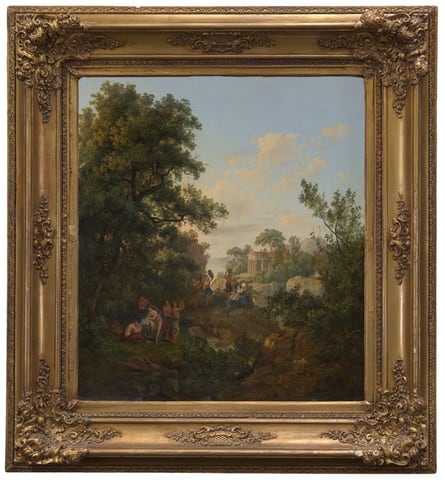
  3. A work made of oil on canvas.
    Birth of BacchusKároly Markó, Sr., 1826 (?)Courtesy of the Art Institute of Chicago

Second room, south wall
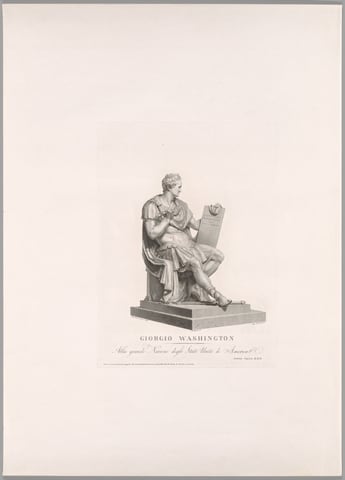
  1. A work made of engraving in black on ivory wove paper.
    George Washington, Front View, from Oeuvre de CanovaAntonio Canova, 1817Courtesy of the Art Institute of Chicago
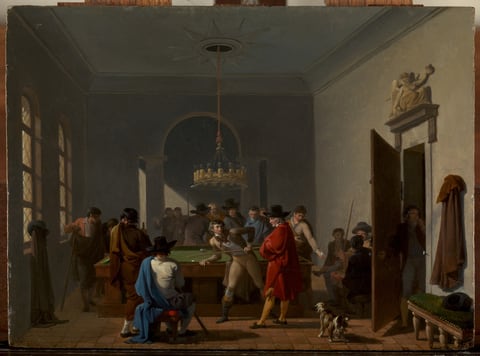
  2. The Billiard Room, by Nicolas Antoine Taunay, after 1810
    The Billiard RoomNicolas Antoine Taunay, after 1810Courtesy of The Metropolitan Museum of Art
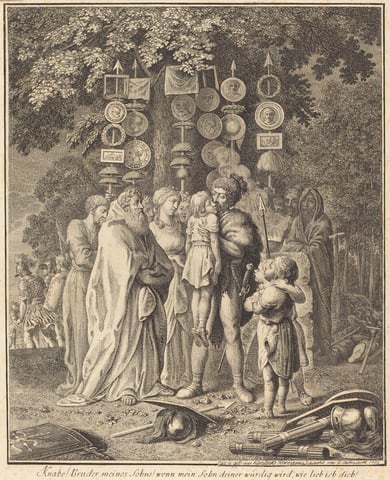
  3. The image depicts a group of people in varying poses and outfits. A central figure, possibly a child, is being held up by a man. Those around them are positioned differently, some standing closely. The figures have detailed faces and wear garments resembling classical attire. Shields and banners decorated with symbols are present in the background. Armor and helmets are scattered on the ground. Trees and a group of people in the distance are part of the background.
    Ancient TeutonsDaniel Nikolaus Chodowiecki, 1782Courtesy National Gallery of Art, Washington
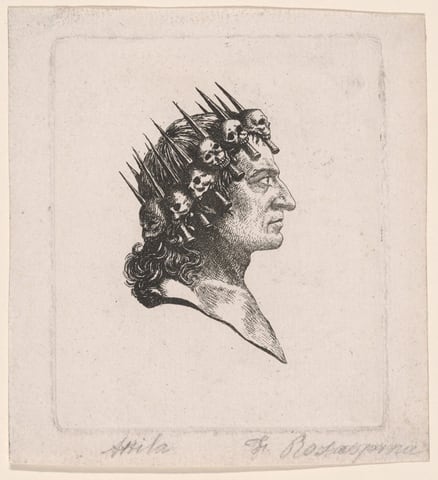
  4. A work made of etching in black on ivory laid paper.
    Portrait of Le Roi MaratViller, c. 1795Courtesy of the Art Institute of Chicago

Second room, north wall
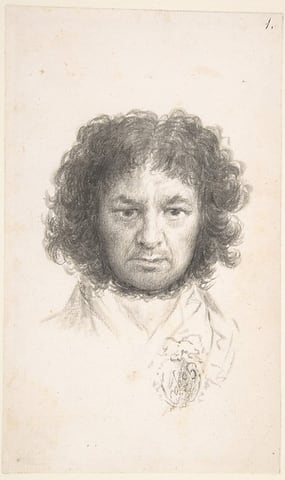
  1. Self-Portrait, by Francisco Goya, ca. 1796
    Self-PortraitFrancisco Goya, ca. 1796Courtesy of The Metropolitan Museum of Art
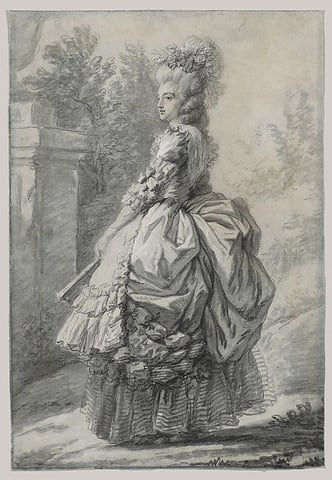
  2. Marie Antoinette in a Park, by Elisabeth Louise Vigée Le Brun, ca. 1780–81
    Marie Antoinette in a ParkElisabeth Louise Vigée Le Brun, ca. 1780–81Courtesy of The Metropolitan Museum of Art
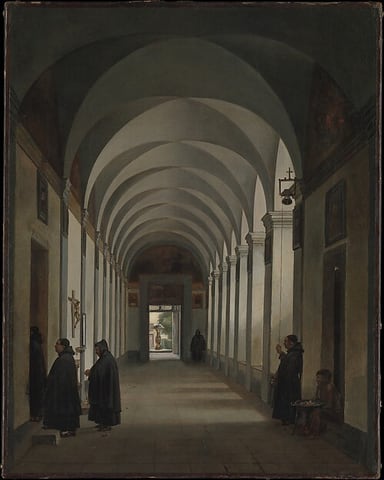
  3. Monks in the Cloister of the Church of Gesù e Maria, Rome, by François Marius Granet, 1808
    Monks in the Cloister of the Church of Gesù e Maria, RomeFrançois Marius Granet, 1808Courtesy of The Metropolitan Museum of Art
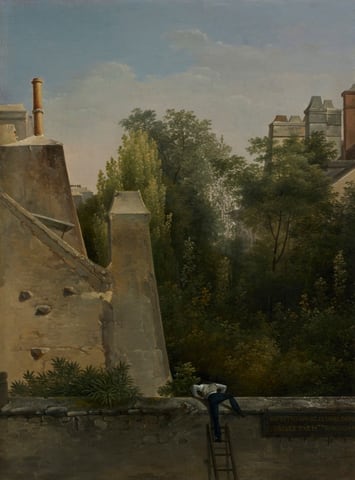
  4. The Curious One, by Antoine Pierre Mongin, 1823
    The Curious OneAntoine Pierre Mongin, 1823Courtesy of the Cleveland Museum of Art

Third room, north wall
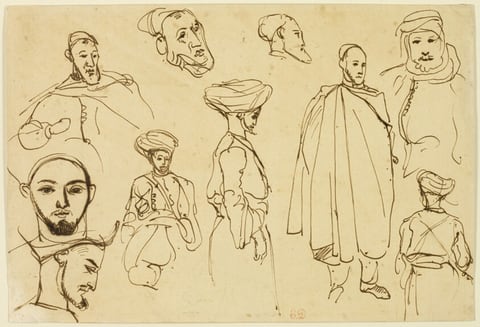
  1. A work made of pen and brown ink, with traces of graphite, on tan wove paper, laid down on cream wove paper.
    Sketches of Algerian MenEugène Delacroix, c. 1832Courtesy of the Art Institute of Chicago
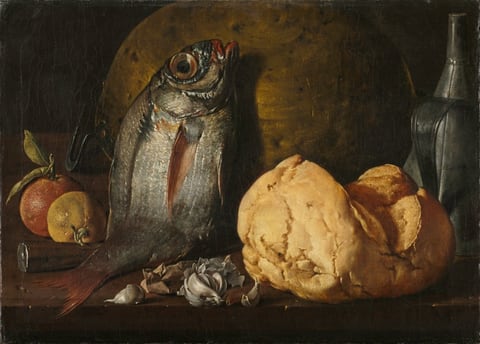
  2. Still Life with Fish, Bread, and Kettle, by Luis Meléndez, c. 1772
    Still Life with Fish, Bread, and KettleLuis Meléndez, c. 1772Courtesy of the Cleveland Museum of Art