Floor plan

Style galleriesThe Italian Renaissance
The Italian Renaissance
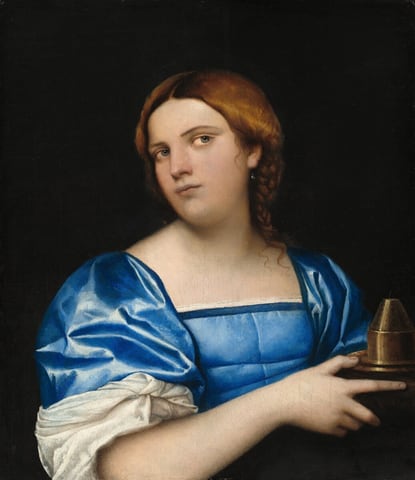
A young woman with a pale, peachy skin is shown from waist up, wearing a shimmering, royal-blue dress in this vertical painting. Her body is angled to our right as she holds a metal object, perhaps a vessel or incense burner, in her hands by her chest. She turns and tilts her head to our left, but then looks back across her body, off to our right with flint-gray eyes. She has a full, oval-shaped face with a straight nose, smooth cheeks, and her pale pink lips are closed. A gray pearl earring hangs from the ear we can see. Her auburn-brown hair is parted down the middle, and loosely pulled back into a braid that brushes her left shoulder, to our right. The blue dress has a square neckline and a fitted bodice. Light glints off the fabric, shading it from royal to sapphire blue. A voluminous white sleeve is rolled back to her right elbow, to our left. That arm and hand nearly span the width of the painting as she holds the vessel, which has a conical top, near the lower right corner of the composition. The background is solid black.
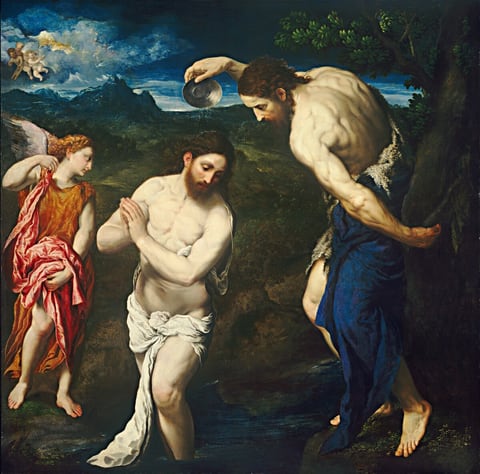
Bright light from the upper left illuminates two muscular men and a winged angel against a dim landscape in this square painting. They all have pale skin, and the two men have dark brown hair and beards. One man, Jesus, stands ankle-deep in a rippling dark blue stream in the center of the composition facing us with downcast eyes. He is nude except for a white cloth that drapes over one shoulder and is tied around his hips. The other end of the cloth drops into the water. Jesus’s hands are pressed together in prayer at chest-height closer to his right shoulder, to our left. He leans his torso in the other direction and looks down at the water. The second man stands on the riverbank to our right. His body faces our left but his left shoulder, closer to us, dips down so his broad back is angled toward us. His lower body is wrapped in a cobalt-blue garment bordered with what looks like sheepskin. His near hand swings back to clutch the trunk of a tree growing immediately behind him. In his other hand, he holds up a pewter-grey dish that dribbles water onto Jesus’s head. On the left riverbank, the copper-haired angel looks on, facing our right in profile but the body faces us. The angel wears a sleeveless, pumpkin-orange robe with a shimmering salmon-pink mantle draped over the right shoulder, to our left. Petal-pink and dark grey wings extend from the shoulders, and the lower legs and feet are bare. The shadowy landscape has a dark green field stretching back to jagged, sapphire-blue mountains along the horizon, which comes four-fifths of the way up this composition. Pale blue clouds skim across the vivid blue sky, where three chubby, winged babies float. One holds a triangle and a rod with which to strike it, and another might hold a rectangular musical instrument. Blue clouds split nearby to show a sliver of golden yellow light, and possibly more angels.
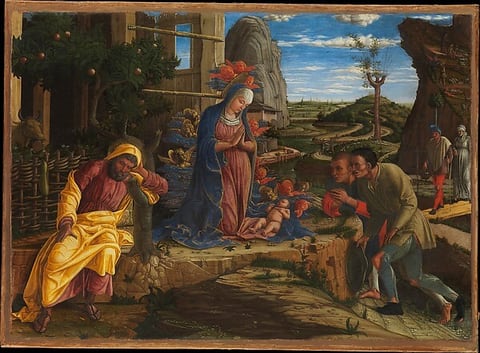
The Adoration of the Shepherds, by Andrea Mantegna, shortly after 1450
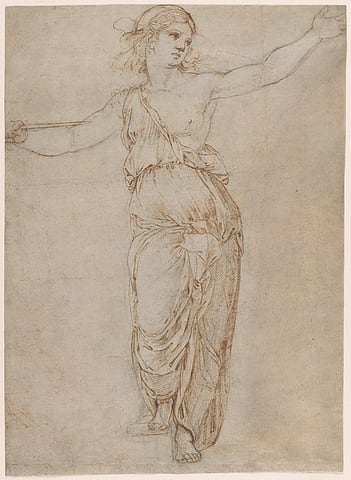
Lucretia, by Raphael, 1508–10
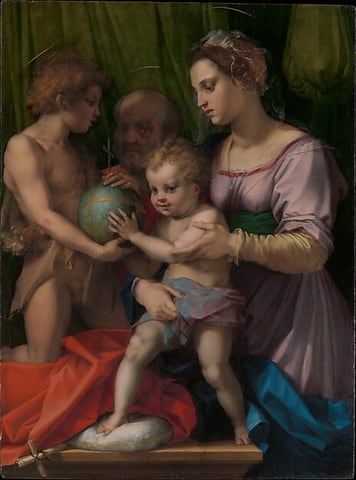
The Holy Family with the Young Saint John the Baptist, by Andrea del Sarto, ca. 1528
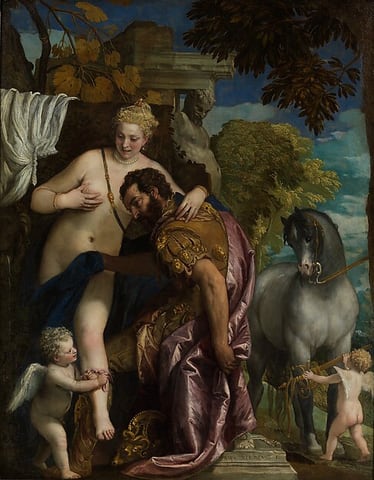
Mars and Venus United by Love, by Paolo Veronese (Paolo Caliari), 1570s

The works in this room are listed below.

Works in this room

Florence, Venice and Rome from 1400 to 1600: perspective, anatomy and the classical past.

First room, north wall

  1. A young woman with a pale, peachy skin is shown from waist up, wearing a shimmering, royal-blue dress in this vertical painting. Her body is angled to our right as she holds a metal object, perhaps a vessel or incense burner, in her hands by her chest. She turns and tilts her head to our left, but then looks back across her body, off to our right with flint-gray eyes. She has a full, oval-shaped face with a straight nose, smooth cheeks, and her pale pink lips are closed. A gray pearl earring hangs from the ear we can see. Her auburn-brown hair is parted down the middle, and loosely pulled back into a braid that brushes her left shoulder, to our right. The blue dress has a square neckline and a fitted bodice. Light glints off the fabric, shading it from royal to sapphire blue. A voluminous white sleeve is rolled back to her right elbow, to our left. That arm and hand nearly span the width of the painting as she holds the vessel, which has a conical top, near the lower right corner of the composition. The background is solid black.
    Portrait of a Young Woman as a Wise VirginSebastiano del Piombo, c. 1510Courtesy National Gallery of Art, Washington
  2. Bright light from the upper left illuminates two muscular men and a winged angel against a dim landscape in this square painting. They all have pale skin, and the two men have dark brown hair and beards. One man, Jesus, stands ankle-deep in a rippling dark blue stream in the center of the composition facing us with downcast eyes. He is nude except for a white cloth that drapes over one shoulder and is tied around his hips. The other end of the cloth drops into the water. Jesus’s hands are pressed together in prayer at chest-height closer to his right shoulder, to our left. He leans his torso in the other direction and looks down at the water. The second man stands on the riverbank to our right. His body faces our left but his left shoulder, closer to us, dips down so his broad back is angled toward us. His lower body is wrapped in a cobalt-blue garment bordered with what looks like sheepskin. His near hand swings back to clutch the trunk of a tree growing immediately behind him. In his other hand, he holds up a pewter-grey dish that dribbles water onto Jesus’s head. On the left riverbank, the copper-haired angel looks on, facing our right in profile but the body faces us. The angel wears a sleeveless, pumpkin-orange robe with a shimmering salmon-pink mantle draped over the right shoulder, to our left. Petal-pink and dark grey wings extend from the shoulders, and the lower legs and feet are bare. The shadowy landscape has a dark green field stretching back to jagged, sapphire-blue mountains along the horizon, which comes four-fifths of the way up this composition. Pale blue clouds skim across the vivid blue sky, where three chubby, winged babies float. One holds a triangle and a rod with which to strike it, and another might hold a rectangular musical instrument. Blue clouds split nearby to show a sliver of golden yellow light, and possibly more angels.
    The Baptism of ChristParis Bordone, c. 1535/1540Courtesy National Gallery of Art, Washington
  3. The Adoration of the Shepherds, by Andrea Mantegna, shortly after 1450
    The Adoration of the ShepherdsAndrea Mantegna, shortly after 1450Courtesy of The Metropolitan Museum of Art

First room, south wall

  1. Lucretia, by Raphael, 1508–10
    LucretiaRaphael, 1508–10Courtesy of The Metropolitan Museum of Art
  2. The Holy Family with the Young Saint John the Baptist, by Andrea del Sarto, ca. 1528
    The Holy Family with the Young Saint John the BaptistAndrea del Sarto, ca. 1528Courtesy of The Metropolitan Museum of Art
  3. Mars and Venus United by Love, by Paolo Veronese (Paolo Caliari), 1570s
    Mars and Venus United by LovePaolo Veronese (Paolo Caliari), 1570sCourtesy of The Metropolitan Museum of Art

Second room, south wall
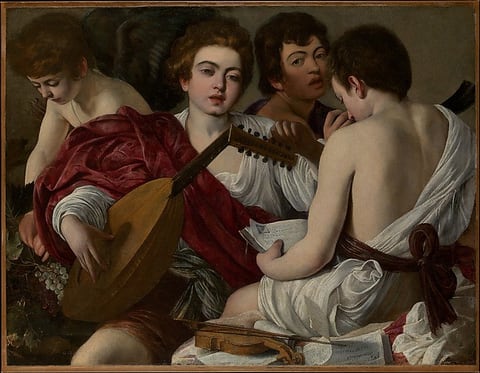
  1. The Musicians, by Caravaggio, 1597
    The MusiciansCaravaggio, 1597Courtesy of The Metropolitan Museum of Art
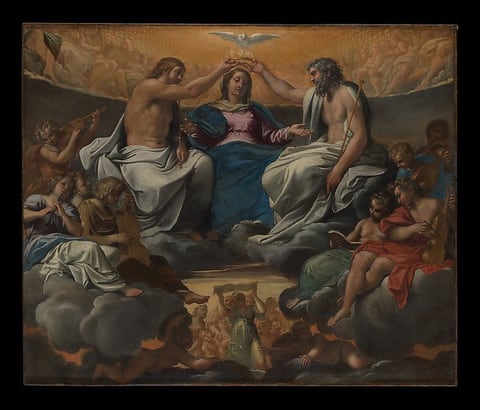
  2. The Coronation of the Virgin, by Annibale Carracci, after 1595
    The Coronation of the VirginAnnibale Carracci, after 1595Courtesy of The Metropolitan Museum of Art

Second room, north wall
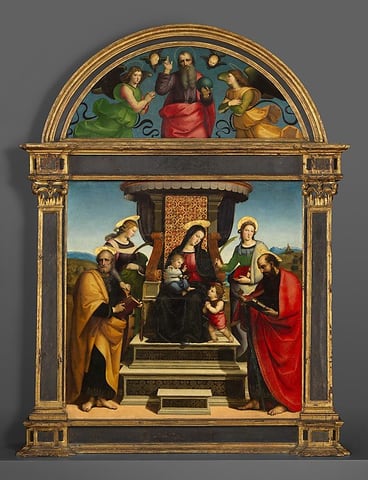
  1. Madonna and Child Enthroned with Saints, by Raphael, ca. 1504
    Madonna and Child Enthroned with SaintsRaphael, ca. 1504Courtesy of The Metropolitan Museum of Art
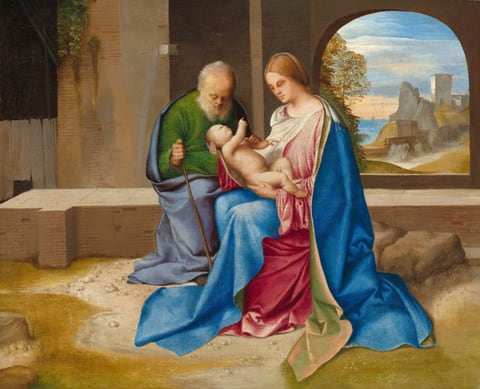
  2. An old man and a young woman holding an infant are seated together in the center of this almost square painting. All three people have pale, peachy skin. To our left, the man sits on a low, tan brick wall with his head bowed to look at the baby on the woman’s lap. A periwinkle-blue cloak is wrapped around the kelly-green robe that covers his shoulders, back, and legs. One hand grips a short staff planted on the ground. His receding white hair and beard are thin and scraggly with tufts sticking out over his ears. The woman sits next to and slightly in front of him, to our right, on a low rock, her body angled toward the man. A long, cobalt-blue cloak is draped around her shoulders and covers her knees over her rose-pink gown. Her honey-brown hair is parted in the middle and gathered at the back of her head. Her brown eyes look down at the infant, who is blond with brown eyes. A long white shawl is tucked into the neckline of her dress, drapes over her shoulders, and wraps under the baby as she cradles his body with one hand under his backside and the other behind his head. The baby lies on his back with his head turned toward the woman, and he points to her with one outstretched arm. The dirt ground is scattered with pebbles that make a loose ring around the trio, with moss-green growth to either side. A brown brick wall fills the upper half of the composition behind the people and extends off the top edge. A rounded arch pierces the back wall to our right of the woman. On the other side of the opening, trees with copper-brown leaves grow up along the left and the landscape beyond opens onto rocky hills with a white, square tower. In the deep distance, the silhouette of a town is painted in robin’s egg-blue against a pale peach horizon line. Thin, white clouds skim across the blue sky above.
    The Holy FamilyGiorgione, probably c. 1500Courtesy National Gallery of Art, Washington
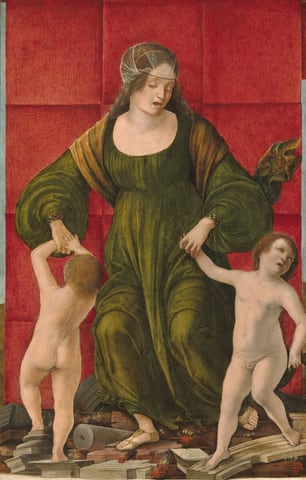
  3. A woman holds the hands of two nude children in front of a crimson-red cloth in this vertical painting. All three have pale skin and brown hair. The woman wears a forest-green dress with voluminous sleeves and a gauzy white headdress that wraps around her hair and is fastened with a band across her forehead. She stands crouching with one foot extended slightly forward in a sandal, surrounded by broken chunks of masonry and bits of burning logs. Her body faces us but she turns her head to the right. Her mouth is wide open, and her eyes cut back to our left. The woman clutches the children’s hands in both of her own. The child to our left turns away from us and reaches one hand up to touch the back of the woman’s hand. The child on the right twists away from the woman, eyes squinted up and to the right and mouth open. Behind them, fold lines create a grid across the red cloth. Slivers of grass and blue sky line each side of the composition.
    The Wife of Hasdrubal and Her ChildrenErcole de' Roberti, c. 1490/1493Courtesy National Gallery of Art, Washington

Third room, north wall
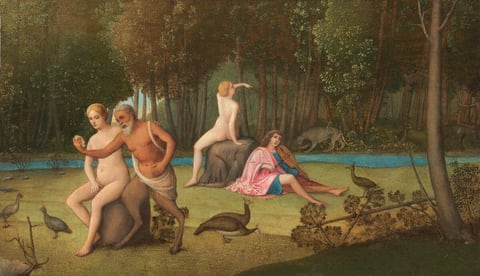
  1. Two women, a man, and a satyr, a man with goat’s legs, are in two pairs in a forested landscape in this horizontal painting. The pale-skinned women are nude, and their blond hair is tied up and back. One woman sits on a brown boulder to the left of center. One hand covers her groin, and the other hand rests on the satyr’s shoulder. The satyr has deeply tanned skin, short white hair, and a long white beard. A white cloth wraps over one shoulder and across his hips. He holds up an object, perhaps a shell, with one hand. That arm crosses over the woman’s breasts. His other hand is by his lower belly, and he looks at the shell. A bit farther back and to our right, a second nude woman also sits on a boulder. She faces away from us and holds up a long stick with her left arm, which arcs over her body. A clean-shaven, pale-skinned man sits with his back against the boulder. He has long brown hair and looks off to the distance to our right. He wears a carnation-pink robe over a sapphire-blue tunic. His legs splay in front of him, his feet bare, as he holds a bow to a violin-like instrument tucked under his chin. The two pairs sit in a grassy glade occupied also by five pheasant- or peacock-like birds. A thin river running behind the glade is lined with spindly trees that together make an impenetrable bronze-brown and laurel-green canopy. The second woman’s stick points or is directed to a gray, mountain lion-like cat on the far bank. Closer inspection reveals deer and another person, who points, tucked among the trunks. A glimpse of blue sky is visible through a break in the tree trunks.
    OrpheusUnrecorded Italian maker, c. 1515Courtesy National Gallery of Art, Washington
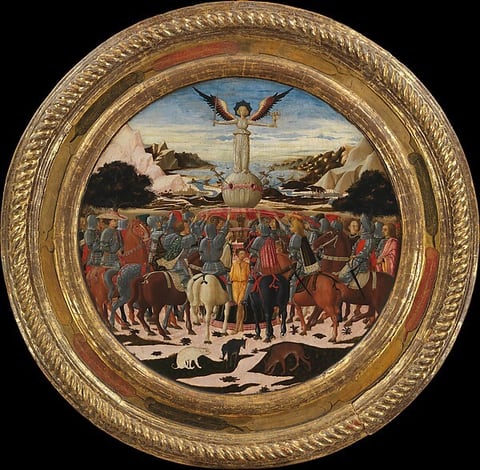
  2. The Triumph of Fame; (reverse) Impresa of the Medici Family and Arms of the Medici and Tornabuoni Families, by Giovanni di ser Giovanni Guidi (called Scheggia), ca. 1449
    The Triumph of Fame; (reverse) Impresa of the Medici Family and Arms of the Medici and Tornabuoni FamiliesGiovanni di ser Giovanni Guidi (called Scheggia), ca. 1449Courtesy of The Metropolitan Museum of Art
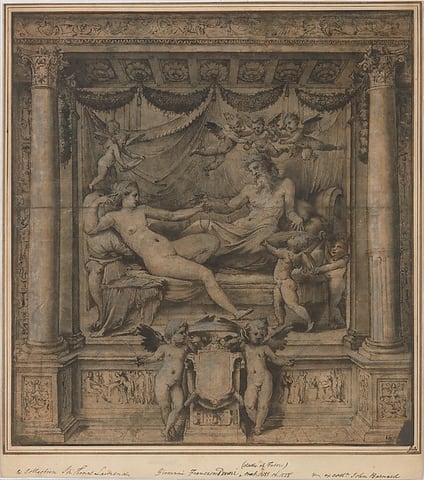
  3. Jupiter and Juno: Study for the "Furti di Giove" Tapestries, by Perino del Vaga (Pietro Buonaccorsi), ca. 1532–35
    Jupiter and Juno: Study for the "Furti di Giove" TapestriesPerino del Vaga (Pietro Buonaccorsi), ca. 1532–35Courtesy of The Metropolitan Museum of Art

Third room, south wall
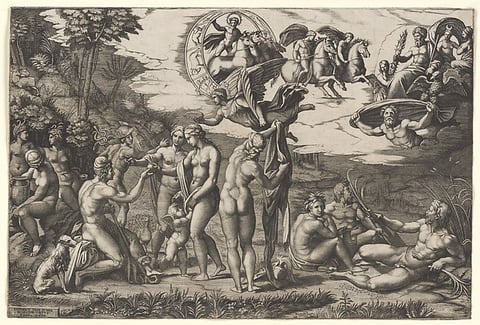
  1. The Judgment of Paris: he is sitting at left with Venus, Juno and Pallas Athena, a winged victory above. In the upper section the Sun in his chariot preceeded by Castor and Pollux on horseback, at lower right two river gods and a naiad above whom Jupiter, an eagle, Ganymede, Diana and another goddess, by Marcantonio Raimondi, ca. 1510–20
    The Judgment of Paris: he is sitting at left with Venus, Juno and Pallas Athena, a winged victory above. In the upper section the Sun in his chariot preceeded by Castor and Pollux on horseback, at lower right two river gods and a naiad above whom Jupiter, an eagle, Ganymede, Diana and another goddessMarcantonio Raimondi, ca. 1510–20Courtesy of The Metropolitan Museum of Art
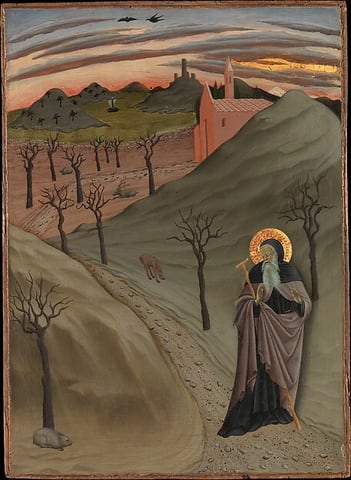
  2. Saint Anthony the Abbot in the Wilderness, by Sano di Pietro (Ansano di Pietro di Mencio), ca. 1440
    Saint Anthony the Abbot in the WildernessSano di Pietro (Ansano di Pietro di Mencio), ca. 1440Courtesy of The Metropolitan Museum of Art