Floor plan

Style galleriesGeorgian Britain

Georgian Britain

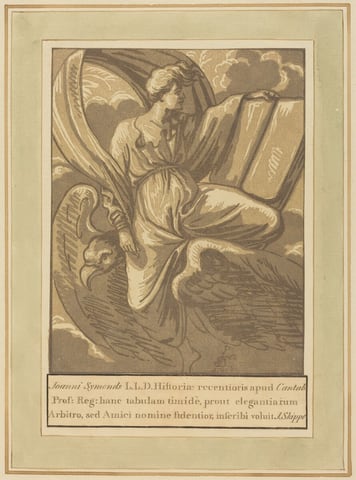
This is a drawing of a seated figure on a large bird. The image depicts a classically draped figure seated on a stylized bird. The figure holds an open book and gazes into the distance. The bird has sharp features and spread wings. The background contains swirling clouds. The scene is framed with a border, and there is text at the bottom. The lines are bold and the shades are muted.
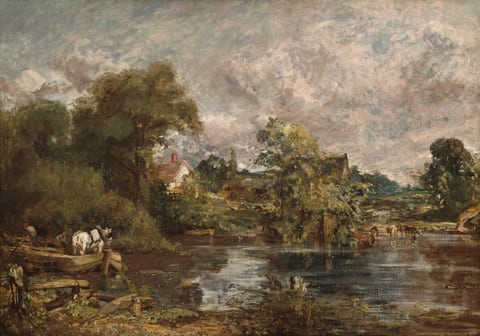
From a grassy riverbank, we look across the placid surface of a river lined along the far bank with trees and farm animals in this horizontal landscape painting. The scene is painted loosely with brushstrokes visible throughout, so some details are difficult to make out. For the surface of the river, russet-brown and steel-gray paint skims lightly across the canvas and leaves some unpainted areas visible, creating the effect of light shimmering on the still water. On our left, a shallow wooden barge is propelled along the stream by two men in red caps with long poles. The boat carries a white horse wearing blinders and a harness. The riverbank beyond is lined with pale, sage-green grass tinged with gold, growing in front of a tangle of darker green trees and bushes. Across the water from us near the middle of the picture, a small rowboat sits in the shallows at the foot of a steep riverbank. Above, a white cottage with a reddish roof and chimney is tucked behind the trees, with a wooden rack full of hay next to it. Nearby, a plow and wheeled cart, highlighted with strokes of white, sit near more mounds of hay. Rocky fields reach into the distance. The vista is blocked to our right by another clump of trees and a rocky outcropping, rising from the stream, to our right of center. The steep, dark roof of a farmhouse is barely visible among the trees. Along the riverside to our right, a small group of cinnamon-brown and cream-white cows stand at water's edge. A rolling pasture stretches behind them to meet blue hills in the distance. Above, in the upper third of the painting, mottled white, pale rose, and gray clouds rolling across a steel-gray sky are reflected in the water below.
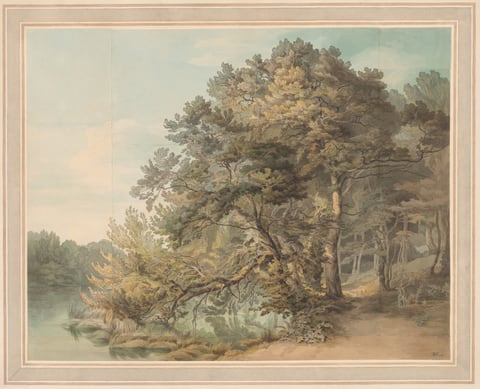
The image shows a forest by a serene, tree-lined body of water. The horizon is high with tall trees extending close to it, creating a sense of depth. The brushstrokes and watercolor application are delicate, capturing textures of leaves and water gently. The color palette includes muted greens, soft browns, and hints of blue and cream. Closest to us is a dense cluster of trees on the right, curving over the water. Across the water, other tree clusters and shrubs recede into the misty background towards the left.
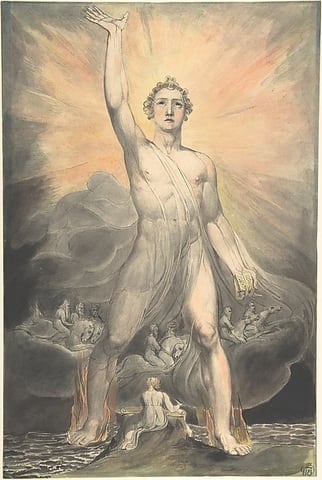
Angel of the Revelation (Book of Revelation, chapter 10), by William Blake, ca. 1803–5
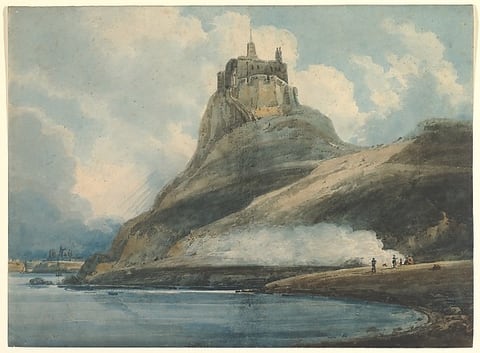
Lindisfarne Castle, Holy Island, Northumberland, by Thomas Girtin, 1796–97
Large English country landscape painting, farmers with horses, green trees.

The works in this room are listed below.

Works in this room

Portraits, conversation pieces and watercolour landscapes from Hogarth to Constable.

Section 1, north wall

  1. This is a drawing of a seated figure on a large bird. The image depicts a classically draped figure seated on a stylized bird. The figure holds an open book and gazes into the distance. The bird has sharp features and spread wings. The background contains swirling clouds. The scene is framed with a border, and there is text at the bottom. The lines are bold and the shades are muted.
    Saint John the EvangelistJohn Skippe, 1771Courtesy National Gallery of Art, Washington
  2. From a grassy riverbank, we look across the placid surface of a river lined along the far bank with trees and farm animals in this horizontal landscape painting. The scene is painted loosely with brushstrokes visible throughout, so some details are difficult to make out. For the surface of the river, russet-brown and steel-gray paint skims lightly across the canvas and leaves some unpainted areas visible, creating the effect of light shimmering on the still water. On our left, a shallow wooden barge is propelled along the stream by two men in red caps with long poles. The boat carries a white horse wearing blinders and a harness. The riverbank beyond is lined with pale, sage-green grass tinged with gold, growing in front of a tangle of darker green trees and bushes. Across the water from us near the middle of the picture, a small rowboat sits in the shallows at the foot of a steep riverbank. Above, a white cottage with a reddish roof and chimney is tucked behind the trees, with a wooden rack full of hay next to it. Nearby, a plow and wheeled cart, highlighted with strokes of white, sit near more mounds of hay. Rocky fields reach into the distance. The vista is blocked to our right by another clump of trees and a rocky outcropping, rising from the stream, to our right of center. The steep, dark roof of a farmhouse is barely visible among the trees. Along the riverside to our right, a small group of cinnamon-brown and cream-white cows stand at water's edge. A rolling pasture stretches behind them to meet blue hills in the distance. Above, in the upper third of the painting, mottled white, pale rose, and gray clouds rolling across a steel-gray sky are reflected in the water below.
    The White HorseJohn Constable, 1818-1819Courtesy National Gallery of Art, Washington
  3. The image shows a forest by a serene, tree-lined body of water. The horizon is high with tall trees extending close to it, creating a sense of depth. The brushstrokes and watercolor application are delicate, capturing textures of leaves and water gently. The color palette includes muted greens, soft browns, and hints of blue and cream. Closest to us is a dense cluster of trees on the right, curving over the water. Across the water, other tree clusters and shrubs recede into the misty background towards the left.
    Peamore, DevonJohn White Abbott, 1799Courtesy National Gallery of Art, Washington

Section 1, south wall

  1. Angel of the Revelation (Book of Revelation, chapter 10), by William Blake, ca. 1803–5
    Angel of the Revelation (Book of Revelation, chapter 10)William Blake, ca. 1803–5Courtesy of The Metropolitan Museum of Art
  2. Lindisfarne Castle, Holy Island, Northumberland, by Thomas Girtin, 1796–97
    Lindisfarne Castle, Holy Island, NorthumberlandThomas Girtin, 1796–97Courtesy of The Metropolitan Museum of Art
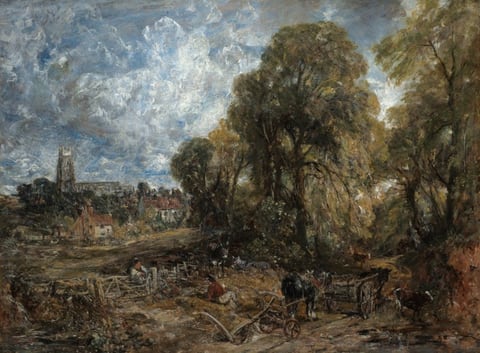
  3. Large English country landscape painting, farmers with horses, green trees.
    Stoke-by-NaylandJohn Constable, 1836Courtesy of the Art Institute of Chicago

Section 2, south wall
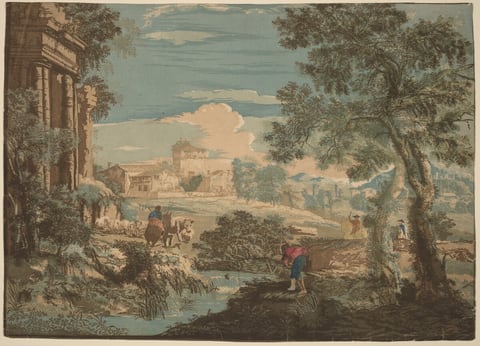
  1. The image shows a landscape scene from an elevated viewpoint. There are large columns of a classical ruin and a leafy tree on the left. On the right, there is a spreading tree with intricate leaves. In the background, there is a pastoral landscape with figures and animals. A shepherd and a cow are guiding a flock of sheep, and buildings can be seen in the distance. The horizon divides the image into sky and earth. The brushstrokes are detailed, capturing textures effectively. The color palette consists of earthy tones with touches of brighter colors on the figures' clothing.
    Heroic Landscape with Fisherman, Cows, and HorsemenJohn Baptist Jackson, 1744Courtesy National Gallery of Art, Washington
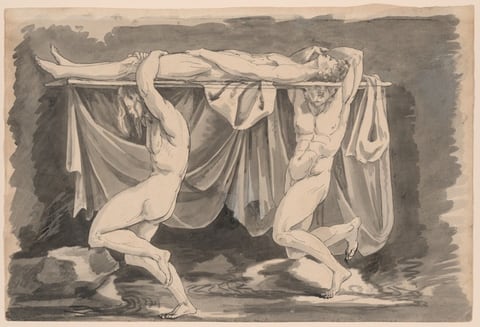
  2. A work made of brush and black ink wash, with pen and black ink and opaque white and gray watercolor, on cream laid paper.
    A Hero Born on a Bier, from The Master of Giants PortfolioPrince Hoare, 1779Courtesy of the Art Institute of Chicago
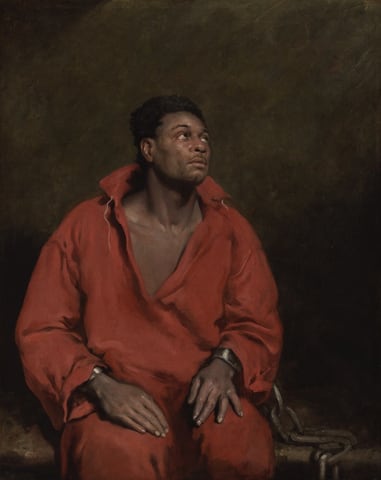
  3. Painting of a dark-skinned man seated and wearing a red open-necked tunic. He looks up to the right. His wrists are shackled and a large chain rests at his right, running down the bench he sits upon.
    The Captive Slave (Ira Aldridge)John Philip Simpson, 1827Courtesy of the Art Institute of Chicago
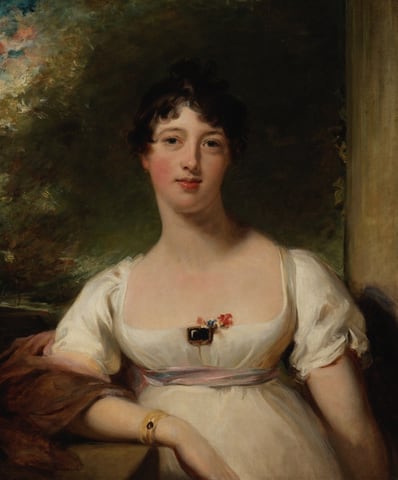
  4. A work made of oil on canvas.
    Anna Maria Dashwood, later Marchioness of ElyThomas Lawrence, c. 1805Courtesy of the Art Institute of Chicago

Section 2, north wall
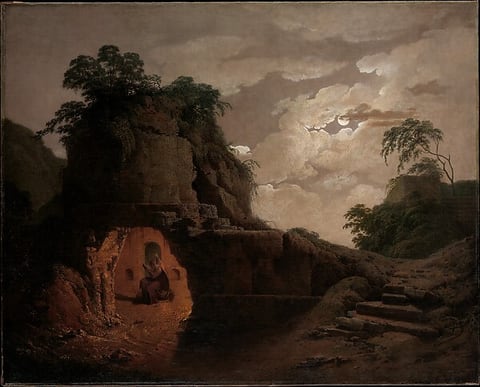
  1. Virgil's Tomb by Moonlight, with Silius Italicus Declaiming, by Joseph Wright of Derby, 1779
    Virgil's Tomb by Moonlight, with Silius Italicus DeclaimingJoseph Wright of Derby, 1779Courtesy of The Metropolitan Museum of Art
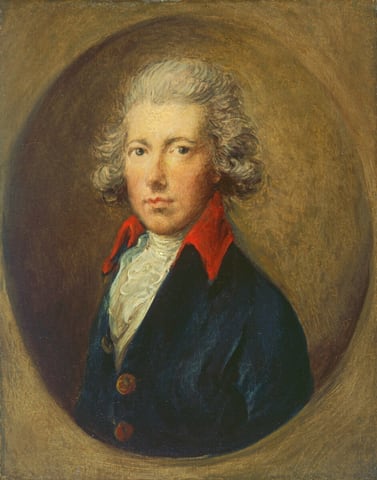
  2. The image depicts a portrait of an individual with the upper half of their body visible. The person is facing forward with their head slightly turned to the side, looking directly at the viewer. They have a fair complexion, with distinct facial features, including a rounded face and closed lips. The hair is styled in an 18th-century manner, with curls around the ears. They are wearing a dark coat with red lapels and brass buttons, over a white shirt with ruffled details. There are no visible jewelry or objects in their hands. The background is a textured, earth-toned surface.
    William PittGainsborough Dupont, 1787/1796Courtesy National Gallery of Art, Washington
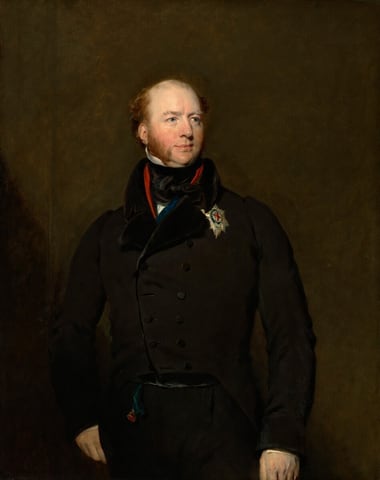
  3. The image displays a man in a portrait from the waist up, in a three-quarter view. He is facing slightly to the right and looking into the distance with a calm expression. The man has fair skin, light reddish-brown hair, sideburns, a defined nose, and a slightly upturned chin. He is wearing a black double-breasted coat with a high collar, a dark waistcoat, a white shirt, and a medal on his chest with an insignia and ribbon. The background is plain and deep brown.
    Francis Charles Seymour-Conway, 3rd Marquess of HertfordThomas Lawrence, c. 1822/1823Courtesy National Gallery of Art, Washington

Section 3, north wall
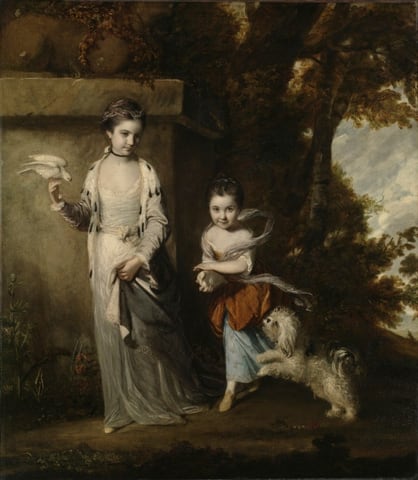
  1. Portrait of the Ladies Amabel and Mary Jemima Yorke, by Joshua Reynolds, c. 1761
    Portrait of the Ladies Amabel and Mary Jemima YorkeJoshua Reynolds, c. 1761Courtesy of the Cleveland Museum of Art
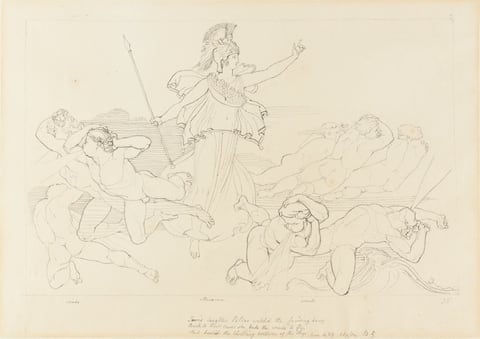
  2. A work made of pen and black ink, over traces of graphite, on tan wove paper, laid down on cream wove paper.
    Athena and the WindsJohn Flaxman, n.d.Courtesy of the Art Institute of Chicago
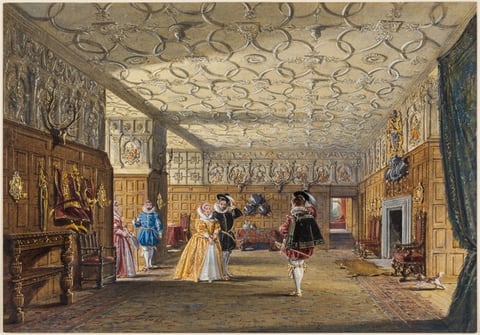
  3. A work made of watercolor and gouache, heightened with white gouache, over graphite selectively gum varnished on cream wove card.
    The Hall, Levens, WestmorelandJoseph Nash, n.d.Courtesy of the Art Institute of Chicago