Floor plan

Style galleriesThe Etching Revival

The Etching Revival

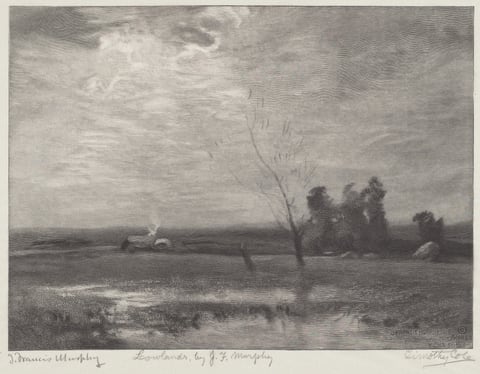
This print displays a landscape with a wide view of flat land stretching towards the horizon. The ground is covered in small black dots, with some bare patches in the bottom center. A few silhouetted trees and a hint of smoke coming up from behind some rocks are visible in the distance. The gray sky dominates the scene with soft, swirling clouds.
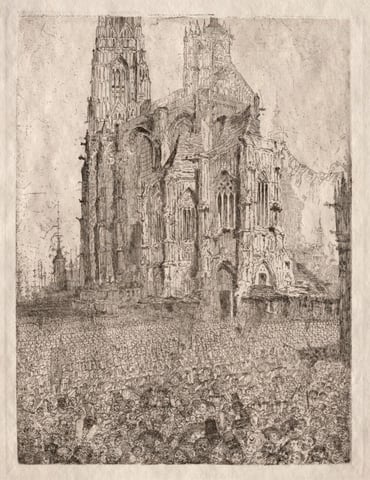
The Cathedral, by James Ensor, 1886
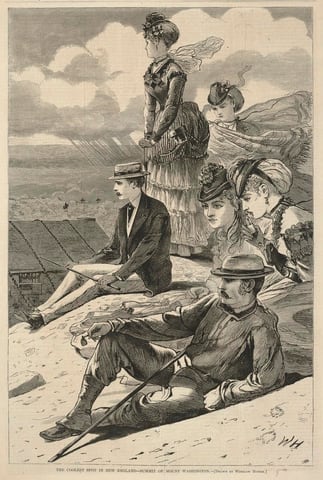
The Coolest Spot in New England--Summit of Mount Washington, from Harper's Bazar, July 23, 1870, by Winslow Homer, 1870
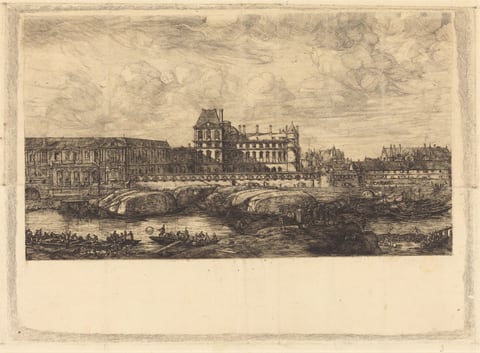
The image features a riverside scene with a large building in the center and smaller structures in the background. The sky is filled with clouds, and there are boats on the water. The artwork is done in an etching style, with detailed lines showing architectural elements, boats, and water ripples. The color scheme is monochromatic in shades of brown and black.
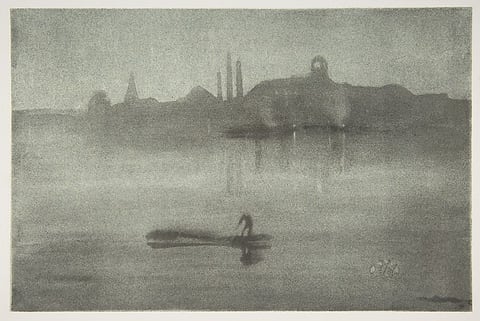
Nocturne (Nocturne: The Thames at Battersea), by James McNeill Whistler, 1878
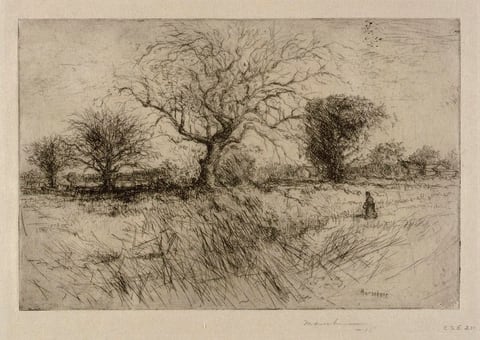
The Old Orchard, by Arthur A. Marschner, 1915

The works in this room are listed below.

Works in this room

Artists who took up the etching needle again, from Whistler to the Paris printmakers.

Section 1, north wall

  1. This print displays a landscape with a wide view of flat land stretching towards the horizon. The ground is covered in small black dots, with some bare patches in the bottom center. A few silhouetted trees and a hint of smoke coming up from behind some rocks are visible in the distance. The gray sky dominates the scene with soft, swirling clouds.
    LowlandsTimothy Cole, 1918Courtesy National Gallery of Art, Washington
  2. The Cathedral, by James Ensor, 1886
    The CathedralJames Ensor, 1886Courtesy of the Cleveland Museum of Art
  3. The Coolest Spot in New England--Summit of Mount Washington, from Harper's Bazar, July 23, 1870, by Winslow Homer, 1870
    The Coolest Spot in New England--Summit of Mount Washington, from Harper's Bazar, July 23, 1870Winslow Homer, 1870Courtesy of the Smithsonian American Art Museum

Section 1, south wall

  1. The image features a riverside scene with a large building in the center and smaller structures in the background. The sky is filled with clouds, and there are boats on the water. The artwork is done in an etching style, with detailed lines showing architectural elements, boats, and water ripples. The color scheme is monochromatic in shades of brown and black.
    L'ancien Louvre d'après une peinture de Zeeman, 1651 (The Old Louvre, from a Painting by Zeeman, l651)Charles Meryon, 1866Courtesy National Gallery of Art, Washington
  2. Nocturne (Nocturne: The Thames at Battersea), by James McNeill Whistler, 1878
    Nocturne (Nocturne: The Thames at Battersea)James McNeill Whistler, 1878Courtesy of The Metropolitan Museum of Art
  3. The Old Orchard, by Arthur A. Marschner, 1915
    The Old OrchardArthur A. Marschner, 1915Courtesy of the Smithsonian American Art Museum

Section 2, south wall
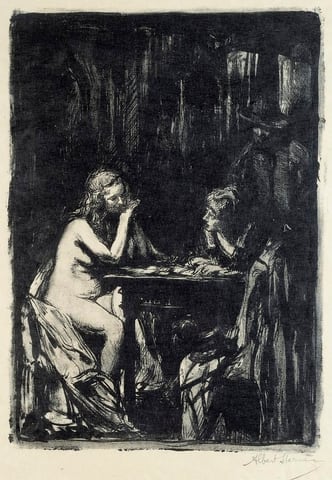
  1. The Stranger, by Albert Sterner, 1916
    The StrangerAlbert Sterner, 1916Courtesy of the Smithsonian American Art Museum
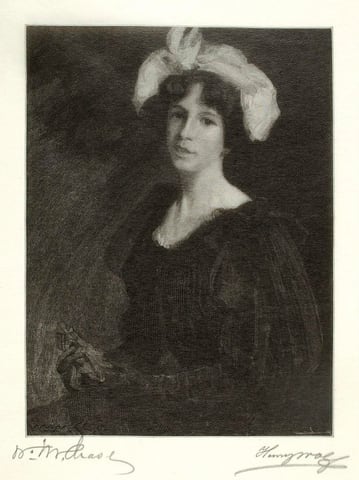
  2. Portrait of Mrs. C--, by Henry Wolf, 1894
    Portrait of Mrs. C--Henry Wolf, 1894Courtesy of the Smithsonian American Art Museum
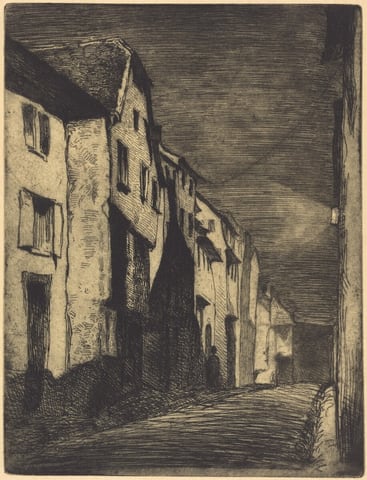
  3. The image shows a street scene from a close perspective down a narrow alleyway. The horizon is not visible, with buildings on both sides. The style features detailed etching with fine lines and shading for depth and texture. The color palette is monochromatic with black, gray, and off-white tones. The houses have worn facades, and there is a distant figure. The sky is dark and overcast, enhancing the shadow-filled scene.
    Street in SaverneJames McNeill Whistler, 1858Courtesy National Gallery of Art, Washington

Section 2, north wall
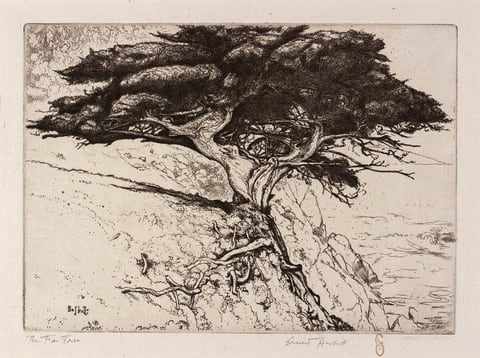
  1. The Fan Tree, by Ernest Haskell, ca. 1915
    The Fan TreeErnest Haskell, ca. 1915Courtesy of the Smithsonian American Art Museum
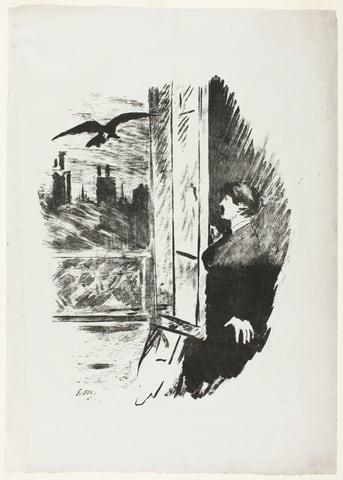
  2. A work made of transfer lithograph in black on gray china paper.
    At the window ("Open here I flung the shutter..."), from The Raven (Le Corbeau)Édouard Manet, 1875Courtesy of the Art Institute of Chicago
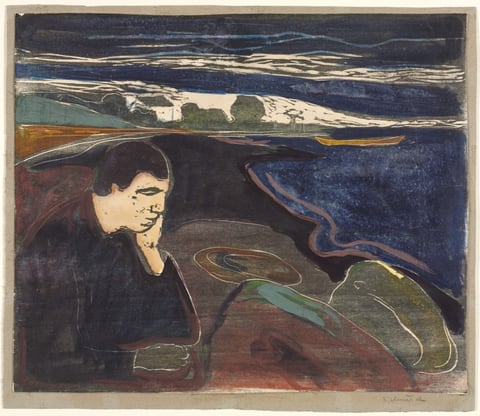
  3. Evening, Melancholy I, by Edvard Munch, 1896
    Evening, Melancholy IEdvard Munch, 1896Courtesy of the Cleveland Museum of Art

Section 3, north wall
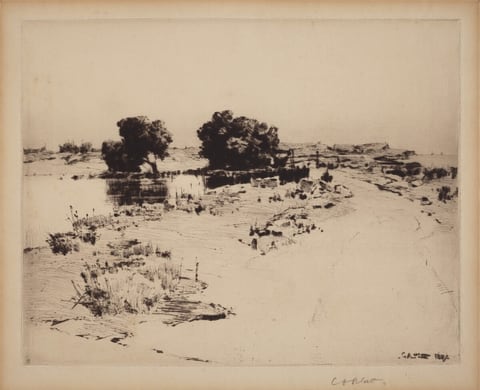
  1. The image depicts a landscape seen from a slightly elevated perspective, with a tranquil scene. The horizon is high in the composition, showing a vast view. There are a few distant trees and silhouettes blending into the sky. The brushstrokes are expressive and fluid, with a sketch-like quality depicting texture and movement in the trees and ground. The color palette is primarily monochrome, using shades of black and grey. Near the viewer, there are low plants and shrubs on sandy ground, leading to a small body of water reflecting dense trees. In the distance, the landscape becomes more open and sparse towards the horizon.
    Cape Ann WillowsCharles A. Platt, 1887Courtesy National Gallery of Art, Washington
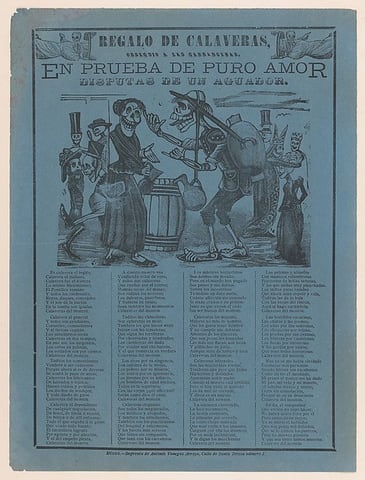
  2. In proof of true love, a watercarrier skeleton arguing with a woman (Posada); two skeleton angels in upper corners (Manilla), by José Guadalupe Posada, ca. 1890–96
    In proof of true love, a watercarrier skeleton arguing with a woman (Posada); two skeleton angels in upper corners (Manilla)José Guadalupe Posada, ca. 1890–96Courtesy of The Metropolitan Museum of Art

Section 3, south wall
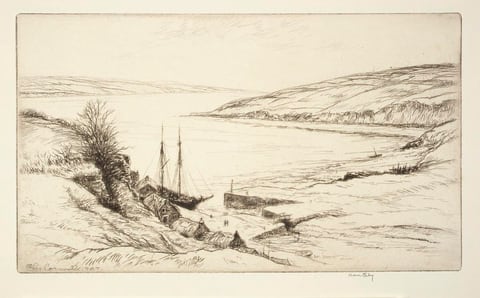
  1. Cornwall, by Kerr Eby, 1927
    CornwallKerr Eby, 1927Courtesy of the Smithsonian American Art Museum
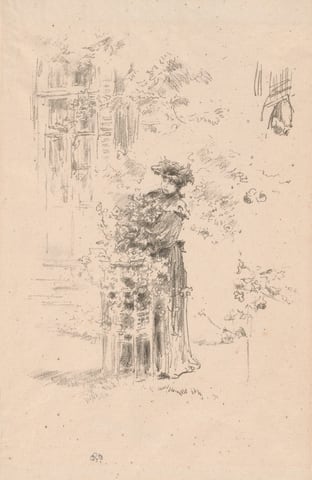
  2. A work made of transfer lithograph in black, with stumping and scraping, on cream laid paper, laid down on a heavy backing sheet.
    La Belle JardinièreJames McNeill Whistler, 1894Courtesy of the Art Institute of Chicago