Floor plan

Style galleriesThe Etching Revival

The Etching Revival

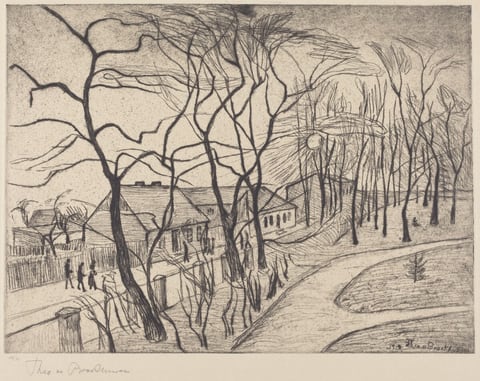
The image shows a residential area with barren trees, rooftops of houses, and people walking along fences. The trees sway in the wind, their branches extending in various directions. The scene is depicted in a monochromatic black and white style, with expressive lines creating a sense of movement and a sketch-like quality. The horizon is high, showing rooftops and the sun above it.
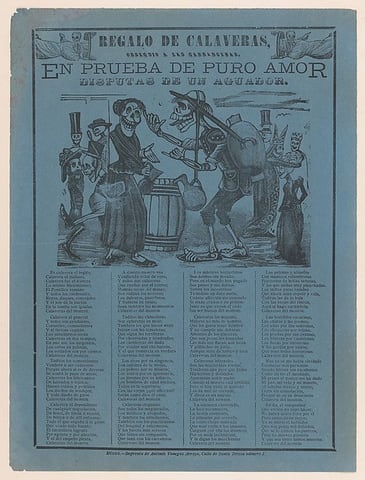
In proof of true love, a watercarrier skeleton arguing with a woman (Posada); two skeleton angels in upper corners (Manilla), by José Guadalupe Posada, ca. 1890–96
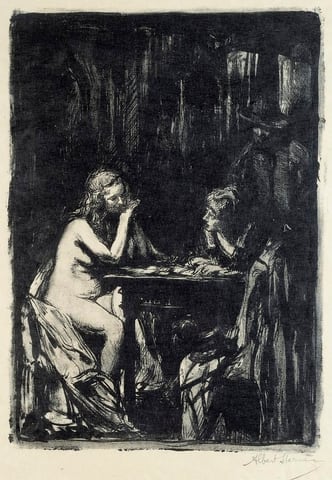
The Stranger, by Albert Sterner, 1916
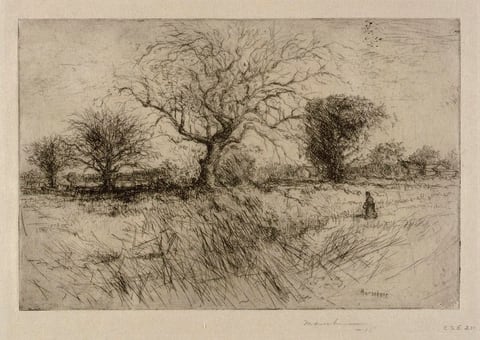
The Old Orchard, by Arthur A. Marschner, 1915
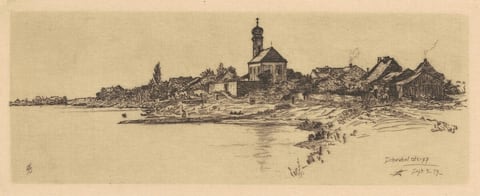
The image shows a village scene viewed from a low vantage point near a water's edge. A row of small, closely packed buildings and a church with an onion-shaped dome are prominently featured. There are gentle slopes leading towards the structures. The image uses fine, detailed line work to depict texture and depth in the buildings and natural landscape. The lines are delicate and varied, creating a sense of detail and softness. The color palette is monochromatic, with dark ink on a pale background, resulting in a classic and timeless feel.

The works in this room are listed below.

Works in this room

Artists who took up the etching needle again, from Whistler to the Paris printmakers.

Section 1, north wall

  1. The image shows a residential area with barren trees, rooftops of houses, and people walking along fences. The trees sway in the wind, their branches extending in various directions. The scene is depicted in a monochromatic black and white style, with expressive lines creating a sense of movement and a sketch-like quality. The horizon is high, showing rooftops and the sun above it.
    LandscapeTheo von BrockhusenCourtesy National Gallery of Art, Washington
  2. In proof of true love, a watercarrier skeleton arguing with a woman (Posada); two skeleton angels in upper corners (Manilla), by José Guadalupe Posada, ca. 1890–96
    In proof of true love, a watercarrier skeleton arguing with a woman (Posada); two skeleton angels in upper corners (Manilla)José Guadalupe Posada, ca. 1890–96Courtesy of The Metropolitan Museum of Art

Section 1, south wall

  1. The Stranger, by Albert Sterner, 1916
    The StrangerAlbert Sterner, 1916Courtesy of the Smithsonian American Art Museum
  2. The Old Orchard, by Arthur A. Marschner, 1915
    The Old OrchardArthur A. Marschner, 1915Courtesy of the Smithsonian American Art Museum
  3. The image shows a village scene viewed from a low vantage point near a water's edge. A row of small, closely packed buildings and a church with an onion-shaped dome are prominently featured. There are gentle slopes leading towards the structures. The image uses fine, detailed line work to depict texture and depth in the buildings and natural landscape. The lines are delicate and varied, creating a sense of detail and softness. The color palette is monochromatic, with dark ink on a pale background, resulting in a classic and timeless feel.
    SchwabelweissOtto Henry Bacher, 1879Courtesy National Gallery of Art, Washington

Section 2, south wall
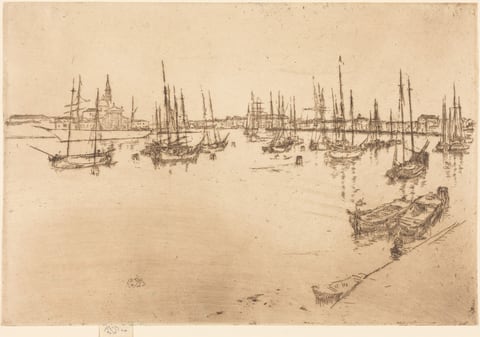
  1. The image displays a harbor filled with boats and ships. The perspective is slightly elevated, likely from a dock, with a partially visible boat and dock at the forefront. The horizon is in the upper third of the image, showing a distant cityscape with spires and structures. The brushwork is delicate, with fine, linear strokes typical of etching. The color palette is monochromatic, sepia tones creating a vintage and serene mood. The ships with tall masts populate the water, with reflections giving a sense of stillness. In the distance, faint impressions of buildings line the harbor, blending into the horizon.
    San GiorgioJames McNeill Whistler, 1880Courtesy National Gallery of Art, Washington
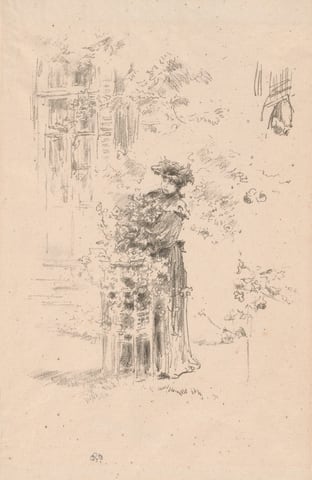
  2. A work made of transfer lithograph in black, with stumping and scraping, on cream laid paper, laid down on a heavy backing sheet.
    La Belle JardinièreJames McNeill Whistler, 1894Courtesy of the Art Institute of Chicago
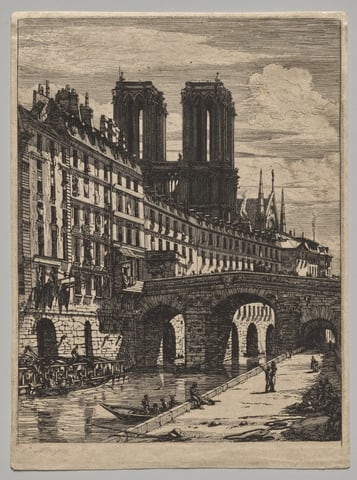
  3. The Petit Pont, by Charles Meryon, 1850
    The Petit PontCharles Meryon, 1850Courtesy of the Cleveland Museum of Art

Section 2, north wall
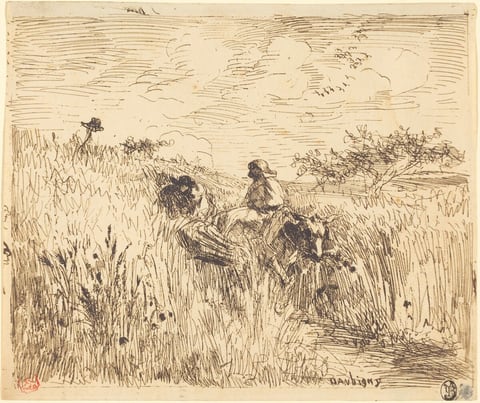
  1. This image shows an elevated view of a grassy landscape with sparse trees and vegetation at the horizon. The linear brushstrokes create texture and movement in the grass and sky. The color palette is monochromatic with sepia tones. In the foreground, a figure is on a horse amidst tall grasses, while in the distance, another figure stands on the left and a cluster of trees is on the right. The sky has wisps of clouds.
    Path through a Wheat Field (Sentier dans les bles)Charles-François Daubigny, 1862Courtesy National Gallery of Art, Washington
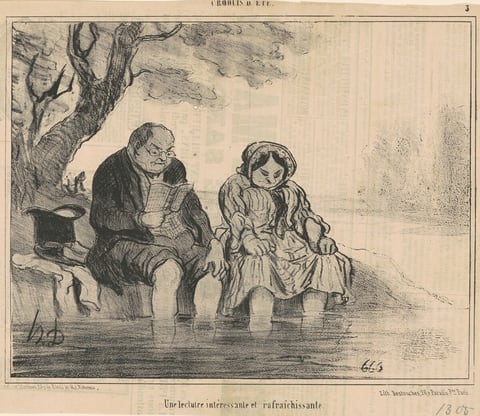
  2. The image shows two individuals seated outdoors near a body of water with their feet submerged. Both individuals are seen from head to toe. The person on the left is seated with a slightly hunched posture, reading a document or a book. They have a balding head, wear glasses, a dark suit with the coat draped over their knees, and a top hat placed on the ground. The individual on the right is sitting upright with a scarf over their hair. They wear a long dress with a shawl, and their hands rest on their lap. The background features a bare tree and a rough, sketched environment. The sky and landscape are depicted in shades of light and dark.
    Une lecture intéressante et rafraichissanteHonoré Daumier, 1854Courtesy National Gallery of Art, Washington

Section 3, north wall
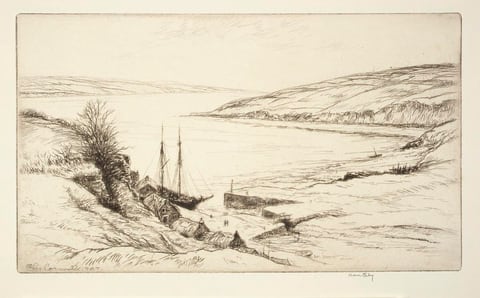
  1. Cornwall, by Kerr Eby, 1927
    CornwallKerr Eby, 1927Courtesy of the Smithsonian American Art Museum
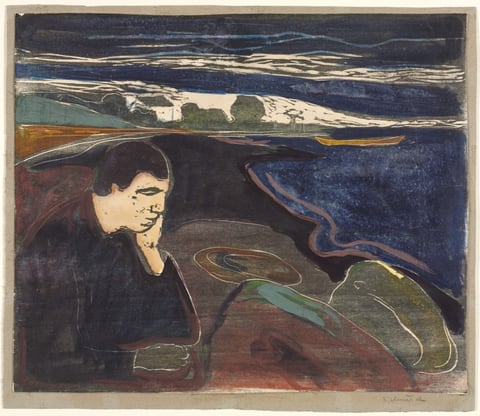
  2. Evening, Melancholy I, by Edvard Munch, 1896
    Evening, Melancholy IEdvard Munch, 1896Courtesy of the Cleveland Museum of Art

Section 3, south wall
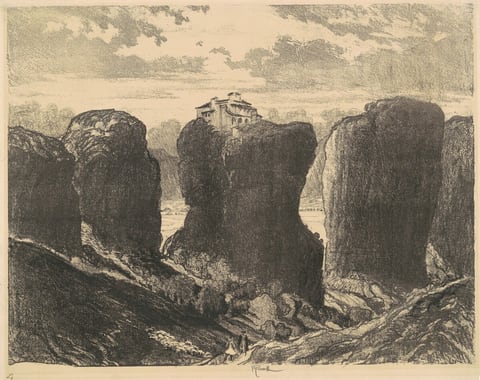
  1. The image depicts a landscape with towering rock formations dominating the scene. The ground is rugged and textured, leading the eye towards the rock pillars in the center. A structure or building is perched atop one of these rocks. The background shows the horizon above the structure, with clouds and sky stretching out beyond. The artwork features detailed brushstrokes adding texture to the rocks. The color palette is monochromatic with varying shades of charcoal or ink, emphasizing the contrast between the rocks and the sky.
    The Cliffs of the TrinityJoseph Pennell, 1913Courtesy National Gallery of Art, Washington
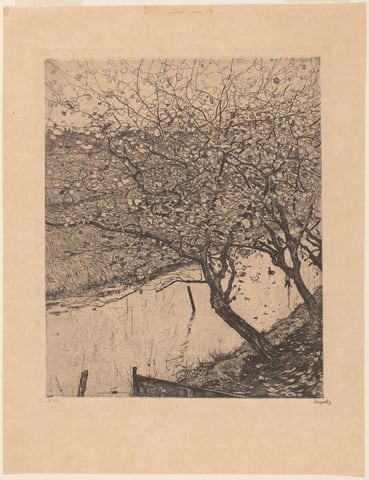
  2. The image shows a small body of water with grass-covered banks on either side. The viewpoint is slightly elevated, looking down at the scene. The horizon is in the upper third of the composition, separating the sky from the land. The artwork features intricate linework and stippling to create texture and detail, particularly in the tree branches. The color palette is monochrome, with shades of sepia and brown. A tree dominates the right side of the scene, leaning over the water. In the distance, more trees and fields are visible with minimal detail in the far background.
    Apple Trees along the Side of a DitchPieter Dupont, 1894Courtesy National Gallery of Art, Washington

Section 4, south wall
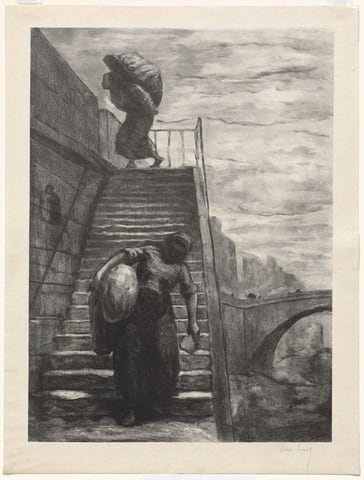
  1. Washerwomen Descending a Quai Staircase, by Alexandre Lunois, 1888
    Washerwomen Descending a Quai StaircaseAlexandre Lunois, 1888Courtesy of the Cleveland Museum of Art
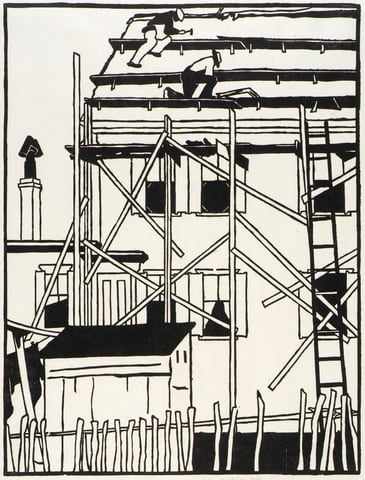
  2. Untitled, by Mildred McMillen, 1915
    UntitledMildred McMillen, 1915Courtesy of the Smithsonian American Art Museum