Floor plan

Style galleriesDutch and Flemish Baroque
Dutch and Flemish Baroque
A work made of oil on copper.
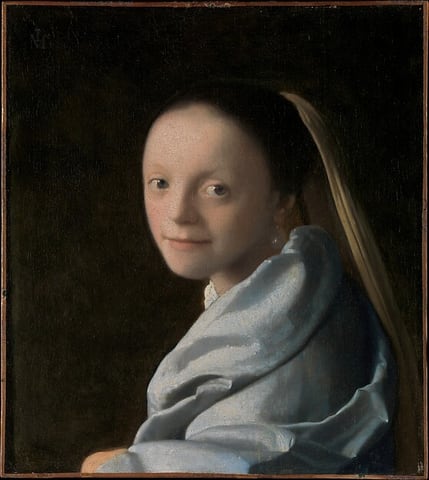
Study of a Young Woman, by Johannes Vermeer, ca. 1665–67
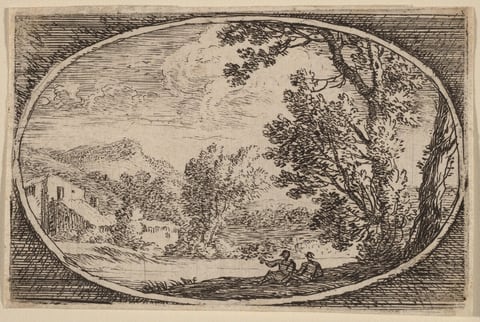
The image shows an oval framing a scene with mountains, clouds, and trees. Delicate etched lines create textures in the landscape. The color palette is monochrome. Two figures are sitting under leafy trees, with a structure nearby.
Gathered in a round glass vase, a tall bouquet of flowers in shades of light and deep pink, sunshine yellow, and white with pine-green leaves nearly fills this vertical still life painting. Shown against an gray background, the vase sits on a narrow ledge, perhaps made of wood. A label with looping, cursive French text painted in gold against a baby blue background is affixed to the front of the ledge, along the bottom edge of the composition. The text reads, “C'est l'Angelicq main du grad Peinctre de Flore AMBROISE, renommé jusqu' au Rivage Moré.” A few of the flowers draw the eye, including a tulip and iris at the top of the bouquet. To our left, the tulip is mauve pink with cream-colored streaks, and one petal folds down to reveal the stamen inside. Next to it, a damselfly, an insect like a delicate dragonfly, rests on the vibrant yellow iris. The petals curling down from the iris are veined in muted burgundy red. Flowers filling in the bouquet below include a shell-pink cyclamen, a white gardenia, a closed blue and white striped columbine, a slate-blue grape hyacinth, lily of the valley, pale blue forget-me-nots, and a pink peony interspersed with leaves and greenery. The round glass vase has a narrow opening. A sprig of viola rests to our left of the vase on the ledge, and an orange, black, white, and brown butterfly perches on the stem of a pink cyclamen laying to our right of the vase. The artist signed the painting with a monogram and dated it in dark paint to our right on the face of the ledge: “AB 1621.”
The image features a detailed black and white illustration with multiple human and animal figures in a symbolic arrangement. In the foreground, two full-body figures are depicted in long robes and sandals, positioned on either side of a large draped banner with text. One figure holds an open book. Above the banner are celestial figures in dynamic poses. To the left is a winged bull-like creature and a seated male figure with a beard, next to a female figure in classical attire. They are all surrounded by flowing fabric and a lion-like animal. In the lower center foreground, there is an emblem resembling a coat of arms with an eagle and a crowned shield. The background is textured, with no natural landscape or architecture present, allowing the figures to stand out. The illustration is framed by the margins of an open book.
A work made of pen and brown ink, with traces of black chalk, on cream laid paper.
The Lovesick Maiden, by Jan Steen, ca. 1660
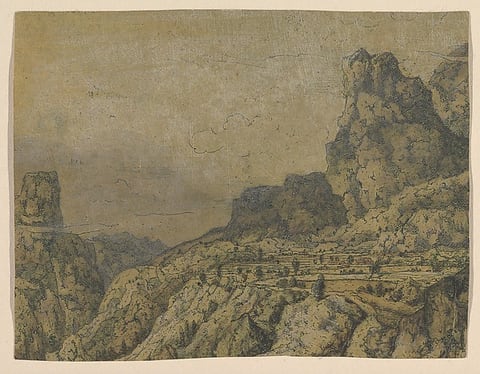
Mountain Valley with a Plateau, by Hercules Segers, ca. 1625–30

The works in this room are listed below.

Works in this room

The Low Countries in the 1600s: Rubens's Antwerp and the painters of the Dutch Republic.

First room, north wall

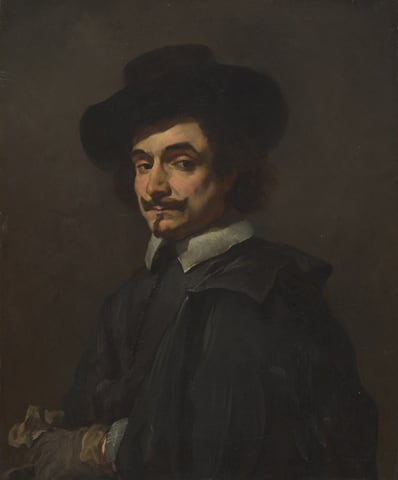
  1. A work made of oil on copper.
    Portrait of a ManJan Baptist Weenix, c. 1650Courtesy of the Art Institute of Chicago
  2. Study of a Young Woman, by Johannes Vermeer, ca. 1665–67
    Study of a Young WomanJohannes Vermeer, ca. 1665–67Courtesy of The Metropolitan Museum of Art
  3. The image shows an oval framing a scene with mountains, clouds, and trees. Delicate etched lines create textures in the landscape. The color palette is monochrome. Two figures are sitting under leafy trees, with a structure nearby.
    Two Men Seated Near the WatersideHerman van SwaneveltCourtesy National Gallery of Art, Washington
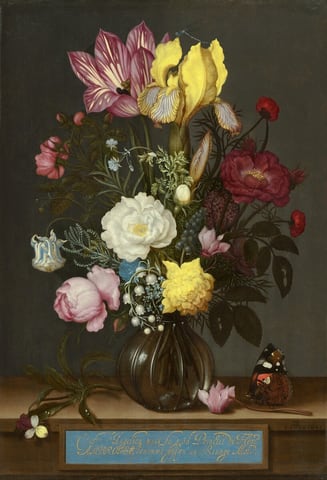
  4. Gathered in a round glass vase, a tall bouquet of flowers in shades of light and deep pink, sunshine yellow, and white with pine-green leaves nearly fills this vertical still life painting. Shown against an gray background, the vase sits on a narrow ledge, perhaps made of wood. A label with looping, cursive French text painted in gold against a baby blue background is affixed to the front of the ledge, along the bottom edge of the composition. The text reads, “C'est l'Angelicq main du grad Peinctre de Flore AMBROISE, renommé jusqu' au Rivage Moré.” A few of the flowers draw the eye, including a tulip and iris at the top of the bouquet. To our left, the tulip is mauve pink with cream-colored streaks, and one petal folds down to reveal the stamen inside. Next to it, a damselfly, an insect like a delicate dragonfly, rests on the vibrant yellow iris. The petals curling down from the iris are veined in muted burgundy red. Flowers filling in the bouquet below include a shell-pink cyclamen, a white gardenia, a closed blue and white striped columbine, a slate-blue grape hyacinth, lily of the valley, pale blue forget-me-nots, and a pink peony interspersed with leaves and greenery. The round glass vase has a narrow opening. A sprig of viola rests to our left of the vase on the ledge, and an orange, black, white, and brown butterfly perches on the stem of a pink cyclamen laying to our right of the vase. The artist signed the painting with a monogram and dated it in dark paint to our right on the face of the ledge: “AB 1621.”
    Bouquet of Flowers in a Glass VaseAmbrosius Bosschaert, 1621Courtesy National Gallery of Art, Washington

First room, south wall

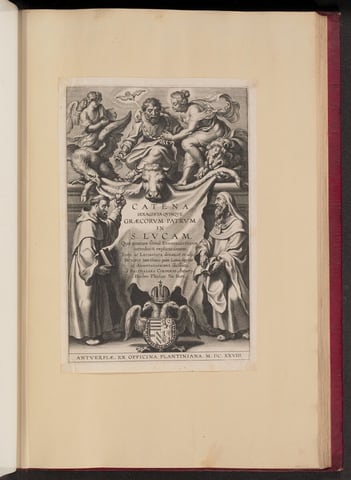
  1. The image features a detailed black and white illustration with multiple human and animal figures in a symbolic arrangement. In the foreground, two full-body figures are depicted in long robes and sandals, positioned on either side of a large draped banner with text. One figure holds an open book. Above the banner are celestial figures in dynamic poses. To the left is a winged bull-like creature and a seated male figure with a beard, next to a female figure in classical attire. They are all surrounded by flowing fabric and a lion-like animal. In the lower center foreground, there is an emblem resembling a coat of arms with an eagle and a crowned shield. The background is textured, with no natural landscape or architecture present, allowing the figures to stand out. The illustration is framed by the margins of an open book.
    Title Page for Balthasar Cordier, Catena Sexaginta Qvinqve Graecorvm Patrvm in S. Lvcam...Cornelis Galle I, 1628Courtesy National Gallery of Art, Washington
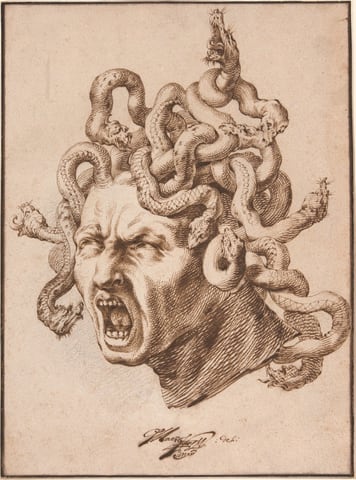
  2. A work made of pen and brown ink, with traces of black chalk, on cream laid paper.
    Head of MedusaGodfried Maes, 1680Courtesy of the Art Institute of Chicago
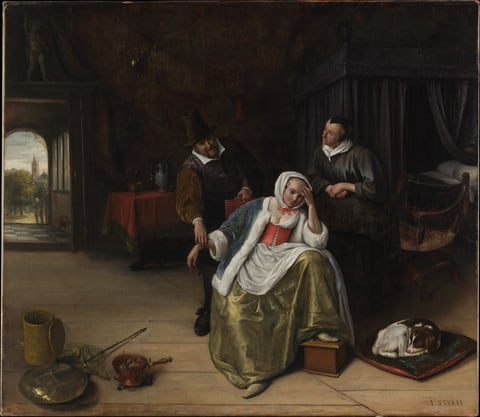
  3. The Lovesick Maiden, by Jan Steen, ca. 1660
    The Lovesick MaidenJan Steen, ca. 1660Courtesy of The Metropolitan Museum of Art
  4. Mountain Valley with a Plateau, by Hercules Segers, ca. 1625–30
    Mountain Valley with a PlateauHercules Segers, ca. 1625–30Courtesy of The Metropolitan Museum of Art

Second room, south wall
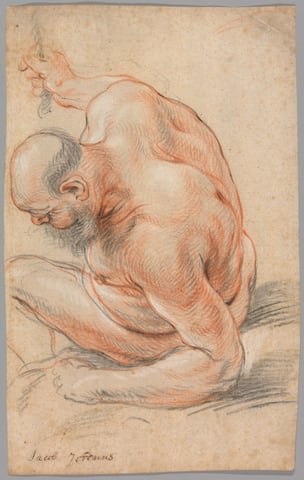
  1. A work made of red and black chalk, with touches of white chalk, on cream laid paper.
    Nude Old Man Seated, Leaning on His Forearm, Facing LeftJacob Jordaens, c. 1640Courtesy of the Art Institute of Chicago
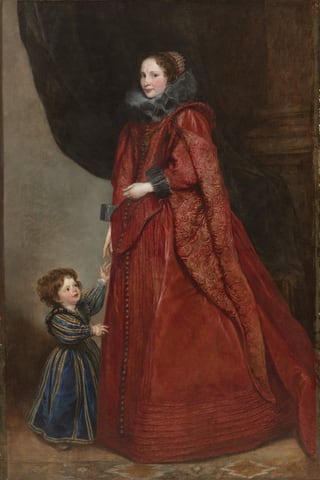
  2. A Genoese Lady with Her Child, by Anthony van Dyck, c. 1623–25
    A Genoese Lady with Her ChildAnthony van Dyck, c. 1623–25Courtesy of the Cleveland Museum of Art
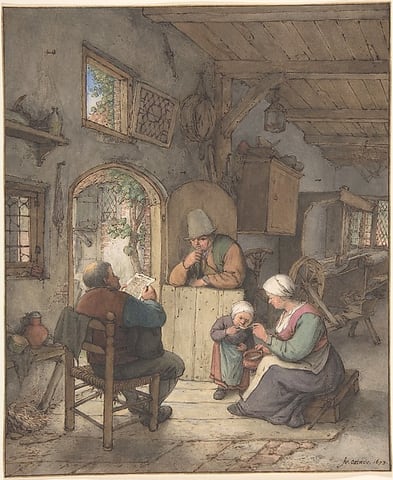
  3. Reading the News at the Weavers' Cottage, by Adriaen van Ostade, 1673
    Reading the News at the Weavers' CottageAdriaen van Ostade, 1673Courtesy of The Metropolitan Museum of Art

Second room, north wall
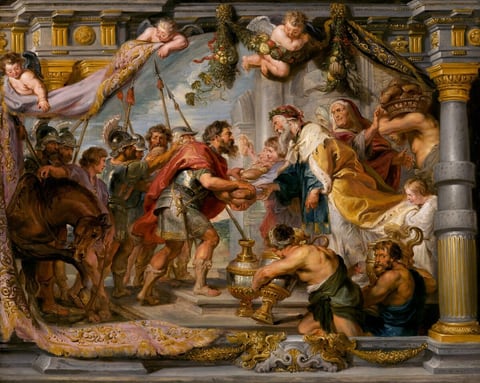
  1. This horizontal painting shows a tapestry being unfurled and held up by winged, baby-like putti against a structure with gray and gold columns, seen at the edges of the composition. Taking up most of the composition, the tapestry shows two ranks of men, women, and children gathered behind two central men, who meet at the center. All the people have light or tanned skin, and the bodies we can see are muscular. In the central pair of men, the one to our left, Abraham, faces our right in profile as he holds two loaves of bread. He has a brown beard and short, wavy hair, and dark brows over a prominent nose. He looks at the other man with dark eyes and leans toward him, to our right. Abraham wears an armored breastplate over silver chainmail edged with gold, which falls to mid-thigh. A crimson-red cape wraps around his shoulders and swirls around his back. A sword hangs by his hip, and tan sandals cover his heels and shins. Behind him are seven men and one brown horse, who gnaws at its foreleg. Most of the men are bearded and five wear armored helmets. A cleanshaven man wearing a lavender-purple tunic stands with his arm slung over the horse’s neck, holding the rein between thumb and forefinger. The man to our right, Melchizedek has a long white beard and short white hair. His red cap is encircled with a wreath of dark green leaves. He wears a long-sleeved, waist-length, aquamarine-blue garment over a white skirt. A heavy, golden-yellow cape with a broad, white fur collar and lining drapes over his shoulders, and is supported by at least one attendant. Behind and around Melchizedek are eight men, women, and children, standing near stone, gray ruins. Behind Melchizedek, one portly person wearing a dark pink mantle reaches into a basket of bread held across the shoulders of a blond, bearded, bare-chested man. Closer to us, in the lower right corner of the tapestry, one man wearing a green toga and another wearing blue kneel and sit, holding oversized silver and gold urns, the size of their torsos. The man in blue, to our right, turns to look at us over his shoulder. A third large urn sits near the other man. A view into the landscape with a low, green hill and a pale blue sky is glimpsed between the groups. The tapestry showing this scene curls over at the edges where the pudgy angels lift the top edge. The top right corner of the tapestry wraps around the edge of an unseen feature of the building, next to a gray column that rises the height of the painting up along the right edge. The border of the tapestry is rose pink with stylized gold designs. One putto with brown hair holds up the left corner, and one with light gray hair holds up the middle one arm slung over the front of the tapestry. The third putto, with blond hair, hooks an arm over a leafy garland with fruit that hangs from the cornice near the top center of the composition.
    The Meeting of Abraham and MelchizedekPeter Paul Rubens, c. 1626Courtesy National Gallery of Art, Washington
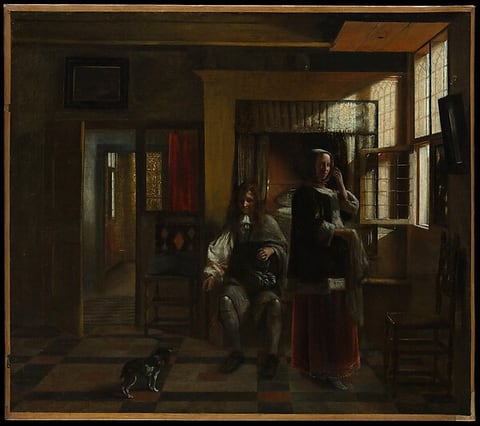
  2. Interior with a Young Couple, by Pieter de Hooch, probably ca. 1662–65
    Interior with a Young CouplePieter de Hooch, probably ca. 1662–65Courtesy of The Metropolitan Museum of Art
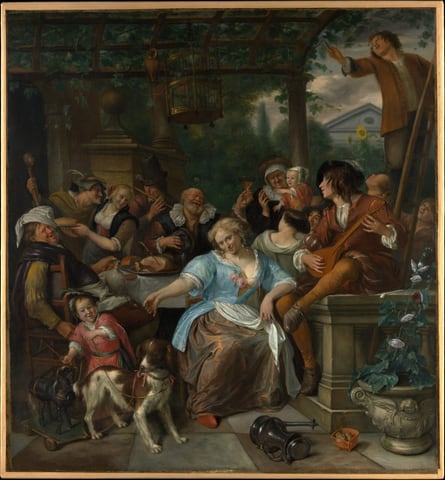
  3. Merry Company on a Terrace, by Jan Steen, ca. 1670
    Merry Company on a TerraceJan Steen, ca. 1670Courtesy of The Metropolitan Museum of Art

Third room, north wall
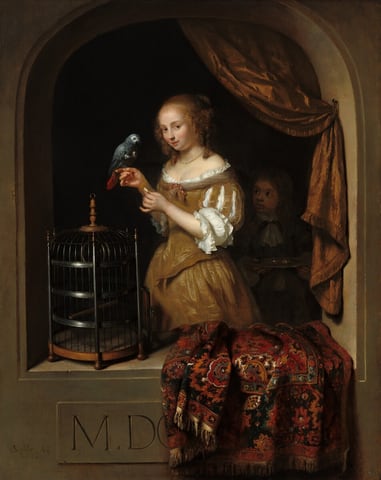
  1. Shown from about the knees up, a pale-skinned young woman stands within a stone niche, with a parrot perched on her finger as she gazes out at us in this vertical painting. The woman’s hands are raised to chest height, and she balances the spruce-blue parrot on the index finger of her far hand while her other hand holds an indistinct, white object. Her body is angled to our left, and she looks at us from the corner of her green eyes under faint brows. Her round face has a small nose, flushed cheeks, and her coral-red mouth curls up in a slight smile, her lips parted. Her honey-blond hair is gathered at the back of her head with curly tendrils framing her face and falling to her shoulders. She wears a golden-brown gown trimmed with a narrow ruffle of white fabric along the low neckline that reveals her décolletage. The bird faces the woman and lifts something, presumably a bit of food, up with one dark claw. The underside of its tail is crimson red. A light-skinned boy stands in deep shadow just to the right of the woman. He looks up at her and holds a silver tray in both hands. They stand within a light brown, arched, stone opening beyond a ledge, which comes up to about the woman’s knees. A carpet patterned with stylized flowers in ruby red, burnt orange, teal blue, white, and black is bunched up and draped over the parapet, to our right. A tall, iron-gray cage sits to our left. The rug partly covers an inscription on the front face of the niche that reads, “M. DO,” with the O cut off. A copper-colored, fringe-lined drapery hangs from the upper right of the arch and is fastened to the inner edge of the opening to create a swag. The woman is brightly lit from the upper left, and the space behind her and the boy is ink black. The artist signed and dated the lower left corner as if he had carved into the front face of the arch. It reads, “CNetscher .Ao. 16.66,” with the C and N overlapping to make a monogram.
    A Woman Feeding a Parrot, with a PageCaspar Netscher, 1666Courtesy National Gallery of Art, Washington
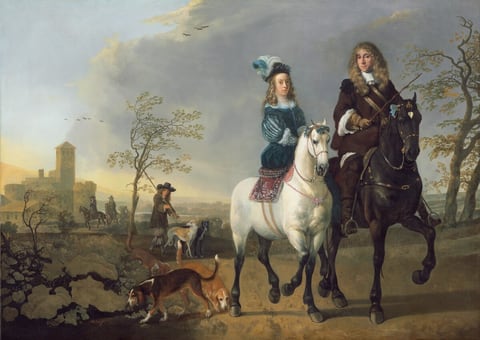
  2. An elegantly dressed man and woman ride horses toward us and to our right in a landscape with low, rolling hills, stone buildings, and trees in this horizontal painting. The two horses and riders take up the right half of the composition. Both people have pale skin and look at us. The woman has a high forehead, a straight nose, a round face, and curly blond hair falling to her shoulders. She wears a sapphire-blue dress with slashed sleeves to reveal a white garment beneath. Her hat is adorned with blue and white feathers, and she wears a string of pearls around her neck. The legs of her white horse darken to black below the knees, and the bridle is tied with blue bows near the horse’s ears. The sidesaddle sits on a woven, rug-like blanket. Next to her, to our right, the man rides a larger chestnut-brown horse with a white triangle between its eyes. The man looks at us out of the corners of his dark eyes under gathered brows. He has a long, straight nose and is cleanshaven, though a hint of a five o’clock shadow slightly darkens his cleft chin. His light brown hair falls in curls down past his shoulders, and he wears a dark brown coat with voluminous white fabric rippling out above tan-colored gloves. He holds a riding crop in his right hand, on our left, resting against his hip. Near the white horse’s feet, to our left, a dark brown dog with a white nose sniffs at a plant. Behind it, another reddish-brown dog sniffs the ground near the horse’s back hoof. A third dog stands beyond, partially obscured by bushes and plants growing in the lower left corner of the canvas. A man wearing a tall black, wide-brimmed hat and carrying a long staff leads two slender dogs resembling grayhounds on leashes along the path, a little behind the riders. Two more elegantly dressed men ride horses toward us father back on the path. Sand-colored stone buildings, hazy in the distance, are clustered around a squared tower, possibly a bell tower, to our left. The land dips gently to the horizon line in the deep distance. The riders are silhouetted against a swirling slate-blue cloud that fills most of the sky in the top two-thirds of the painting. The sky clears to pale blue to our left and then warms to golden yellow along the horizon, beyond the buildings. The artist signed the painting near the lower left corner: “A. Cuijp.”
    Lady and Gentleman on HorsebackAelbert Cuyp, c. 1655, reworked 1660/1665Courtesy National Gallery of Art, Washington