Floor plan

Style galleriesDrawings of the 19th century
Drawings of the 19th century
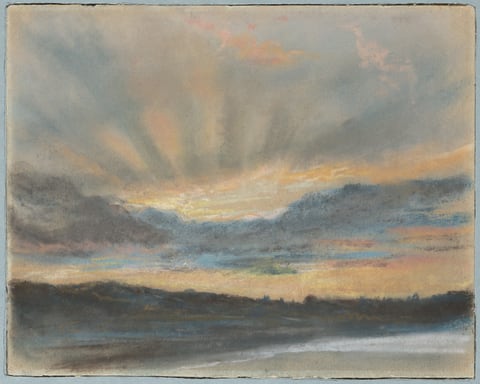
Sunset, by Eugène Delacroix, ca. 1850
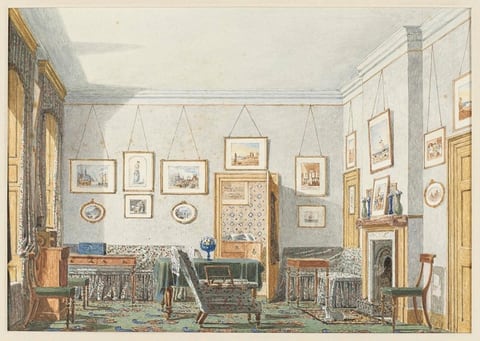
GEORGE JAMES DRUMMOND'S ROOM AT OXFORD, 1853
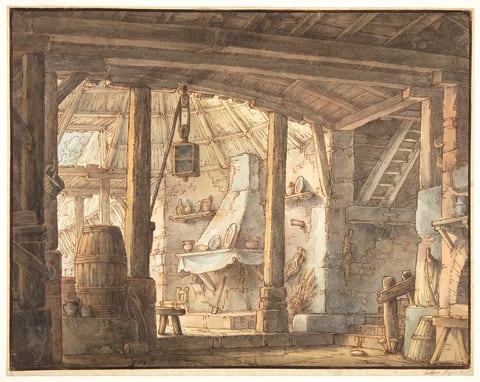
RUSTIC INTERIOR: STAGE DESIGN FOR THE TEATRO DE' FELICINI, BOLOGNA
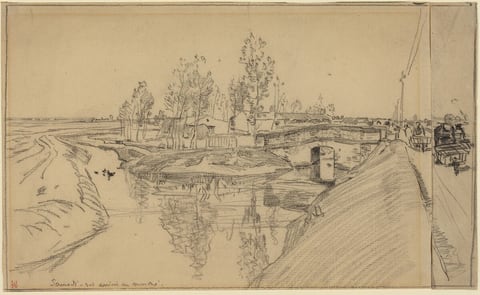
The image depicts a landscape with a road alongside a canal. The view is elevated, showing the road, canal, trees, and structures on the horizon. The style of the sketch is characterized by soft lines and shading, creating depth. The color palette is monochromatic with shades of gray. Closest to us, a canal borders the road with some ducks in the water. Figures and carts are seen on the road leading into the distance.

The works in this room are listed below.

Works in this room

Drawings made in the 19th century, from every museum.

Section 1, north wall

  1. Sunset, by Eugène Delacroix, ca. 1850
    SunsetEugène Delacroix, ca. 1850Courtesy of The Metropolitan Museum of Art
  2. GEORGE JAMES DRUMMOND'S ROOM AT OXFORD, 1853
    George James Drummond's Room at Oxford, 1853George Pyne, 1853Courtesy of Cooper Hewitt, Smithsonian Design Museum

Section 1, south wall

  1. RUSTIC INTERIOR: STAGE DESIGN FOR THE TEATRO DE' FELICINI, BOLOGNA
    Rustic Interior: Stage Design for the Teatro de' Felicini, BolognaAntonio Giuseppe Basoli, ca. 1810Courtesy of Cooper Hewitt, Smithsonian Design Museum
  2. The image depicts a landscape with a road alongside a canal. The view is elevated, showing the road, canal, trees, and structures on the horizon. The style of the sketch is characterized by soft lines and shading, creating depth. The color palette is monochromatic with shades of gray. Closest to us, a canal borders the road with some ducks in the water. Figures and carts are seen on the road leading into the distance.
    Arrivee au MarcheAuguste LepèreCourtesy National Gallery of Art, Washington

Section 2, south wall
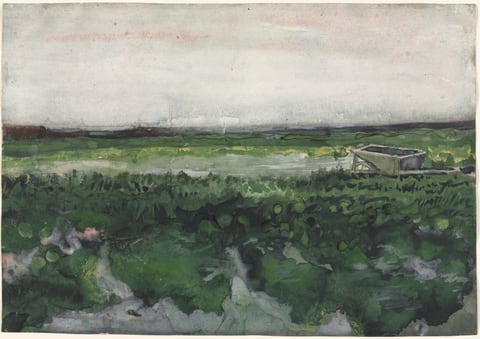
  1. Landscape with Wheelbarrow, by Vincent van Gogh, 1883
    Landscape with WheelbarrowVincent van Gogh, 1883Courtesy of the Cleveland Museum of Art
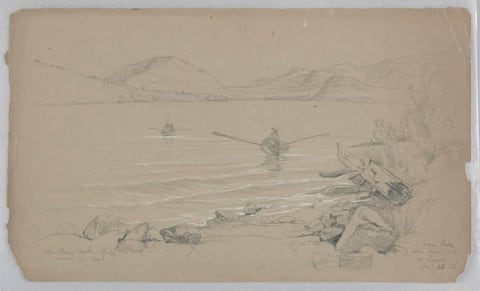
  2. EAGLE LAKE, MT. DESERT
    Eagle Lake, Mt. DesertDaniel Huntington, August 23, 1856Courtesy of Cooper Hewitt, Smithsonian Design Museum

Section 2, north wall
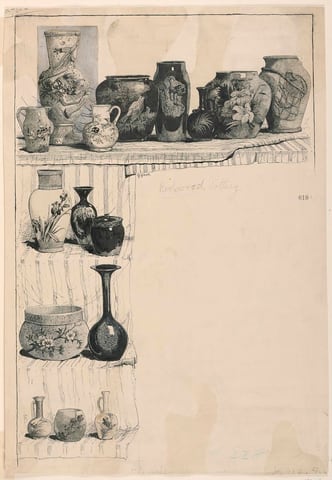
  1. ROOKWOOD POTTERY
    Rookwood PotteryGeorge Gibson, 1886Courtesy of Cooper Hewitt, Smithsonian Design Museum
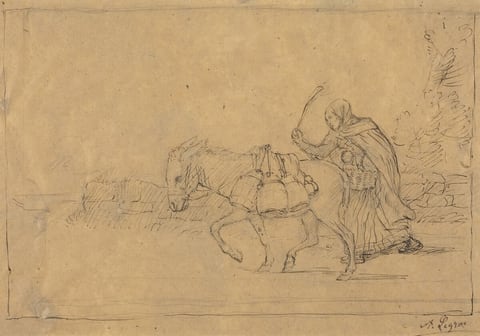
  2. This is a drawing of a person leading a donkey laden with goods. The image depicts a scene with a donkey walking to the left side while being guided by an individual dressed in layered clothing. The donkey is burdened with sacks or baskets that are strapped to its back. The lines and shading are subtle and detailed, capturing the texture of the clothing and fur. The figure and the donkey are positioned on a lightly sketched landscape with a few hints of foliage to the right, suggesting a rural setting. The drawing's simplicity and detail suggest a narrative moment, with a sense of movement and purpose conveyed through the lines.
    The Milkmaid of BoulogneAlphonse LegrosCourtesy National Gallery of Art, Washington
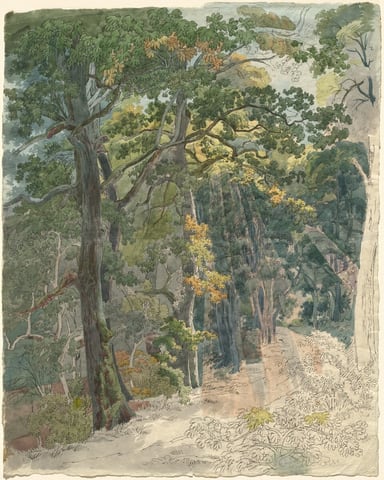
  3. The image shows a dense, forested area with towering trees. The composition leads the eye along a pathway into the distance, without a distinct horizon line. The intricate brushstrokes depict the texture and foliage of the trees, suggesting movement and light filtering through the leaves. The color palette is rich and earthy, with shades of green, brown, yellow, and orange, creating a vibrant yet tranquil atmosphere emphasizing light and shadow.
    Rays of Sunlight Striking a Woodland PathFriedrich Salathé, c. 1815Courtesy National Gallery of Art, Washington

Section 3, north wall
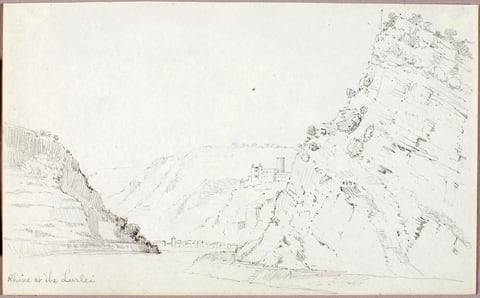
  1. Rhine at the Lurlei, by George Elbert Burr, 1900
    Rhine at the LurleiGeorge Elbert Burr, 1900Courtesy of the Smithsonian American Art Museum
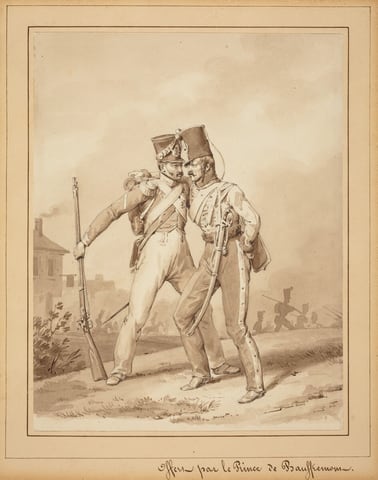
  2. The image features two men in military uniform engaging closely with each other. Both are shown from head to toe. The man on the left stands with his left leg forward, holding a rifle, and has his right arm around the shoulder of the other man. The man on the right has his right leg slightly bent, supporting his weight, and is holding a sword in his left hand. Each man has distinctive facial features. Both wear tall, elaborate military hats and detailed uniforms. The man on the left displays a strap over his shoulder, while the man on the right has intricate decorations on his jacket and trousers. In the background, there are a few more soldiers and part of a building to the left. The setting is monochromatic.
    Two GrenadiersVictor AdamCourtesy National Gallery of Art, Washington
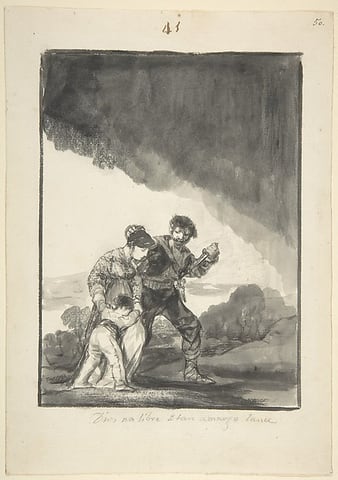
  3. God save us from such a bitter fate; a bandit threatening a woman and a child with a knife, page 41 from the "Black Border Album" (E), by Francisco Goya, ca. 1816–20
    God save us from such a bitter fate; a bandit threatening a woman and a child with a knife, page 41 from the "Black Border Album" (E)Francisco Goya, ca. 1816–20Courtesy of The Metropolitan Museum of Art

Section 3, south wall
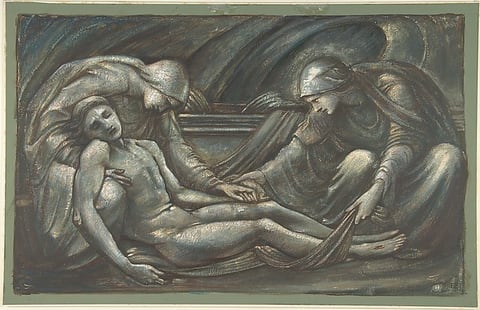
  1. The Entombment, by Sir Edward Burne-Jones, 1879
    The EntombmentSir Edward Burne-Jones, 1879Courtesy of The Metropolitan Museum of Art
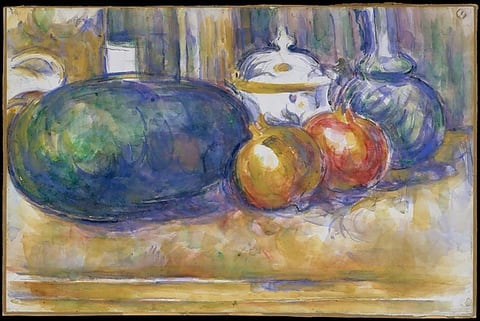
  2. Still-Life with a Watermelon and Pomegranates, by Paul Cézanne, 1900–1906
    Still-Life with a Watermelon and PomegranatesPaul Cézanne, 1900–1906Courtesy of The Metropolitan Museum of Art

Section 4, south wall
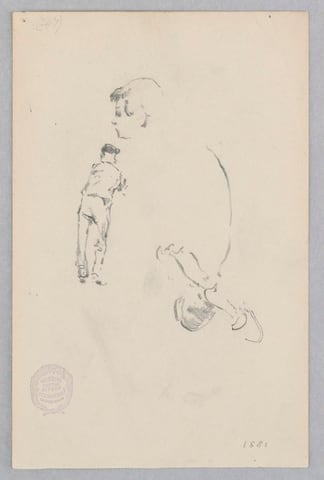
  1. FIGURES
    FiguresRobert Frederick Blum, 1881Courtesy of Cooper Hewitt, Smithsonian Design Museum
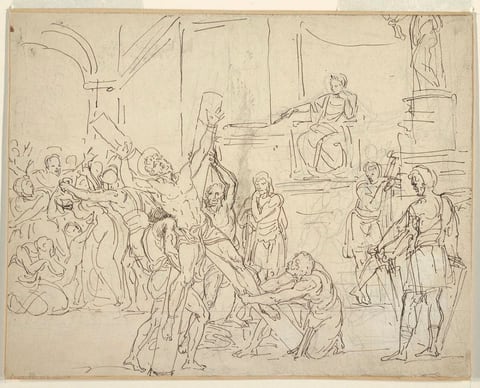
  2. MARTYRDOM OF ST. ANDREW
    Martyrdom of St. AndrewFrancesco Coghetti, 1825–50Courtesy of Cooper Hewitt, Smithsonian Design Museum