Floor plan

Time and placeGermany

Germany

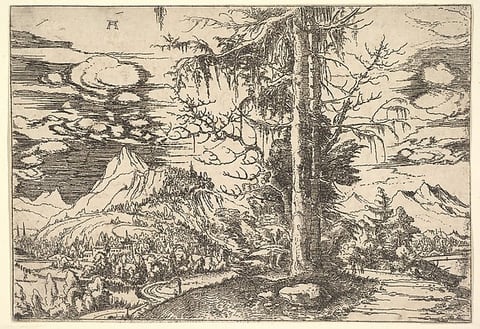
Landscape with a Double Spruce, by Albrecht Altdorfer, ca. 1521–22
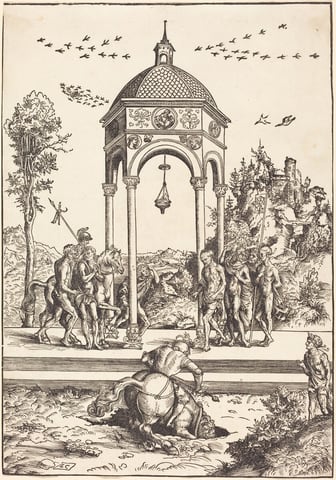
This print features a detailed scene. In the center is a classical-style pavilion with arched openings and a domed roof adorned with intricate designs. A group of mostly-nude people is gathered around the pavilion, with one on horseback, holding a spear, and another holding a flag. In front of the pavilion, a knight on horseback appears to be falling into a dark hole in the ground. Vegetation, including trees and shrubs, is scattered throughout the landscape, and birds are seen flying in the sky above the pavilion. The horizon shows hills leading to a distant castle on a rocky formation on the right.
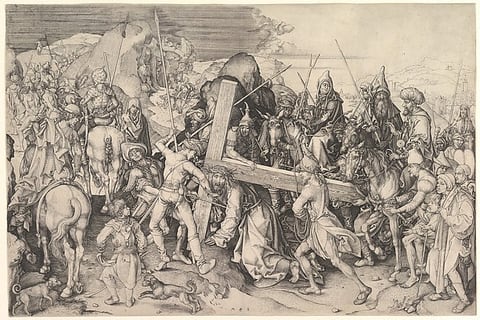
Christ Carrying the Cross, by Martin Schongauer, ca. 1475–80
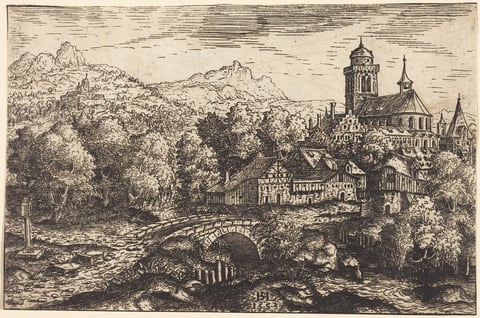
The image features a landscape view of a medieval village scene. It includes a stone bridge over a river, buildings, a church with a tower, trees, hills, mountains, and cloudy sky. The image is depicted in intricate detail using a monochromatic palette, focusing on contrasts of light and shadow.
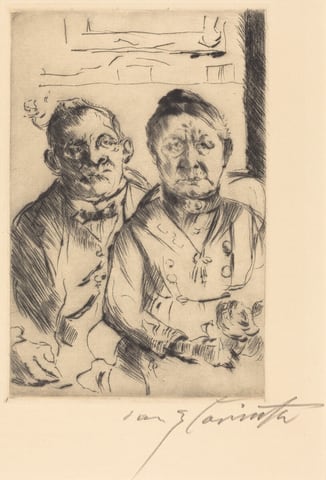
The image depicts two individuals from the waist up. The person on the left has a round face and is slightly behind the person on the right who has a slightly elongated face. Both individuals appear to be seated and have short, neatly combed hair. They have neutral facial expressions and their features are indistinct. The person on the left wears a suit with a bow tie, while the person on the right is dressed in clothing with detailed patterns and holds a flower-like object in their left hand. The background shows simple line sketches that suggest an interior setting.
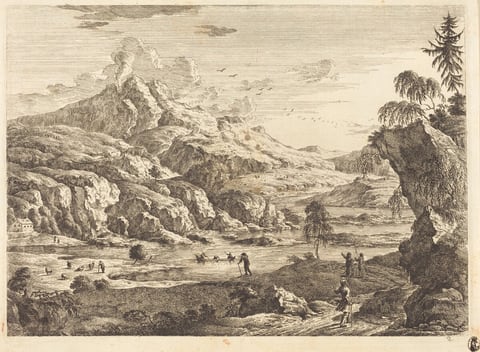
The image depicts a landscape scene from an elevated point of view. The horizon shows distant mountains with smoke rising from the tallest peak. Linear brushstrokes create detailed textures of the rocky landscape, clouds, and birds in the sky. The color palette is monochromatic with earthy tones. Figures are shown engaging in activities near a river, surrounded by trees, rocks, and meadows. Hills lead to mountainous formations on the far horizon, under a cloudy sky with a flock of birds.
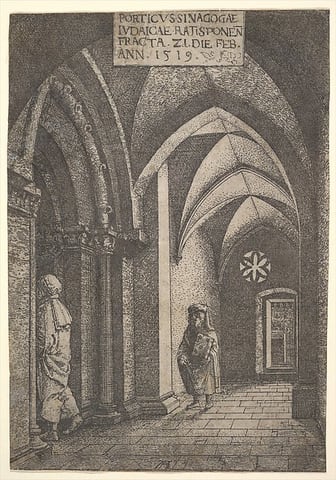
The Entrance Hall of the Regensburg Synagogue, by Albrecht Altdorfer, 1519
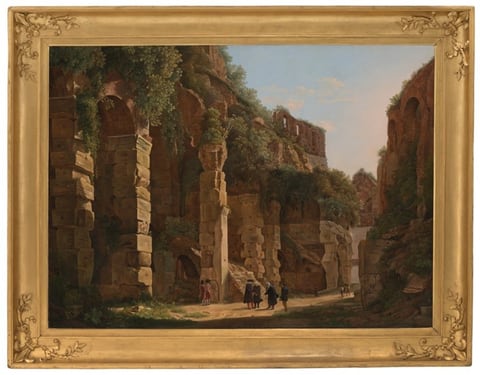
A work made of oil on canvas.

The works in this room are listed below.

Works in this room

Works made in Germany, from every century in the collection.

First room, north wall

  1. Landscape with a Double Spruce, by Albrecht Altdorfer, ca. 1521–22
    Landscape with a Double SpruceAlbrecht Altdorfer, ca. 1521–22Courtesy of The Metropolitan Museum of Art
  2. This print features a detailed scene. In the center is a classical-style pavilion with arched openings and a domed roof adorned with intricate designs. A group of mostly-nude people is gathered around the pavilion, with one on horseback, holding a spear, and another holding a flag. In front of the pavilion, a knight on horseback appears to be falling into a dark hole in the ground. Vegetation, including trees and shrubs, is scattered throughout the landscape, and birds are seen flying in the sky above the pavilion. The horizon shows hills leading to a distant castle on a rocky formation on the right.
    Marcus Curtius Plunging into the ChasmLucas Cranach the ElderCourtesy National Gallery of Art, Washington
  3. Christ Carrying the Cross, by Martin Schongauer, ca. 1475–80
    Christ Carrying the CrossMartin Schongauer, ca. 1475–80Courtesy of The Metropolitan Museum of Art
  4. The image features a landscape view of a medieval village scene. It includes a stone bridge over a river, buildings, a church with a tower, trees, hills, mountains, and cloudy sky. The image is depicted in intricate detail using a monochromatic palette, focusing on contrasts of light and shadow.
    Mountainous Landscape with a VillageHanns Lautensack, 1553Courtesy National Gallery of Art, Washington

First room, south wall

  1. The image depicts two individuals from the waist up. The person on the left has a round face and is slightly behind the person on the right who has a slightly elongated face. Both individuals appear to be seated and have short, neatly combed hair. They have neutral facial expressions and their features are indistinct. The person on the left wears a suit with a bow tie, while the person on the right is dressed in clothing with detailed patterns and holds a flower-like object in their left hand. The background shows simple line sketches that suggest an interior setting.
    Ostpreussisches Ehepaar (Couple from East Prussia)Lovis Corinth, 1916Courtesy National Gallery of Art, Washington
  2. The image depicts a landscape scene from an elevated point of view. The horizon shows distant mountains with smoke rising from the tallest peak. Linear brushstrokes create detailed textures of the rocky landscape, clouds, and birds in the sky. The color palette is monochromatic with earthy tones. Figures are shown engaging in activities near a river, surrounded by trees, rocks, and meadows. Hills lead to mountainous formations on the far horizon, under a cloudy sky with a flock of birds.
    Mountainous Riverscape with FiguresGeorg EisenmannCourtesy National Gallery of Art, Washington
  3. The Entrance Hall of the Regensburg Synagogue, by Albrecht Altdorfer, 1519
    The Entrance Hall of the Regensburg SynagogueAlbrecht Altdorfer, 1519Courtesy of The Metropolitan Museum of Art
  4. A work made of oil on canvas.
    Inside the ColosseumFranz Ludwig Catel, c. 1823Courtesy of the Art Institute of Chicago

Second room, south wall
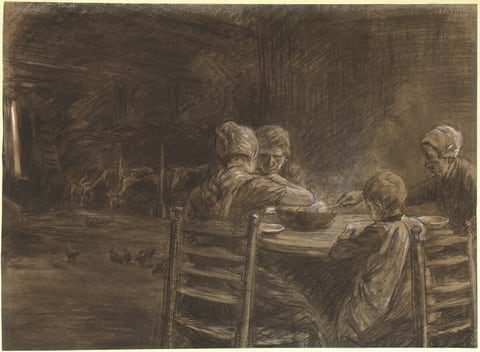
  1. This is a drawing of a rustic interior scene. The artwork depicts an interior where a table is surrounded by chairs. On the table, there is a bowl, as the individuals appear to be interacting or reaching towards it. In the background, livestock and chickens are visible, suggesting the environment is possibly a farm or a barn with a dining space. The use of soft lines and shading creates a warm, intimate, and slightly somber atmosphere within the image, with light and shadow playing an important role in highlighting the subjects and their surroundings.
    East Frisian Peasants Eating SupperMax Liebermann, 1893Courtesy National Gallery of Art, Washington
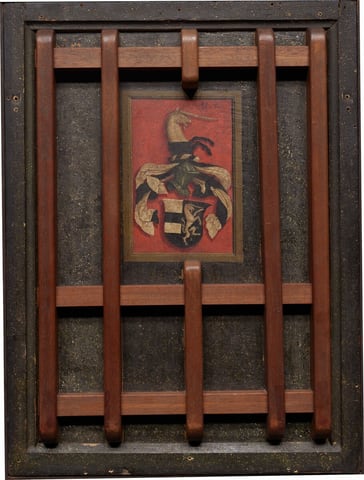
  2. This is a painting depicting a heraldic coat of arms. The image features a detailed coat of arms with a central shield, adorned with black and gold sections, and additional decorative elements above it. There is a figure resembling a unicorn emerging from the crest. The background is a deep red hue. The artwork is displayed within a wooden frame with crossbars. This style is associated with displaying family crests and lineage.
    Hans Roth [reverse]Bernhard Strigel, 1527Courtesy National Gallery of Art, Washington
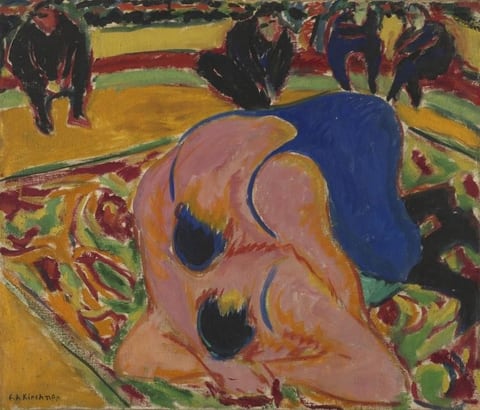
  3. Wrestlers in a Circus, by Ernst Ludwig Kirchner, 1909
    Wrestlers in a CircusErnst Ludwig Kirchner, 1909Courtesy of the Cleveland Museum of Art
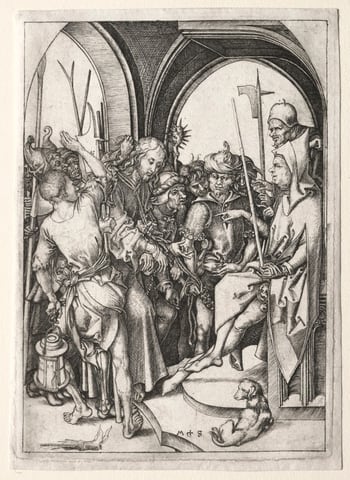
  4. The Passion: Christ Before Annas, by Martin Schongauer, c. 1480
    The Passion: Christ Before AnnasMartin Schongauer, c. 1480Courtesy of the Cleveland Museum of Art

Second room, north wall
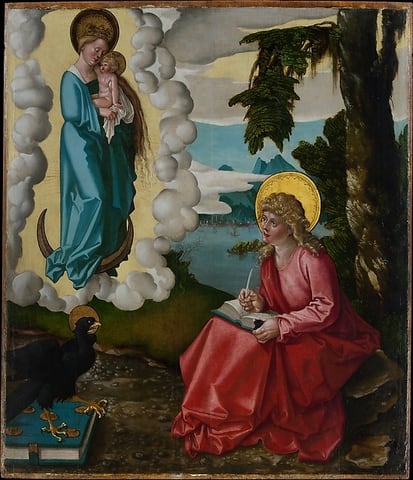
  1. Saint John on Patmos, by Hans Baldung (called Hans Baldung Grien), ca. 1511
    Saint John on PatmosHans Baldung (called Hans Baldung Grien), ca. 1511Courtesy of The Metropolitan Museum of Art
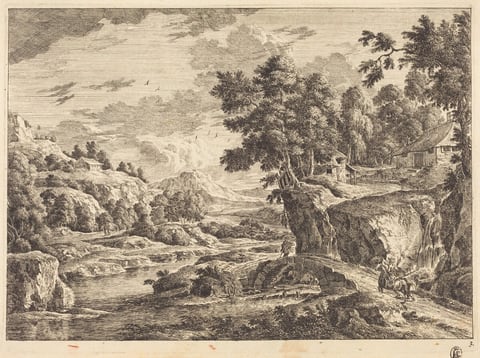
  2. The image shows a landscape scene with an elevated perspective. The horizon is placed low, emphasizing the sky with swirling clouds and scattered birds. A river winds through a valley with a stone bridge. A rocky outcrop with trees and a small building are on the right. In the distance, hills lead to mountains. The style uses intricate cross-hatching for texture and depth. The color palette is monochrome with varying shades of sepia.
    Landscape with a Bridge and Three Farm BuildingsGeorg EisenmannCourtesy National Gallery of Art, Washington
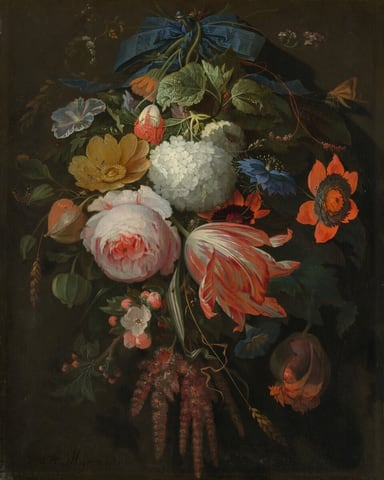
  3. A bouquet of flowers against a dark brown background hangs from a sapphire-blue bow to fill this vertical still life painting. The three largest blooms make a pyramid at the center. A pale pink, flat-leaved carnation is to the lower right of this trio. A red and white striped tulip with flame-shaped petals is next to it, to our right, and a white viburnum bloom, which is made of dozens of smaller clusters, is above. A tan-colored spider builds a web at the center of these three blossoms. Using the face of a clock to work around this trio, we find a spotted bug on a smaller viburnum and some frosty green leaves at noon. A muted orange moth rests on a stalk nearby. Down the right side, the layered vivid blue petals of a love-in-the-mist explode like a starburst. Two coral-red peonies, a mostly closed peony, a topaz-blue morning glory, and the fuzzy fingers of amaranth bring us to six o’clock. Up the left side are delicate pink crab apple blossoms, a spray of Chinese lanterns, a yellow rose with ants crawling across its splayed petals, a striped morning glory, and a few blue, orange, and red buds. A caterpillar rears up on a Chinese lantern bud and a ladybug sits on a leaf nearby. A few stalks of wheat are scattered throughout. Stems weave through the blue ribbon at the top, which is tied around a protruding nail. The artist signed the lower left corner, “AB Mignon f,” with the AB conjoined in a monogram.
    A Hanging Bouquet of FlowersAbraham Mignon, probably 1665/1670Courtesy National Gallery of Art, Washington
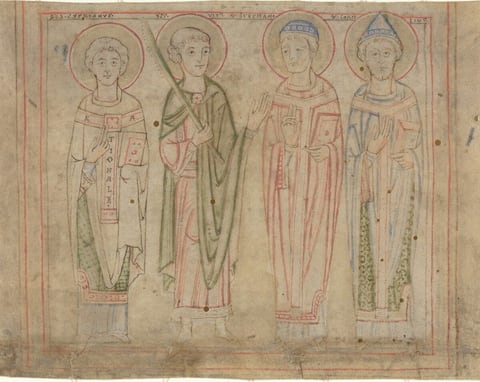
  4. The image features four figures depicted upright from head to toe, each with a halo. The person on the far left has short, curly hair, wearing a decorated robe and holding a book, gesturing with the other hand. Next to him, the second figure also has short, curly hair and wears a striped robe, holding a staff. The third person has short hair under a blue and white cap, in a striped robe, holding a book while gesturing. The fourth figure has curly hair under a pointed cap, wearing a robe with blue and red detailing, holding a book with one hand raised. The background is a parchment-like surface with decorative red lining at the border.
    Saints Cyprian, Vitus, Stephan, and CorneliusUnrecorded German maker, third quarter 12th centuryCourtesy National Gallery of Art, Washington