Floor plan

Time and placeFrance

France

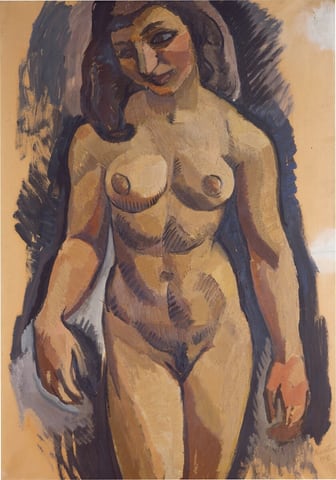
The image is a painting of a woman's nude upper body extending from her head down to her hips, depicted in a standing position with her head slightly tilted to one side. Her facial features are distinct with a strong brow, prominent nose, and full lips, and her long dark hair cascades down to her shoulders. The background features abstract brushstrokes in dark blues and browns, blending into the lighter brown tone of the canvas, enhancing the figure's prominence in the composition. The woman appears naturalistic, with no jewelry or other objects visible in the painting.
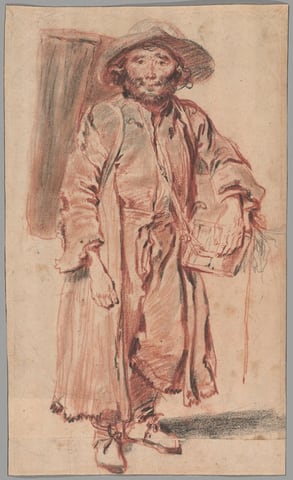
Chalk drawing with red and black shading of man carrying crate and pack.
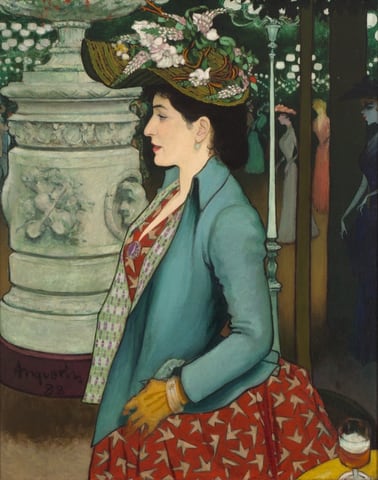
A work made of oil on canvas.
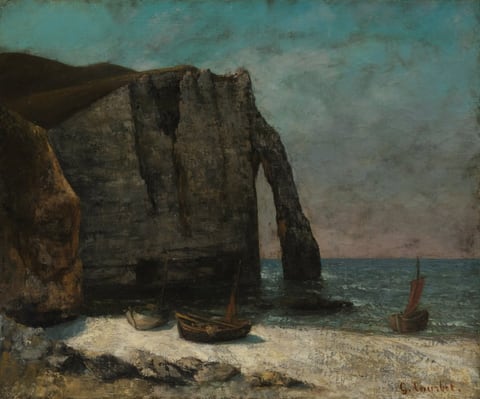
The Cliff at Étretat, by Gustave Courbet, after 1872
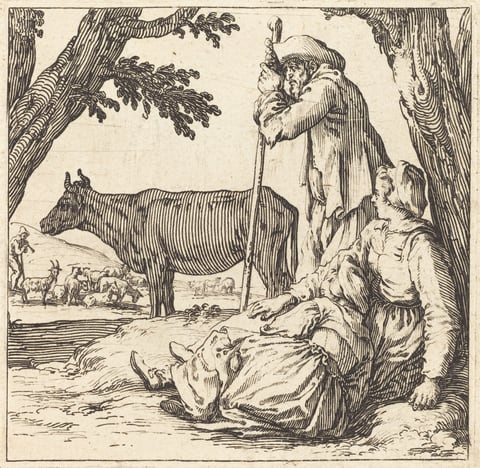
The image has an elevated perspective showing two figures with animals in the scene. One person is leaning against a tree with a stick, while the other is seated on the ground. A cow is between them and other livestock in the middle distance. A person in the distance is tending to the animals. The horizon is low in the image, hidden by rolling hills. The artwork is in monochrome with fine linework, creating texture through hatching and cross-hatching, emphasizing depth and dimensionality.
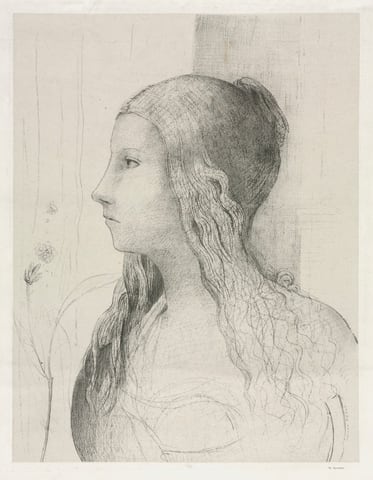
Brünnhilde in Twilight of the Gods, by Odilon Redon, 1894
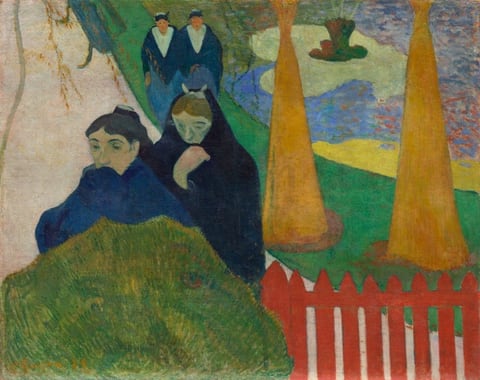
Painting of four women with blue shawls walking near red fence.

The works in this room are listed below.

Works in this room

Works made in France, from every century in the collection.

First room, north wall

  1. The image is a painting of a woman's nude upper body extending from her head down to her hips, depicted in a standing position with her head slightly tilted to one side. Her facial features are distinct with a strong brow, prominent nose, and full lips, and her long dark hair cascades down to her shoulders. The background features abstract brushstrokes in dark blues and browns, blending into the lighter brown tone of the canvas, enhancing the figure's prominence in the composition. The woman appears naturalistic, with no jewelry or other objects visible in the painting.
    NudeRoger de La Fresnaye, 1910Courtesy National Gallery of Art, Washington
  2. Chalk drawing with red and black shading of man carrying crate and pack.
    The Old SavoyardAntoine Watteau, c. 1715Courtesy of the Art Institute of Chicago
  3. A work made of oil on canvas.
    A Woman at the Élysée Montmartre (Femme à l’Élysée Montmartre)Louis Anquetin, 1888Courtesy of the Art Institute of Chicago
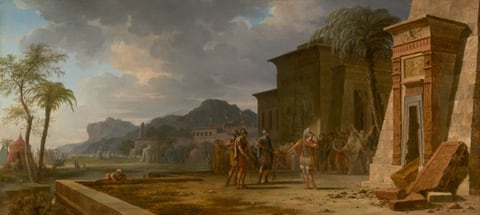
  4. A work made of oil on canvas.
    Alexander at the Tomb of Cyrus the GreatPierre Henri de Valenciennes, 1796Courtesy of the Art Institute of Chicago

First room, south wall

  1. The Cliff at Étretat, by Gustave Courbet, after 1872
    The Cliff at ÉtretatGustave Courbet, after 1872Courtesy of the Cleveland Museum of Art
  2. The image has an elevated perspective showing two figures with animals in the scene. One person is leaning against a tree with a stick, while the other is seated on the ground. A cow is between them and other livestock in the middle distance. A person in the distance is tending to the animals. The horizon is low in the image, hidden by rolling hills. The artwork is in monochrome with fine linework, creating texture through hatching and cross-hatching, emphasizing depth and dimensionality.
    Peasant Couple with CowJacques Callot, c. 1621Courtesy National Gallery of Art, Washington
  3. Brünnhilde in Twilight of the Gods, by Odilon Redon, 1894
    Brünnhilde in Twilight of the GodsOdilon Redon, 1894Courtesy of the Cleveland Museum of Art
  4. Painting of four women with blue shawls walking near red fence.
    Arlésiennes (Mistral)Paul Gauguin, 1888Courtesy of the Art Institute of Chicago

Second room, south wall
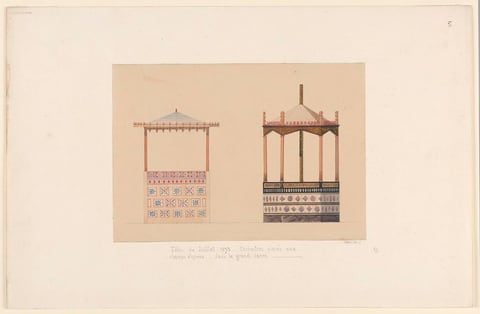
  1. "ORCHSTRES PLACES AUX CHAMPS ELYSEES, DANS LE GRAN CARRES"
    "Orchstres places aux Champs elysees, dans le gran carres"Félix Duban, 1833Courtesy of Cooper Hewitt, Smithsonian Design Museum
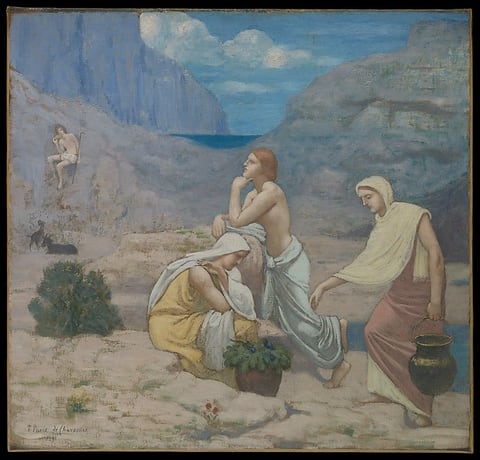
  2. The Shepherd's Song, by Pierre Puvis de Chavannes, 1891
    The Shepherd's SongPierre Puvis de Chavannes, 1891Courtesy of The Metropolitan Museum of Art
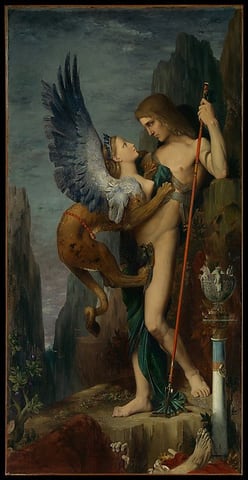
  3. Oedipus and the Sphinx, by Gustave Moreau, 1864
    Oedipus and the SphinxGustave Moreau, 1864Courtesy of The Metropolitan Museum of Art

Second room, north wall
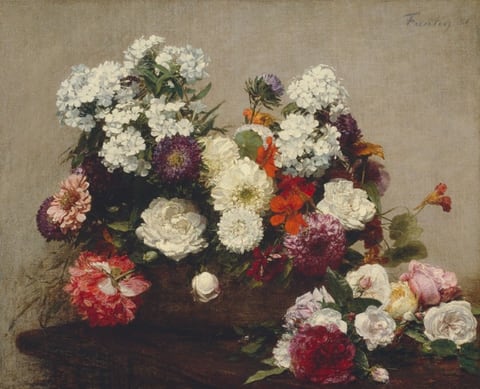
  1. A work made of oil on canvas.
    Still Life with FlowersHenri Fantin-Latour, 1881Courtesy of the Art Institute of Chicago
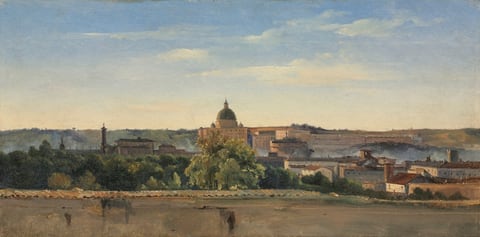
  2. View of Rome, by Pierre Henri de Valenciennes, c. 1782–84
    View of RomePierre Henri de Valenciennes, c. 1782–84Courtesy of the Cleveland Museum of Art
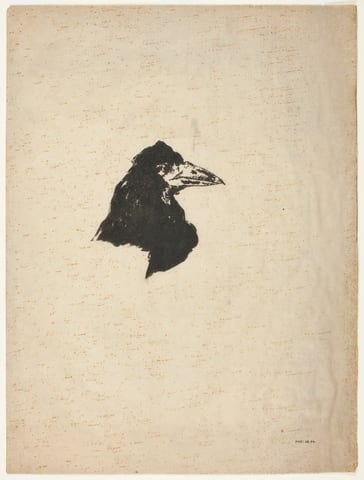
  3. A work made of transfer lithograph in black on tan simili-parchment paper.
    Head of a Raven in Profile, from The Raven (Le Corbeau)Édouard Manet, 1875Courtesy of the Art Institute of Chicago

Third room, north wall
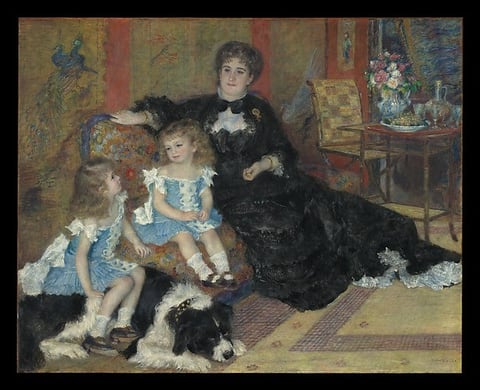
  1. Madame Georges Charpentier (Marguerite-Louise Lemonnier, 1848–1904) and Her Children, Georgette-Berthe (1872–1945) and Paul-Emile-Charles (1875–1895), by Pierre-Auguste Renoir, 1878
    Madame Georges Charpentier (Marguerite-Louise Lemonnier, 1848–1904) and Her Children, Georgette-Berthe (1872–1945) and Paul-Emile-Charles (1875–1895)Pierre-Auguste Renoir, 1878Courtesy of The Metropolitan Museum of Art
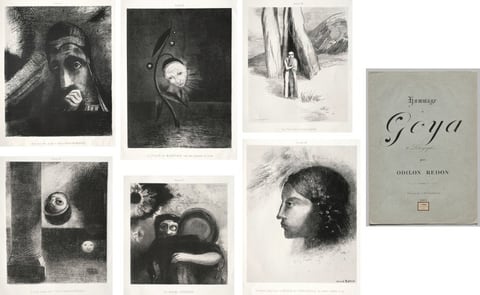
  2. Homage to Goya, by Odilon Redon, 1885
    Homage to GoyaOdilon Redon, 1885Courtesy of the Cleveland Museum of Art