Floor plan

Time and placeThe 20th century

The 20th century

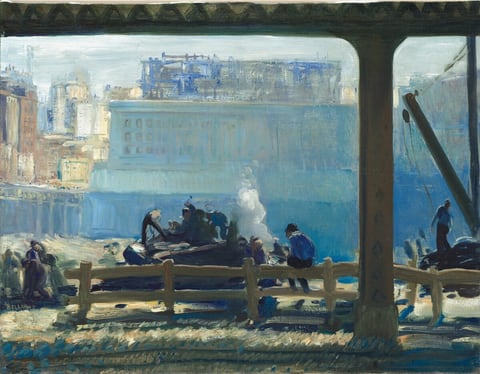
From under an elevated train track, we look at a cluster of people hammering and working on the far side of a wooden fence, all against a silvery-blue building that fills most of the background in this horizontal painting. The scene is loosely painted mostly in tones of hazy and saturated blues, so many of the details are indistinct. About a quarter of the way in from the right edge of the composition, a thin iron column holds up the train platform. The column nearly spans the height of the painting, and the track it supports runs across the top edge of the canvas. At the foot of the column, along the bottom edge, are two parallel tracks embedded in an area otherwise painted with short, diagonal strokes in topaz blue, olive green, and straw yellow. Just beyond the tracks, the split-rail wooden fence runs across most of the painting, though there is an opening at the left edge of the canvas. A man sits with his back to us on the railing to our right of center. He wears a dark cap, a lapis-blue shirt, and navy-blue pants. Several men work on or near a mound-shaped form, perhaps a piece of machinery, just beyond the fence, near the center of the painting. One man holds a hammer high overhead while another reaches down or strikes the mound with his feet planted wide. More people work together to our left, and a man to our right stands near a crane. The people and these areas are painted with broad strokes and touches of cobalt blue, charcoal gray, khaki brown, and a few swipes of shell pink and bright white. A puff of white smoke billows up behind the central group, before the land drops precipitously away. The chasm is painted with shimmering tones of aquamarine and cerulean blue. A sky-blue, rectangular building perches at the far edge. A few windows are outlined in royal blue to our left but the rest of the building is loosely painted with long, vertical strokes so no architectural details can be made out. Behind this structure are more city buildings, suggested with strokes of muted rust red, parchment and bright white, and cobalt blue. The ice-blue sky fills the band between the top of the buildings and the train track running overhead. The artist signed his name near the lower left corner, “BELLOWS.”
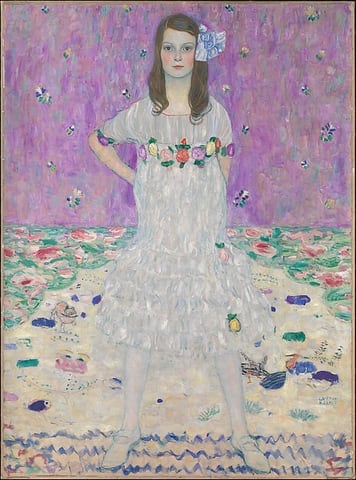
Mäda Primavesi (1903–2000), by Gustav Klimt, 1912–13
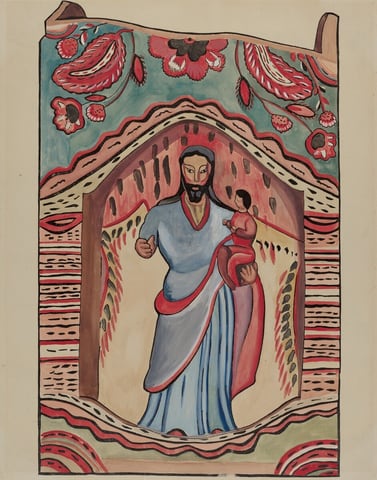
This is a painting of stylized figures within an ornate frame. The artwork features two central figures that are reminiscent of a traditional religious iconography but rendered in a simplified and almost cartoonish form. The larger figure is draped in blue with red accents, while a smaller figure is held in one hand, enrobed in red. The background is decorated with a variety of patterns including an arch-like structure with wavy designs and lines, all outlining the central figures. The outer sections feature floral patterns with bold, contrasting colors of red, black, and teal. The use of thick outlines and vivid colors suggests a playful and decorative approach to the portrayal of the figures, drawing inspiration possibly from folk art traditions.
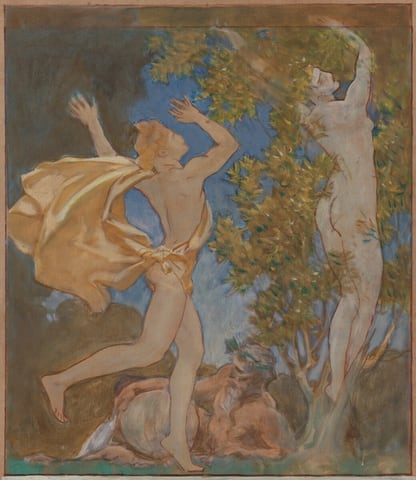
This is a painting showing two people in nature. The person on the left appears to be running towards the right, with one leg in the air and their arms outstretched. They have tan, golden-toned skin, blond hair, and golden fabric draped loosely around them, billowing backward as they run. On the right is a pale person standing upright in a tree, their arms outstretched. They appear intertwined with the tree, with their feet nestled in the light brown trunk and their head and hands covered in olive-green leaves. The background features indistinct brown shapes against a clear blue sky.
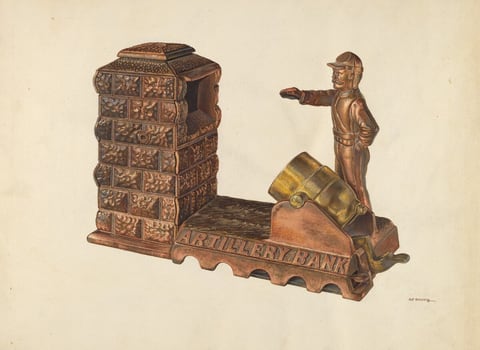
The image displays a vintage mechanical bank with a brick-patterned tower on the left and a soldier figure on the right, prepared to operate a cannon. The color scheme is mainly earthy tones including brown, bronze, and hints of gold, creating a retro metallic appearance. The label "ARTILLERY BANK" is engraved on the base in front of the cannon.
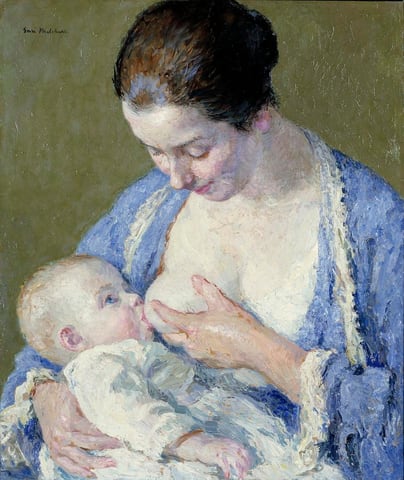
Mother and Child, by Gari Melchers, ca. 1920
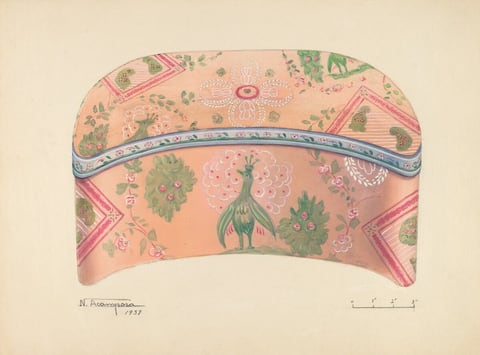
The image shows a decorative curved object with intricate patterns. There is a large green peacock motif in the center, surrounded by floral and geometric patterns. The color palette includes soft pinks, greens, and blue accents outlining the curve of the object. The object is placed on a plain light background.

The works in this room are listed below.

Works in this room

Works made in the 20th century, anywhere in the world.

Section 1, north wall

  1. From under an elevated train track, we look at a cluster of people hammering and working on the far side of a wooden fence, all against a silvery-blue building that fills most of the background in this horizontal painting. The scene is loosely painted mostly in tones of hazy and saturated blues, so many of the details are indistinct. About a quarter of the way in from the right edge of the composition, a thin iron column holds up the train platform. The column nearly spans the height of the painting, and the track it supports runs across the top edge of the canvas. At the foot of the column, along the bottom edge, are two parallel tracks embedded in an area otherwise painted with short, diagonal strokes in topaz blue, olive green, and straw yellow. Just beyond the tracks, the split-rail wooden fence runs across most of the painting, though there is an opening at the left edge of the canvas. A man sits with his back to us on the railing to our right of center. He wears a dark cap, a lapis-blue shirt, and navy-blue pants. Several men work on or near a mound-shaped form, perhaps a piece of machinery, just beyond the fence, near the center of the painting. One man holds a hammer high overhead while another reaches down or strikes the mound with his feet planted wide. More people work together to our left, and a man to our right stands near a crane. The people and these areas are painted with broad strokes and touches of cobalt blue, charcoal gray, khaki brown, and a few swipes of shell pink and bright white. A puff of white smoke billows up behind the central group, before the land drops precipitously away. The chasm is painted with shimmering tones of aquamarine and cerulean blue. A sky-blue, rectangular building perches at the far edge. A few windows are outlined in royal blue to our left but the rest of the building is loosely painted with long, vertical strokes so no architectural details can be made out. Behind this structure are more city buildings, suggested with strokes of muted rust red, parchment and bright white, and cobalt blue. The ice-blue sky fills the band between the top of the buildings and the train track running overhead. The artist signed his name near the lower left corner, “BELLOWS.”
    Blue MorningGeorge Bellows, 1909Courtesy National Gallery of Art, Washington
  2. Mäda Primavesi (1903–2000), by Gustav Klimt, 1912–13
    Mäda Primavesi (1903–2000)Gustav Klimt, 1912–13Courtesy of The Metropolitan Museum of Art
  3. This is a painting of stylized figures within an ornate frame. The artwork features two central figures that are reminiscent of a traditional religious iconography but rendered in a simplified and almost cartoonish form. The larger figure is draped in blue with red accents, while a smaller figure is held in one hand, enrobed in red. The background is decorated with a variety of patterns including an arch-like structure with wavy designs and lines, all outlining the central figures. The outer sections feature floral patterns with bold, contrasting colors of red, black, and teal. The use of thick outlines and vivid colors suggests a playful and decorative approach to the portrayal of the figures, drawing inspiration possibly from folk art traditions.
    St. JosephE. Boyd, 1936Courtesy National Gallery of Art, Washington

Section 1, south wall

  1. This is a painting showing two people in nature. The person on the left appears to be running towards the right, with one leg in the air and their arms outstretched. They have tan, golden-toned skin, blond hair, and golden fabric draped loosely around them, billowing backward as they run. On the right is a pale person standing upright in a tree, their arms outstretched. They appear intertwined with the tree, with their feet nestled in the light brown trunk and their head and hands covered in olive-green leaves. The background features indistinct brown shapes against a clear blue sky.
    Apollo and DaphneJohn Singer Sargent, c. 1916/1919Courtesy National Gallery of Art, Washington
  2. The image displays a vintage mechanical bank with a brick-patterned tower on the left and a soldier figure on the right, prepared to operate a cannon. The color scheme is mainly earthy tones including brown, bronze, and hints of gold, creating a retro metallic appearance. The label "ARTILLERY BANK" is engraved on the base in front of the cannon.
    Mechanical Artillery BankAlf Bruseth, c. 1940Courtesy National Gallery of Art, Washington
  3. Mother and Child, by Gari Melchers, ca. 1920
    Mother and ChildGari Melchers, ca. 1920Courtesy of the Smithsonian American Art Museum
  4. The image shows a decorative curved object with intricate patterns. There is a large green peacock motif in the center, surrounded by floral and geometric patterns. The color palette includes soft pinks, greens, and blue accents outlining the curve of the object. The object is placed on a plain light background.
    BandboxNicholas Acampora, 1937Courtesy National Gallery of Art, Washington

Section 2, south wall
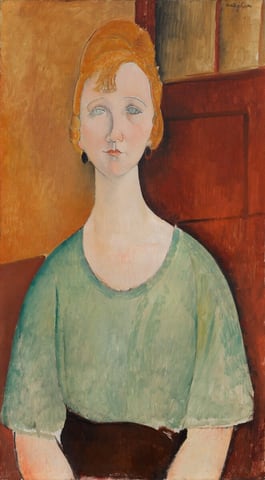
  1. Shown from the lap up, a pale-skinned woman with an oval face and long neck sits facing us in this vertical painting. The portrait is created with areas of mottled colors outlined with black lines. Her body faces us, and she looks out with pale blue eyes, the irises almost white. Her thin eyebrows slope down the sides and her small, dark peach lips are closed. Golden-orange hair is piled atop her head and a few bangs fall onto her high forehead. Black oval earrings hang from her lobes. Her shoulders also slope unnaturally down. Her mint-green shirt has a scooped neckline and elbow-length sleeves, and it appears to be tucked into a brown skirt or pants. The background is honey orange in the top left quadrant, amber brown in the lower left, and a russet brown door with windows across the top fills the right half. The artist signed the top right corner, “modigliani.”
    Girl in a Green BlouseAmedeo Modigliani, 1917Courtesy National Gallery of Art, Washington
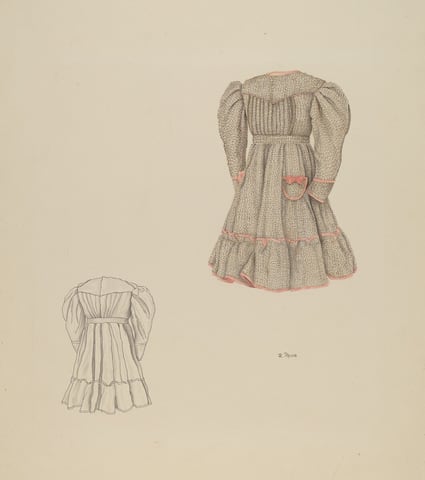
  2. The image depicts a detailed illustration of a dress with exaggerated puff sleeves and ruffles towards the bottom. It is created using a dotted pattern with red accents around the edges and seams. The color palette consists of mostly muted tones with touches of red. The dress is positioned in the upper right quadrant of the image, while a smaller, less detailed sketch of the same dress without colors is located in the lower left quadrant.
    Child's DressRay Price, c. 1937Courtesy National Gallery of Art, Washington
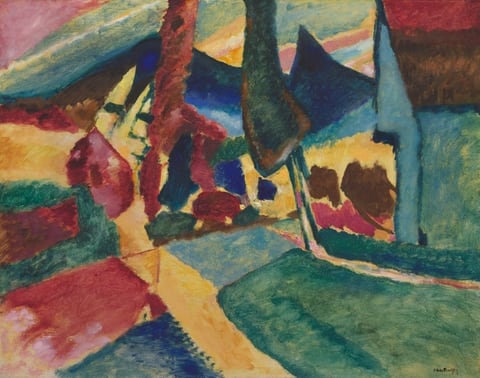
  3. Vibrant yellow, red, blue, and green painting of landscape with trees and mountains.
    Landscape with Two PoplarsVasily Kandinsky, 1912Courtesy of the Art Institute of Chicago
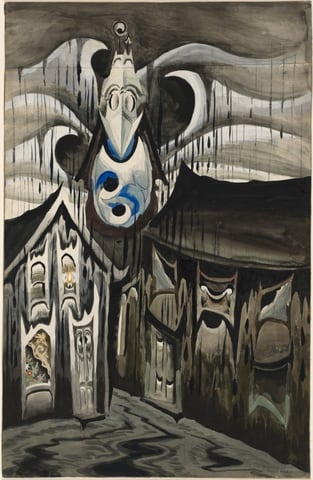
  4. Church Bells Ringing, Rainy Winter Night, by Charles Burchfield, December 1917
    Church Bells Ringing, Rainy Winter NightCharles Burchfield, December 1917Courtesy of the Cleveland Museum of Art

Section 2, north wall
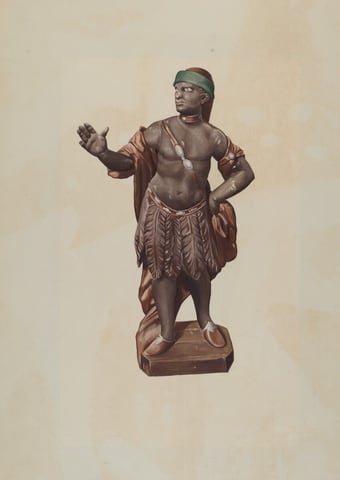
  1. The sculpture depicts a male figure standing upright with one hand raised and the other resting on his hip. The subject is wearing a garment that drapes over one shoulder and a feather-patterned skirt, accessorized with a headband. The colors of the sculpture are predominantly earth tones, including browns and a green headband. The material appears to be a type of stone or ceramic with a polished finish. The figure is slightly larger than everyday objects, allowing viewers to appreciate the intricacies of the carving and the details in the drapery and texture. The statue stands on a rectangular base that is consistent with the overall color palette.
    Cigar Store IndianRosamond P. Gray, 1935/1942Courtesy National Gallery of Art, Washington
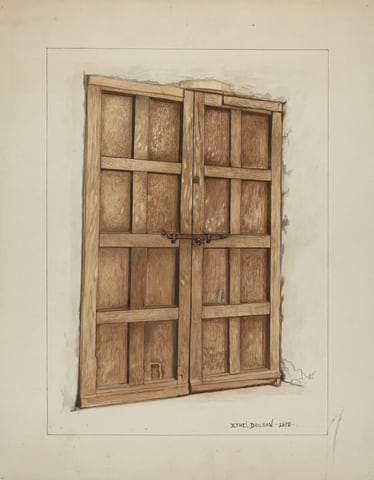
  2. This is a drawing of a wooden window shutter in a light-colored wall. The detailed study shows the craftsmanship of the shutter, with a focus on texture, form, wood grain, and panels. The aged and weathered texture suggests exposure to the elements. The shutter is secured with a metal latch in the center. The wall is subtly shaded to imply depth and setting, with slight distress marks adding to the aged ambiance of the scene.
    Sacristy Door at Mission San Juan BautistaEthel Dougan, 1938Courtesy National Gallery of Art, Washington
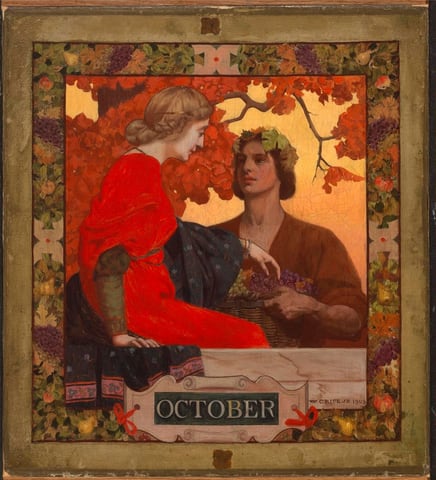
  3. October (cover illustration for Harper's Magazine), by William Clarke Rice, 1903
    October (cover illustration for Harper's Magazine)William Clarke Rice, 1903Courtesy of the Smithsonian American Art Museum

Section 3, north wall
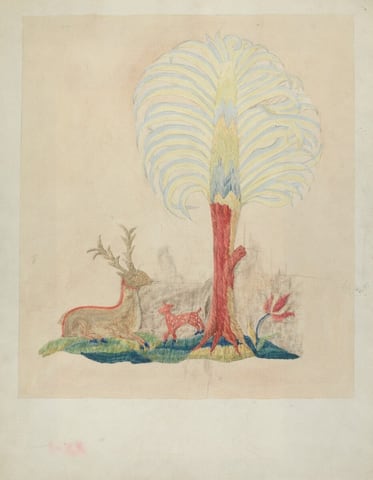
  1. This is a painting of two deer under a tree. The larger deer has antlers and is resting next to a smaller deer. They are depicted with red and brown strokes. The background shows a patch of earth and grass in green and blue. Beside the deer is a tree with colorful leaves or a feather-like structure and a red trunk. A pink flower is near the tree's base. The background is neutral. This painting is in the style of Henri Rousseau.
    Crewel EmbroideryHelen Dana, 1935/1942Courtesy National Gallery of Art, Washington
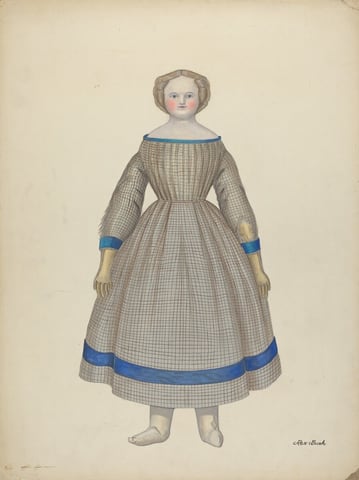
  2. The image depicts a person standing upright. The person has a round face with a small mouth and rosy cheeks, and their hair is styled smoothly with a middle part. They are wearing a long-sleeved dress with a checkered pattern in subdued colors, highlighted with blue bands around the sleeves and hem. The dress has a fitted bodice and a full skirt. Bare feet are visible under the dress. The background is plain and neutral, and there is a signature in the lower right corner.
    Doll - "Emily"Rex F. Bush, c. 1938Courtesy National Gallery of Art, Washington