Floor plan

Time and placeThe 20th century

The 20th century

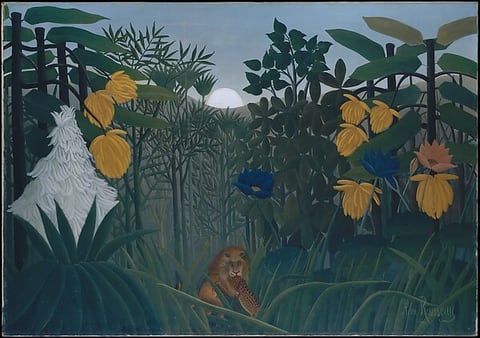
The Repast of the Lion, by Henri Rousseau, ca. 1907
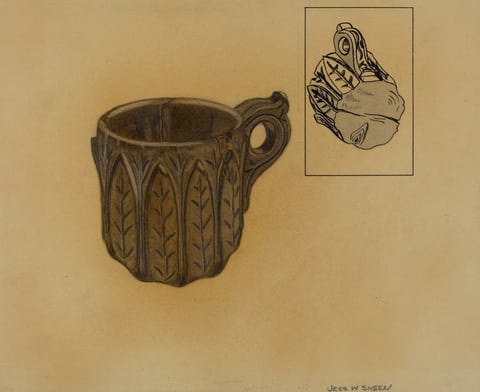
The image shows an illustration of a decorative cup with a relief design and handle to the left. The cup is brown with leaf patterns. The background is light tan. In the top right corner, there is a sketch of the cup's underside.
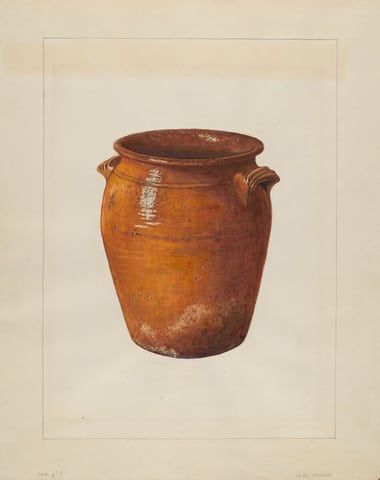
The image features a large terracotta pot with two small handles on its sides. The pot is primarily in shades of earthy orange and brown with some lighter patches that suggest a slightly weathered texture. It is positioned centrally against a plain, light background.
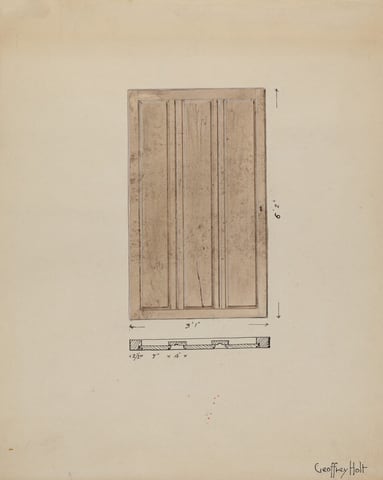
This is a drawing of a wooden door panel. It features a detailed rendering of a rectangular wooden door panel with vertical lines. Below the door panel, there is an elevation view showing the construction detail of the door in cross-section, with measurements indicating dimensions and proportions. The color palette is in shades of brown and beige. A signature in the lower right corner attributes the drawing to an artist named Geoffrey Holt.
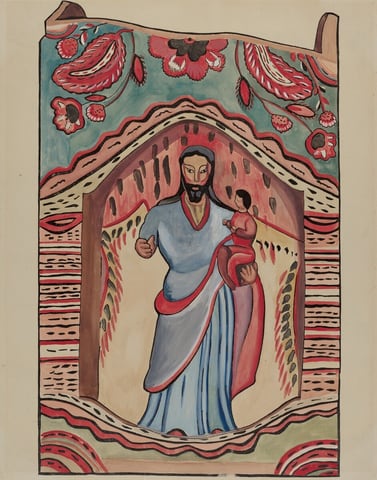
This is a painting of stylized figures within an ornate frame. The artwork features two central figures that are reminiscent of a traditional religious iconography but rendered in a simplified and almost cartoonish form. The larger figure is draped in blue with red accents, while a smaller figure is held in one hand, enrobed in red. The background is decorated with a variety of patterns including an arch-like structure with wavy designs and lines, all outlining the central figures. The outer sections feature floral patterns with bold, contrasting colors of red, black, and teal. The use of thick outlines and vivid colors suggests a playful and decorative approach to the portrayal of the figures, drawing inspiration possibly from folk art traditions.

The works in this room are listed below.

Works in this room

Works made in the 20th century, anywhere in the world.

Section 1, north wall

  1. The Repast of the Lion, by Henri Rousseau, ca. 1907
    The Repast of the LionHenri Rousseau, ca. 1907Courtesy of The Metropolitan Museum of Art
  2. The image shows an illustration of a decorative cup with a relief design and handle to the left. The cup is brown with leaf patterns. The background is light tan. In the top right corner, there is a sketch of the cup's underside.
    Wooden Shaving MugJesse W. Skeen, c. 1936Courtesy National Gallery of Art, Washington

Section 1, south wall

  1. The image features a large terracotta pot with two small handles on its sides. The pot is primarily in shades of earthy orange and brown with some lighter patches that suggest a slightly weathered texture. It is positioned centrally against a plain, light background.
    Preserving JarWilford H. Shurtliff, c. 1938Courtesy National Gallery of Art, Washington
  2. This is a drawing of a wooden door panel. It features a detailed rendering of a rectangular wooden door panel with vertical lines. Below the door panel, there is an elevation view showing the construction detail of the door in cross-section, with measurements indicating dimensions and proportions. The color palette is in shades of brown and beige. A signature in the lower right corner attributes the drawing to an artist named Geoffrey Holt.
    One of Original Inside Doors to SacristyGeoffrey Holt, c. 1936Courtesy National Gallery of Art, Washington
  3. This is a painting of stylized figures within an ornate frame. The artwork features two central figures that are reminiscent of a traditional religious iconography but rendered in a simplified and almost cartoonish form. The larger figure is draped in blue with red accents, while a smaller figure is held in one hand, enrobed in red. The background is decorated with a variety of patterns including an arch-like structure with wavy designs and lines, all outlining the central figures. The outer sections feature floral patterns with bold, contrasting colors of red, black, and teal. The use of thick outlines and vivid colors suggests a playful and decorative approach to the portrayal of the figures, drawing inspiration possibly from folk art traditions.
    St. JosephE. Boyd, 1936Courtesy National Gallery of Art, Washington

Section 2, south wall
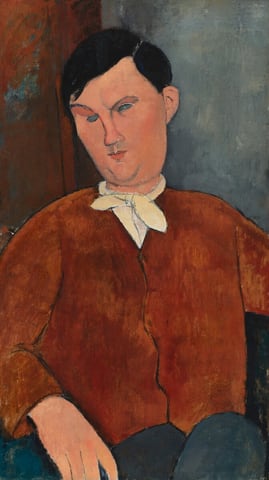
  1. Shown from the lap up, a person with peach-colored skin sits facing us as he looks down and to our left in this vertical, stylized, portrait painting. The person’s clothing and features are outlined with thin black lines, and areas are filled in with mottled, streaked color painted with visible strokes. The person has a round face with a double chin and a small red mouth. The eyes are painted as slate-blue slivers under thin brows, one of which is cocked. The man’s short black hair is parted to one side and combed across the top of his head. He wears a white cravat tied at his neck under a rust-red jacket or shirt. Two rounded, muted blue forms below suggest crossed knees. The man’s right elbow rests next to his body, and that hand is near his lap. The background is painted with pecan brown on the left third and gray-blue on the right two-thirds.
    Monsieur DeleuAmedeo Modigliani, 1916Courtesy National Gallery of Art, Washington
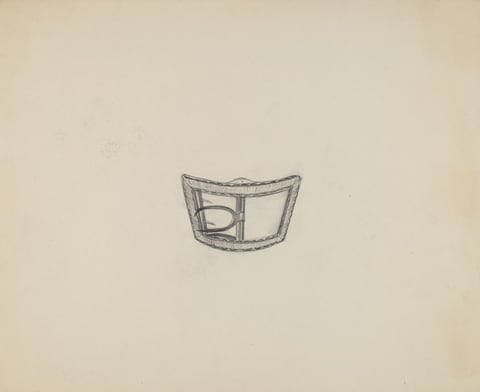
  2. The image displays a detailed pencil sketch of a curved architectural structure in the center of a light beige canvas. The sketch is in grayscale, with a simple color palette. The object occupies a small portion of the canvas, surrounded by negative space.
    Knee BuckleEdna Crenshaw Rex, c. 1937Courtesy National Gallery of Art, Washington
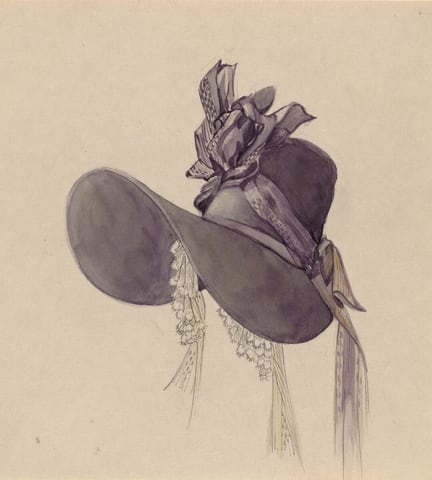
  3. The image shows a large hat with a broad brim, decorated with a ribbon and floral or lace-like embellishments. The color palette consists of shades of gray and soft purples. The hat is centered in the frame, with its brim curving to the left and the decorative elements extending to the sides.
    BonnetRosalia Lane, 1935/1942Courtesy National Gallery of Art, Washington

Section 2, north wall
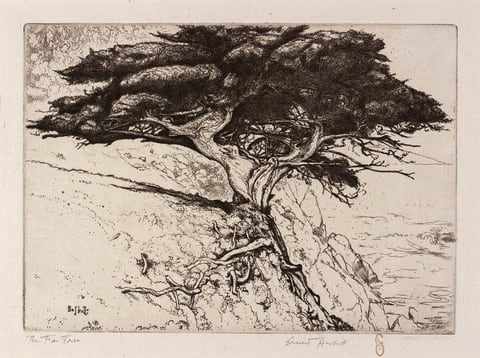
  1. The Fan Tree, by Ernest Haskell, ca. 1915
    The Fan TreeErnest Haskell, ca. 1915Courtesy of the Smithsonian American Art Museum
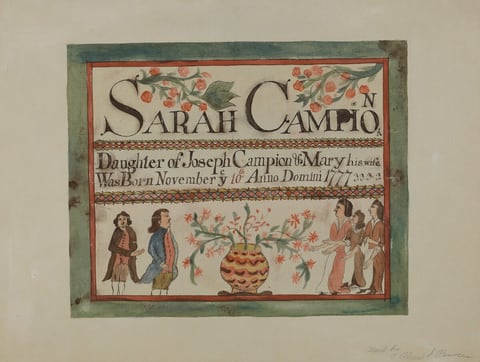
  2. This painting is a birth record for Sarah Campion, daughter of Joseph and Mary Campion, born on November 16th, 1777. It features elaborate calligraphy and ornamental designs. The borders contain floral patterns with red and orange-colored flowers and green leaves. The central text is decorative, and at the bottom are human-like figures in colonial attire standing beside a flower vase. The artwork reflects a style reminiscent of early American folk art, created by an anonymous folk artist capturing the essence of 18th-century American artistry.
    Pa. German Birth CertificateGlenn Pearce, c. 1936Courtesy National Gallery of Art, Washington
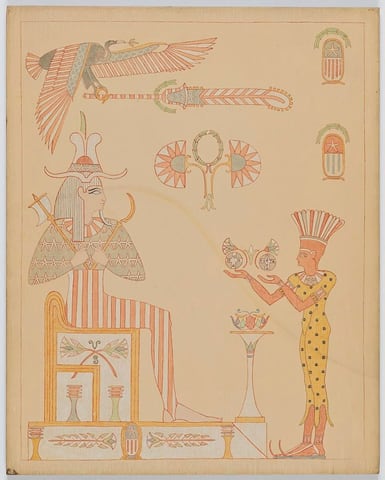
  3. THE TRIUMPH OF UNCLE SAM
    The Triumph of Uncle SamVictor Wilbour, 1917Courtesy of Cooper Hewitt, Smithsonian Design Museum

Section 3, north wall
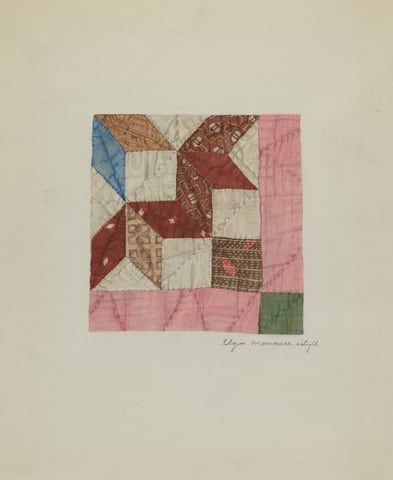
  1. This is a painting of a quilt design pattern. The image depicts a square quilt block featuring a variety of geometric shapes and patterns pieced together. The quilt features a mix of colors, including blues, reds, browns, and a pink border, with intricate patterns in the fabric segments. The textures and colors create an intricate optical composition resembling different geometric forms and depth. The piece is delicately framed within a larger white space, which emphasizes the detail of the quilt pattern. This is in the style of a traditional textile or quilting pattern illustrator.
    Cotton Bed QuiltElgin Moncure Styll, c. 1941Courtesy National Gallery of Art, Washington
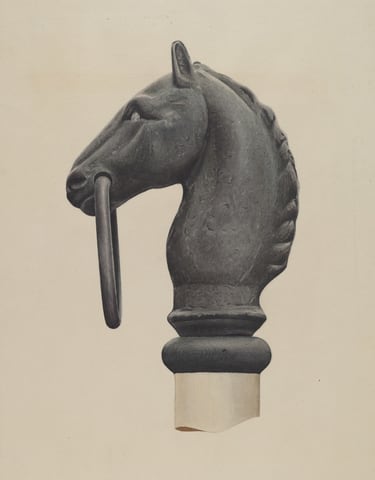
  2. The sculpture is a depiction of a horse's head crafted from a dark material that appears to be metal. The horse's ears are perked up, and its mane is depicted with smooth, curving lines trailing down the back of the neck. The sculpture includes a ring that extends from the horse's mouth. Positioned on a simple cylindrical pedestal, the sculpture's material and design suggest a robust and timeless feel. The details of the horse's expression and mane are rendered with a smooth finish.
    Hitching PostAlbert Ryder, c. 1938Courtesy National Gallery of Art, Washington
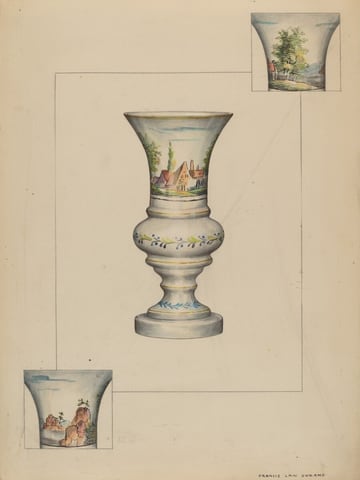
  3. The image shows a large, intricately designed vase with a bulbous base and flared top at the center. The vase is decorated with painted scenes of a town or village. The color scheme includes shades of blue, green, brown, and touches of yellow and red. Surrounding the vase are two smaller detailed sections showing close-ups of the painted scenes on it. The main vase image is enclosed within a boxed outline on the page.
    Fire Lighter VaseFrancis Law Durand, 1935/1942Courtesy National Gallery of Art, Washington

Section 3, south wall
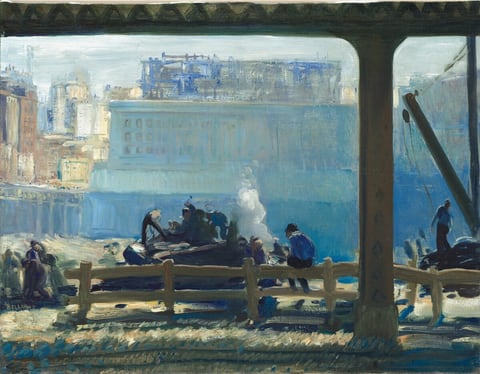
  1. From under an elevated train track, we look at a cluster of people hammering and working on the far side of a wooden fence, all against a silvery-blue building that fills most of the background in this horizontal painting. The scene is loosely painted mostly in tones of hazy and saturated blues, so many of the details are indistinct. About a quarter of the way in from the right edge of the composition, a thin iron column holds up the train platform. The column nearly spans the height of the painting, and the track it supports runs across the top edge of the canvas. At the foot of the column, along the bottom edge, are two parallel tracks embedded in an area otherwise painted with short, diagonal strokes in topaz blue, olive green, and straw yellow. Just beyond the tracks, the split-rail wooden fence runs across most of the painting, though there is an opening at the left edge of the canvas. A man sits with his back to us on the railing to our right of center. He wears a dark cap, a lapis-blue shirt, and navy-blue pants. Several men work on or near a mound-shaped form, perhaps a piece of machinery, just beyond the fence, near the center of the painting. One man holds a hammer high overhead while another reaches down or strikes the mound with his feet planted wide. More people work together to our left, and a man to our right stands near a crane. The people and these areas are painted with broad strokes and touches of cobalt blue, charcoal gray, khaki brown, and a few swipes of shell pink and bright white. A puff of white smoke billows up behind the central group, before the land drops precipitously away. The chasm is painted with shimmering tones of aquamarine and cerulean blue. A sky-blue, rectangular building perches at the far edge. A few windows are outlined in royal blue to our left but the rest of the building is loosely painted with long, vertical strokes so no architectural details can be made out. Behind this structure are more city buildings, suggested with strokes of muted rust red, parchment and bright white, and cobalt blue. The ice-blue sky fills the band between the top of the buildings and the train track running overhead. The artist signed his name near the lower left corner, “BELLOWS.”
    Blue MorningGeorge Bellows, 1909Courtesy National Gallery of Art, Washington
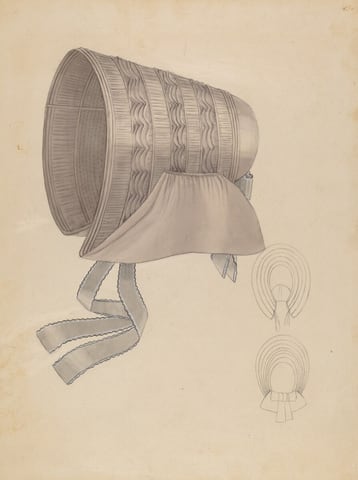
  2. This is an image of a bonnet and its details. The drawing showcases a bonnet with intricate design and texture. The bonnet is viewed from the side, revealing its woven structure with patterns representing fabric pleats or folds. It has a long ribbon hanging from the back, depicted with flowing lines. There are also two smaller sketches showing the bonnet from the back, emphasizing its shape and construction. The background is plain.
    BonnetBessie Forman, c. 1936Courtesy National Gallery of Art, Washington