Floor plan

Time and placeThe 20th century

The 20th century

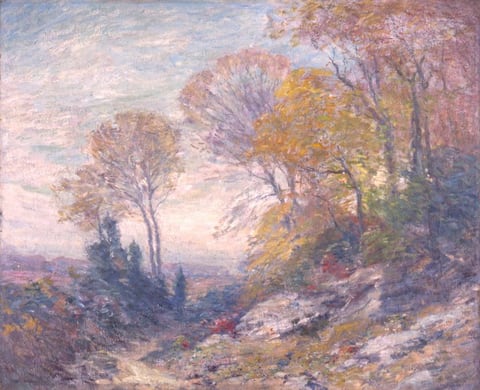
October Morning, by Frank A. Bicknell, ca. 1910
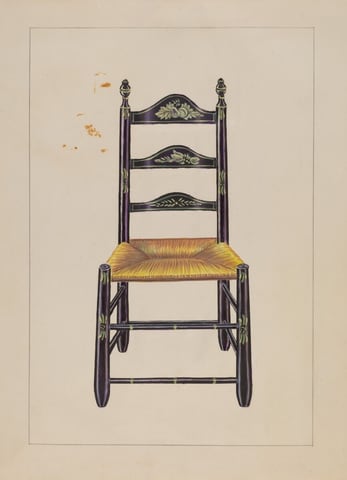
The image shows a wooden chair with a rush seat. It features ornate details on the backrest. The color palette includes dark wood tones, pale greenish detailing, and a warm yellowish hue for the seat. The chair is centrally positioned in the image, viewed from the front, with no other objects around it.
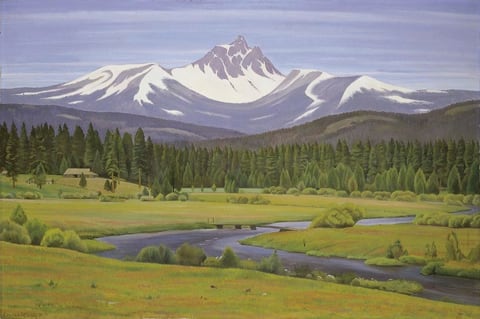
In the Cascade Mountains, by Edward Bruce, 1931
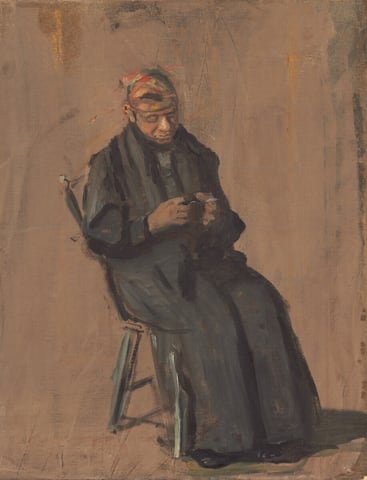
This painting shows a person seated on a stool or chair, wearing a long, dark-blue robe or gown. They are slightly turned toward the right, looking downward at something they hold in their hands, and their head is covered with a cloth or cap. The background is textured with earthy tones, mostly tan with some patches of yellow ochre and gray.
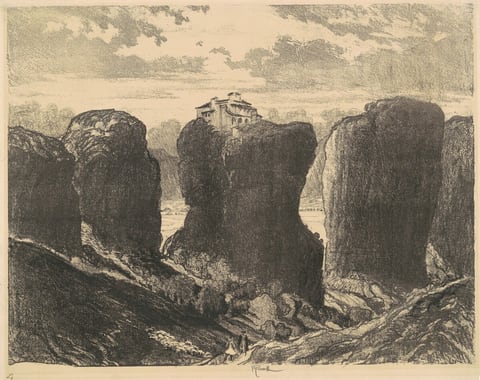
The image depicts a landscape with towering rock formations dominating the scene. The ground is rugged and textured, leading the eye towards the rock pillars in the center. A structure or building is perched atop one of these rocks. The background shows the horizon above the structure, with clouds and sky stretching out beyond. The artwork features detailed brushstrokes adding texture to the rocks. The color palette is monochromatic with varying shades of charcoal or ink, emphasizing the contrast between the rocks and the sky.
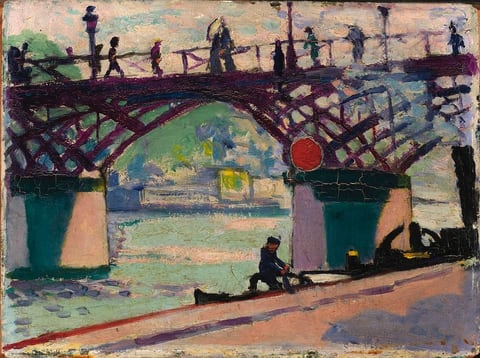
Pont des Arts, by H. Lyman Saÿen, 1908-1911
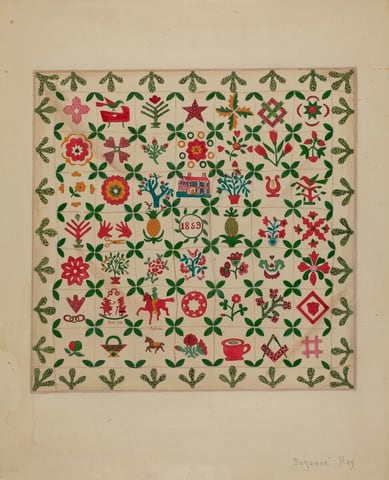
This is a painting of a decorative quilt pattern. The image shows a grid of square sections with various colorful motifs including stars, flowers, a horse, a house, and a cup. The design features vibrant colors, symmetrical patterns, and a central section with the date "1859". The quilt border has leaf-like patterns creating a frame around the central grid. The style is folk art.

The works in this room are listed below.

Works in this room

Works made in the 20th century, anywhere in the world.

Section 1, north wall

  1. October Morning, by Frank A. Bicknell, ca. 1910
    October MorningFrank A. Bicknell, ca. 1910Courtesy of the Smithsonian American Art Museum
  2. The image shows a wooden chair with a rush seat. It features ornate details on the backrest. The color palette includes dark wood tones, pale greenish detailing, and a warm yellowish hue for the seat. The chair is centrally positioned in the image, viewed from the front, with no other objects around it.
    Ladderback ChairGerald Bernhardt, c. 1936Courtesy National Gallery of Art, Washington
  3. In the Cascade Mountains, by Edward Bruce, 1931
    In the Cascade MountainsEdward Bruce, 1931Courtesy of the Smithsonian American Art Museum

Section 1, south wall

  1. This painting shows a person seated on a stool or chair, wearing a long, dark-blue robe or gown. They are slightly turned toward the right, looking downward at something they hold in their hands, and their head is covered with a cloth or cap. The background is textured with earthy tones, mostly tan with some patches of yellow ochre and gray.
    The ChaperoneThomas Eakins, c. 1908Courtesy National Gallery of Art, Washington
  2. The image depicts a landscape with towering rock formations dominating the scene. The ground is rugged and textured, leading the eye towards the rock pillars in the center. A structure or building is perched atop one of these rocks. The background shows the horizon above the structure, with clouds and sky stretching out beyond. The artwork features detailed brushstrokes adding texture to the rocks. The color palette is monochromatic with varying shades of charcoal or ink, emphasizing the contrast between the rocks and the sky.
    The Cliffs of the TrinityJoseph Pennell, 1913Courtesy National Gallery of Art, Washington
  3. Pont des Arts, by H. Lyman Saÿen, 1908-1911
    Pont des ArtsH. Lyman Saÿen, 1908-1911Courtesy of the Smithsonian American Art Museum
  4. This is a painting of a decorative quilt pattern. The image shows a grid of square sections with various colorful motifs including stars, flowers, a horse, a house, and a cup. The design features vibrant colors, symmetrical patterns, and a central section with the date "1859". The quilt border has leaf-like patterns creating a frame around the central grid. The style is folk art.
    Applique QuiltSuzanne Roy, 1938Courtesy National Gallery of Art, Washington

Section 2, south wall
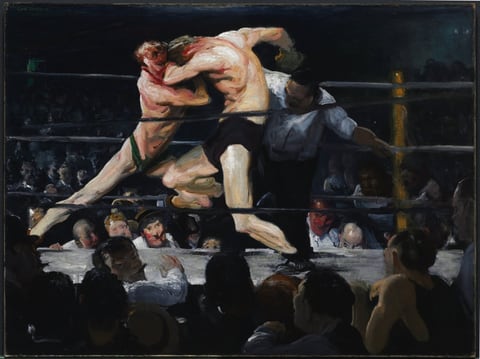
  1. Stag at Sharkey's, by George Bellows, 1909
    Stag at Sharkey'sGeorge Bellows, 1909Courtesy of the Cleveland Museum of Art
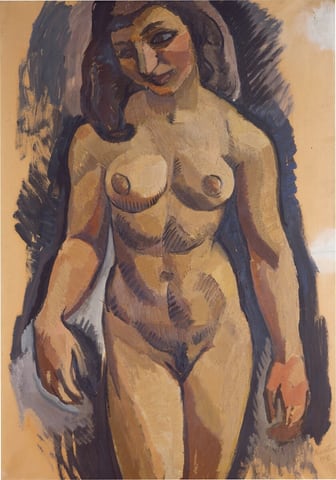
  2. The image is a painting of a woman's nude upper body extending from her head down to her hips, depicted in a standing position with her head slightly tilted to one side. Her facial features are distinct with a strong brow, prominent nose, and full lips, and her long dark hair cascades down to her shoulders. The background features abstract brushstrokes in dark blues and browns, blending into the lighter brown tone of the canvas, enhancing the figure's prominence in the composition. The woman appears naturalistic, with no jewelry or other objects visible in the painting.
    NudeRoger de La Fresnaye, 1910Courtesy National Gallery of Art, Washington
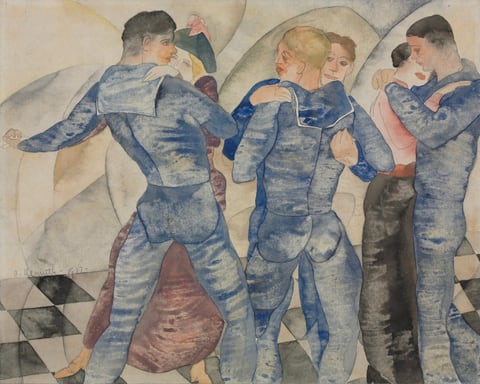
  3. Dancing Sailors, by Charles Demuth, 1917
    Dancing SailorsCharles Demuth, 1917Courtesy of the Cleveland Museum of Art
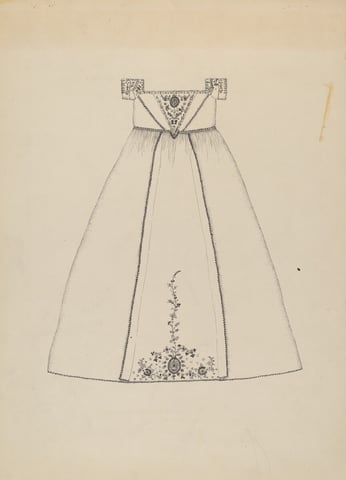
  4. This is a drawing of a dress design. The illustration features a dress with a square neckline, adorned with embroidery around the bust area. The dress has a high waistline with a gathered skirt. The lower part of the dress also features floral embroidery patterns. The design emphasizes fine lines and delicate patterns.
    Baptismal DressEvelyn Bailey, c. 1936Courtesy National Gallery of Art, Washington

Section 2, north wall
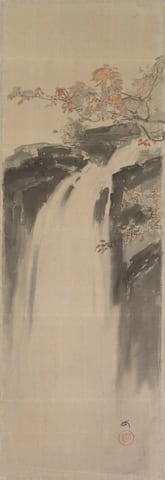
  1. Waterfall, by Yoshida Hiroshi, 1924
    WaterfallYoshida Hiroshi, 1924Courtesy of the Cleveland Museum of Art
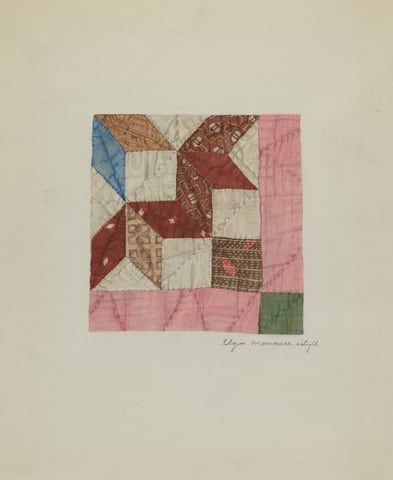
  2. This is a painting of a quilt design pattern. The image depicts a square quilt block featuring a variety of geometric shapes and patterns pieced together. The quilt features a mix of colors, including blues, reds, browns, and a pink border, with intricate patterns in the fabric segments. The textures and colors create an intricate optical composition resembling different geometric forms and depth. The piece is delicately framed within a larger white space, which emphasizes the detail of the quilt pattern. This is in the style of a traditional textile or quilting pattern illustrator.
    Cotton Bed QuiltElgin Moncure Styll, c. 1941Courtesy National Gallery of Art, Washington
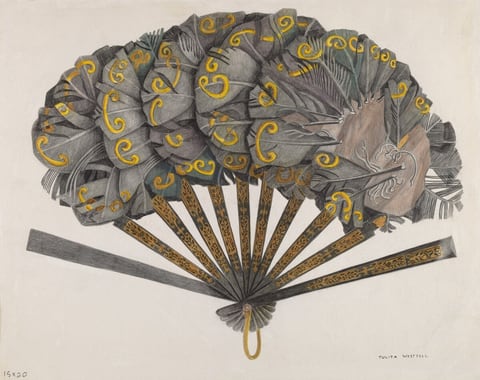
  3. The image shows a large fan with intricate feather-like segments adorned with yellow patterns and a bird depiction. The color palette is grey with hints of yellow, brown, and metallic sheen on the ribs. The fan is positioned upright with the handle at the bottom center, and the feathers extend outward in a semi-circular shape.
    Feather FanTulita Westfall, c. 1937Courtesy National Gallery of Art, Washington

Section 3, north wall
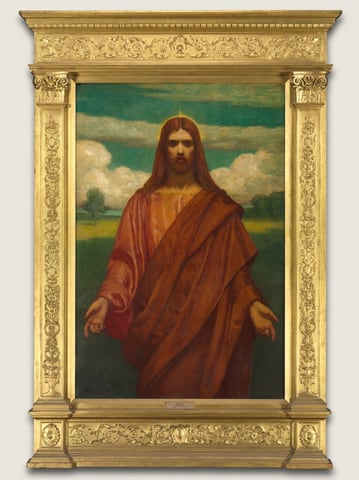
  1. Christ, by Kenyon Cox, 1905
    ChristKenyon Cox, 1905Courtesy of the Cleveland Museum of Art
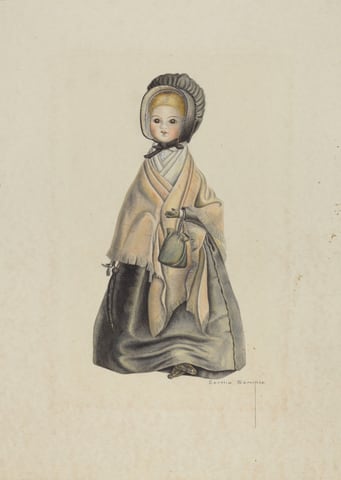
  2. The image displays a full-body illustration of a person standing upright. They have a delicate and round face with rosy cheeks and small, pink lips. Their eyes are large and expressive, and they have light-colored hair peeking out from under a bonnet. The person's attire consists of a long, dark skirt and a light-colored shawl draped over their shoulders. They wear a hooded cloak tied with a bow at the neck, and hold a small bag in their left hand. The background is plain with a light-colored texture. The artwork is a painted illustration with visible fine lines and shading to enhance details of the clothing and facial features.
    Quaker DollBertha Semple, 1935/1942Courtesy National Gallery of Art, Washington