Floor plan

Time and placeThe 20th century

The 20th century

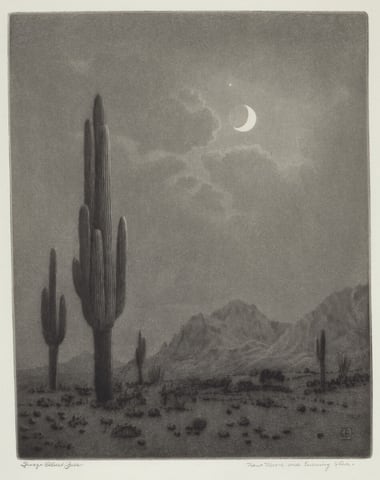
This print depicts a grayscale desert landscape with a prominent saguaro cactus to the left. In the background, rocky mountains are visible in the darkness. The sky shows a crescent moon and a bright star through an opening in the soft gray clouds. Sparse desert vegetation is faintly visible on the ground, and more cacti can be seen in the distance.
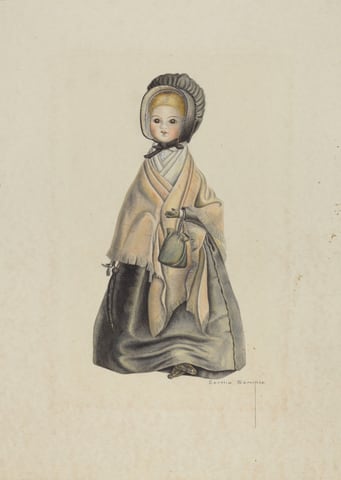
The image displays a full-body illustration of a person standing upright. They have a delicate and round face with rosy cheeks and small, pink lips. Their eyes are large and expressive, and they have light-colored hair peeking out from under a bonnet. The person's attire consists of a long, dark skirt and a light-colored shawl draped over their shoulders. They wear a hooded cloak tied with a bow at the neck, and hold a small bag in their left hand. The background is plain with a light-colored texture. The artwork is a painted illustration with visible fine lines and shading to enhance details of the clothing and facial features.
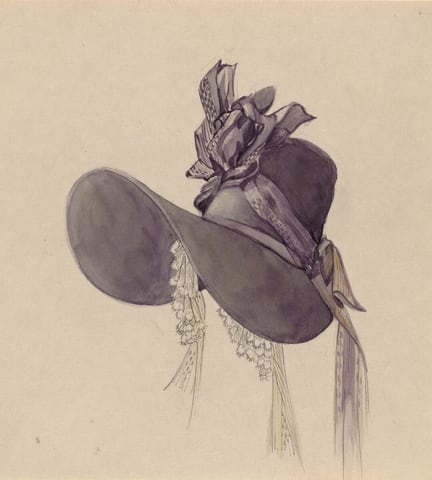
The image shows a large hat with a broad brim, decorated with a ribbon and floral or lace-like embellishments. The color palette consists of shades of gray and soft purples. The hat is centered in the frame, with its brim curving to the left and the decorative elements extending to the sides.
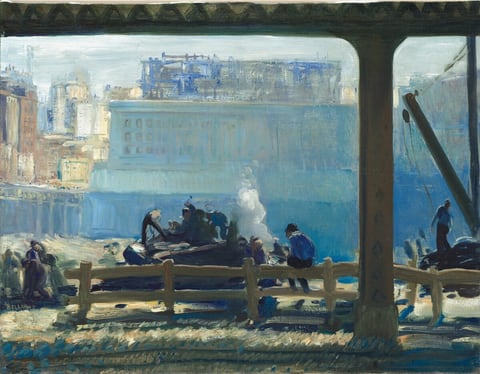
From under an elevated train track, we look at a cluster of people hammering and working on the far side of a wooden fence, all against a silvery-blue building that fills most of the background in this horizontal painting. The scene is loosely painted mostly in tones of hazy and saturated blues, so many of the details are indistinct. About a quarter of the way in from the right edge of the composition, a thin iron column holds up the train platform. The column nearly spans the height of the painting, and the track it supports runs across the top edge of the canvas. At the foot of the column, along the bottom edge, are two parallel tracks embedded in an area otherwise painted with short, diagonal strokes in topaz blue, olive green, and straw yellow. Just beyond the tracks, the split-rail wooden fence runs across most of the painting, though there is an opening at the left edge of the canvas. A man sits with his back to us on the railing to our right of center. He wears a dark cap, a lapis-blue shirt, and navy-blue pants. Several men work on or near a mound-shaped form, perhaps a piece of machinery, just beyond the fence, near the center of the painting. One man holds a hammer high overhead while another reaches down or strikes the mound with his feet planted wide. More people work together to our left, and a man to our right stands near a crane. The people and these areas are painted with broad strokes and touches of cobalt blue, charcoal gray, khaki brown, and a few swipes of shell pink and bright white. A puff of white smoke billows up behind the central group, before the land drops precipitously away. The chasm is painted with shimmering tones of aquamarine and cerulean blue. A sky-blue, rectangular building perches at the far edge. A few windows are outlined in royal blue to our left but the rest of the building is loosely painted with long, vertical strokes so no architectural details can be made out. Behind this structure are more city buildings, suggested with strokes of muted rust red, parchment and bright white, and cobalt blue. The ice-blue sky fills the band between the top of the buildings and the train track running overhead. The artist signed his name near the lower left corner, “BELLOWS.”
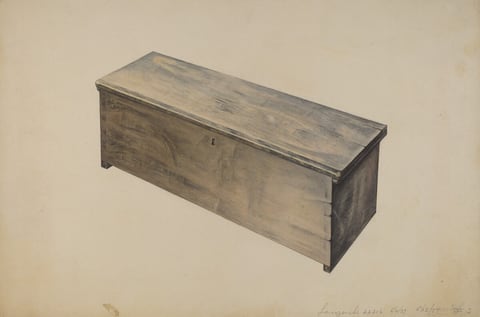
The image shows a large wooden chest with a rectangular design and a keyhole on its front panel. The chest has a weathered look in muted browns and grays. It is positioned in the center with its top, front, and side panels visible. The background is plain and light in color.

The works in this room are listed below.

Works in this room

Works made in the 20th century, anywhere in the world.

Section 1, north wall

  1. This print depicts a grayscale desert landscape with a prominent saguaro cactus to the left. In the background, rocky mountains are visible in the darkness. The sky shows a crescent moon and a bright star through an opening in the soft gray clouds. Sparse desert vegetation is faintly visible on the ground, and more cacti can be seen in the distance.
    New Moon and Evening StarGeorge Elbert Burr, c. 1932Courtesy National Gallery of Art, Washington
  2. The image displays a full-body illustration of a person standing upright. They have a delicate and round face with rosy cheeks and small, pink lips. Their eyes are large and expressive, and they have light-colored hair peeking out from under a bonnet. The person's attire consists of a long, dark skirt and a light-colored shawl draped over their shoulders. They wear a hooded cloak tied with a bow at the neck, and hold a small bag in their left hand. The background is plain with a light-colored texture. The artwork is a painted illustration with visible fine lines and shading to enhance details of the clothing and facial features.
    Quaker DollBertha Semple, 1935/1942Courtesy National Gallery of Art, Washington
  3. The image shows a large hat with a broad brim, decorated with a ribbon and floral or lace-like embellishments. The color palette consists of shades of gray and soft purples. The hat is centered in the frame, with its brim curving to the left and the decorative elements extending to the sides.
    BonnetRosalia Lane, 1935/1942Courtesy National Gallery of Art, Washington

Section 1, south wall

  1. From under an elevated train track, we look at a cluster of people hammering and working on the far side of a wooden fence, all against a silvery-blue building that fills most of the background in this horizontal painting. The scene is loosely painted mostly in tones of hazy and saturated blues, so many of the details are indistinct. About a quarter of the way in from the right edge of the composition, a thin iron column holds up the train platform. The column nearly spans the height of the painting, and the track it supports runs across the top edge of the canvas. At the foot of the column, along the bottom edge, are two parallel tracks embedded in an area otherwise painted with short, diagonal strokes in topaz blue, olive green, and straw yellow. Just beyond the tracks, the split-rail wooden fence runs across most of the painting, though there is an opening at the left edge of the canvas. A man sits with his back to us on the railing to our right of center. He wears a dark cap, a lapis-blue shirt, and navy-blue pants. Several men work on or near a mound-shaped form, perhaps a piece of machinery, just beyond the fence, near the center of the painting. One man holds a hammer high overhead while another reaches down or strikes the mound with his feet planted wide. More people work together to our left, and a man to our right stands near a crane. The people and these areas are painted with broad strokes and touches of cobalt blue, charcoal gray, khaki brown, and a few swipes of shell pink and bright white. A puff of white smoke billows up behind the central group, before the land drops precipitously away. The chasm is painted with shimmering tones of aquamarine and cerulean blue. A sky-blue, rectangular building perches at the far edge. A few windows are outlined in royal blue to our left but the rest of the building is loosely painted with long, vertical strokes so no architectural details can be made out. Behind this structure are more city buildings, suggested with strokes of muted rust red, parchment and bright white, and cobalt blue. The ice-blue sky fills the band between the top of the buildings and the train track running overhead. The artist signed his name near the lower left corner, “BELLOWS.”
    Blue MorningGeorge Bellows, 1909Courtesy National Gallery of Art, Washington
  2. The image shows a large wooden chest with a rectangular design and a keyhole on its front panel. The chest has a weathered look in muted browns and grays. It is positioned in the center with its top, front, and side panels visible. The background is plain and light in color.
    Utility ChestHenry Tomaszewski, 1937Courtesy National Gallery of Art, Washington

Section 2, south wall
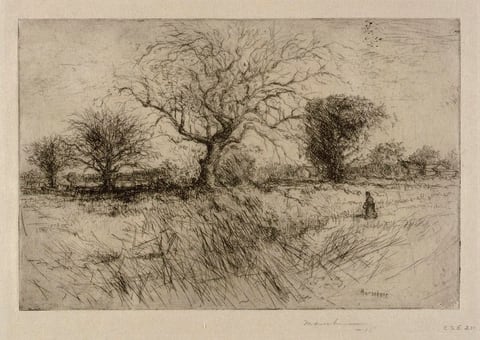
  1. The Old Orchard, by Arthur A. Marschner, 1915
    The Old OrchardArthur A. Marschner, 1915Courtesy of the Smithsonian American Art Museum
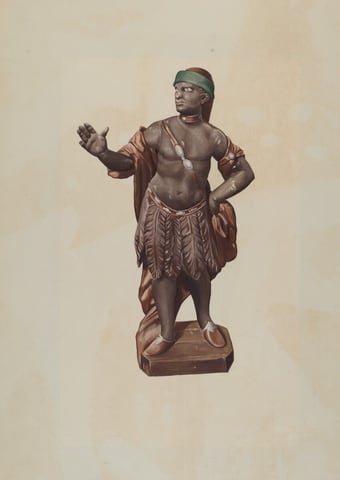
  2. The sculpture depicts a male figure standing upright with one hand raised and the other resting on his hip. The subject is wearing a garment that drapes over one shoulder and a feather-patterned skirt, accessorized with a headband. The colors of the sculpture are predominantly earth tones, including browns and a green headband. The material appears to be a type of stone or ceramic with a polished finish. The figure is slightly larger than everyday objects, allowing viewers to appreciate the intricacies of the carving and the details in the drapery and texture. The statue stands on a rectangular base that is consistent with the overall color palette.
    Cigar Store IndianRosamond P. Gray, 1935/1942Courtesy National Gallery of Art, Washington

Section 2, north wall
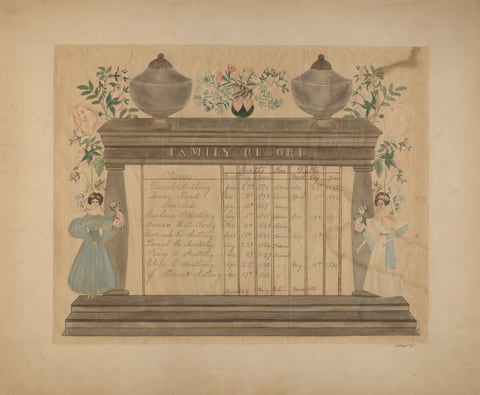
  1. This is a drawing of a decorative family record. The central feature is a structure resembling a classical monument or altar labeled "FAMILY RECORD" at the top. The structure has columns and a pediment with names and dates. Flanking the list are two figures holding flowers, dressed in long gowns of blue and white. Above the structure are two large urns and a floral arrangement with pink flowers and green foliage. The background is a soft, neutral color. Green leaves and small flowers further embellish the scene.
    Family Record of Susan B. AnthonyJohn Wilkes, c. 1937Courtesy National Gallery of Art, Washington
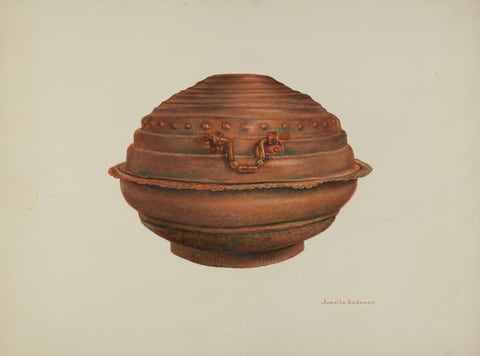
  2. The image depicts a large, round, domed container with a handle on its side. It has a textured and layered appearance with a central band. The color palette consists of various shades of brown and some orange tones. The container is centered in the image with the handle facing towards the viewer. The name "Janetta Badanes" is visible near the bottom right of the image.
    Copper Baptismal FontJuanita Donahoo, c. 1941Courtesy National Gallery of Art, Washington

Section 3, north wall
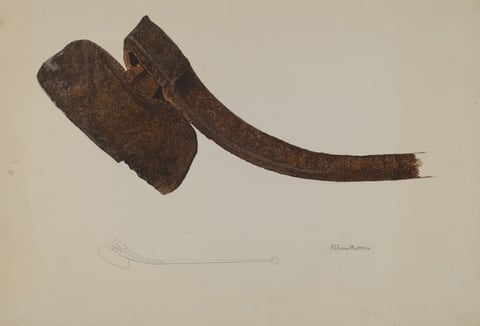
  1. The image shows a large, rusted ax with a curved brown handle placed diagonally across the canvas. The color palette consists of muted browns and beiges, highlighting the aged appearance of the ax. Beneath the ax, there is a faint outline sketch of a similar object, and the artist's signature is located to the right of the sketch. The ax is in the upper half of the image, while the sketch and signature are in the center-bottom section.
    Dumb IronAlfonso Moreno, c. 1938Courtesy National Gallery of Art, Washington
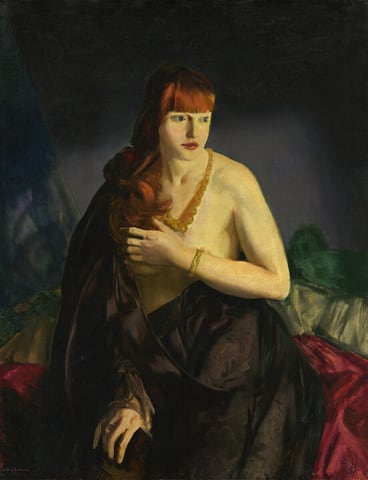
  2. Shown from the knees up, a woman sits partially covered by a black cloth as she holds one forearm across her bare breasts in this vertical painting. The woman has pale, yellow-tinged skin and long, copper-red hair and bangs. Her body faces us, but she turns her head to look off to our right with large blue, wide-set eyes. Her cheeks are flushed, and her full, dark pink lips are closed. A strand of gradually larger amber-yellow beads hangs around her neck, and she wears a gold-colored bracelet on the arm braced across her chest, her left arm, to our right. Glimpses of pale pink nipples are visible. The voluminous black cloth drapes down over one shoulder and across her hips. She wears a ring on the other hand, which emerges from the cloth to rest on that knee. Piles of garnet red, peridot green, and forest green are piled up to chest height behind her, and the background is nickel gray around her body and darkens to black around the top and side edges. The scene is loosely painted, especially in the fabric and background. The artist signed the canvas in the lower left corner, “Geo. Bellows E.S.B.”
    Nude with Red HairGeorge Bellows, 1920Courtesy National Gallery of Art, Washington

Section 3, south wall
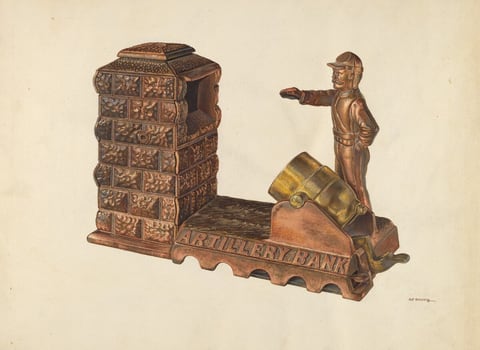
  1. The image displays a vintage mechanical bank with a brick-patterned tower on the left and a soldier figure on the right, prepared to operate a cannon. The color scheme is mainly earthy tones including brown, bronze, and hints of gold, creating a retro metallic appearance. The label "ARTILLERY BANK" is engraved on the base in front of the cannon.
    Mechanical Artillery BankAlf Bruseth, c. 1940Courtesy National Gallery of Art, Washington
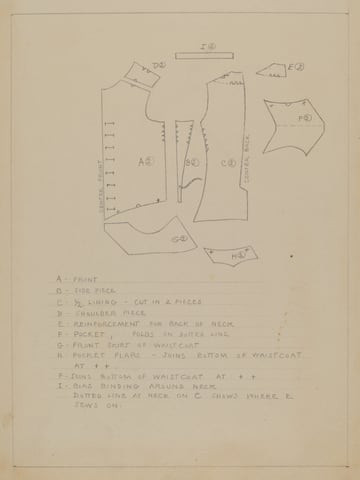
  2. This is a drawing depicting instructional annotations on a pattern for tailoring or assembling clothing. The pattern includes various pieces labeled with letters and numbers corresponding to specific parts of a garment, like "FRONT," "SIDE BACK," and "COLLAR." The layout is precise and technical, resembling a guide for constructing a garment with detailed cutting and assembly instructions.
    Waistcoat PatternRosalia Lane, c. 1936Courtesy National Gallery of Art, Washington
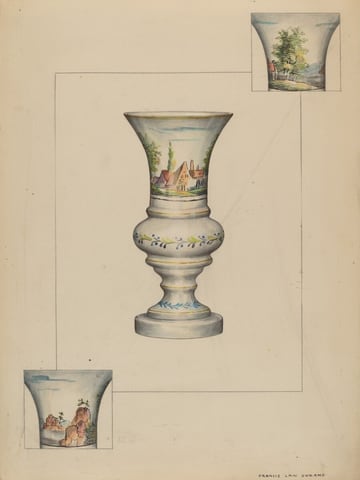
  3. The image shows a large, intricately designed vase with a bulbous base and flared top at the center. The vase is decorated with painted scenes of a town or village. The color scheme includes shades of blue, green, brown, and touches of yellow and red. Surrounding the vase are two smaller detailed sections showing close-ups of the painted scenes on it. The main vase image is enclosed within a boxed outline on the page.
    Fire Lighter VaseFrancis Law Durand, 1935/1942Courtesy National Gallery of Art, Washington

Section 4, south wall
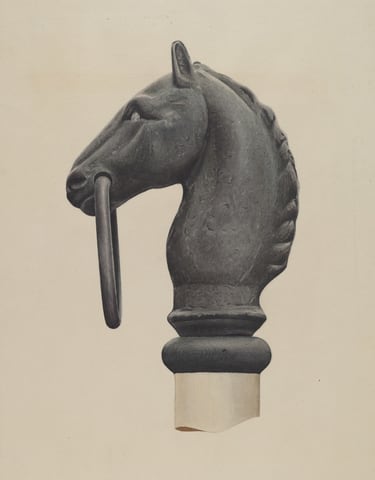
  1. The sculpture is a depiction of a horse's head crafted from a dark material that appears to be metal. The horse's ears are perked up, and its mane is depicted with smooth, curving lines trailing down the back of the neck. The sculpture includes a ring that extends from the horse's mouth. Positioned on a simple cylindrical pedestal, the sculpture's material and design suggest a robust and timeless feel. The details of the horse's expression and mane are rendered with a smooth finish.
    Hitching PostAlbert Ryder, c. 1938Courtesy National Gallery of Art, Washington
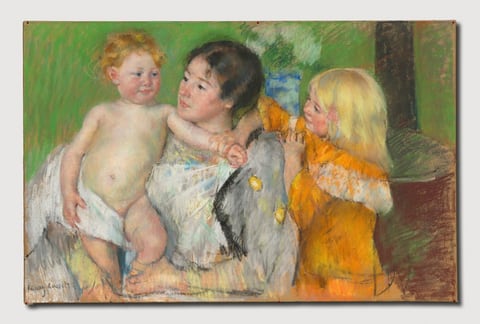
  2. After the Bath, by Mary Cassatt, 1901
    After the BathMary Cassatt, 1901Courtesy of the Cleveland Museum of Art