Floor plan

Time and placeThe 20th century

The 20th century

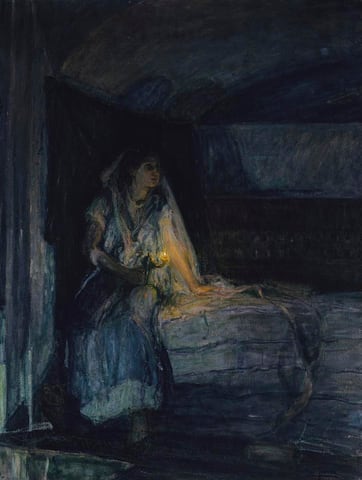
Mary, by Henry Ossawa Tanner, ca. 1914
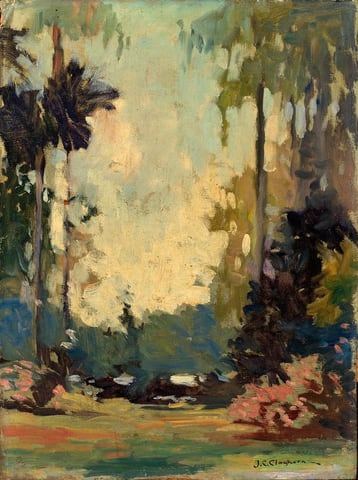
A Florida Park, by Joseph C. Claghorn, before 1935
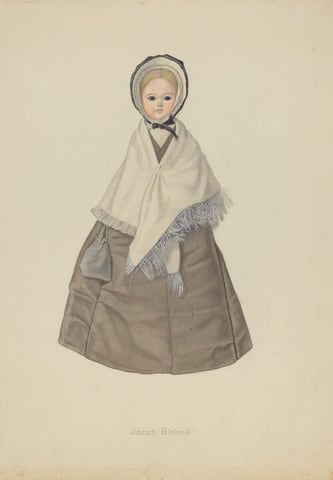
The image depicts a young person standing upright with distinct facial features including rounded cheeks, a small mouth, and large eyes. They are wearing a brown dress with a cream-colored shawl, a bonnet with dark trim, and a pouch hanging from their left side. The background is plain and cream-colored.
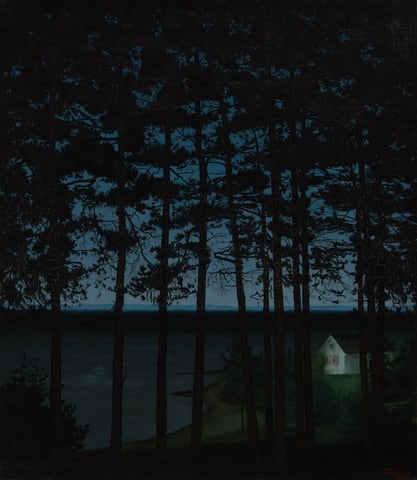
Dark twilight scene of a a brightly illuminated white cottage along the shore of an expansive body of water, seen through a thick of silhouetted trees.
The image shows a large, copper-colored pitcher with a hammered texture and a curving handle on the right side. The color palette consists of muted, warm tones of copper and brown against a pale beige background. The pitcher is centrally placed in the image, with its handle positioned on the right side.
The image displays a full-body illustration of a person standing upright. They have a delicate and round face with rosy cheeks and small, pink lips. Their eyes are large and expressive, and they have light-colored hair peeking out from under a bonnet. The person's attire consists of a long, dark skirt and a light-colored shawl draped over their shoulders. They wear a hooded cloak tied with a bow at the neck, and hold a small bag in their left hand. The background is plain with a light-colored texture. The artwork is a painted illustration with visible fine lines and shading to enhance details of the clothing and facial features.
This print displays a landscape with a wide view of flat land stretching towards the horizon. The ground is covered in small black dots, with some bare patches in the bottom center. A few silhouetted trees and a hint of smoke coming up from behind some rocks are visible in the distance. The gray sky dominates the scene with soft, swirling clouds.
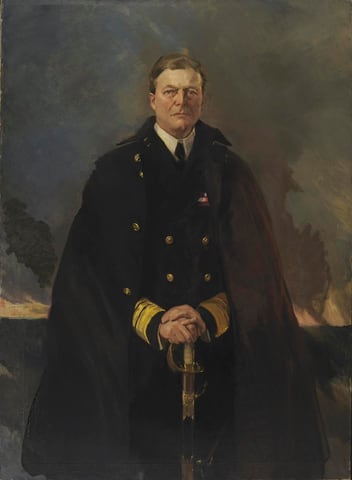
Admiral Sir David Beatty, Lord Beatty, by Cecilia Beaux, ca. 1920

The works in this room are listed below.

Works in this room

Works made in the 20th century, anywhere in the world.

Section 1, north wall

  1. Mary, by Henry Ossawa Tanner, ca. 1914
    MaryHenry Ossawa Tanner, ca. 1914Courtesy of the Smithsonian American Art Museum
  2. A Florida Park, by Joseph C. Claghorn, before 1935
    A Florida ParkJoseph C. Claghorn, before 1935Courtesy of the Smithsonian American Art Museum
  3. The image depicts a young person standing upright with distinct facial features including rounded cheeks, a small mouth, and large eyes. They are wearing a brown dress with a cream-colored shawl, a bonnet with dark trim, and a pouch hanging from their left side. The background is plain and cream-colored.
    Quaker DollJacob Gielens, 1935/1942Courtesy National Gallery of Art, Washington
  4. Dark twilight scene of a a brightly illuminated white cottage along the shore of an expansive body of water, seen through a thick of silhouetted trees.
    Fisherman's CottageHarald Oscar Sohlberg, 1906Courtesy of the Art Institute of Chicago

Section 1, south wall

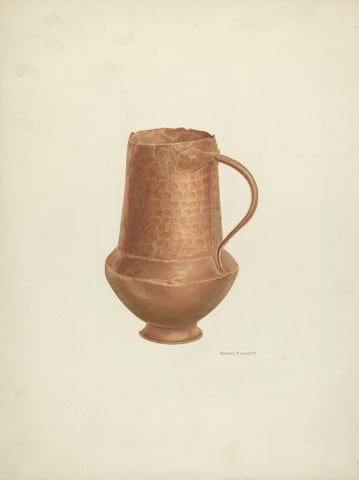
  1. The image shows a large, copper-colored pitcher with a hammered texture and a curving handle on the right side. The color palette consists of muted, warm tones of copper and brown against a pale beige background. The pitcher is centrally placed in the image, with its handle positioned on the right side.
    Copper CruetEdward Jewett, 1937Courtesy National Gallery of Art, Washington
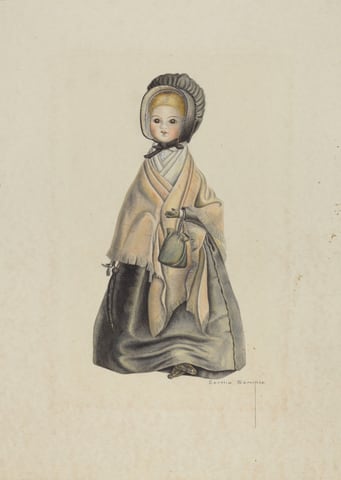
  2. The image displays a full-body illustration of a person standing upright. They have a delicate and round face with rosy cheeks and small, pink lips. Their eyes are large and expressive, and they have light-colored hair peeking out from under a bonnet. The person's attire consists of a long, dark skirt and a light-colored shawl draped over their shoulders. They wear a hooded cloak tied with a bow at the neck, and hold a small bag in their left hand. The background is plain with a light-colored texture. The artwork is a painted illustration with visible fine lines and shading to enhance details of the clothing and facial features.
    Quaker DollBertha Semple, 1935/1942Courtesy National Gallery of Art, Washington
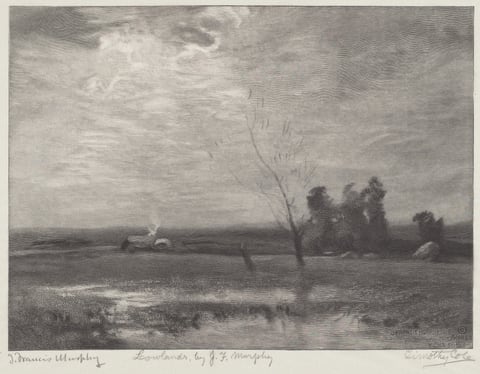
  3. This print displays a landscape with a wide view of flat land stretching towards the horizon. The ground is covered in small black dots, with some bare patches in the bottom center. A few silhouetted trees and a hint of smoke coming up from behind some rocks are visible in the distance. The gray sky dominates the scene with soft, swirling clouds.
    LowlandsTimothy Cole, 1918Courtesy National Gallery of Art, Washington
  4. Admiral Sir David Beatty, Lord Beatty, by Cecilia Beaux, ca. 1920
    Admiral Sir David Beatty, Lord BeattyCecilia Beaux, ca. 1920Courtesy of the Smithsonian American Art Museum

Section 2, south wall
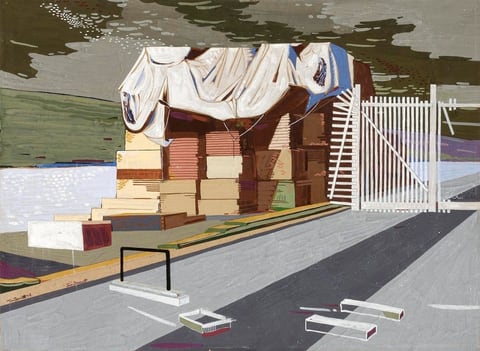
  1. Dutton Lumber Yard, by Thomas Weeks Barrett, 1942
    Dutton Lumber YardThomas Weeks Barrett, 1942Courtesy of the Smithsonian American Art Museum
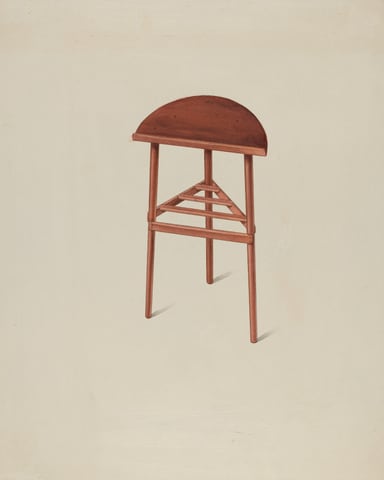
  2. The image shows a wooden stool with a semi-circular seat on a light beige background. The stool has four slim legs and a primarily brown color.
    Shaker Music RackAlfred H. Smith, c. 1936Courtesy National Gallery of Art, Washington
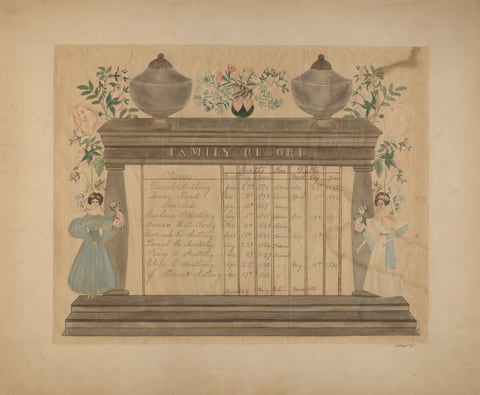
  3. This is a drawing of a decorative family record. The central feature is a structure resembling a classical monument or altar labeled "FAMILY RECORD" at the top. The structure has columns and a pediment with names and dates. Flanking the list are two figures holding flowers, dressed in long gowns of blue and white. Above the structure are two large urns and a floral arrangement with pink flowers and green foliage. The background is a soft, neutral color. Green leaves and small flowers further embellish the scene.
    Family Record of Susan B. AnthonyJohn Wilkes, c. 1937Courtesy National Gallery of Art, Washington
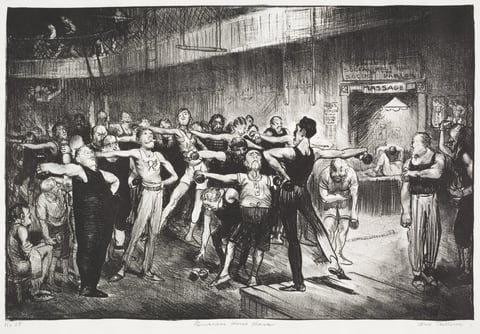
  4. Business Men's Class, by George Bellows, 1916
    Business Men's ClassGeorge Bellows, 1916Courtesy of the Cleveland Museum of Art

Section 2, north wall
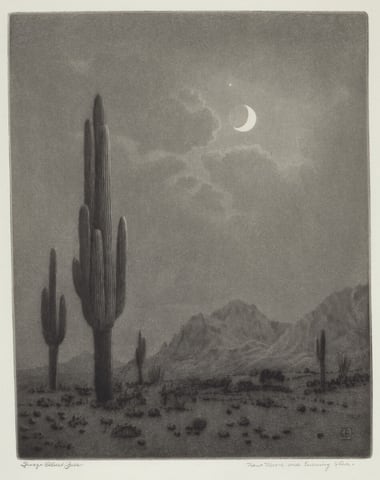
  1. This print depicts a grayscale desert landscape with a prominent saguaro cactus to the left. In the background, rocky mountains are visible in the darkness. The sky shows a crescent moon and a bright star through an opening in the soft gray clouds. Sparse desert vegetation is faintly visible on the ground, and more cacti can be seen in the distance.
    New Moon and Evening StarGeorge Elbert Burr, c. 1932Courtesy National Gallery of Art, Washington
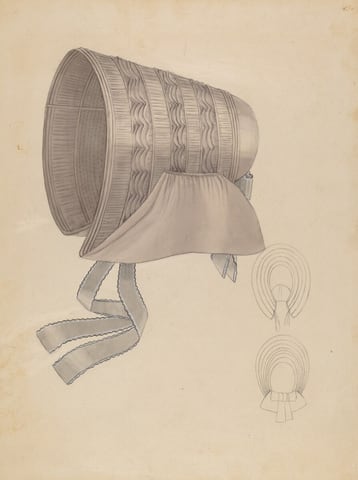
  2. This is an image of a bonnet and its details. The drawing showcases a bonnet with intricate design and texture. The bonnet is viewed from the side, revealing its woven structure with patterns representing fabric pleats or folds. It has a long ribbon hanging from the back, depicted with flowing lines. There are also two smaller sketches showing the bonnet from the back, emphasizing its shape and construction. The background is plain.
    BonnetBessie Forman, c. 1936Courtesy National Gallery of Art, Washington
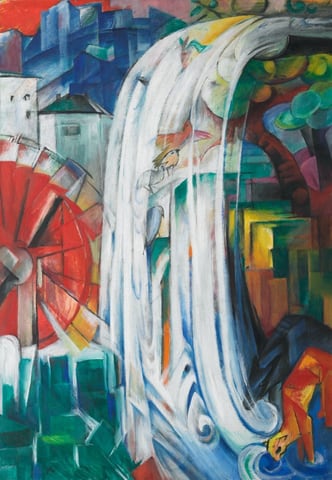
  3. Vibrantly colored geometric painting of a central white and blue waterfall with birds visible through it. A stylized red jungle cat and black wild boar drink at bottom right. Red water wheel at left, angular blue and white cityscape top at left, tree top at right.
    The Bewitched MillFranz Marc, 1913Courtesy of the Art Institute of Chicago
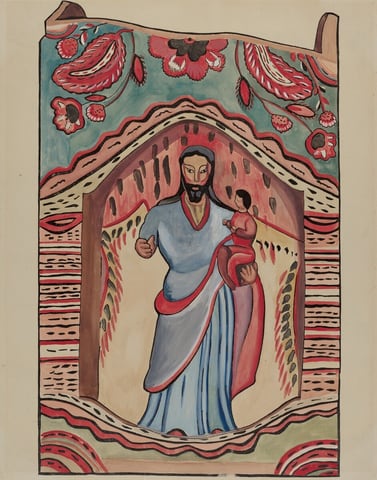
  4. This is a painting of stylized figures within an ornate frame. The artwork features two central figures that are reminiscent of a traditional religious iconography but rendered in a simplified and almost cartoonish form. The larger figure is draped in blue with red accents, while a smaller figure is held in one hand, enrobed in red. The background is decorated with a variety of patterns including an arch-like structure with wavy designs and lines, all outlining the central figures. The outer sections feature floral patterns with bold, contrasting colors of red, black, and teal. The use of thick outlines and vivid colors suggests a playful and decorative approach to the portrayal of the figures, drawing inspiration possibly from folk art traditions.
    St. JosephE. Boyd, 1936Courtesy National Gallery of Art, Washington