Floor plan

Time and placeThe 19th century

The 19th century

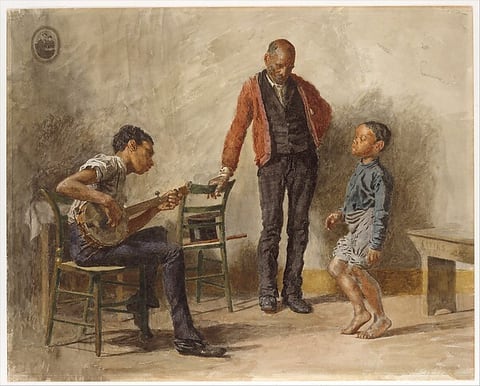
The Dancing Lesson, by Thomas Eakins, 1878
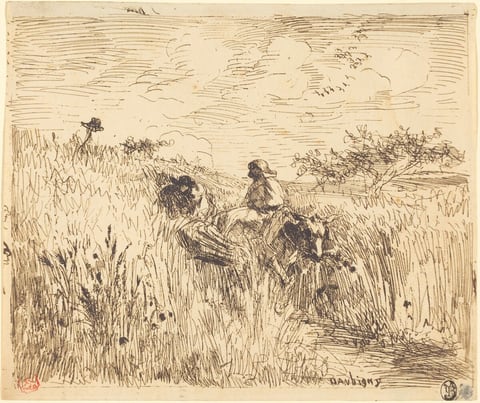
This image shows an elevated view of a grassy landscape with sparse trees and vegetation at the horizon. The linear brushstrokes create texture and movement in the grass and sky. The color palette is monochromatic with sepia tones. In the foreground, a figure is on a horse amidst tall grasses, while in the distance, another figure stands on the left and a cluster of trees is on the right. The sky has wisps of clouds.
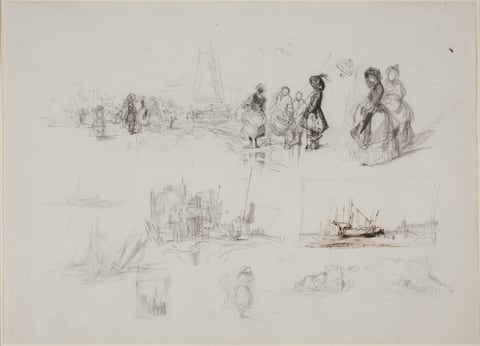
This image is a pencil sketch on paper with a monochrome palette of graphite gray. The viewer sees various scenes without a defined horizon line. The upper section shows figures in period clothing, possibly mid-19th century women's fashion. The middle area has abstract architectural forms. In the lower right corner, a sailing ship or boat is sketched with more detail than the rest. The drawing style consists of quick, expressive strokes. The image conveys multiple narrative or compositional ideas on a single sheet.
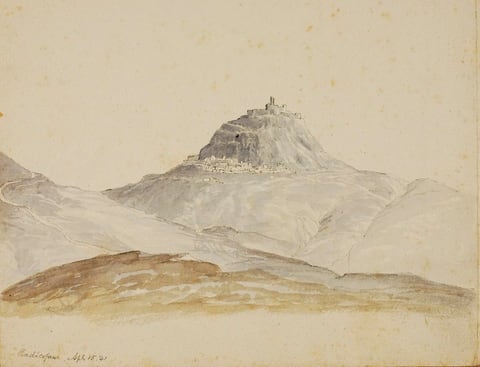
Radicofane, by Miner Kilbourne Kellogg, 1841
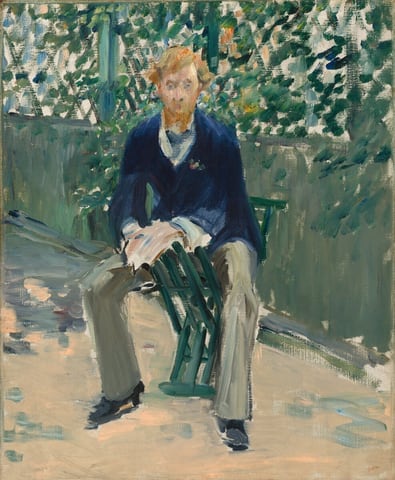
A pale-skinned young man with a carrot-red beard and hair faces us, straddling a green chair in a sunny outdoor setting in this vertical painting. The scene is loosely painted so his features are indistinct. His eyes are painted as pale blue dots, and he looks out at us. His chair unfolds into an X shape, with interlacing slats to make the seat. He leans forward to rest his hands on one side of the chair, and his legs are spread wide. He wears a marine-blue jacket over a white shirt, sage-green trousers streaked with gray, and black shoes. A soft blue V-shape at the neck suggests a neckerchief. Behind him, a half wall is topped by a trellis. The wall is painted in muted tones of pale laurel green while the trellis is painted with crisscrossed strokes of pine green. Daubs of emerald, pine, and forest green suggest vines and leaves, and flicks of orange, gold, and blue could be flowers. The ground beneath the man is pale peach scattered with thin scribbles and patches of fog blue. The painting is inscribed with “E 72.” in the lower right.
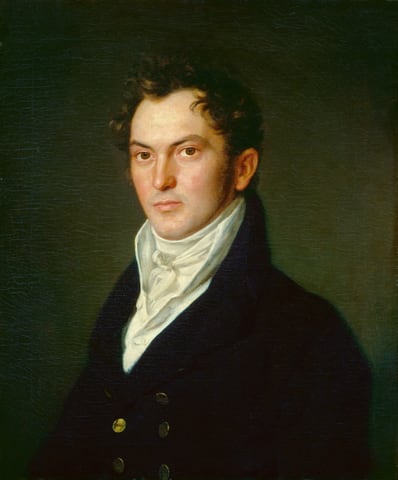
The image shows a man depicted from the waist up, positioned slightly turned to the side yet facing the viewer directly. He has a composed expression with defined facial features, including a high forehead, strong eyebrows, prominent cheekbones, and a clean-shaven face. His hair is dark and curly, styled away from his forehead. He is dressed in a dark coat featuring a double-breasted design with gold buttons, complemented by a high-collared, white cravat intricately tied at his neck. In the background, there is a subtle, dark, greenish hue.
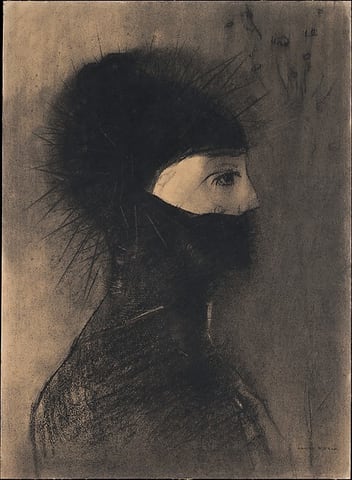
Armor, by Odilon Redon, 1891
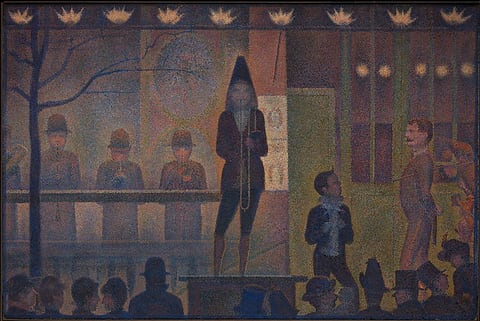
Circus Sideshow (Parade de cirque), by Georges Seurat, 1887–88

The works in this room are listed below.

Works in this room

Works made in the 19th century, anywhere in the world.

Section 1, north wall

  1. The Dancing Lesson, by Thomas Eakins, 1878
    The Dancing LessonThomas Eakins, 1878Courtesy of The Metropolitan Museum of Art
  2. This image shows an elevated view of a grassy landscape with sparse trees and vegetation at the horizon. The linear brushstrokes create texture and movement in the grass and sky. The color palette is monochromatic with sepia tones. In the foreground, a figure is on a horse amidst tall grasses, while in the distance, another figure stands on the left and a cluster of trees is on the right. The sky has wisps of clouds.
    Path through a Wheat Field (Sentier dans les bles)Charles-François Daubigny, 1862Courtesy National Gallery of Art, Washington
  3. This image is a pencil sketch on paper with a monochrome palette of graphite gray. The viewer sees various scenes without a defined horizon line. The upper section shows figures in period clothing, possibly mid-19th century women's fashion. The middle area has abstract architectural forms. In the lower right corner, a sailing ship or boat is sketched with more detail than the rest. The drawing style consists of quick, expressive strokes. The image conveys multiple narrative or compositional ideas on a single sheet.
    Seaside StudiesEugène Isabey, 1830sCourtesy National Gallery of Art, Washington
  4. Radicofane, by Miner Kilbourne Kellogg, 1841
    RadicofaneMiner Kilbourne Kellogg, 1841Courtesy of the Smithsonian American Art Museum

Section 1, south wall

  1. A pale-skinned young man with a carrot-red beard and hair faces us, straddling a green chair in a sunny outdoor setting in this vertical painting. The scene is loosely painted so his features are indistinct. His eyes are painted as pale blue dots, and he looks out at us. His chair unfolds into an X shape, with interlacing slats to make the seat. He leans forward to rest his hands on one side of the chair, and his legs are spread wide. He wears a marine-blue jacket over a white shirt, sage-green trousers streaked with gray, and black shoes. A soft blue V-shape at the neck suggests a neckerchief. Behind him, a half wall is topped by a trellis. The wall is painted in muted tones of pale laurel green while the trellis is painted with crisscrossed strokes of pine green. Daubs of emerald, pine, and forest green suggest vines and leaves, and flicks of orange, gold, and blue could be flowers. The ground beneath the man is pale peach scattered with thin scribbles and patches of fog blue. The painting is inscribed with “E 72.” in the lower right.
    George Moore in the Artist's GardenÉdouard Manet, c. 1879Courtesy National Gallery of Art, Washington
  2. The image shows a man depicted from the waist up, positioned slightly turned to the side yet facing the viewer directly. He has a composed expression with defined facial features, including a high forehead, strong eyebrows, prominent cheekbones, and a clean-shaven face. His hair is dark and curly, styled away from his forehead. He is dressed in a dark coat featuring a double-breasted design with gold buttons, complemented by a high-collared, white cravat intricately tied at his neck. In the background, there is a subtle, dark, greenish hue.
    Zachariah SchoonmakerJohn Vanderlyn, 1815/1818Courtesy National Gallery of Art, Washington
  3. Armor, by Odilon Redon, 1891
    ArmorOdilon Redon, 1891Courtesy of The Metropolitan Museum of Art
  4. Circus Sideshow (Parade de cirque), by Georges Seurat, 1887–88
    Circus Sideshow (Parade de cirque)Georges Seurat, 1887–88Courtesy of The Metropolitan Museum of Art

Section 2, south wall
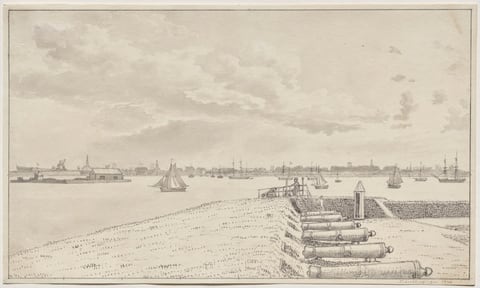
  1. View from the Battery toward the City, by Christoffer Wilhelm Eckersberg, 1836
    View from the Battery toward the CityChristoffer Wilhelm Eckersberg, 1836Courtesy of the Cleveland Museum of Art
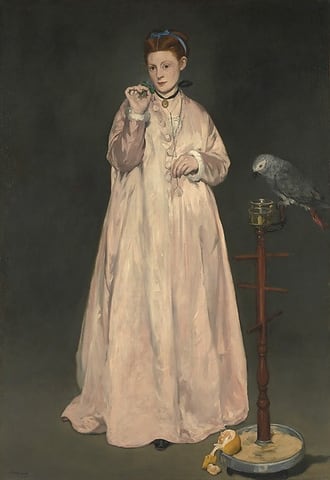
  2. Young Lady in 1866, by Édouard Manet, 1866
    Young Lady in 1866Édouard Manet, 1866Courtesy of The Metropolitan Museum of Art
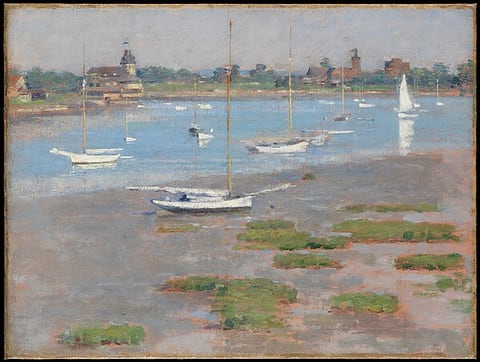
  3. Low Tide, Riverside Yacht Club, by Theodore Robinson, 1894
    Low Tide, Riverside Yacht ClubTheodore Robinson, 1894Courtesy of The Metropolitan Museum of Art
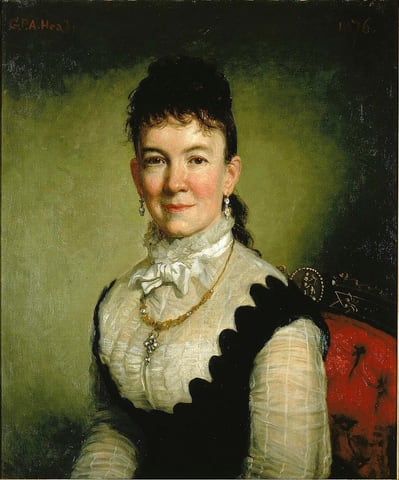
  4. Mrs. Albert J. Myer (Catherine Walden), by George Peter Alexander Healy, 1876
    Mrs. Albert J. Myer (Catherine Walden)George Peter Alexander Healy, 1876Courtesy of the Smithsonian American Art Museum

Section 2, north wall
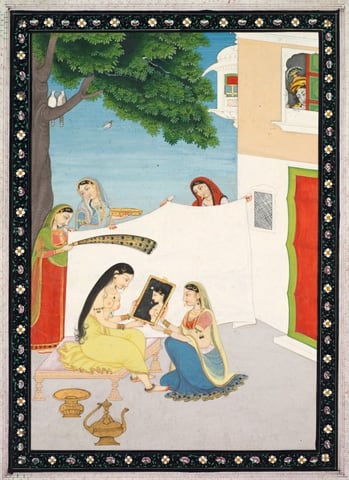
  1. Toilette of Radha, c. 1810–20
    Toilette of RadhaUnrecorded Indian maker, c. 1810–20Courtesy of the Cleveland Museum of Art
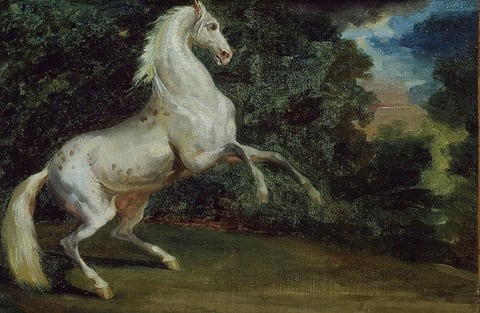
  2. A work made of oil on canvas.
    Prancing HorseFollower of Jean Louis André Théodore Géricault, 1808–12Courtesy of the Art Institute of Chicago
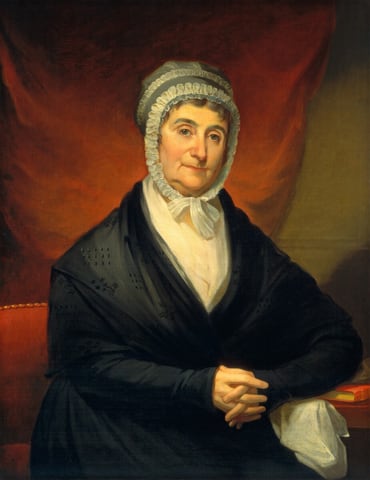
  3. The image shows the upper half of a seated woman facing forward. She has her hands clasped together in front of her. The woman appears calm with visible signs of age, including a few wrinkles on her face. She wears a white bonnet with a frilled edge tied under her chin, a dark shawl over a white high-collared blouse, and sits on a red chair with a gold trim. A red book and a handkerchief are on the surface next to her. The background transitions from deep red to brown tones.
    Ann Old Coleman (Mrs. Robert Coleman)Jacob Eichholtz, c. 1820Courtesy National Gallery of Art, Washington
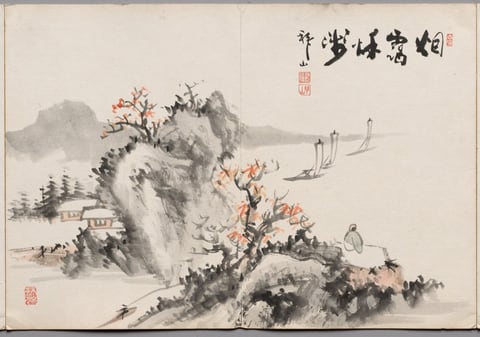
  4. Painting Nine from Album of Paintings by Haizan, by Yoshitsugu Haizan, late 1800s–early 1900s
    Painting Nine from Album of Paintings by HaizanYoshitsugu Haizan, late 1800s–early 1900sCourtesy of the Cleveland Museum of Art