Floor plan

Time and placeThe 19th century

The 19th century

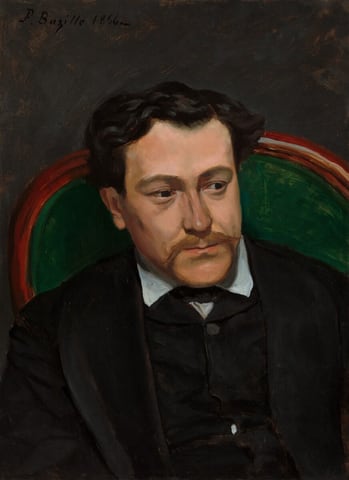
Shown from the chest up, a pale-skinned man in a suit sits in a high-backed chair, looking slightly to our right in this vertical portrait painting. His eyes and head are both turned slightly to our right, with only one ear visible on our left. His shoulder on our right and the right side of the chair are slightly cut off by the edge of the painting. He has a straight nose, high cheekbones, and pale pink closed lips. His eyes are dark, with small shadows beneath them. His black, wavy hair is parted on our right and cropped short on the sides of his head, with thick, defined waves on top. He has a light brown mustache that extends past the edge of his lips and flips up at the ends and a small, thin goatee. Beneath his chin, the collar of his white shirt is visible. The man wears an open suit jacket with a black vest, which folds slightly just below his chest, revealing a glimpse of his white shirt beneath it in a gap between buttons. The chair is only visible from the man’s shoulders up and ends at his forehead. It has a curved, round top back with a red frame and dark green upholstery. The part of the red frame on the right side of the painting has white and yellow highlights. The background is dark gray with visible brushstrokes. The artist signed and dated the painting at the top left, “F. Bazille. 1866.”
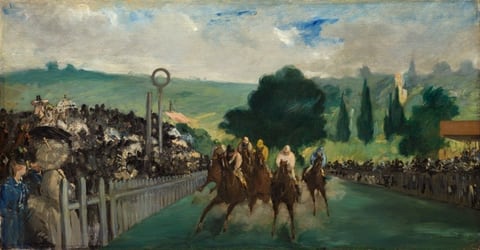
A work made of oil on canvas.
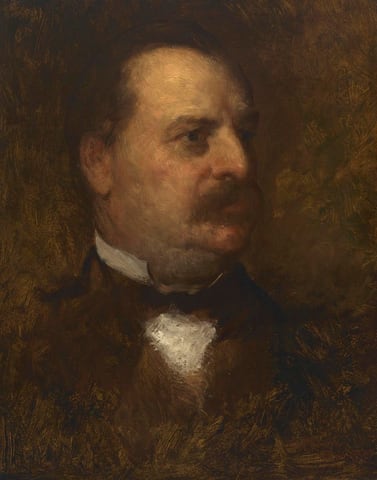
Artist: Eastman Johnson, Sitter: Grover Cleveland, Current owner: National Portrait Gallery, Smithsonian Institution
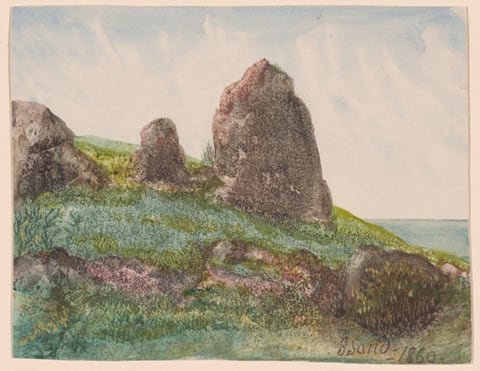
A work made of transparent and opaque watercolor on cream wove paper.
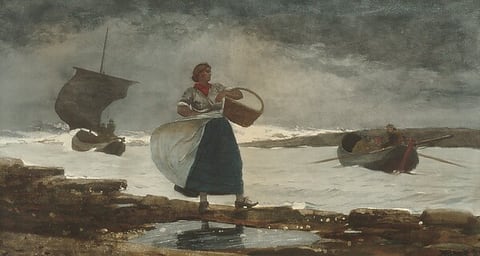
Inside the Bar, by Winslow Homer, 1883
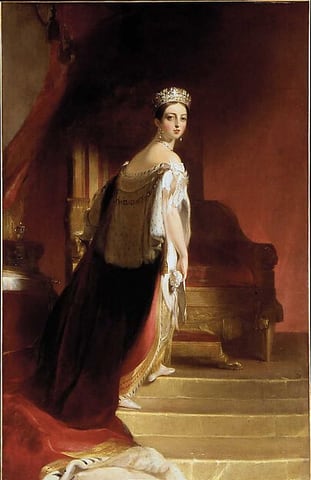
Queen Victoria, by Thomas Sully, 1838
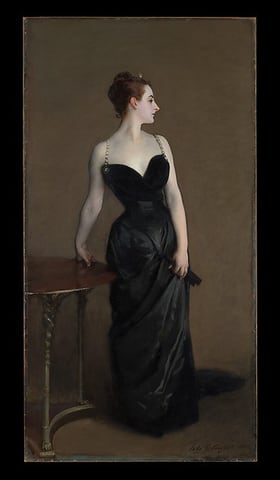
Madame X (Virginie Amélie Avegno Gautreau), by John Singer Sargent, 1883–84

The works in this room are listed below.

Works in this room

Works made in the 19th century, anywhere in the world.

Section 1, north wall

  1. Shown from the chest up, a pale-skinned man in a suit sits in a high-backed chair, looking slightly to our right in this vertical portrait painting. His eyes and head are both turned slightly to our right, with only one ear visible on our left. His shoulder on our right and the right side of the chair are slightly cut off by the edge of the painting. He has a straight nose, high cheekbones, and pale pink closed lips. His eyes are dark, with small shadows beneath them. His black, wavy hair is parted on our right and cropped short on the sides of his head, with thick, defined waves on top. He has a light brown mustache that extends past the edge of his lips and flips up at the ends and a small, thin goatee. Beneath his chin, the collar of his white shirt is visible. The man wears an open suit jacket with a black vest, which folds slightly just below his chest, revealing a glimpse of his white shirt beneath it in a gap between buttons. The chair is only visible from the man’s shoulders up and ends at his forehead. It has a curved, round top back with a red frame and dark green upholstery. The part of the red frame on the right side of the painting has white and yellow highlights. The background is dark gray with visible brushstrokes. The artist signed and dated the painting at the top left, “F. Bazille. 1866.”
    Edouard BlauFrédéric Bazille, probably 1869Courtesy National Gallery of Art, Washington
  2. A work made of oil on canvas.
    The Races at LongchampÉdouard Manet, 1866Courtesy of the Art Institute of Chicago
  3. Artist: Eastman Johnson, Sitter: Grover Cleveland, Current owner: National Portrait Gallery, Smithsonian Institution
    Grover ClevelandEastman Johnson, 1884Courtesy of the National Portrait Gallery, Smithsonian Institution
  4. A work made of transparent and opaque watercolor on cream wove paper.
    Landscape with RocksGeorge Sand, c. 1868/76Courtesy of the Art Institute of Chicago

Section 1, south wall

  1. Inside the Bar, by Winslow Homer, 1883
    Inside the BarWinslow Homer, 1883Courtesy of The Metropolitan Museum of Art
  2. Queen Victoria, by Thomas Sully, 1838
    Queen VictoriaThomas Sully, 1838Courtesy of The Metropolitan Museum of Art
  3. Madame X (Virginie Amélie Avegno Gautreau), by John Singer Sargent, 1883–84
    Madame X (Virginie Amélie Avegno Gautreau)John Singer Sargent, 1883–84Courtesy of The Metropolitan Museum of Art

Section 2, south wall
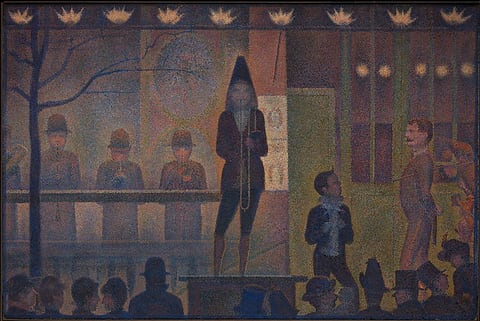
  1. Circus Sideshow (Parade de cirque), by Georges Seurat, 1887–88
    Circus Sideshow (Parade de cirque)Georges Seurat, 1887–88Courtesy of The Metropolitan Museum of Art
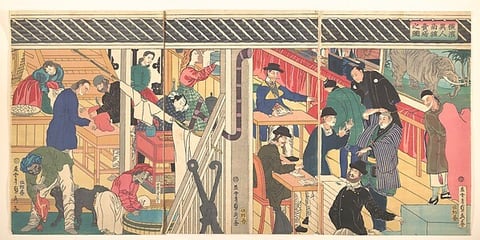
  2. Foreign Business Establishment in Yokohama (Yokohama ijin shōkan uriba no zu), by Utagawa (Gountei) Sadahide, 9th month, 1861
    Foreign Business Establishment in Yokohama (Yokohama ijin shōkan uriba no zu)Utagawa (Gountei) Sadahide, 9th month, 1861Courtesy of The Metropolitan Museum of Art
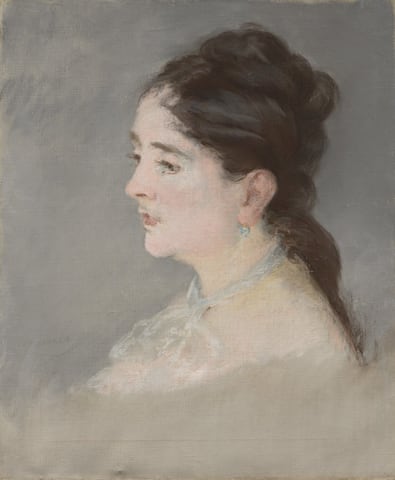
  3. Claire Campbell, by Édouard Manet, 1876
    Claire CampbellÉdouard Manet, 1876Courtesy of the Cleveland Museum of Art
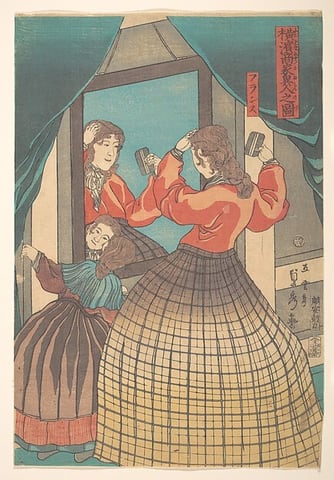
  4. French Woman and Girl, from the series Foreign Merchants in Yokohama (Yokohama shōka ijin no zu), by Utagawa (Gountei) Sadahide, 1st month, 1861
    French Woman and Girl, from the series Foreign Merchants in Yokohama (Yokohama shōka ijin no zu)Utagawa (Gountei) Sadahide, 1st month, 1861Courtesy of The Metropolitan Museum of Art

Section 2, north wall
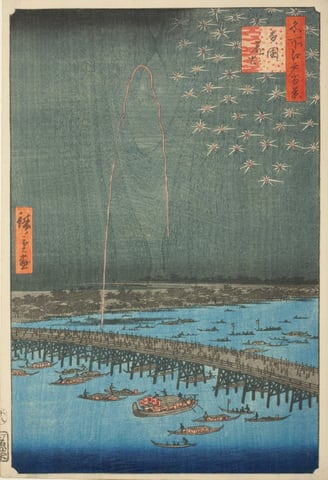
  1. A work made of color woodblock print; oban.
    Fireworks at Ryōgoku (Ryōgoku hanabi), from the series One Hundred Famous Views of Edo (Meisho Edo hyakkei)Utagawa Hiroshige, 1858Courtesy of the Art Institute of Chicago
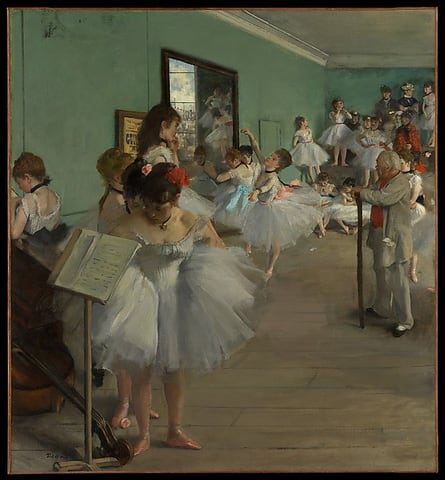
  2. The Dance Class, by Edgar Degas, 1874
    The Dance ClassEdgar Degas, 1874Courtesy of The Metropolitan Museum of Art
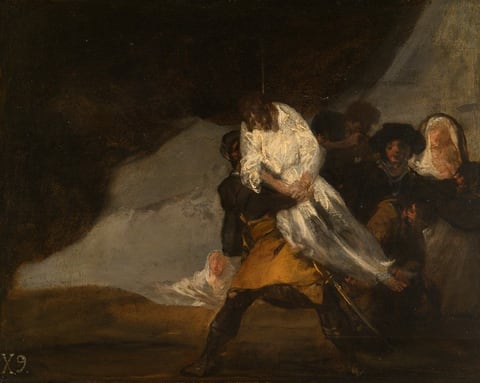
  3. A work made of oil on panel.
    The Hanged MonkFrancisco Goya, c. 1810Courtesy of the Art Institute of Chicago

Section 3, north wall
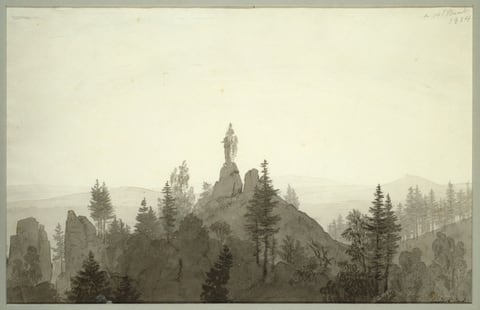
  1. Black ink drawing of forested landscape, statue of woman holding child at pinnacle of mountain.
    Statue of the Madonna in the MountainsCaspar David Friedrich, 1804Courtesy of the Art Institute of Chicago
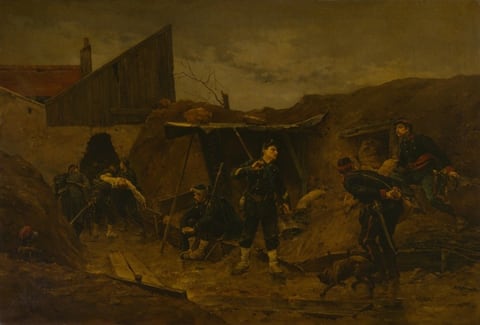
  2. A work made of oil on canvas.
    Dans la TranchéeEtienne Prosper Berne-Bellecour, c. 1875Courtesy of the Art Institute of Chicago