Floor plan

Time and place19th-century United States
19th-century United States
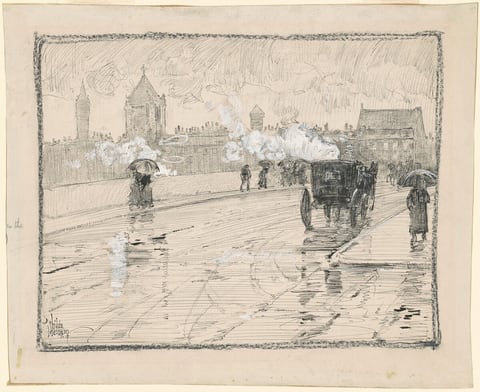
The image shows a street scene from an elevated viewpoint. A horse-drawn carriage is seen moving on a wet road, reflecting light. Pedestrians with umbrellas populate the avenue. The road is visibly marked with rainwater. The skyline displays detailed architectural features like church spires and towers. The painting is done in fine, linear brushstrokes highlighting movement and atmosphere. The grayscale palette emphasizes the rainy urban setting. Wisps of steam or smoke are visible. The intricate line work and shading depict a textured, busy street under an overcast sky.
NEAR MEADOW CREEK, UTAH
FIGURES
Albert Bierstadt
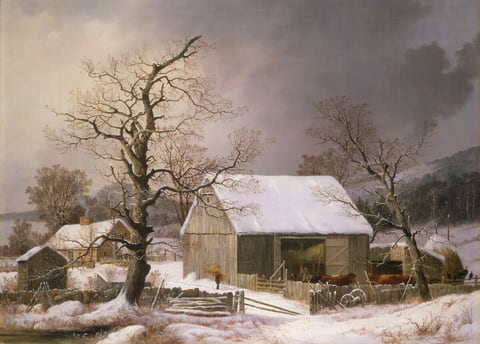
This painting shows a winter landscape with snowy, rural terrain. It includes a large barn, a farmhouse, and some bare trees covered in snow. Some brown cows are fenced in by the barn on the left, and a person walking along a snowy path brings them a bundle of golden hay. The sky is overcast, with dark gray clouds, and the color palette of the painting consists of earth tones with variations of grey and brown among the white snow.
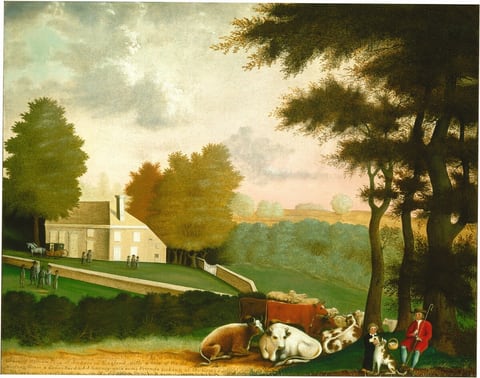
This painting shows a pastoral setting with a large white-and-gray house on a hill to the left. Distant people stand in front of the house, along with a horse-drawn wagon. In the bottom right corner, two people sit in the grass under a tree, one dressed in red holding a tall crook and the other wearing a black garment and a yellow hat and petting a large brown-and-white dog. There is a basket on the ground between them, and next to them is a large herd of cows and sheep, all resting on the grass. The landscape includes trees with green leaves and yellow hills in the distance. The sky above is in pastel shades of pink and blue, with fluffy clouds. In the bottom left, a patch of yellow ground has several lines of text written over it.
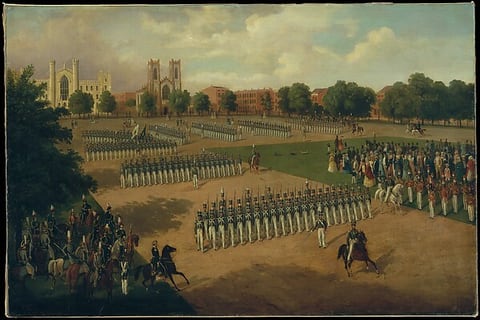
Seventh Regiment on Review, Washington Square, New York, by Otto Boetticher, 1851

The works in this room are listed below.

Works in this room

Works made in the United States in the 19th century.

Section 1, north wall

  1. The image shows a street scene from an elevated viewpoint. A horse-drawn carriage is seen moving on a wet road, reflecting light. Pedestrians with umbrellas populate the avenue. The road is visibly marked with rainwater. The skyline displays detailed architectural features like church spires and towers. The painting is done in fine, linear brushstrokes highlighting movement and atmosphere. The grayscale palette emphasizes the rainy urban setting. Wisps of steam or smoke are visible. The intricate line work and shading depict a textured, busy street under an overcast sky.
    Rainy Day, BostonChilde Hassam, 1886Courtesy National Gallery of Art, Washington
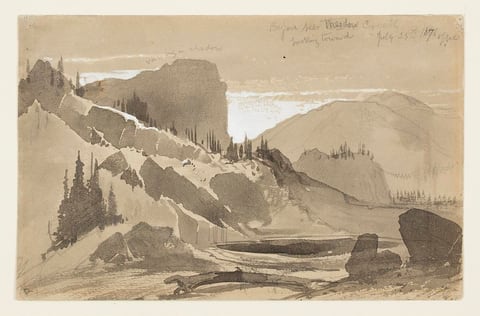
  2. NEAR MEADOW CREEK, UTAH
    Near Meadow Creek, UtahThomas Moran, July 25, 1871Courtesy of Cooper Hewitt, Smithsonian Design Museum
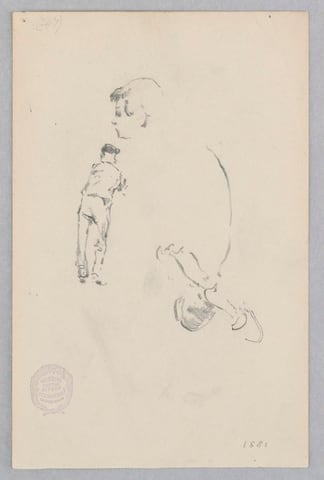
  3. FIGURES
    FiguresRobert Frederick Blum, 1881Courtesy of Cooper Hewitt, Smithsonian Design Museum
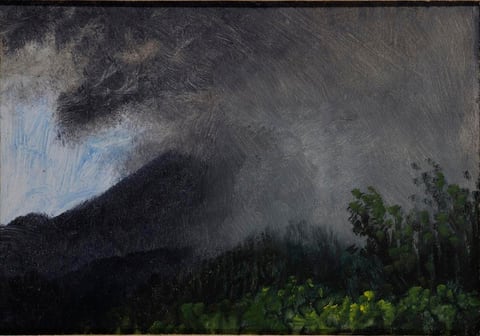
  4. Albert Bierstadt
    Gathering StormAlbert Bierstadt, (c. 1857-1858)Courtesy of the Hirshhorn Museum and Sculpture Garden, Smithsonian Institution

Section 1, south wall

  1. This painting shows a winter landscape with snowy, rural terrain. It includes a large barn, a farmhouse, and some bare trees covered in snow. Some brown cows are fenced in by the barn on the left, and a person walking along a snowy path brings them a bundle of golden hay. The sky is overcast, with dark gray clouds, and the color palette of the painting consists of earth tones with variations of grey and brown among the white snow.
    Winter in the CountryGeorge Henry Durrie, c. 1859Courtesy National Gallery of Art, Washington
  2. This painting shows a pastoral setting with a large white-and-gray house on a hill to the left. Distant people stand in front of the house, along with a horse-drawn wagon. In the bottom right corner, two people sit in the grass under a tree, one dressed in red holding a tall crook and the other wearing a black garment and a yellow hat and petting a large brown-and-white dog. There is a basket on the ground between them, and next to them is a large herd of cows and sheep, all resting on the grass. The landscape includes trees with green leaves and yellow hills in the distance. The sky above is in pastel shades of pink and blue, with fluffy clouds. In the bottom left, a patch of yellow ground has several lines of text written over it.
    The Grave of William PennEdward Hicks, c. 1847/1848Courtesy National Gallery of Art, Washington
  3. Seventh Regiment on Review, Washington Square, New York, by Otto Boetticher, 1851
    Seventh Regiment on Review, Washington Square, New YorkOtto Boetticher, 1851Courtesy of The Metropolitan Museum of Art

Section 2, south wall
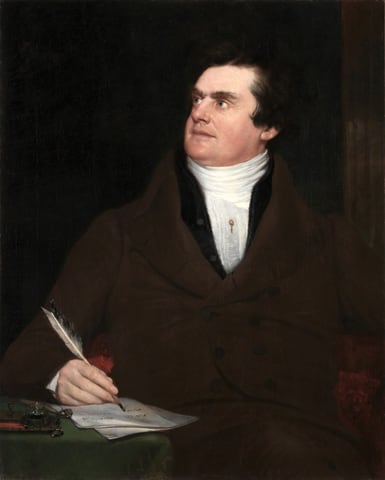
  1. Colonel William Leete Stone, by William Page, 1839
    Colonel William Leete StoneWilliam Page, 1839Courtesy of the Cleveland Museum of Art
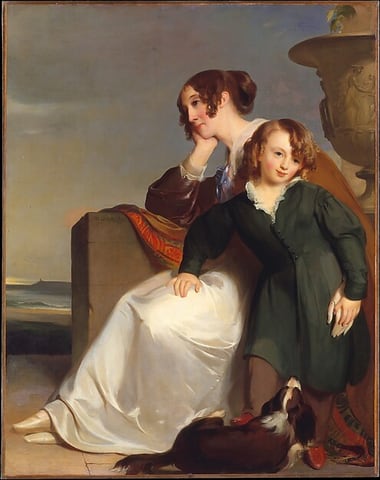
  2. Mother and Son, by Thomas Sully, 1840
    Mother and SonThomas Sully, 1840Courtesy of The Metropolitan Museum of Art
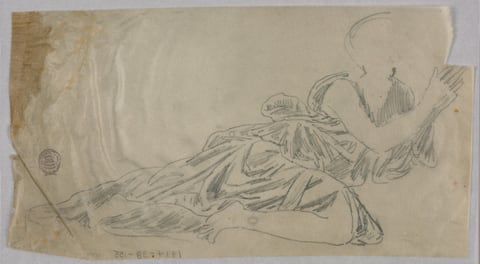
  3. DRAPERY STUDY
    Drapery StudyFrancis Augustus Lathrop, ca. 1895Courtesy of Cooper Hewitt, Smithsonian Design Museum
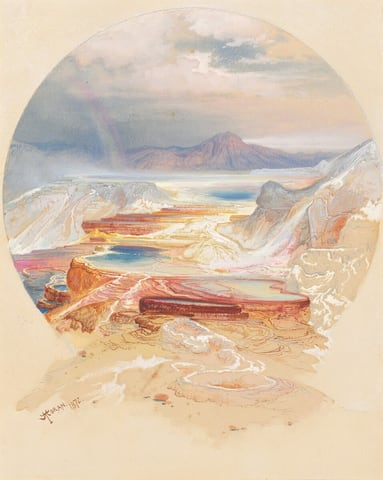
  4. This painting shows a view looking out over a vast landscape. Most of the painting is circular, with a small part of the bottom bleeding out of the circle towards us. The top third of the circle shows a mountain range with a large purple peak in the distance. In front of the mountain is a faint rainbow. A body of water flows from in front of the mountain to the bottom of the painting, weaving in between shorter white peaks. Towards the bottom, the water appears to flow into small, layered pools of various bright colors including yellow, orange, red, pink, blue, and teal. The sky is a light blue-gray color. The background of the painting outside of the circle is plain paper.
    Minerva Terrace, YellowstoneThomas Moran, 1872Courtesy National Gallery of Art, Washington

Section 2, north wall
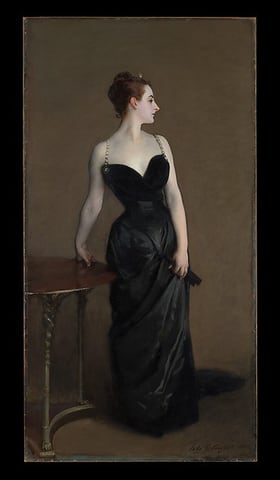
  1. Madame X (Virginie Amélie Avegno Gautreau), by John Singer Sargent, 1883–84
    Madame X (Virginie Amélie Avegno Gautreau)John Singer Sargent, 1883–84Courtesy of The Metropolitan Museum of Art
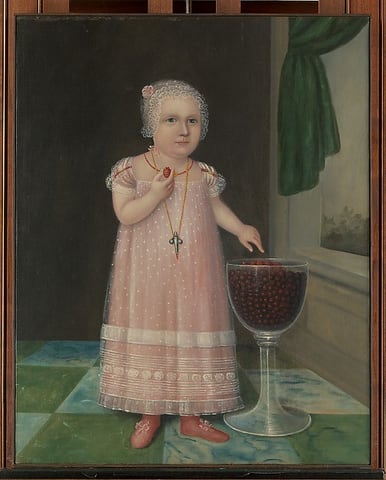
  2. Emma Van Name, by Joshua Johnson, ca. 1805
    Emma Van NameJoshua Johnson, ca. 1805Courtesy of The Metropolitan Museum of Art
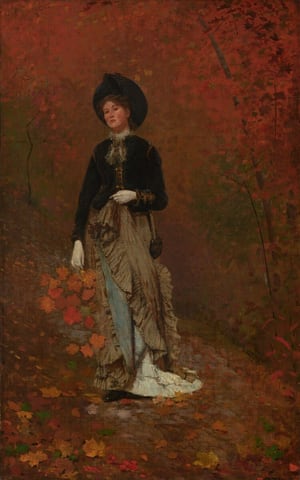
  3. A woman with smooth, pale skin and wearing a hat, long dress, and gloves, stands holding a bunch of pumpkin-orange leaves against a background of trees painted with touches of rust orange and pine green in this vertical painting. The woman tips her head back slightly to look at us with dark eyes under arched eyebrows. Her cheeks are flushed and her coral-pink lips closed. Her round black hat perches on the back of her head and she has an inky black, long-sleeved, hip-length jacket with bronze trim at the shoulders, cuffs, and down the front. A gauzy bow is tied at her neck. Her left elbow, on our right, is bent and she holds up her tan-colored, ruffled skirt with a white-gloved hand. The raised skirt exposes sky-blue lining and white, ruffled flounces at her feet. Her right arm, on our left, hangs at her side and holds the handle of a basket. Deep marigold-orange leaves cascade out of the basket. One black shoe peeks out from under her long skirt. She stands on a hill carpeted with crimson-red, tawny-brown, golden yellow, and forest-green leaves. The space behind her is filled with touches and dabs of red, orange, brown, black, and tan.
    AutumnWinslow Homer, 1877Courtesy National Gallery of Art, Washington

Section 3, north wall
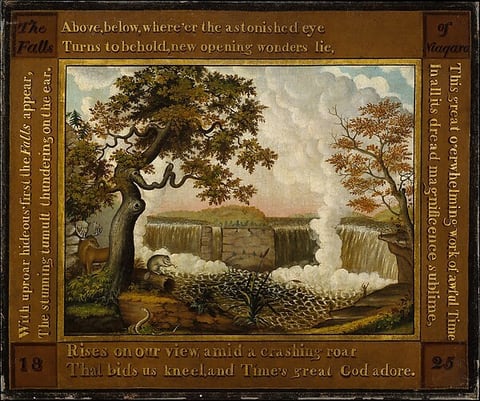
  1. The Falls of Niagara, by Edward Hicks, ca. 1825
    The Falls of NiagaraEdward Hicks, ca. 1825Courtesy of The Metropolitan Museum of Art
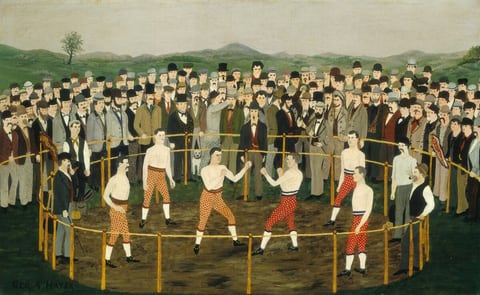
  2. This is a painting depicting a bare-knuckle boxing match with two fighters in a ring surrounded by a crowd. Both fighters are men with light skin, and they wear no shirts. The fighter on the left wears orange pants with black dots, while the fighter on the right wears red pants with white dots. Behind these men are two other shirtless men wearing the same types of pants, as well as two other men wearing more formal attire, including jackets, vests, and hats. Outside the ring, a semi-circle of light-skinned men in formal attire watch the central fight. The setting is outdoors, with grass around the feet of the spectators and green hills in the background. Above the group, the sky is light gray.
    Bare KnucklesGeorge A. Hayes, c. 1870/1885Courtesy National Gallery of Art, Washington