Floor plan

Time and place19th-century United States
19th-century United States
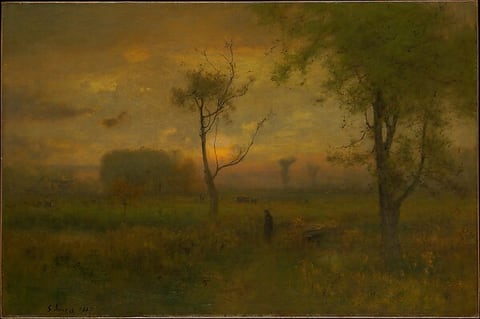
Sunrise, by George Inness, 1887
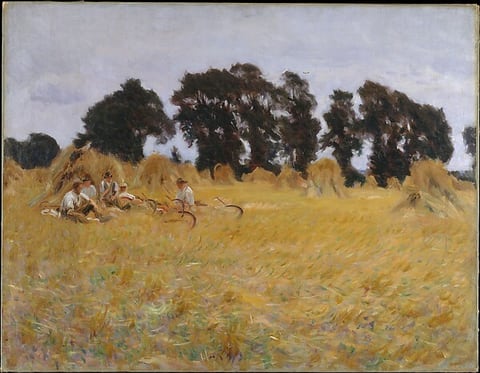
Reapers Resting in a Wheat Field, by John Singer Sargent, 1885
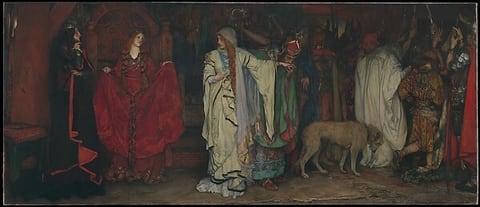
"King Lear," Act I, Scene I, by Edwin Austin Abbey, 1898
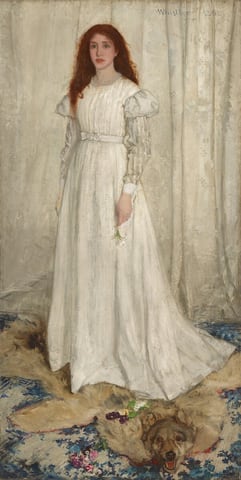
A young woman with pale, peachy skin, wearing a long, flowing white dress, stands in front of a white curtain in this vertical portrait painting. Her auburn-red hair cascades down over and behind her shoulders. She looks to our left with green eyes, and her pink, full lips are closed. Her dress has puffed shoulders above a white-on-white striped pattern on the long sleeves. She stands on an animal pelt; it is not clear whether it is a wolf or a bear. The pelt spans the width of the painting and overlaps a blue patterned carpet. The animal’s mouth gapes to show sharp teeth. Its glassy eyes are wide open, and it seems to look at us. The edges of the animal skin are red. The woman holds a white lily by her side in her left hand, while yellow and purple flowers lie scattered on the pelt.

The works in this room are listed below.

Works in this room

Works made in the United States in the 19th century.

Section 1, north wall

  1. Sunrise, by George Inness, 1887
    SunriseGeorge Inness, 1887Courtesy of The Metropolitan Museum of Art
  2. Reapers Resting in a Wheat Field, by John Singer Sargent, 1885
    Reapers Resting in a Wheat FieldJohn Singer Sargent, 1885Courtesy of The Metropolitan Museum of Art

Section 1, south wall

  1. "King Lear," Act I, Scene I, by Edwin Austin Abbey, 1898
    "King Lear," Act I, Scene IEdwin Austin Abbey, 1898Courtesy of The Metropolitan Museum of Art
  2. A young woman with pale, peachy skin, wearing a long, flowing white dress, stands in front of a white curtain in this vertical portrait painting. Her auburn-red hair cascades down over and behind her shoulders. She looks to our left with green eyes, and her pink, full lips are closed. Her dress has puffed shoulders above a white-on-white striped pattern on the long sleeves. She stands on an animal pelt; it is not clear whether it is a wolf or a bear. The pelt spans the width of the painting and overlaps a blue patterned carpet. The animal’s mouth gapes to show sharp teeth. Its glassy eyes are wide open, and it seems to look at us. The edges of the animal skin are red. The woman holds a white lily by her side in her left hand, while yellow and purple flowers lie scattered on the pelt.
    Symphony in White, No. 1: The White GirlJames McNeill Whistler, 1861-1863, 1872Courtesy National Gallery of Art, Washington

Section 2, south wall
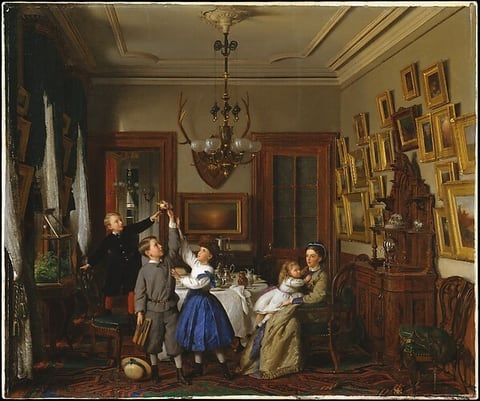
  1. The Contest for the Bouquet: The Family of Robert Gordon in Their New York Dining-Room, by Seymour Joseph Guy, 1866
    The Contest for the Bouquet: The Family of Robert Gordon in Their New York Dining-RoomSeymour Joseph Guy, 1866Courtesy of The Metropolitan Museum of Art
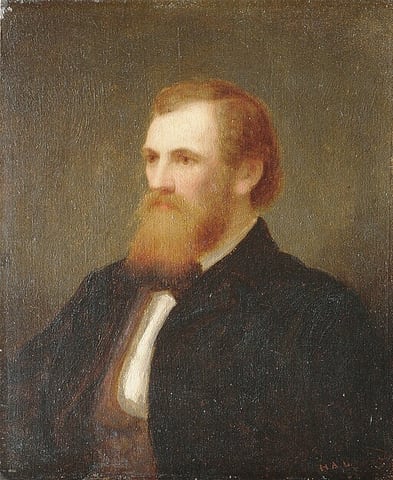
  2. John Quincy Adams Ward, by Henry Augustus Loop, 1863
    John Quincy Adams WardHenry Augustus Loop, 1863Courtesy of The Metropolitan Museum of Art
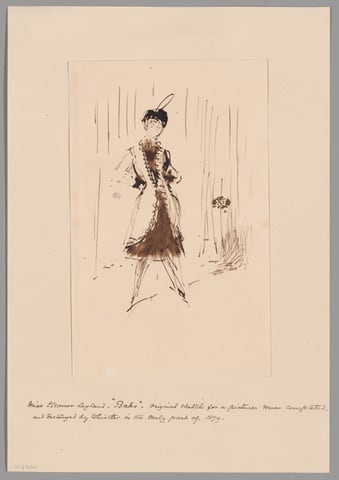
  3. A work made of pen and brown ink, with brush and brown ink, on cream pseudo-laid paper tipped onto cream wove paper.
    Study for "The Blue Girl: Portrait of Miss Elinor Leyland"James McNeill Whistler, c. 1879Courtesy of the Art Institute of Chicago
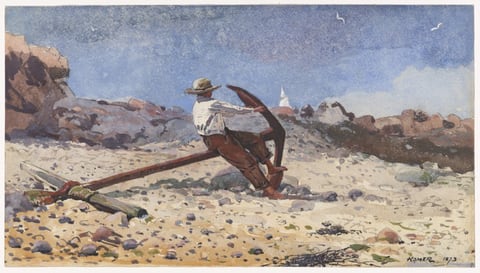
  4. Boy with Anchor, by Winslow Homer, 1873
    Boy with AnchorWinslow Homer, 1873Courtesy of the Cleveland Museum of Art

Section 2, north wall
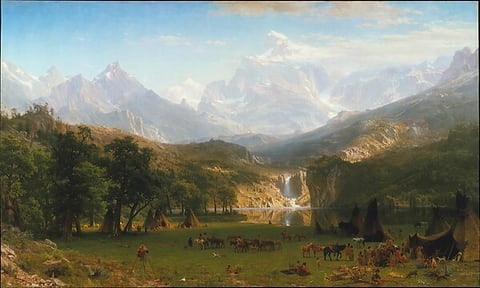
  1. The Rocky Mountains, Lander's Peak, by Albert Bierstadt, 1863
    The Rocky Mountains, Lander's PeakAlbert Bierstadt, 1863Courtesy of The Metropolitan Museum of Art
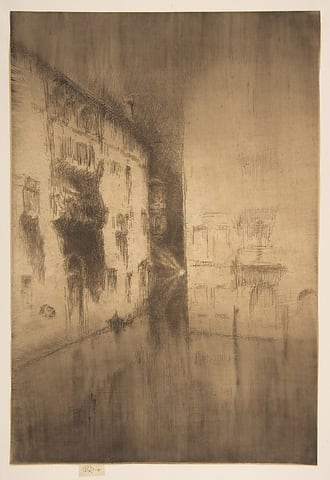
  2. Nocturne: Palaces, by James McNeill Whistler, 1879–80
    Nocturne: PalacesJames McNeill Whistler, 1879–80Courtesy of The Metropolitan Museum of Art
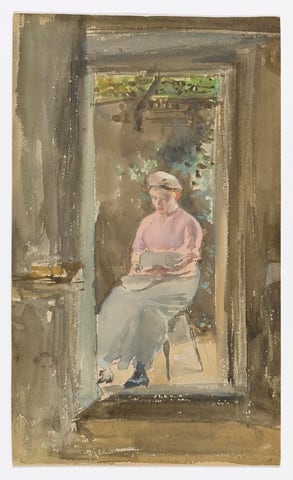
  3. Watercolor
    Pink Note–Shelling PeasJames McNeill Whistler, 1882-1884Courtesy of the National Museum of Asian Art, Smithsonian Institution

Section 3, north wall
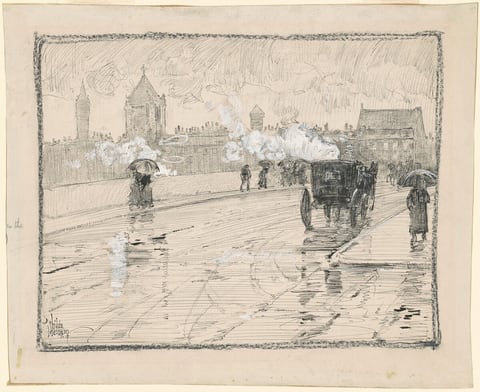
  1. The image shows a street scene from an elevated viewpoint. A horse-drawn carriage is seen moving on a wet road, reflecting light. Pedestrians with umbrellas populate the avenue. The road is visibly marked with rainwater. The skyline displays detailed architectural features like church spires and towers. The painting is done in fine, linear brushstrokes highlighting movement and atmosphere. The grayscale palette emphasizes the rainy urban setting. Wisps of steam or smoke are visible. The intricate line work and shading depict a textured, busy street under an overcast sky.
    Rainy Day, BostonChilde Hassam, 1886Courtesy National Gallery of Art, Washington
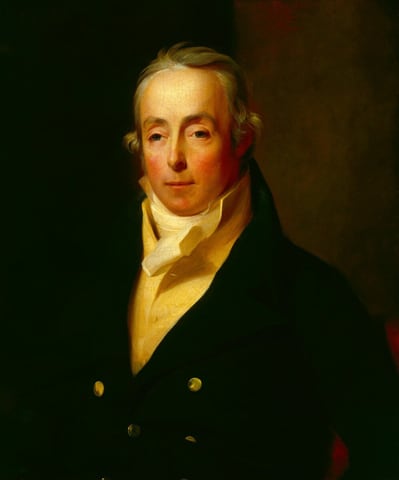
  2. This painting is a portrait of a man from the waist up. He is facing us, with pale skin, thin lips, rosy cheeks, light green eyes, and gray hair styled into curls around his ears. He has a neutral expression. The man is wearing a dark coat with gold buttons on the front, with a pale-yellow shirt underneath and a white cravat around his neck. The background is a dark and indistinct brown color.
    Abraham KintzingThomas Sully, 1815Courtesy National Gallery of Art, Washington
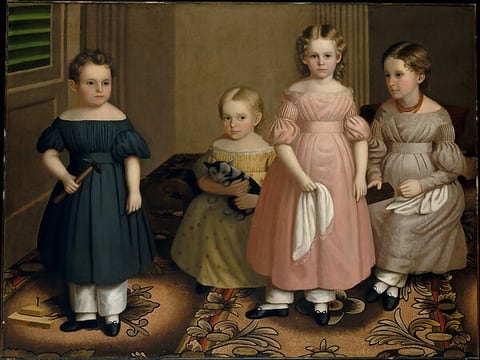
  3. The Alling Children, by Oliver Tarbell Eddy, ca. 1839
    The Alling ChildrenOliver Tarbell Eddy, ca. 1839Courtesy of The Metropolitan Museum of Art

Section 3, south wall
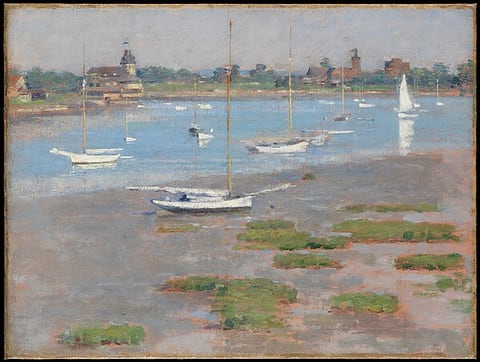
  1. Low Tide, Riverside Yacht Club, by Theodore Robinson, 1894
    Low Tide, Riverside Yacht ClubTheodore Robinson, 1894Courtesy of The Metropolitan Museum of Art
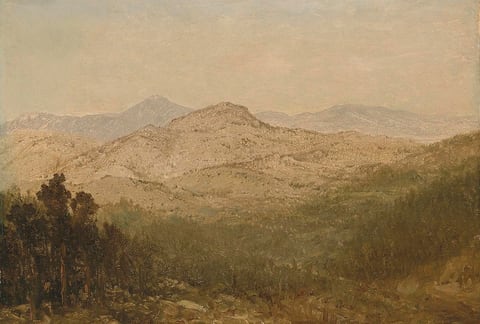
  2. Mountains in Colorado, by John Frederick Kensett, 1870
    Mountains in ColoradoJohn Frederick Kensett, 1870Courtesy of the Smithsonian American Art Museum