Floor plan

Time and place19th-century United States
19th-century United States
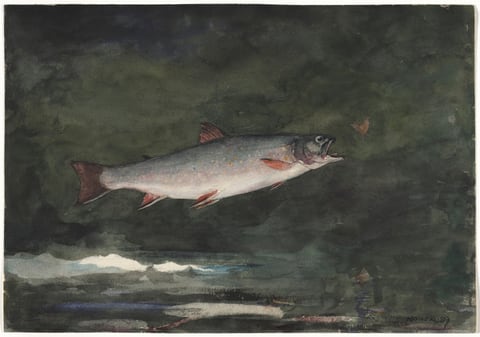
Leaping Trout, by Winslow Homer, 1889
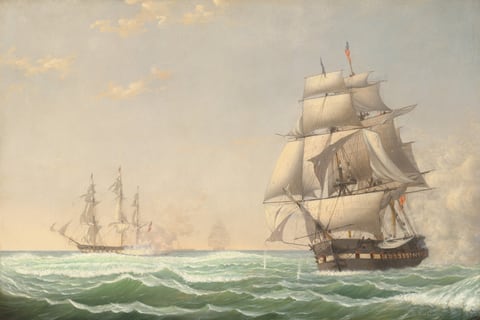
This painting shows a maritime landscape with an expansive view of the ocean and sky. The horizon is positioned in the lower third of the composition, meeting a clear sky with soft, diffused clouds. Two ships appear to be engaged in a conflict on the green, wave-filled water. One large sailing ship with fully extended sails is near the bottom right corner of the painting. It has two tall masts and multiple white sails, and it flies the flag of the U.S.A in several places. The body of this ship is gray with a wide white stripe, and cannons stick out of small holes across the ship. Small people climb on ropes up into the sails, which are covered in small white and gray dots, perhaps indicating holes. Another ship is visible in the distance on the left side of the painting, and its cannons appear to be firing, with bursts of yellow flame and smoke drifting across the water. This ship flies several flags in shades of red, blue, and white. In the background, the faint gray silhouettes of other ships can be seen across the water. The ocean is depicted with smooth brushstrokes in shades of green and white, and the wide sky is a gradient, with light blue at the top and pale yellow towards the horizon. Faint white clouds drift in the top left corner of the painting.
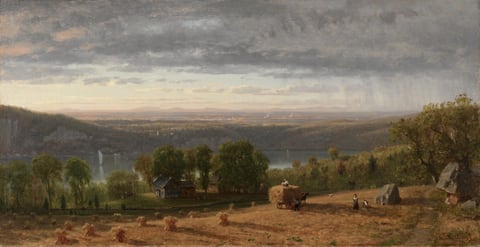
Landscape with Haywain, by Worthington Whittredge, 1861
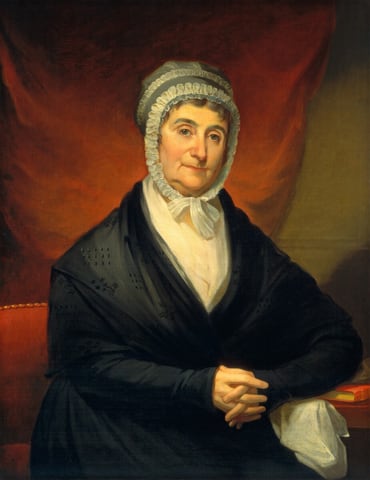
The image shows the upper half of a seated woman facing forward. She has her hands clasped together in front of her. The woman appears calm with visible signs of age, including a few wrinkles on her face. She wears a white bonnet with a frilled edge tied under her chin, a dark shawl over a white high-collared blouse, and sits on a red chair with a gold trim. A red book and a handkerchief are on the surface next to her. The background transitions from deep red to brown tones.
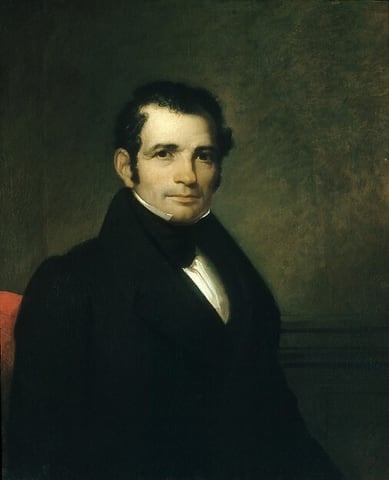
Luman Reed, by Asher Brown Durand, 1835
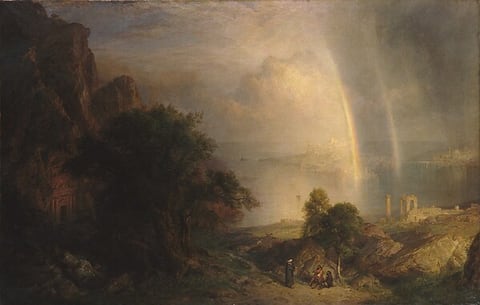
The Aegean Sea, by Frederic Edwin Church, ca. 1877

The works in this room are listed below.

Works in this room

Works made in the United States in the 19th century.

Section 1, north wall

  1. Leaping Trout, by Winslow Homer, 1889
    Leaping TroutWinslow Homer, 1889Courtesy of the Cleveland Museum of Art
  2. This painting shows a maritime landscape with an expansive view of the ocean and sky. The horizon is positioned in the lower third of the composition, meeting a clear sky with soft, diffused clouds. Two ships appear to be engaged in a conflict on the green, wave-filled water. One large sailing ship with fully extended sails is near the bottom right corner of the painting. It has two tall masts and multiple white sails, and it flies the flag of the U.S.A in several places. The body of this ship is gray with a wide white stripe, and cannons stick out of small holes across the ship. Small people climb on ropes up into the sails, which are covered in small white and gray dots, perhaps indicating holes. Another ship is visible in the distance on the left side of the painting, and its cannons appear to be firing, with bursts of yellow flame and smoke drifting across the water. This ship flies several flags in shades of red, blue, and white. In the background, the faint gray silhouettes of other ships can be seen across the water. The ocean is depicted with smooth brushstrokes in shades of green and white, and the wide sky is a gradient, with light blue at the top and pale yellow towards the horizon. Faint white clouds drift in the top left corner of the painting.
    The United States Frigate "President" Engaging the British Squadron, 1815Fitz Henry Lane, 1850Courtesy National Gallery of Art, Washington
  3. Landscape with Haywain, by Worthington Whittredge, 1861
    Landscape with HaywainWorthington Whittredge, 1861Courtesy of the Cleveland Museum of Art

Section 1, south wall

  1. The image shows the upper half of a seated woman facing forward. She has her hands clasped together in front of her. The woman appears calm with visible signs of age, including a few wrinkles on her face. She wears a white bonnet with a frilled edge tied under her chin, a dark shawl over a white high-collared blouse, and sits on a red chair with a gold trim. A red book and a handkerchief are on the surface next to her. The background transitions from deep red to brown tones.
    Ann Old Coleman (Mrs. Robert Coleman)Jacob Eichholtz, c. 1820Courtesy National Gallery of Art, Washington
  2. Luman Reed, by Asher Brown Durand, 1835
    Luman ReedAsher Brown Durand, 1835Courtesy of The Metropolitan Museum of Art
  3. The Aegean Sea, by Frederic Edwin Church, ca. 1877
    The Aegean SeaFrederic Edwin Church, ca. 1877Courtesy of The Metropolitan Museum of Art

Section 2, south wall
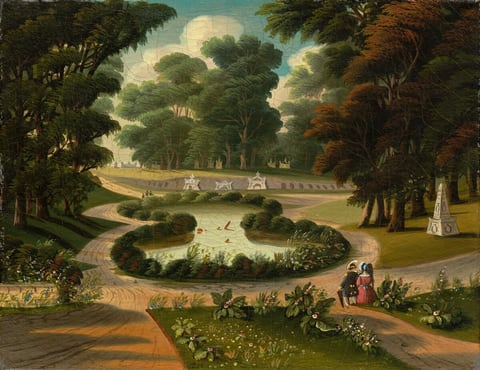
  1. This painting shows a park-like landscape with trees, flowers, bushes, and a pond, all surrounded by light brown paths. The pond is in the center of the park, with light green-blue water framed by bushes, ferns, and tall flowers. Across from the pond are three large, white structures that could be mausoleums. Behind them is a hill with trees and more white graves or mausoleums on top of it. On either side of the pond, past the paths that encircle it, are tall trees with leaves in shades of dark green and brown. On the right side is a tall white structure that could be a grave or a monument. At the bottom of the painting, the paths curve up over a small hill in front of the pond. In between the paths are sections of grass dotted with small pink and white flowers. On the right side of the painting, a couple walks down the hill towards the pond. The person on the left wears a long blue coat decorated with gold buttons and a large, plumed hat, while the person on the right wears a pink gown and blue bonnet. Above the scene, the sky is blue, with puffy white clouds.
    Mount Auburn CemeteryThomas Chambers, mid 19th centuryCourtesy National Gallery of Art, Washington
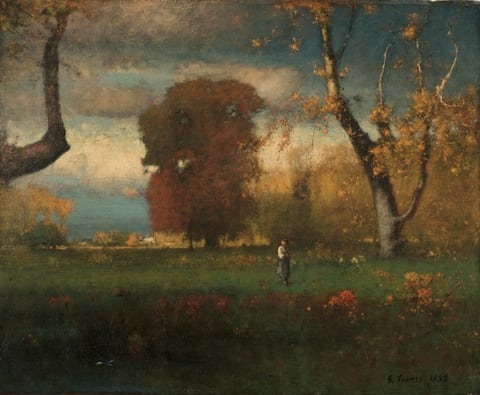
  2. Landscape, by George Inness, 1888
    LandscapeGeorge Inness, 1888Courtesy of the Cleveland Museum of Art
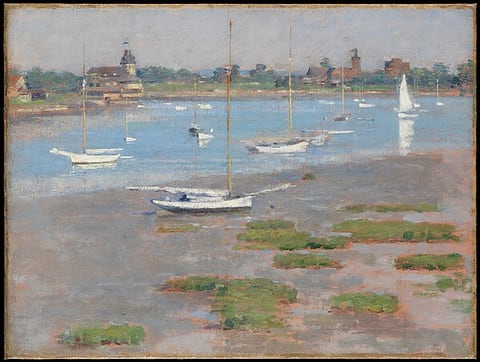
  3. Low Tide, Riverside Yacht Club, by Theodore Robinson, 1894
    Low Tide, Riverside Yacht ClubTheodore Robinson, 1894Courtesy of The Metropolitan Museum of Art
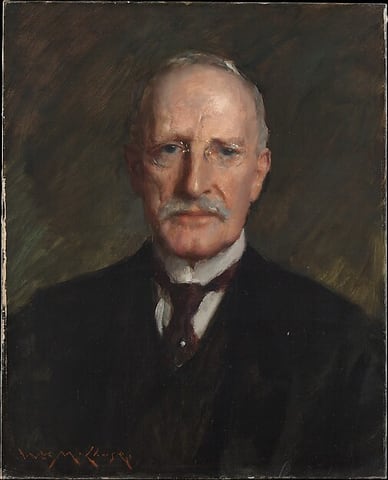
  4. Edward Guthrie Kennedy, by William Merritt Chase, ca. 1895
    Edward Guthrie KennedyWilliam Merritt Chase, ca. 1895Courtesy of The Metropolitan Museum of Art

Section 2, north wall
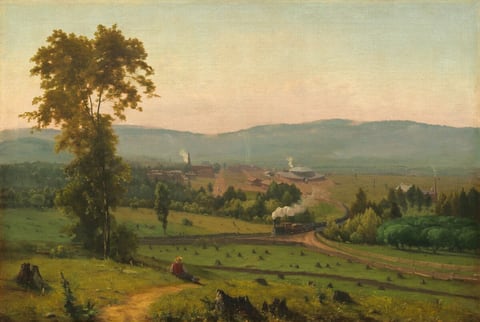
  1. We look across and down into a valley with a person sitting near a tall tree and a train puffing smoke beyond, all enclosed by a band of mountains in the distance in this horizontal landscape painting. Closest to us, several broken, jagged tree stumps are spaced across the painting’s width. A little distance away and to our left, the person wears a yellow, broad-brimmed hat, red vest, and gray pants. He reclines propped on his left elbow near a walking path beside a tall, slender tree with golden leaves. The green meadow stretching in front of him is dotted with tree stumps cut close to the ground. Beyond the meadow, puffs of white smoke trail behind a long steam locomotive that crosses a bridge spanning a tree-filled ravine, headed to our left. The ravine creates a diagonal line across the canvas, moving subtly away from us to our left. The train has climbed out of the valley, away from a cluster of brick-red buildings. The most prominent structure is a train roundhouse, a large building with a high, domed roof to the right of the tracks. Smoke rises from chimneys on long, warehouse-like buildings, and a steeple and smaller structures suggest a church and homes to our left. Hazy in the distance, a row of mountains lines the horizon, which comes about halfway up the composition. The sky above deepens from pale, shell pink over the mountains to watery, pale blue above. The artist signed the work in tiny letters in the lower left corner: “G. Inness.”
    The Lackawanna ValleyGeorge Inness, c. 1856Courtesy National Gallery of Art, Washington
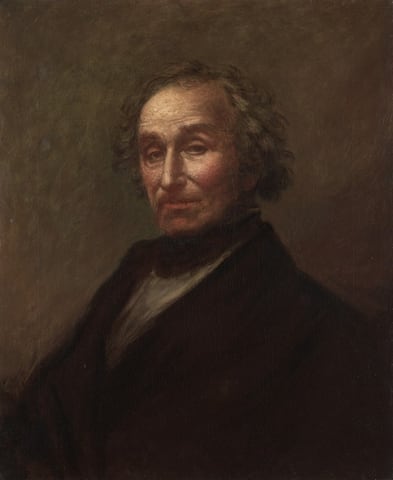
  2. Alvan Clark, 1870s
    Alvan ClarkUnrecorded American maker, 1870sCourtesy of the Cleveland Museum of Art
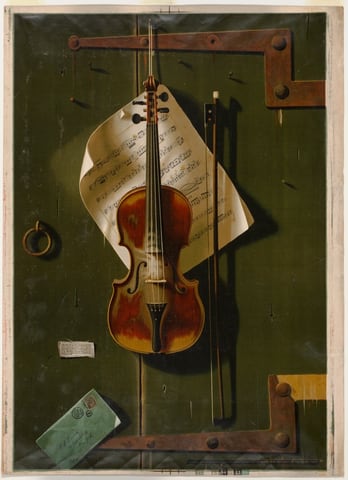
  3. A work made of color lithograph on paper.
    The Old ViolinWilliam Michael Harnett, 1887Courtesy of the Art Institute of Chicago
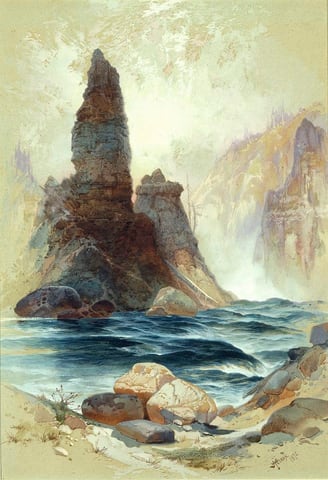
  4. Above Tower Falls, Yellowstone, by Thomas Moran, 1872
    Above Tower Falls, YellowstoneThomas Moran, 1872Courtesy of the Smithsonian American Art Museum

Section 3, north wall
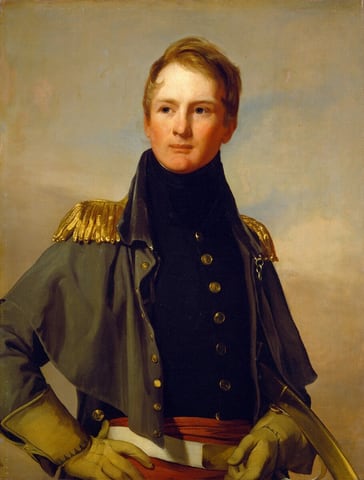
  1. Major Thomas Biddle, by Thomas Wilcocks Sully, 1832
    Major Thomas BiddleThomas Wilcocks Sully, 1832Courtesy National Gallery of Art, Washington
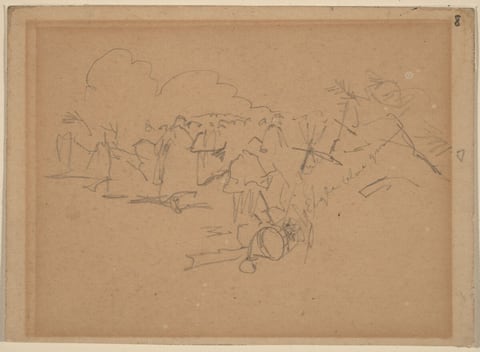
  2. The image displays curved and angular lines creating an abstract composition hinting at humanoid shapes and possible vegetation or trees. The lines suggest motion and activity, with shapes resembling drums and sticks scattered around. The overall impression is of a gathering or event, with figures depicted standing or moving, along with lines indicating movement or sound waves from musical instruments.
    End of the March [recto]Winslow Homer, 1862Courtesy National Gallery of Art, Washington