Floor plan

Time and place19th-century France

19th-century France

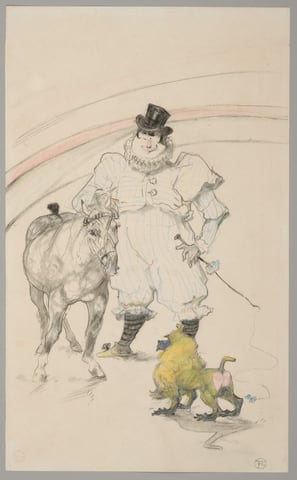
A work made of pastel and graphite on cream wove paper.
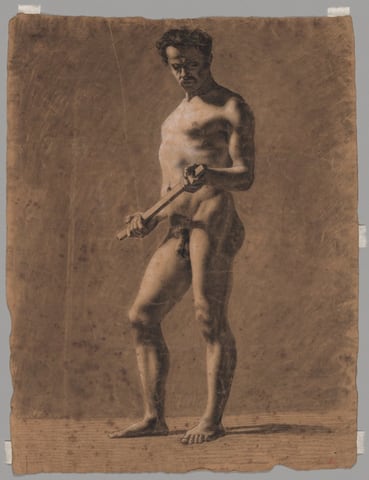
A work made of black chalk and charcoal with stumping, heightened with white chalk (recto), and black chalk and charcoal with stumping (verso), on dark tan laid paper.
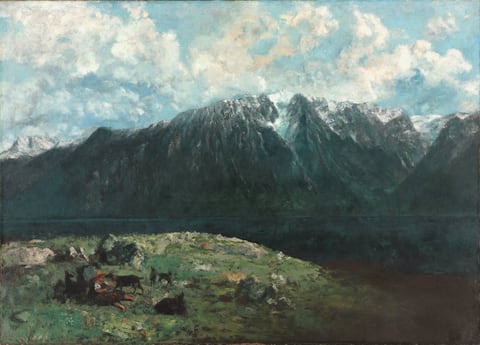
Panoramic View of the Alps, Les Dents du Midi, by Gustave Courbet, 1877
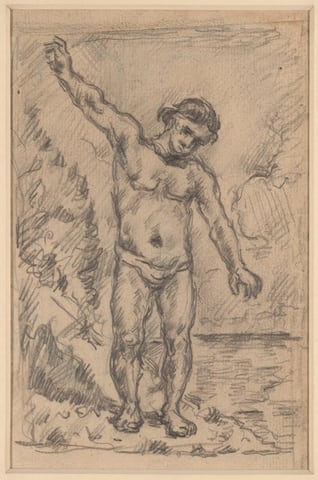
A work made of graphite on cream laid paper (pieced).
A work made of oil on canvas.
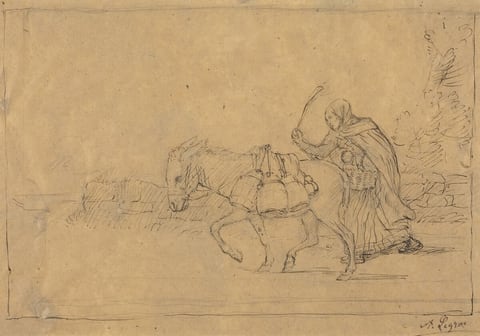
This is a drawing of a person leading a donkey laden with goods. The image depicts a scene with a donkey walking to the left side while being guided by an individual dressed in layered clothing. The donkey is burdened with sacks or baskets that are strapped to its back. The lines and shading are subtle and detailed, capturing the texture of the clothing and fur. The figure and the donkey are positioned on a lightly sketched landscape with a few hints of foliage to the right, suggesting a rural setting. The drawing's simplicity and detail suggest a narrative moment, with a sense of movement and purpose conveyed through the lines.
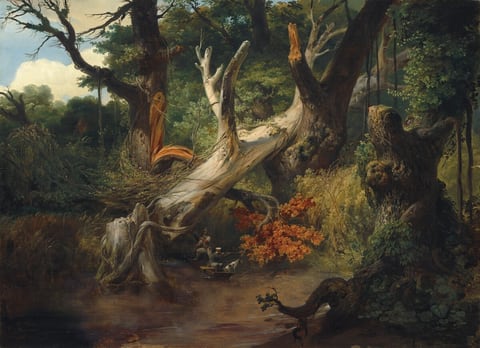
A leafless, ash-white tree trunk has fallen from a broken stump into the wide V of a neighboring tree at the edge of a body of water near a verdant forest in this horizontal landscape painting. The fallen trunk creates a diagonal from near the lower left corner to the upper right. As it fell, it sheared off a substantial branch from a neighboring tree with a dark trunk. The bark where the damaged branch has pulled away is honey-orange, the same color as the leaves at the canopy, which has been pinned under the fallen trunk. Trees, vines, and other vegetation fill the space around and beyond this pair. In the lower right corner of the painting, vines grow over a broken stump, which deep in shadow. Between the stump and fallen tree, the peanut-brown surface of the water is smooth. Tiny in scale beneath the fallen tree and easily overlooked, there are two men and a dog in a boat. One man stands at the back of the boat and pushes it along with a long pole. He wears a tall, brown, cloth hat, a white shirt rolled up to the elbows under a blue vest, and loose-fitting pants. A second man wears a flat-topped, white hat with a black brim, a long, forest-green jacket, and tight-fitting slate-blue pants. He braces a rifle against one shoulder and shoots into the forest. The dog is white with brown spots, and it stands with its front paws on the edge of the boat, presumably ready to spring after the target. A patch of blue sky with puffy white clouds is seen above the trees in the upper left corner. The artist signed and dated the work in the lower right corner: “H. Vernet Rome 1833.”

The works in this room are listed below.

Works in this room

Works made in France in the 19th century.

First room, north wall

  1. A work made of pastel and graphite on cream wove paper.
    At the Circus: Trained Pony and BaboonHenri de Toulouse-Lautrec, 1899Courtesy of the Art Institute of Chicago
  2. A work made of black chalk and charcoal with stumping, heightened with white chalk (recto), and black chalk and charcoal with stumping (verso), on dark tan laid paper.
    Standing Academic Male Nude (recto); Sketch of Upper Arm (verso)Eugène Delacroix, 1816Courtesy of the Art Institute of Chicago
  3. Panoramic View of the Alps, Les Dents du Midi, by Gustave Courbet, 1877
    Panoramic View of the Alps, Les Dents du MidiGustave Courbet, 1877Courtesy of the Cleveland Museum of Art

First room, south wall

  1. A work made of graphite on cream laid paper (pieced).
    Bather With Outstretched Arms (recto); Study of a Tree (verso)Paul Cézanne, 1874/77Courtesy of the Art Institute of Chicago
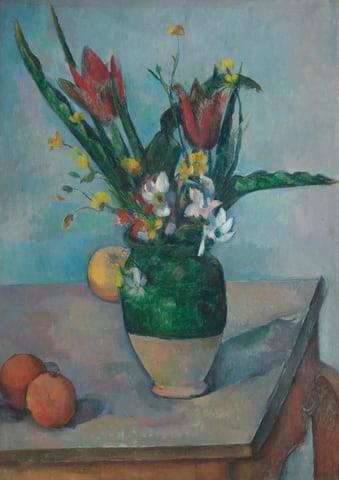
  2. A work made of oil on canvas.
    The Vase of TulipsPaul Cézanne, c. 1890Courtesy of the Art Institute of Chicago
  3. This is a drawing of a person leading a donkey laden with goods. The image depicts a scene with a donkey walking to the left side while being guided by an individual dressed in layered clothing. The donkey is burdened with sacks or baskets that are strapped to its back. The lines and shading are subtle and detailed, capturing the texture of the clothing and fur. The figure and the donkey are positioned on a lightly sketched landscape with a few hints of foliage to the right, suggesting a rural setting. The drawing's simplicity and detail suggest a narrative moment, with a sense of movement and purpose conveyed through the lines.
    The Milkmaid of BoulogneAlphonse LegrosCourtesy National Gallery of Art, Washington
  4. A leafless, ash-white tree trunk has fallen from a broken stump into the wide V of a neighboring tree at the edge of a body of water near a verdant forest in this horizontal landscape painting. The fallen trunk creates a diagonal from near the lower left corner to the upper right. As it fell, it sheared off a substantial branch from a neighboring tree with a dark trunk. The bark where the damaged branch has pulled away is honey-orange, the same color as the leaves at the canopy, which has been pinned under the fallen trunk. Trees, vines, and other vegetation fill the space around and beyond this pair. In the lower right corner of the painting, vines grow over a broken stump, which deep in shadow. Between the stump and fallen tree, the peanut-brown surface of the water is smooth. Tiny in scale beneath the fallen tree and easily overlooked, there are two men and a dog in a boat. One man stands at the back of the boat and pushes it along with a long pole. He wears a tall, brown, cloth hat, a white shirt rolled up to the elbows under a blue vest, and loose-fitting pants. A second man wears a flat-topped, white hat with a black brim, a long, forest-green jacket, and tight-fitting slate-blue pants. He braces a rifle against one shoulder and shoots into the forest. The dog is white with brown spots, and it stands with its front paws on the edge of the boat, presumably ready to spring after the target. A patch of blue sky with puffy white clouds is seen above the trees in the upper left corner. The artist signed and dated the work in the lower right corner: “H. Vernet Rome 1833.”
    Hunting in the Pontine MarshesHorace Vernet, 1833Courtesy National Gallery of Art, Washington

Second room, south wall
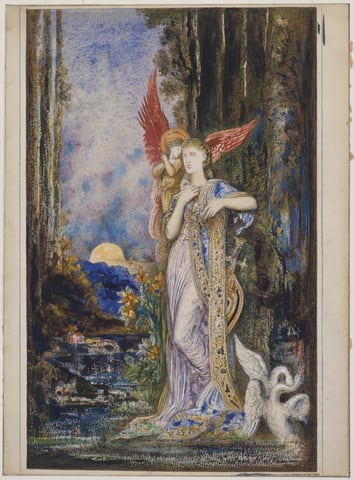
  1. A work made of watercolor and gouache, with pen and blue ink, over traces of graphite, on ivory wove paper, wrapped and adhered on verso to wood pulp board.
    InspirationGustave Moreau, c. 1893Courtesy of the Art Institute of Chicago
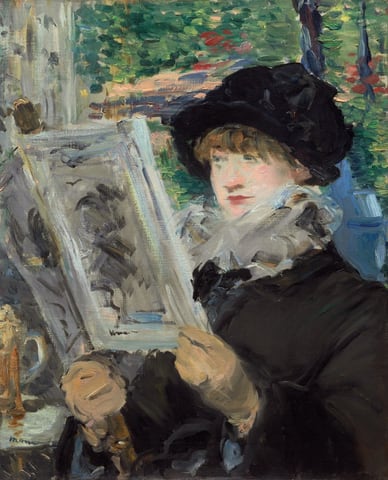
  2. A young woman in a dark hat and coat with light ruffled collar sits reading a large periodical held up in her gloved hands. Flowers and foliage are suggested behind her.
    Woman ReadingÉdouard Manet, 1880–82Courtesy of the Art Institute of Chicago
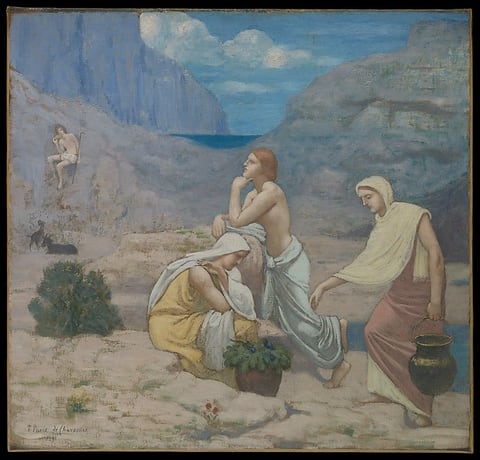
  3. The Shepherd's Song, by Pierre Puvis de Chavannes, 1891
    The Shepherd's SongPierre Puvis de Chavannes, 1891Courtesy of The Metropolitan Museum of Art

Second room, north wall
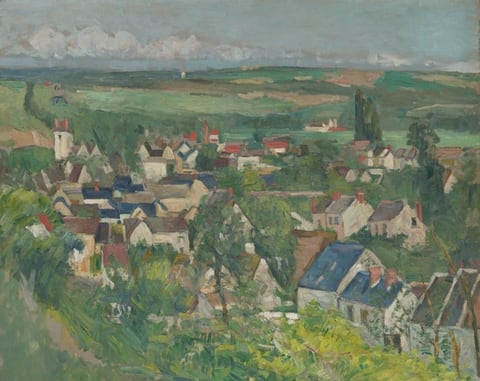
  1. View of a village surrounded by hills, fields, and trees, shown from a vantage point above the scene. Subtly rolling hills recede into a bluish gray-ish sky punctuated by white clouds. Thick brushstrokes built up atop each other are visible throughout.
    Auvers, Panoramic ViewPaul Cézanne, 1873–75Courtesy of the Art Institute of Chicago
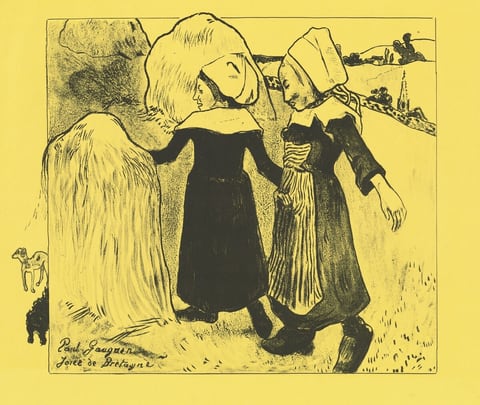
  2. The image shows two women walking arm in arm, both in traditional attire. One woman is facing away with a slight profile, while the other is seen from the side. Their faces are stylized and simplistic with covered hair. They wear long dresses with aprons and collars, and one has a striped apron. Haystacks and greenery surround them. Faint figures are in the background, as well as a spire-like structure. A dog is seen near the haystack, with simple lines suggesting a landscape.
    Pleasures of Brittany (Joies de Bretagne)Paul Gauguin, 1889Courtesy National Gallery of Art, Washington
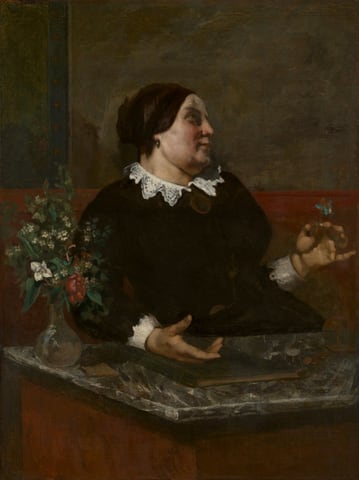
  3. Dark portrait of older woman in black dress with lace collar, flowers.
    Mère GrégoireGustave Courbet, 1855, reworked 1857–59Courtesy of the Art Institute of Chicago

Third room, north wall
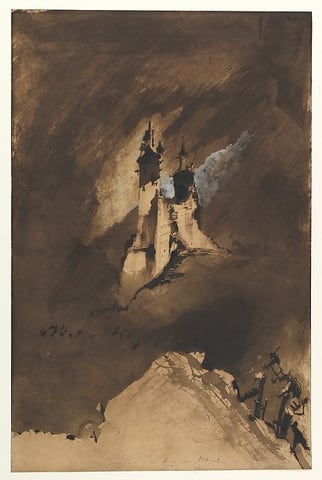
  1. Souvenir of a Castle in Vosges, by Victor Hugo, 1857
    Souvenir of a Castle in VosgesVictor Hugo, 1857Courtesy of The Metropolitan Museum of Art
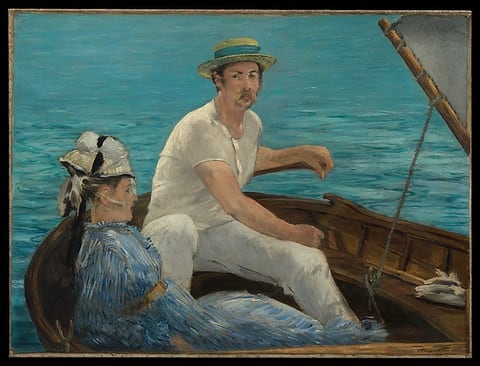
  2. Boating, by Édouard Manet, 1874
    BoatingÉdouard Manet, 1874Courtesy of The Metropolitan Museum of Art
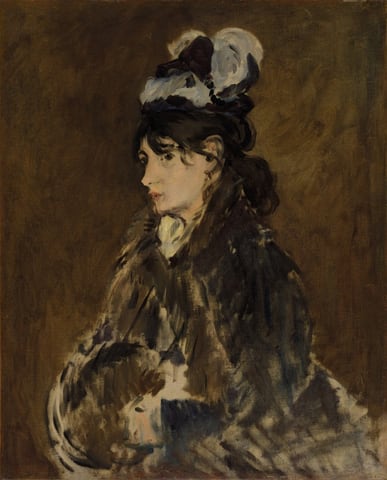
  3. Berthe Morisot with a Muff, by Édouard Manet, c. 1871–72
    Berthe Morisot with a MuffÉdouard Manet, c. 1871–72Courtesy of the Cleveland Museum of Art