Floor plan

Time and place19th-century France

19th-century France

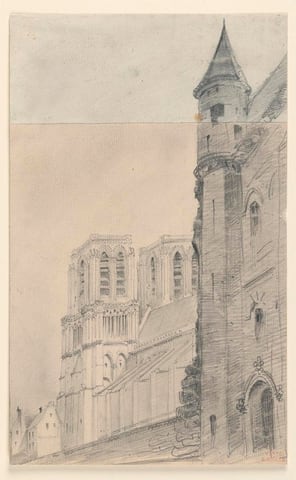
CATHEDRAL OF NOTRE DAME IN PARIS
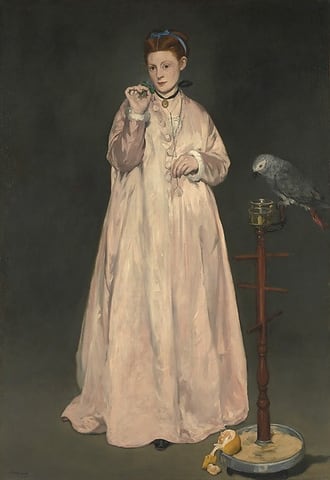
Young Lady in 1866, by Édouard Manet, 1866
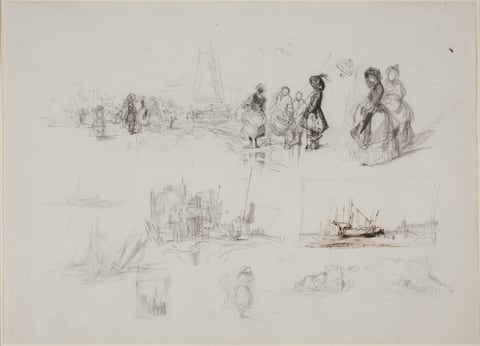
This image is a pencil sketch on paper with a monochrome palette of graphite gray. The viewer sees various scenes without a defined horizon line. The upper section shows figures in period clothing, possibly mid-19th century women's fashion. The middle area has abstract architectural forms. In the lower right corner, a sailing ship or boat is sketched with more detail than the rest. The drawing style consists of quick, expressive strokes. The image conveys multiple narrative or compositional ideas on a single sheet.
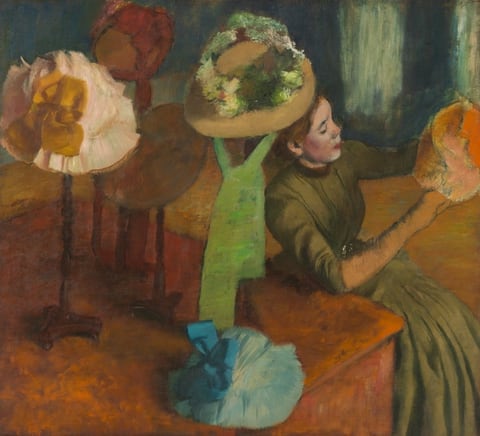
Impressionist painting of woman wearing green dress trying on hats.
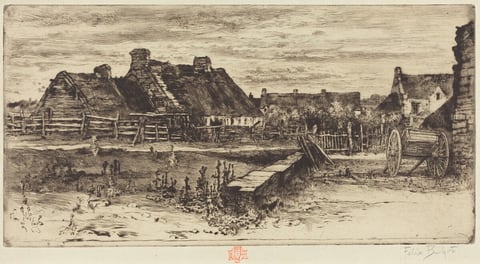
The image depicts a rustic village scene featuring thatched-roof cottages, wooden fences, and a low horizon with rooftops and chimneys. The etching showcases detailed brushstrokes capturing various textures, with a monochromatic sepia color palette. A stone or wooden wall leads into the scene, alongside grassy vegetation. The cottages create a sense of enclosure, with trees and other structures in the background. A cart is placed near the wall.
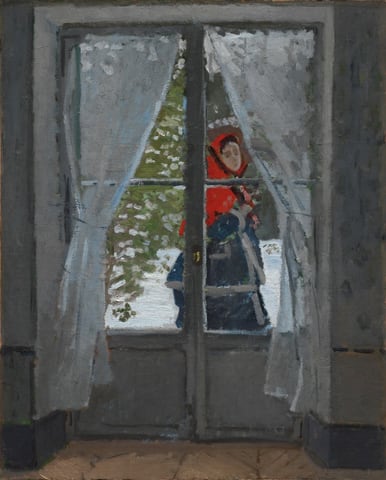
The Red Kerchief, by Claude Monet, c. 1868–73

The works in this room are listed below.

Works in this room

Works made in France in the 19th century.

First room, north wall

  1. CATHEDRAL OF NOTRE DAME IN PARIS
    Cathedral of Notre Dame in ParisCharles Nicolas Ransonnette, 1825–1840Courtesy of Cooper Hewitt, Smithsonian Design Museum
  2. Young Lady in 1866, by Édouard Manet, 1866
    Young Lady in 1866Édouard Manet, 1866Courtesy of The Metropolitan Museum of Art
  3. This image is a pencil sketch on paper with a monochrome palette of graphite gray. The viewer sees various scenes without a defined horizon line. The upper section shows figures in period clothing, possibly mid-19th century women's fashion. The middle area has abstract architectural forms. In the lower right corner, a sailing ship or boat is sketched with more detail than the rest. The drawing style consists of quick, expressive strokes. The image conveys multiple narrative or compositional ideas on a single sheet.
    Seaside StudiesEugène Isabey, 1830sCourtesy National Gallery of Art, Washington

First room, south wall

  1. Impressionist painting of woman wearing green dress trying on hats.
    The Millinery ShopEdgar Degas, 1879-86Courtesy of the Art Institute of Chicago
  2. The image depicts a rustic village scene featuring thatched-roof cottages, wooden fences, and a low horizon with rooftops and chimneys. The etching showcases detailed brushstrokes capturing various textures, with a monochromatic sepia color palette. A stone or wooden wall leads into the scene, alongside grassy vegetation. The cottages create a sense of enclosure, with trees and other structures in the background. A cart is placed near the wall.
    Les Grandes ChaumièresFélix-Hilaire Buhot, 1881Courtesy National Gallery of Art, Washington
  3. The Red Kerchief, by Claude Monet, c. 1868–73
    The Red KerchiefClaude Monet, c. 1868–73Courtesy of the Cleveland Museum of Art

Second room, south wall
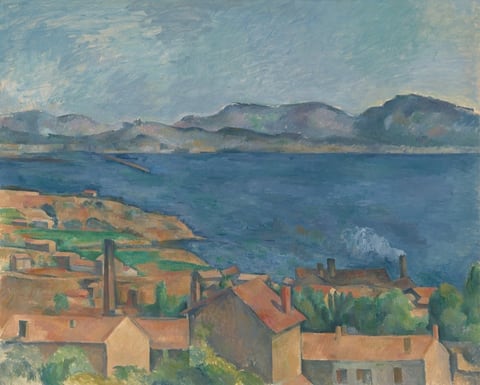
  1. Impressionist sea landscape, tan houses, blue ocean, distant mountains.
    The Bay of Marseille, Seen from L'EstaquePaul Cézanne, c. 1885Courtesy of the Art Institute of Chicago
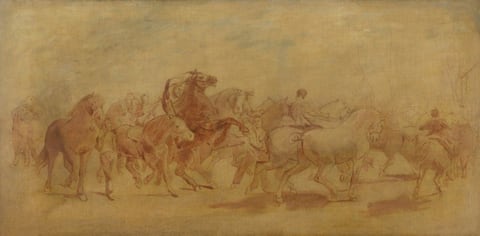
  2. A sketchy black-and-white oil painting of a dozen horses walking in a circle, some with riders. All of the figures are shadowy.
    Study for The Horse FairRosa Bonheur, c. 1850Courtesy of the Art Institute of Chicago
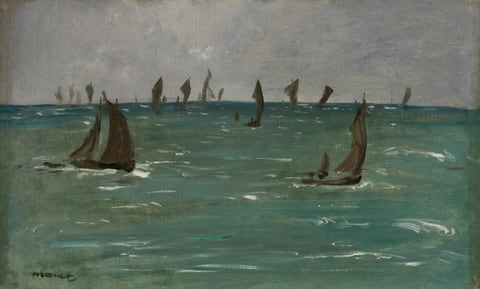
  3. Boats at Berck-sur-Mer, by Édouard Manet, 1873
    Boats at Berck-sur-MerÉdouard Manet, 1873Courtesy of the Cleveland Museum of Art

Second room, north wall
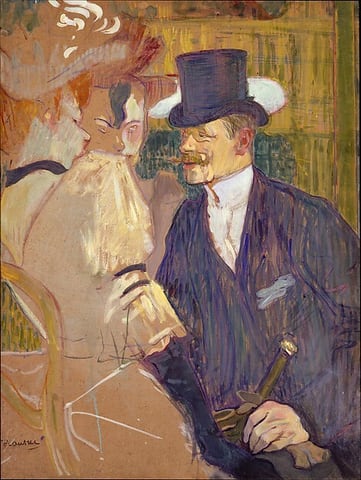
  1. The Englishman (William Tom Warrener, 1861–1934) at the Moulin Rouge, by Henri de Toulouse-Lautrec, 1892
    The Englishman (William Tom Warrener, 1861–1934) at the Moulin RougeHenri de Toulouse-Lautrec, 1892Courtesy of The Metropolitan Museum of Art
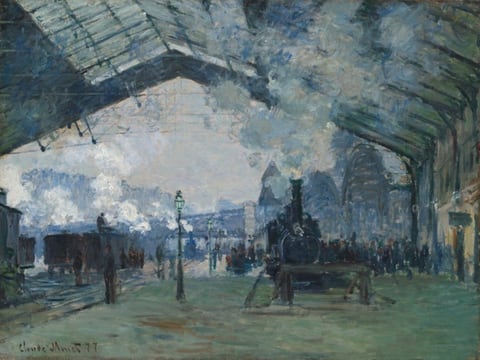
  2. Loosely painted image of an open-air train station. On the right, a parked train gives off an enormous plumb of white smoke, making the scene look as though it were full of clouds. A huddled mass of barely discernible people crowd around the train on both sides of the tracks. Blue, green, and gray tones dominate.
    Arrival of the Normandy Train, Gare Saint-LazareClaude Monet, 1877Courtesy of the Art Institute of Chicago
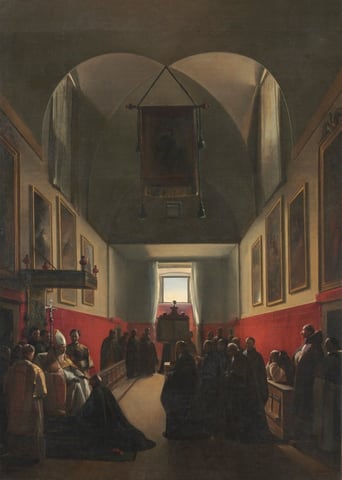
  3. Homage to a Bishop, by François Marius Granet, 1839
    Homage to a BishopFrançois Marius Granet, 1839Courtesy of the Cleveland Museum of Art

Third room, north wall
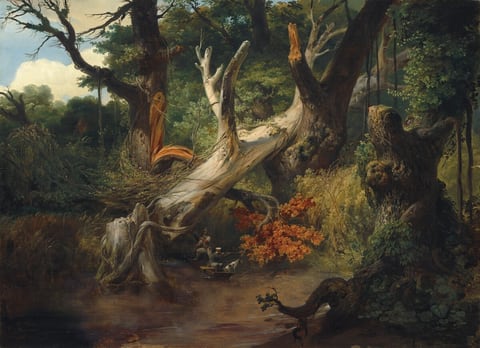
  1. A leafless, ash-white tree trunk has fallen from a broken stump into the wide V of a neighboring tree at the edge of a body of water near a verdant forest in this horizontal landscape painting. The fallen trunk creates a diagonal from near the lower left corner to the upper right. As it fell, it sheared off a substantial branch from a neighboring tree with a dark trunk. The bark where the damaged branch has pulled away is honey-orange, the same color as the leaves at the canopy, which has been pinned under the fallen trunk. Trees, vines, and other vegetation fill the space around and beyond this pair. In the lower right corner of the painting, vines grow over a broken stump, which deep in shadow. Between the stump and fallen tree, the peanut-brown surface of the water is smooth. Tiny in scale beneath the fallen tree and easily overlooked, there are two men and a dog in a boat. One man stands at the back of the boat and pushes it along with a long pole. He wears a tall, brown, cloth hat, a white shirt rolled up to the elbows under a blue vest, and loose-fitting pants. A second man wears a flat-topped, white hat with a black brim, a long, forest-green jacket, and tight-fitting slate-blue pants. He braces a rifle against one shoulder and shoots into the forest. The dog is white with brown spots, and it stands with its front paws on the edge of the boat, presumably ready to spring after the target. A patch of blue sky with puffy white clouds is seen above the trees in the upper left corner. The artist signed and dated the work in the lower right corner: “H. Vernet Rome 1833.”
    Hunting in the Pontine MarshesHorace Vernet, 1833Courtesy National Gallery of Art, Washington
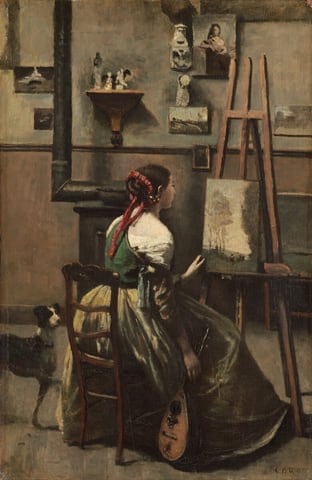
  2. A young, pale-skinned woman sits with her back to us as she looks at a painting on an easel in a studio in this vertical painting. She sits in a ladder-back wood chair so her knees angle away from us, toward the back right corner of the studio. We look onto the side of her right cheek as she leans forward. Her brown hair is combed back and twisted into a bun wrapped with a raspberry-red ribbon that trails down her back. Touches of pearl white, pale pink, and silvery gray suggest flowers by the ear we can see. A cream-white chemise falls off the shoulder closer to us, under a grass-green bodice. She holds a mandolin down by her right side, which is closer to us, to nestle in the folds of her voluminous, olive-green skirt. She reaches forward with her other hand to touch the lower left corner of the painting resting on the easel. That vertically-oriented scene is loosely painted and shows a few people gathered in a landscape. A white and black dog stands with one front leg lifted to the left of the woman's chair, looking at her. The wall opposite us is parchment white over a strip of molding, like a high chair rail, and muted mauve pink below. An L-shaped pipe leads to an iron stove to our left of center. A narrow shelf tucked into the L of the pipe holds three hand-sized sculptures or casts. Small paintings and plaster casts hang around it on the wall above the molding. The artist signed the painting in the lower right: “COROT.”
    Corot's Studio: Woman Seated Before an Easel, a Mandolin in her HandJean Baptiste Camille Corot, c. 1868Courtesy National Gallery of Art, Washington

Third room, south wall
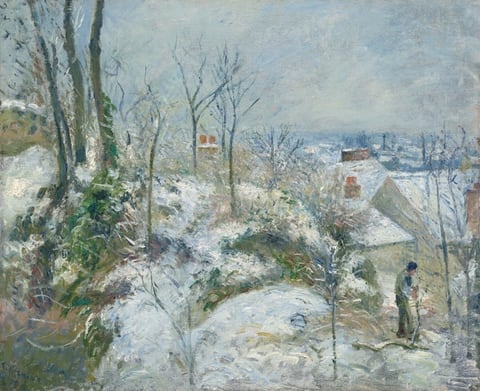
  1. A work made of oil on canvas.
    Rabbit Warren at Pontoise, SnowCamille Pissarro, 1879Courtesy of the Art Institute of Chicago
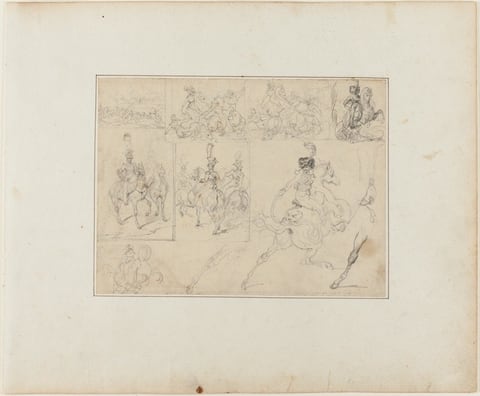
  2. A work made of graphite, on tan wove paper, perimeter mounted on ivory laid paper.
    Sheet of Sketches: Cavalry Battles and Mounted SoldiersJean Louis André Théodore Géricault, 1813/14Courtesy of the Art Institute of Chicago