Floor plan

Time and place19th-century Britain
19th-century Britain
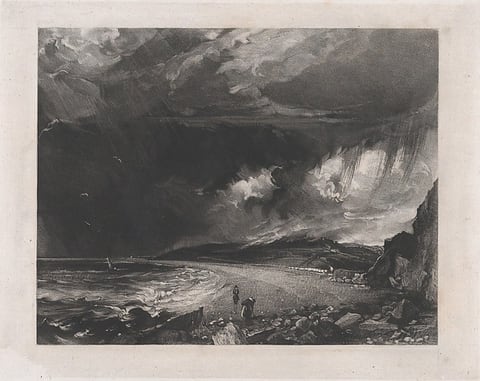
Weymouth Bay, by David Lucas, 1830
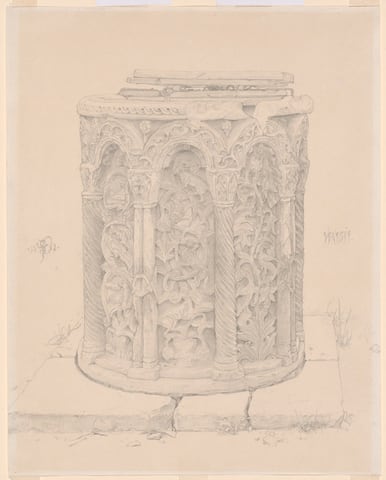
A work made of graphite on ivory wove paper.
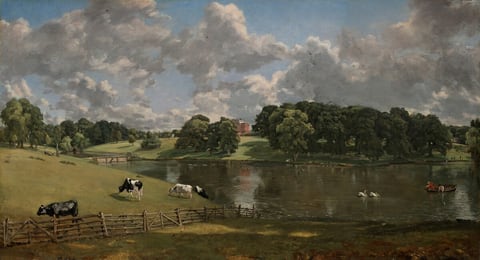
We look out onto a landscape with low, grassy hills to the left, a lake to the right, and a brick building in the center distance below a sky filled with towering white clouds in this horizontal painting. A wooden fence closer to us crosses the landscape from the lower left corner and disappears where the land slopes down to meet the water at the center of the painting. Several black and white cows graze in the field beyond the fence to our left. Two men in a wooden boat pull in nets on the lake to our right near a pair of swans. The lake crosses the composition in the near distance, disappearing into a culvert farther back. A donkey pulls a small carriage with two people near a bridge that crosses the lake in the distance to our left. The brick manor house is visible through a break in the full, deep green trees that line the horizon, which comes halfway up the composition. The clouds cast noticeable shadows in the brightly sunlit scene.
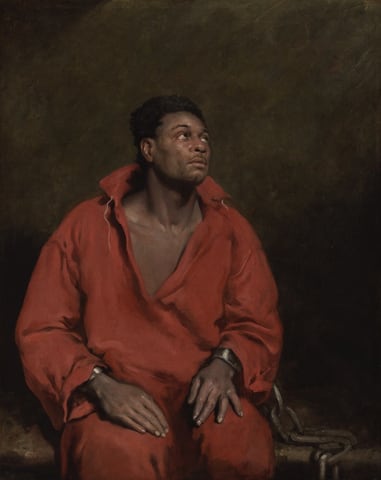
Painting of a dark-skinned man seated and wearing a red open-necked tunic. He looks up to the right. His wrists are shackled and a large chain rests at his right, running down the bench he sits upon.
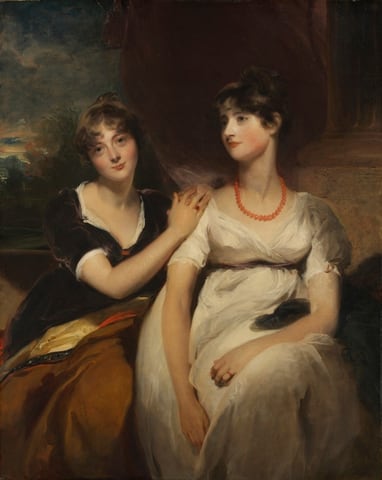
Portrait of Charlotte and Sarah Carteret-Hardy, by Thomas Lawrence, 1801
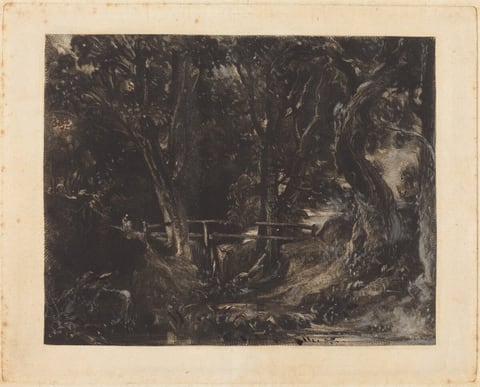
The image shows a landscape scene with a frontal view of a dense forest. A wooden bridge spans across a narrow ravine or creek. The painting features vigorous and textural brushstrokes with dark tones creating a shadowy effect. The color palette includes deep blacks, dark browns, and occasional highlights of light filtering through the canopy. In the distance, lighter areas suggest a path leading further into the woods, surrounded by trees and undergrowth.
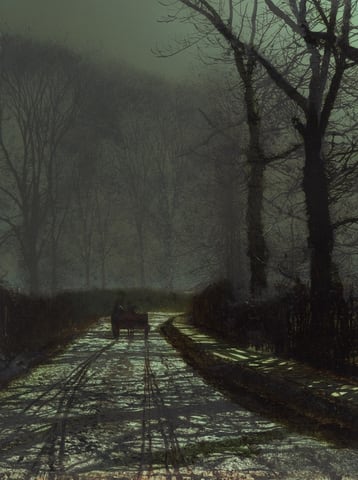
A work made of oil on paperboard.
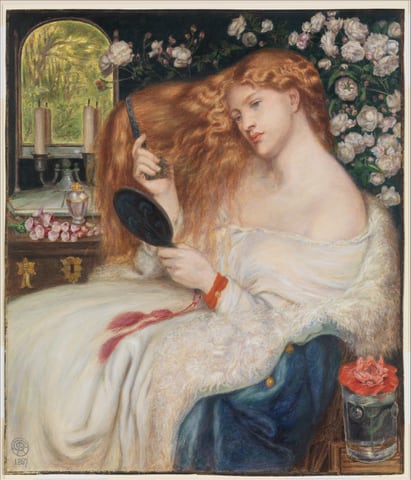
Lady Lilith, by Dante Gabriel Rossetti, 1867

The works in this room are listed below.

Works in this room

Works made in Britain in the 19th century.

Section 1, north wall

  1. Weymouth Bay, by David Lucas, 1830
    Weymouth BayDavid Lucas, 1830Courtesy of The Metropolitan Museum of Art
  2. A work made of graphite on ivory wove paper.
    A Byzantine Well-headFrederic Leighton, 1st Baron Leighton of Stretton, 1852Courtesy of the Art Institute of Chicago
  3. We look out onto a landscape with low, grassy hills to the left, a lake to the right, and a brick building in the center distance below a sky filled with towering white clouds in this horizontal painting. A wooden fence closer to us crosses the landscape from the lower left corner and disappears where the land slopes down to meet the water at the center of the painting. Several black and white cows graze in the field beyond the fence to our left. Two men in a wooden boat pull in nets on the lake to our right near a pair of swans. The lake crosses the composition in the near distance, disappearing into a culvert farther back. A donkey pulls a small carriage with two people near a bridge that crosses the lake in the distance to our left. The brick manor house is visible through a break in the full, deep green trees that line the horizon, which comes halfway up the composition. The clouds cast noticeable shadows in the brightly sunlit scene.
    Wivenhoe Park, EssexJohn Constable, 1816Courtesy National Gallery of Art, Washington
  4. Painting of a dark-skinned man seated and wearing a red open-necked tunic. He looks up to the right. His wrists are shackled and a large chain rests at his right, running down the bench he sits upon.
    The Captive Slave (Ira Aldridge)John Philip Simpson, 1827Courtesy of the Art Institute of Chicago

Section 1, south wall

  1. Portrait of Charlotte and Sarah Carteret-Hardy, by Thomas Lawrence, 1801
    Portrait of Charlotte and Sarah Carteret-HardyThomas Lawrence, 1801Courtesy of the Cleveland Museum of Art
  2. The image shows a landscape scene with a frontal view of a dense forest. A wooden bridge spans across a narrow ravine or creek. The painting features vigorous and textural brushstrokes with dark tones creating a shadowy effect. The color palette includes deep blacks, dark browns, and occasional highlights of light filtering through the canopy. In the distance, lighter areas suggest a path leading further into the woods, surrounded by trees and undergrowth.
    A Dell at Helmingham Park, SuffolkDavid Lucas, 1830Courtesy National Gallery of Art, Washington
  3. A work made of oil on paperboard.
    Lane Scene at NightJohn Atkinson Grimshaw, 1872Courtesy of the Art Institute of Chicago
  4. Lady Lilith, by Dante Gabriel Rossetti, 1867
    Lady LilithDante Gabriel Rossetti, 1867Courtesy of The Metropolitan Museum of Art

Section 2, south wall
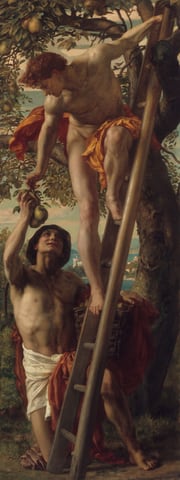
  1. A work made of oil on canvas.
    The Golden AgeSir John Edward Poynter, 1875Courtesy of the Art Institute of Chicago
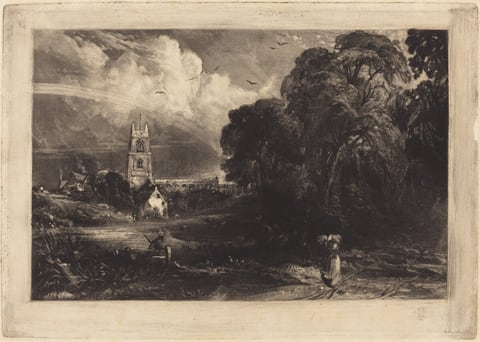
  2. The image displays a landscape with a high vantage point. The horizon is low, with a row of trees. A church tower is off-center to the left. The church is surrounded by trees and buildings. A line of trees is on the right side. The sky has large, expressive clouds. A monochromatic palette of gray is used. A path winds through the scene, with two figures: one person working and another walking.
    Stoke-by-NeylandDavid Lucas, 1830Courtesy National Gallery of Art, Washington
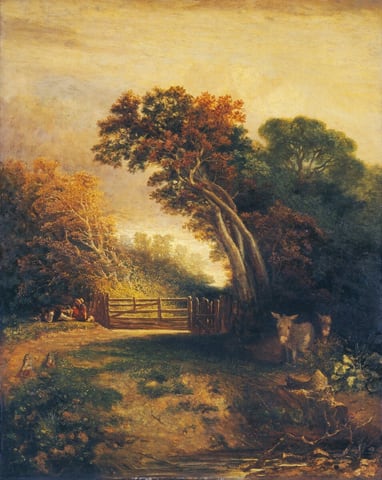
  3. This painting shows a serene pastoral scene with trees, a wooden gate, and foliage extending towards the horizon. Closest to us, there is a low riverbank with some tree branches in the water. Up a grassy dirt hill, two donkeys are visible off to the right, partially hidden by vegetation. On the left, a dirt path leads to the wooden gate. To the left of the gate, two people sit on the grass with a wicker basket between them. The tall trees that rise in the background have leaves in shades of green, yellow, and dark orange. The sky above the scene is yellow with some hints of light blue, and golden light shines down on the landscape.
    Landscape with Picnickers and Donkeys by a GateJoseph Paul, c. 1830-1880Courtesy National Gallery of Art, Washington

Section 2, north wall
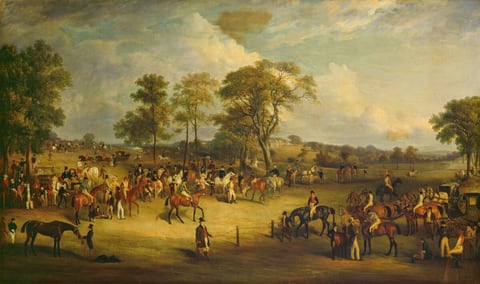
  1. The painting depicts an equestrian scene with people and horses in a green landscape. There are several people on horseback, and others standing by horses. Some people are also sitting in horse-drawn carriages. The horses are in a variety of colors, and the people wear formal clothing like suit jackets, top hats, vests, or colorful dresses. People fill the middle of the scene and the green hills that rise to the left, while a wide path is marked off on the right, bordered by fences. There are some tall trees around the area, with people gathering below them. In the distance, a large white building with columns and blue roofs can be seen. There is also a white tent partially behind a hill on the left. The sky above is blue and filled with white and gray clouds.
    Heaton Park RacesJohn Ferneley, 1829Courtesy National Gallery of Art, Washington
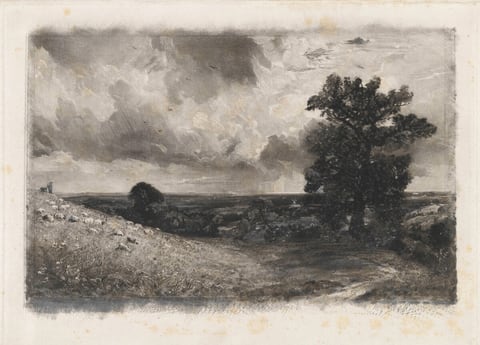
  2. The image shows a landscape with a rolling hill in the foreground sloping downward. The horizon is high, providing a view over fields and sky. Sheep graze on the hill, tended by a person. A large, dark tree is on the right. Brushstrokes vary in the sky and land, with broad strokes for clouds and finer ones for grass and foliage. The color palette is mainly black, white, and shades of grey, highlighting light and shadow.
    NoonDavid Lucas, 1830Courtesy National Gallery of Art, Washington
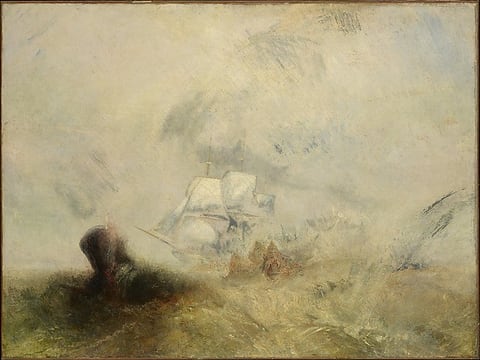
  3. Whalers, by Joseph Mallord William Turner, ca. 1845
    WhalersJoseph Mallord William Turner, ca. 1845Courtesy of The Metropolitan Museum of Art

Section 3, north wall
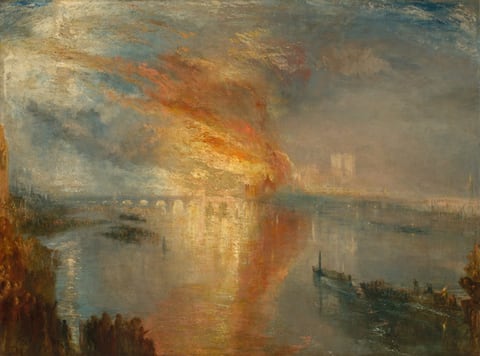
  1. The Burning of the Houses of Lords and Commons, 16 October 1834, by Joseph Mallord William Turner, 1835
    The Burning of the Houses of Lords and Commons, 16 October 1834Joseph Mallord William Turner, 1835Courtesy of the Cleveland Museum of Art
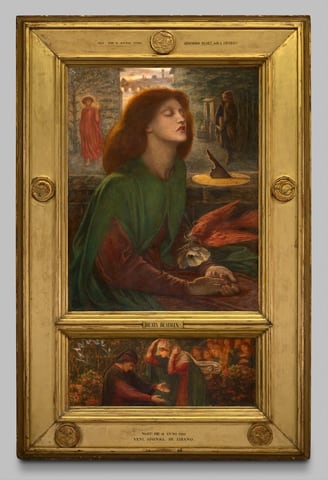
  2. Serene red-haired woman, framed with allegorical symbols of red bird, sundial.
    Beata BeatrixDante Gabriel Rossetti, 1871–72Courtesy of the Art Institute of Chicago