Floor plan

Time and placeThe 18th century

The 18th century

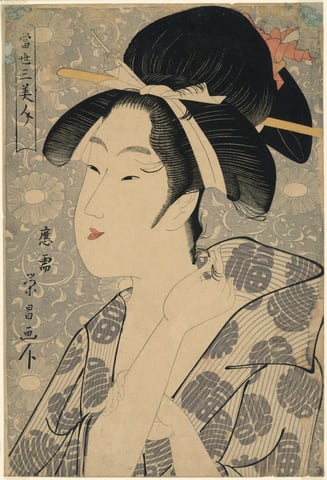
A work made of color woodblock print; oban.
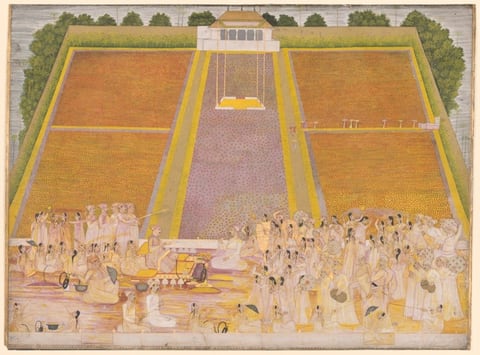
A work made of opaque watercolor and gold on paper.
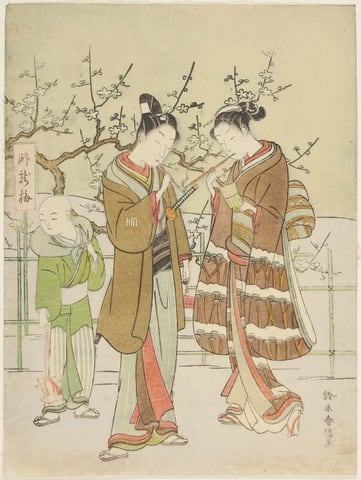
A work made of color woodblock print; chuban.
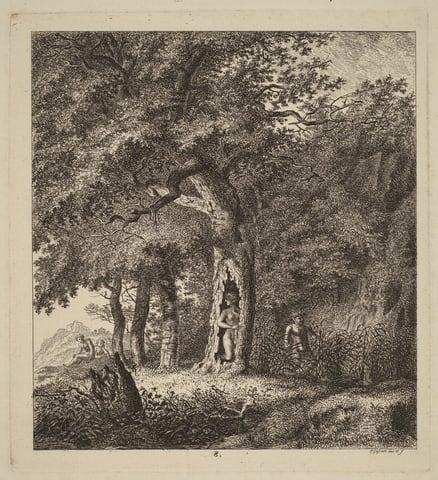
The image shows an etching of a forest scene with towering trees dominating the upper half. The horizon is not clearly visible due to dense foliage, but a line of trees and rocky outcrops in the distance provide a boundary. The fine lines and cross-hatching technique create detailed textures in the tree bark and foliage. The color palette is monochromatic, in shades of black and white emphasizing light and shadow. A large tree with a partially hollow trunk and figures scattered throughout the scene give a sense of scale and activity within the forest setting.
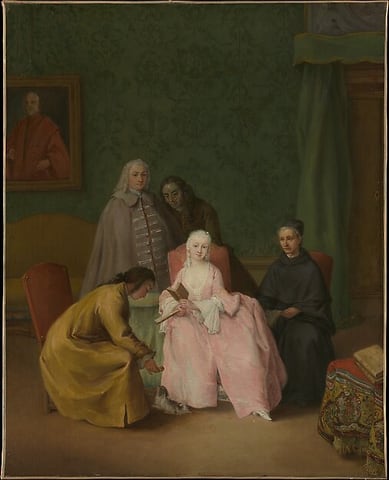
The Visit, by Pietro Longhi, 1746
A work made of oil on canvas.
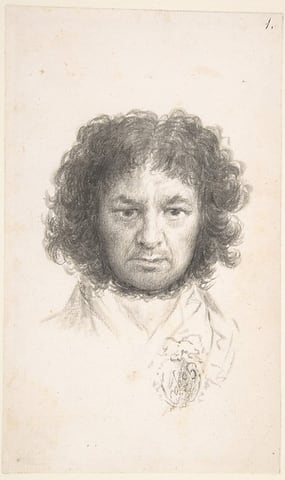
Self-Portrait, by Francisco Goya, ca. 1796

The works in this room are listed below.

Works in this room

Works made in the 18th century, anywhere in the world.

First room, north wall

  1. A work made of color woodblock print; oban.
    Three Beauties of Our Time (Tosei san bijin)Chokosai Eisho, n.d.Courtesy of the Art Institute of Chicago
  2. A work made of opaque watercolor and gold on paper.
    Holi Festival in a Walled Garden with CelebrantsUnrecorded Indian maker, c. 1764Courtesy of the Art Institute of Chicago
  3. A work made of color woodblock print; chuban.
    Giving a Light by the Garyubai Plum TreeSuzuki Harunobu, c. 1767/68Courtesy of the Art Institute of Chicago
  4. The image shows an etching of a forest scene with towering trees dominating the upper half. The horizon is not clearly visible due to dense foliage, but a line of trees and rocky outcrops in the distance provide a boundary. The fine lines and cross-hatching technique create detailed textures in the tree bark and foliage. The color palette is monochromatic, in shades of black and white emphasizing light and shadow. A large tree with a partially hollow trunk and figures scattered throughout the scene give a sense of scale and activity within the forest setting.
    Wooded Landscape with a Nymph and a SatyrSalomon Gessner, 1764Courtesy National Gallery of Art, Washington

First room, south wall

  1. The Visit, by Pietro Longhi, 1746
    The VisitPietro Longhi, 1746Courtesy of The Metropolitan Museum of Art
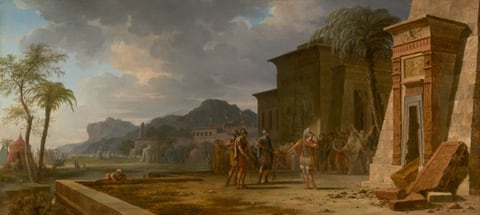
  2. A work made of oil on canvas.
    Alexander at the Tomb of Cyrus the GreatPierre Henri de Valenciennes, 1796Courtesy of the Art Institute of Chicago
  3. Self-Portrait, by Francisco Goya, ca. 1796
    Self-PortraitFrancisco Goya, ca. 1796Courtesy of The Metropolitan Museum of Art

Second room, south wall
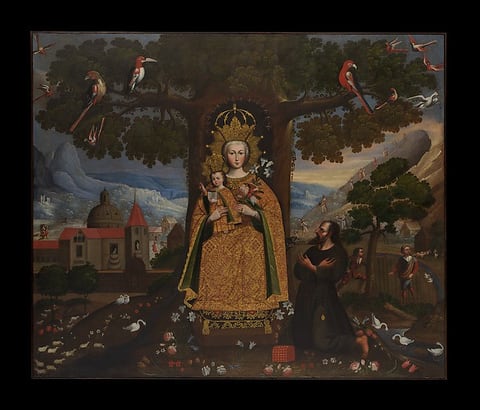
  1. Our Lady of Valvanera, ca. 1770–80
    Our Lady of ValvaneraUnrecorded Latin American maker, ca. 1770–80Courtesy of The Metropolitan Museum of Art
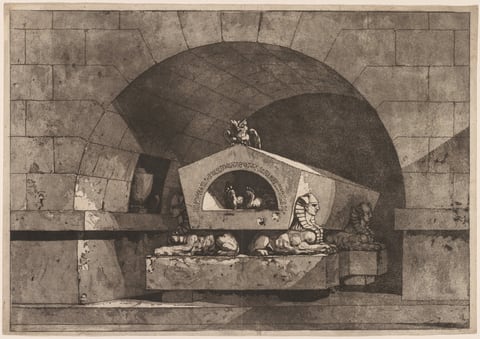
  2. Tomb with Sphinxes and an Owl, by Louis Jean Desprez, c. 1779–84
    Tomb with Sphinxes and an OwlLouis Jean Desprez, c. 1779–84Courtesy of the Cleveland Museum of Art
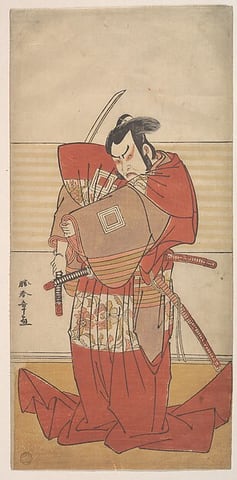
  3. The Actor Ishikawa Danjuro V Performing a Shibaroku Act with a Drawn Sword in His Hand, by Katsukawa Shunshō, ca. 1781
    The Actor Ishikawa Danjuro V Performing a Shibaroku Act with a Drawn Sword in His HandKatsukawa Shunshō, ca. 1781Courtesy of The Metropolitan Museum of Art

Second room, north wall
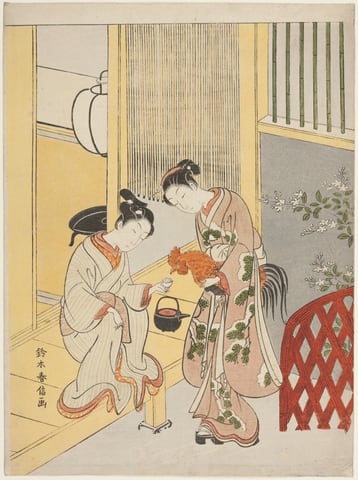
  1. A work made of color woodblock print; chuban.
    Delaying the announcement of dawnSuzuki Harunobu, c. 1767/68Courtesy of the Art Institute of Chicago
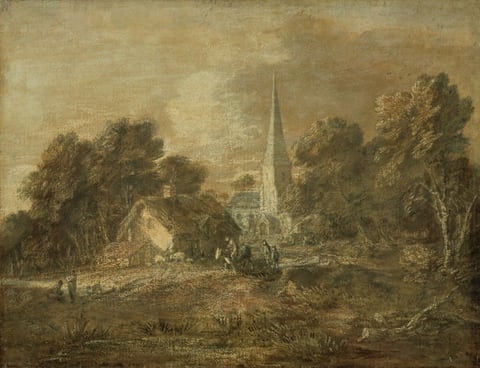
  2. A work made of varnished gouache, over black and red chalks, on cream laid paper, laid down on canvas, stretched on a wooden stretcher and varnished again.
    Wooded Landscape with Village SceneThomas Gainsborough, early 1770s (not later than 1772)Courtesy of the Art Institute of Chicago
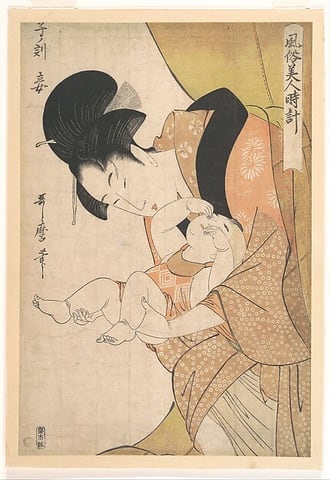
  3. “Hour of the Rat: Mistress,” from the series Women’s Daily Customs (Fuzoku bijin tokei), by Kitagawa Utamaro, 1790
    “Hour of the Rat: Mistress,” from the series Women’s Daily Customs (Fuzoku bijin tokei)Kitagawa Utamaro, 1790Courtesy of The Metropolitan Museum of Art
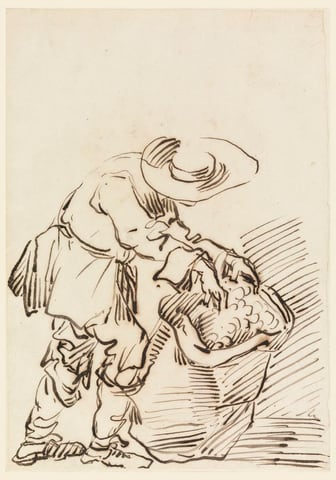
  4. WORKING PEASANT
    Working PeasantCarlo Marchionni, 1728–78Courtesy of Cooper Hewitt, Smithsonian Design Museum

Third room, north wall
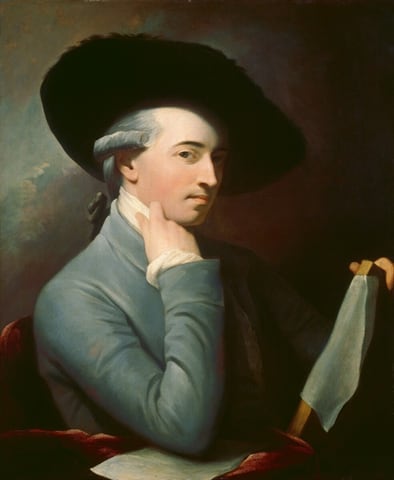
  1. Shown from about the ribcage up, a cleanshaven man with pale skin sits with his elbow resting on the arm of his chair so the back of those fingers brush his chin in this vertical portrait painting. His body and face are angled to our right almost in profile so he looks at us from the corners of his brown eyes under dark, arched eyebrows. He has a straight nose, and his pale coral-pink lips are closed. His nickel-gray hair is curled along his ears and pulled back with an olive-green bow at the nape of his neck. His large hat is pushed back over his forehead, away from us, so its wide brim creates a dark circle around his face. The lapels of his steel-blue, tight-fitting jacket are folded back over a high, white collar. The edge of the white shirt also shows at the cuff of his right hand. The elbow closer to us rests on what might be a piece of light gray paper or piece of fabric, over a cranberry-red cloth or the arm of the upholstered chair. His left hand, farther from us, is propped on a wood frame or board, to which a small, white, square cloth appears to be affixed or draped. The light falls strongly from our upper left so his profile is brightly lit against the dark shadows on the far side of his face. The background darkens from light, slate blue to our left to coffee brown to our right.
    Benjamin WestUnrecorded maker, c. 1776Courtesy National Gallery of Art, Washington
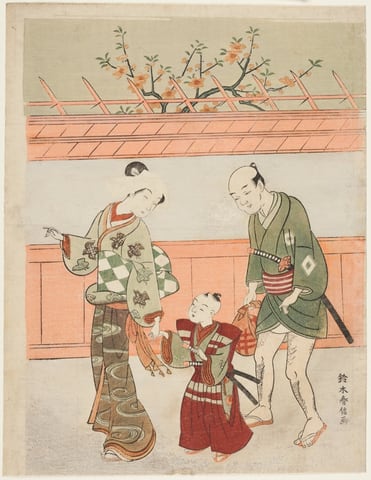
  2. A work made of color woodblock print; chuban.
    A Spring OutingSuzuki Harunobu, c. 1768Courtesy of the Art Institute of Chicago